Skip to content
To prove parental alienation in a Texas court, your case hinges on one thing: documenting a clear pattern of manipulative behavior from the other parent and showing the court exactly how it's harming your child. This isn't about feelings or observations alone; it's about gathering hard, tangible evidence like texts, emails, and witness testimony.
The Heartbreak of Alienation in Texas Families

The fear and confusion can be overwhelming. One moment, your child is your shadow, and the next, they seem cold, distant, or even hostile. You hear them repeat criticisms of you that sound eerily like words your ex would use, and your heart sinks. For Texas parents caught in this nightmare, the shift is baffling and gut-wrenching. You feel like you’re watching your child slip away, and you have no idea why or how to stop it.
This devastating experience is what we call parental alienation. It’s a toxic pattern where one parent methodically turns a child against the other, often escalating in the shadow of a CPS investigation or a contentious custody battle. Texas courts recognize the profound harm this behavior causes, but proving it takes more than a gut feeling. It demands a mountain of clear, consistent evidence.
Recognizing Alienation as Emotional Harm
The emotional toll is immense. You watch your child pull away, and you can't help but second-guess every single thing you've ever done. Did I do something wrong? The truth is, your child is likely trapped in a loyalty conflict they are nowhere near equipped to handle.
Make no mistake: parental alienation is a severe form of emotional abuse. It's a chronic adversity that can inflict deep developmental trauma and scar a child's well-being for life. For a closer look at its long-term effects, this guide on understanding developmental trauma offers some valuable insights. The real tragedy here is the emotional damage done to a child who is manipulated into rejecting a parent who loves them.
In the eyes of Texas Family Law, a parent’s primary duty is to support the child’s relationship with the other parent. Alienating behaviors directly violate this core principle and are not in the child’s best interest.
This guide is designed to give you practical, reassuring steps for gathering the proof you need. Protecting your child's well-being and your parental rights in a Texas courtroom starts now. Learning how to prove parental alienation is the first move you can make to reclaim your relationship and ensure your child has two loving parents in their life.
This is more than just a legal fight; it's a battle for your child's emotional health. We're going to break down how to spot these behaviors, document them meticulously, and build a compelling case based on the standards set by the Texas Family Code. Your journey from fear to action begins with a solid strategy.
When you suspect parental alienation, moving from a gut feeling to concrete proof starts with knowing exactly what you’re looking for. These aren't just isolated arguments or moments of co-parenting frustration. We're talking about a consistent, destructive pattern of behavior designed to methodically tear down your relationship with your child. In the eyes of a Texas court, it’s this deliberate pattern that carries weight.
Recognizing these actions is the first—and most critical—step in building a strong case to protect your child. If what you're about to read sounds familiar, you're not just imagining things. You are likely witnessing a calculated effort to push you out of your child's life.
And you're not alone. This is far more common than many people realize. While conservative estimates suggest parental alienation is a factor in about 9% to 15% of families post-divorce, other studies paint a much starker picture. When parents are asked about specific alienating behaviors, some studies have found that up to 59% report experiencing them. It's a widespread and devastating issue.
Constant Bad-Mouthing and Blame
One of the most common tactics is a relentless campaign of criticism against you, the targeted parent. The alienating parent will blame you for everything from their own financial struggles to the child's unhappiness, often framing it in a way that forces the child to pick a side.
This isn't just venting. It’s a deliberate campaign to rewrite history and paint you as an uncaring, incompetent, or even dangerous parent. You might notice your child suddenly bringing up past events with a negative spin they couldn’t possibly have come up with on their own.
A real-life example we've seen in our practice involved a mother who, during a CPS investigation into unrelated matters, repeatedly told her son, "We can't afford new soccer cleats because your dad won't pay his child support." This statement not only misrepresented the financial reality but directly linked the child's disappointment to his father, planting a clear seed of resentment that complicated the family's reunification plan.
Interference with Communication and Visits
Another huge red flag is the systematic disruption of your time and communication with your child. This behavior is a direct violation of most Texas possession orders, and it's something judges take very seriously.
This interference can show up in several ways:
- Blocked Communication: Your calls to your child consistently go unanswered. Or you’re always told they are "too busy" to talk. Every. Single. Time.
- "Forgotten" Messages: Your child never seems to receive the messages, gifts, or letters you send because the other parent "forgets" to pass them along.
- Scheduling Conflicts: The other parent repeatedly schedules fun activities or appointments during your court-ordered possession time. This forces the child to choose and makes you look like the bad guy for insisting on your rightful time.
A core principle in Texas Family Law is that each parent has a duty to encourage and foster a positive relationship between the child and the other parent. Actively interfering with communication is a direct violation of this principle.
Differentiating between alienation and normal post-divorce friction is key. One is a pattern of intentional harm; the other is just the messy reality of co-parenting.
Alienating Behavior vs Normal Co-Parenting Disagreements
| Behavior | Normal Conflict Example | Potential Alienation Example |
|---|---|---|
| Criticism | "I'm frustrated your dad was late for pickup again. It messed up our evening plans." | "Your dad doesn't care about your schedule. He's selfish and never thinks about us." |
| Scheduling | "Can we swap weekends? I have a family wedding I'd love for the kids to attend." | "The kids have a last-minute party during your weekend. They'd be devastated to miss it." (Repeatedly) |
| Communication | "The kids were in bed when you called last night, but I'll have them call you back today." | "They're too busy with homework to talk to you tonight." (Consistently offers excuses) |
| Finances | "Money is a little tight this month, so we have to stick to a budget for school supplies." | "We can't afford that because your mom spends all her money on herself instead of on you." |
Recognizing these patterns helps you build a case that a judge can understand—one that shows a deliberate effort to harm your parent-child relationship.
Erasing You from Your Child's Life
Perhaps the most heartbreaking tactic is when one parent attempts to completely erase the other from the child’s life and memory. This goes beyond bad-mouthing and becomes an active effort to pretend you don't exist or, worse, that you don’t matter.
It might start subtly. You notice that photos of you have been removed from your child's room or the other parent's home. Then, the alienating parent may forbid any positive talk about you, even punishing the child for sharing a happy memory they had with you. We have a detailed guide that further explores the common signs of parental alienation that every parent should know.
Ultimately, these behaviors create a toxic environment where the child feels that loving you is a betrayal of the other parent. Recognizing these patterns isn't about collecting grievances; it’s about gathering the specific evidence you need to show a judge that your child's emotional well-being is at risk and that you need the court to intervene.
Building a Bulletproof Case with Strong Documentation
After another tense drop-off or a phone call that goes nowhere, the frustration and hurt you feel are completely real. But in a Texas courtroom, your feelings alone, no matter how justified, aren't evidence. To prove parental alienation, you have to switch your mindset from reacting emotionally to documenting methodically. Evidence is what speaks loudest to a judge.
Your objective is to create a clear, factual record that lays out a distinct pattern of harmful behavior. Think of it less like a list of complaints and more like assembling the puzzle pieces that reveal the full picture. Every piece of evidence you gather helps build a powerful story that shows this isn't just a co-parenting spat—it's a deliberate campaign to destroy your relationship with your child.
The Power of a Factual Journal
Your most powerful tool in this fight is a simple, consistent journal. This isn't a diary for your feelings; it's a logbook for facts. The trick is to be objective, detailed, and absolutely relentless in your record-keeping. Every entry needs to be stripped of emotional language and focused only on the who, what, when, where, and why of each incident.
For instance, instead of writing, "My ex was a total jerk again and ruined my time with the kids," a much stronger entry would be:
Entry Example:
Date: October 26, 2023
Time: 6:05 PM
Incident: Scheduled weekend possession exchange. Ex-spouse arrived 35 minutes late.
Child's Behavior: My daughter (age 8) was withdrawn. When I asked about her week, she said, "Mommy said you don't really want to see me, you just don't want to pay her more money." She wouldn't make eye contact and appeared anxious.
Action Taken: I reassured her that I love spending time with her and was excited for our weekend. I did not comment on her mother's statement.
This kind of detailed, factual entry carries immense weight in court. It provides a direct quote, observes the child's reaction, and shows that you're parenting responsibly even when faced with alienation. Over time, these entries build an undeniable timeline.
The flowchart below shows how alienation often progresses. You need to document every stage, from subtle bad-mouthing to more obvious interference and, finally, attempts to erase you from your child's life entirely.
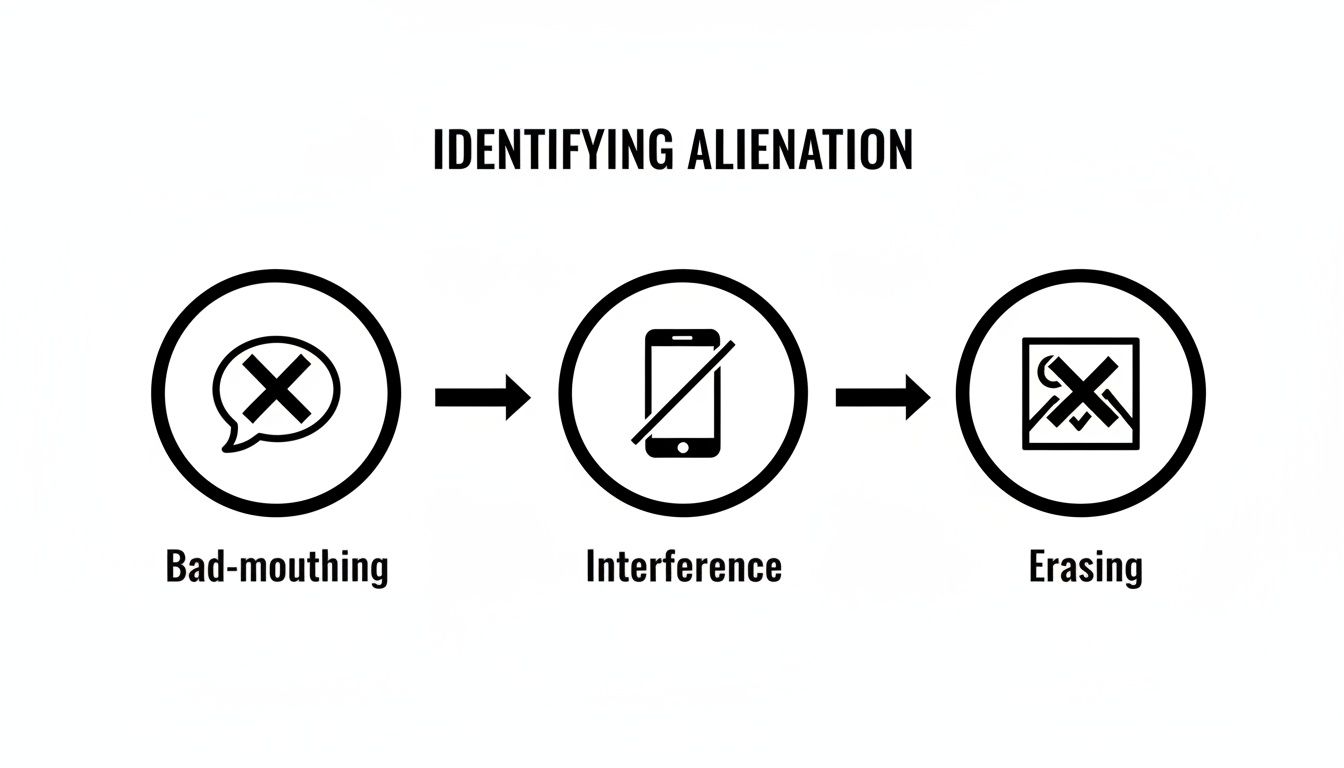
This visual helps clarify how seemingly small incidents can escalate into a serious pattern of behavior that Texas courts will recognize as harmful.
Preserving Digital and Third-Party Evidence
So much of our communication happens digitally, and that means text messages, emails, and social media posts can be a goldmine of proof. You can often capture the alienating parent's own words, and it is absolutely critical that you preserve this evidence the right way.
Take screenshots of everything. Don't just save a text; capture the whole conversation, making sure the date and time stamps are visible. If the other parent posts something negative on social media, grab a screenshot of the post and the comments. This digital trail can be incredibly persuasive.
Beyond your own documentation, third-party witnesses provide objective proof of what's happening. These are neutral people who have seen the alienating behaviors or the negative effects on your child firsthand.
Credible witnesses can include:
- Teachers or School Counselors: They might notice your child is suddenly acting out or repeating negative, scripted-sounding things about you.
- Coaches or Extracurricular Leaders: They might overhear the other parent bad-mouthing you from the sidelines or see your child's sudden resistance to an activity you used to enjoy together.
- Therapists or Pediatricians: Professionals can document changes in your child's emotional state or note concerning things your child says during appointments.
- Family Friends or Neighbors: These people may have witnessed interference with your possession time or heard disparaging remarks.
Imagine a teacher provides a statement to the court saying, "For the last three months, every Monday, the child has told me he hates living with his dad. When I ask why, he says, 'Because Mommy says he doesn't love us anymore.'" That kind of impartial testimony is very hard for an alienating parent to argue against.
Connecting the Dots for the Court
Every journal entry, text message, and witness statement is a single dot. Your attorney's job is to connect those dots and paint a clear, undeniable picture for the judge. This picture has to show a consistent pattern of behavior that is directly harming your child's well-being.
The Texas Family Code is built around one guiding principle: the best interest of the child. All your evidence must work together to show how the other parent's actions go against that principle. This isn't about proving you're the "better" parent; it's about proving that your child needs protection from the other parent's destructive influence.
This can all feel overwhelming, especially if you're also dealing with a CPS investigation. The good news is that the documentation process for an alienation case is very similar to the evidence-gathering needed for a CPS case. For more on that, you can review our guide on the top steps to take after a Texas CPS investigation, as many of the same principles apply.
Remember, every piece of evidence you collect is an act of protection. It becomes your voice in a system that demands proof, and it's the key to fighting for your child’s fundamental right to a healthy relationship with both of their parents.
Navigating the Texas Family Court System with Your Evidence
Walking into a Texas family courtroom with a stack of documents can feel incredibly intimidating. You've spent months meticulously journaling, saving screenshots, and talking to witnesses. Now what? The real challenge is presenting all that hard work in a way a judge will not only understand but find compelling.
This is where strategy and professional guidance become absolutely essential. Your attorney’s job is to take all your individual pieces of evidence—the log of missed calls, the teacher's email, the hurtful text messages—and weave them into a clear, coherent story. The goal is to show a direct line from the other parent's actions to the harm being done to your child.
The Key Players Advocating for Your Child
In highly contentious cases, especially those involving allegations of parental alienation or ongoing CPS involvement, a Texas judge may appoint neutral third parties to help them get a clearer picture of what's really going on. These professionals aren't on "your side" or "their side"; their only client is your child.
It’s crucial to understand their roles:
- Amicus Attorney: This is a lawyer the court appoints specifically to represent the best interests of the child. They will interview you, the other parent, the child, and other relevant people (like teachers or counselors) to give the judge an independent recommendation.
- Guardian ad Litem (GAL): A GAL serves a similar function but can be a non-attorney, like a trained volunteer or a social worker. Their investigation is laser-focused on what environment and custody arrangement would best serve the child’s physical and emotional well-being.
Cooperating fully and honestly with these court-appointed professionals is non-negotiable. Think of them as the judge’s eyes and ears. Their reports often carry significant weight in the final decision.
Leveraging Mental Health Expert Evaluations
While your documentation is powerful, an objective evaluation from a qualified mental health professional can be a game-changer. A court-ordered custody evaluation or a psychological assessment provides an expert opinion on the family dynamics at play.
This isn't just another therapy session. A custody evaluator is trained to spot patterns of behavior consistent with parental alienation. They conduct interviews, observe how you and the other parent interact with your child, and may use psychological tests to give the court a clinical perspective.
A strong custody evaluation can corroborate all the evidence you’ve gathered, giving a professional voice to the concerns you’ve been documenting. It helps elevate your case from a "he said, she said" dispute to a matter of documented psychological harm.
This expert testimony is what helps the court understand the deeper emotional impact on your child. It directly ties the alienating behaviors back to the "best interest of the child" standard that governs every single Texas custody decision. A skilled attorney can walk you through what to expect, and we have some great starting points on how you can prepare for your Texas child custody case.
Presenting a Clear Narrative of Harm
Proving parental alienation is becoming more common in courtrooms, but it demands a very specific kind of proof. Courts in Texas and elsewhere are increasingly looking for concrete, dated, and corroborated evidence—not just labels or accusations. A recent analysis of family court judgments revealed that references to "parental alienation" have seen a roughly tenfold increase in just nine years, which tells you just how critical solid evidence has become.
This is why your documented proof—the frequency counts of missed phone calls, the dates of interfered visits, and the declarations from third-party witnesses—is absolutely essential. Your attorney will organize this evidence to demonstrate a clear pattern of behavior that violates the Texas Family Code.
For example, your attorney might present:
- A timeline showing how your child's loving emails turned cold and dismissive immediately following the other parent's summer possession.
- Testimony from a school counselor detailing the child's sudden anxiety and recitation of adult-like complaints about you.
- A summary of your journal, highlighting dozens of instances where court-ordered communication was systematically blocked.
Ultimately, navigating the court system is about translating your lived experience into a legal argument a judge can act on. It’s about showing that this isn't just about hurt feelings—it’s about protecting your child from emotional harm and preserving their fundamental right to a healthy relationship with both parents.
Why Alienation Is a Form of Emotional Abuse
Let's be blunt: parental alienation isn't just a bitter custody tactic. It's a devastating form of emotional abuse that inflicts deep, lasting psychological wounds on a child. Texas law is built around one central principle—protecting the emotional and physical well-being of children. Any action that systematically damages a child's emotional health falls squarely into the category of abuse.

When one parent manipulates a child into rejecting the other, they are trapping that child in an impossible loyalty bind. This forces the child to bury their real feelings of love for one parent just to keep the approval of the other. Over time, this creates a constant state of anxiety, confusion, and guilt.
This fight isn't about "winning" against your ex. It’s about rescuing your child from ongoing emotional trauma. When you frame parental alienation as the serious child welfare issue it is, you help the court understand the true stakes.
The Connection to Texas CPS and Child Welfare
Under the Texas Family Code, Chapter 261 defines abuse to include not just physical harm, but also "mental or emotional injury to a child that results in an observable and material impairment in the child's growth, development, or psychological functioning."
That definition is a perfect match for what parental alienation does. The "observable effects" can look like a sudden drop in grades, withdrawing from friends, new anxieties, or hostile behavior that seems to come out of nowhere, all directed at you.
In severe cases, these alienating behaviors can absolutely be grounds for a report to Child Protective Services (CPS). While CPS may be more familiar with physical neglect, they are mandated by law to investigate any credible allegation of emotional harm that impairs a child's well-being. A well-documented pattern of alienating behavior, especially when it jeopardizes a child's safety or development, can trigger a CPS investigation and may be relevant in hearings under Chapters 262 and 263 concerning the child's removal and termination of parental rights under Chapter 161.
Your detailed journal, statements from teachers, and saved text messages can serve as crucial evidence—not just for family court, but also to show a CPS investigator that your child’s emotional health is at significant risk, which can be critical for your family's safety plan and reunification goals.
The Long-Term Psychological Scars
The damage from parental alienation doesn't just magically disappear when a child turns 18. The emotional manipulation they've lived with can shape their entire adult life. Research consistently shows that children who experience severe alienation face a much higher risk of long-term mental health problems.
Systematic studies show that adults who were alienated as children have higher rates of depressive disorders, generalized anxiety, and substance abuse issues. In fact, some analyses show the long-term impact can lead to a two- to threefold increase in diagnosed mental health conditions in adulthood. You can read more about these heartbreaking long-term mental health outcomes to grasp the profound stakes here.
Consider this all-too-common scenario: A young girl is told, day after day, that her father is dangerous and doesn't love her. As an adult, she may struggle to trust partners, sabotaging healthy relationships because her first model of love was built on manipulation and fear. Her ability to form secure, healthy attachments has been fundamentally broken.
This is the devastating legacy of alienation. By clearly articulating these well-documented risks, you show the court that your concern isn't about losing time with your child—it's about protecting them from a future defined by the emotional abuse they are suffering today.
Taking Decisive Action to Protect Your Child's Future
The feeling of helplessness that comes with parental alienation is suffocating. It's easy to feel powerless, but you have to remember that you’re not. The way forward is built on taking clear, strategic steps to protect your child from more emotional damage and turn this situation around.
It all starts with what we've talked about: recognizing the toxic behaviors for what they are, documenting every single incident, and getting an expert legal team in your corner. This is especially true when navigating the added complexity of a CPS case, where every action is scrutinized.
The emotional weight of this battle is immense, and you shouldn't have to carry it alone. Taking that first step to build your case isn't just a legal move; it's a powerful statement of love and protection for your child. It tells everyone involved—from your ex to the CPS caseworker to the judge—that you refuse to stand by while your relationship is destroyed and your child's well-being is compromised.
Moving from Fear to Action
Shifting from a place of fear and anxiety to one of proactive defense isn’t easy. It requires a solid support system, both legally and emotionally. The goal here isn't just to win a court case—it's to create a path for long-term healing for your child and your family. Rebuilding that trust and open communication is absolutely essential to helping your child recover from the loyalty conflicts they've been unfairly forced into.
To start mending those fractured relationships, exploring therapeutic options can make a world of difference. Professional guidance, like that offered through virtual family therapy, can provide a safe and structured environment to navigate these incredibly complex emotions and begin the process of reconnecting.
Your Legal Strategy is Your Shield
Think of your legal strategy as your most powerful shield. It's what takes all your meticulous documentation and your firsthand observations and turns them into a compelling story that a Texas judge can act on.
Under the Texas Family Code, particularly provisions in Chapters 262 and 263 that deal with children's welfare, the court's number one priority is always the child's best interest. Your job is to present evidence that clearly shows how the other parent's alienating behavior directly harms that principle.
A decisive legal action plan, especially with CPS involvement, focuses on a few key things:
- Organizing Your Evidence: We’re talking about compiling your journal, text messages, emails, and witness statements into a coherent, easy-to-follow timeline.
- Filing the Right Motions: This means asking the court to step in, whether it's to modify custody, enforce existing possession orders, or address specific concerns raised by CPS.
- Requesting Professional Evaluations: You can ask the court to appoint an Amicus Attorney or order a custody evaluation to get an objective, third-party assessment of the situation.
Taking action is about reclaiming your role as a parent. It's about fighting for your child's fundamental right to have a healthy, loving relationship with both of their parents. It’s about ensuring their future isn’t defined by one person’s destructive agenda.
If you are ready to move from fear to action, our team is here to help you navigate the complexities of Texas family law. We understand what it takes to prove parental alienation and will fight for your child's emotional well-being as if it were our own.
The battle against parental alienation is one of the most difficult and emotionally draining challenges a parent can face, especially when a CPS case is involved. You don't have to walk this path alone. The dedicated attorneys at The Law Office of Bryan Fagan have the experience and compassion to help you build a strong, evidence-based case to protect your child's future and your parental rights. If you feel lost and are ready to take a stand, contact us today for a free, confidential consultation to discuss your case. Visit us at https://texascpslawyer.net to learn more.