Skip to content
Facing the future with a criminal record can feel like a shadow hanging over your family. It’s not just a legal issue; it's a personal burden that affects your ability to secure housing, find a good job, and even volunteer at your child’s school. The fear and confusion about how to move forward are real, but so is the hope for a fresh start.
Many Texans in your shoes feel overwhelmed, especially when it comes to figuring out the cost of clearing their name. This guide is here to lift that weight by giving you a clear, honest breakdown of the cost of expungement in Texas.
Think of this process not as an expense, but as a genuine investment in your family's future, freedom, and opportunities. We'll walk you through every component, from attorney fees to court costs, so you can move forward with confidence and a clear plan.
Understanding the Investment
When you consider an expungement, it’s helpful to see it as a powerful tool for rebuilding. The financial aspect can seem daunting at first, but it's essential to understand exactly what you're paying for.
An expungement is more than just a legal filing; it is the process of reclaiming your narrative and ensuring past mistakes don't define your family's future. It gives you the legal right to deny the arrest ever occurred, opening doors that were once closed.
The process involves meticulous legal work, from drafting a precise petition to serving multiple government agencies and potentially arguing your case before a judge. Each step is critical to getting it right and protecting your family's future.
What Determines the Final Cost?
Several factors influence the final price tag for clearing your record. Generally, the total cost of expungement in Texas typically ranges from $1,500 to $3,500. This amount covers attorney fees—which are the largest component—plus mandatory court filing fees and other administrative costs.
Attorney fees in Texas usually run between $1,000 and $3,000. On top of that, you can expect court and administrative costs to be in the $400 to $500 range. These cover things like filing fees, certified mailing fees, and other expenses necessary to push the expungement through the system.
Here's a quick look at how those costs typically break down:
Estimated Expungement Cost Breakdown in Texas
This table summarizes the typical costs involved in a Texas expungement case to provide a quick financial overview.
| Cost Component | Typical Price Range |
|---|---|
| Attorney Fees | $1,000 – $3,000 |
| Court Filing & Admin Fees | $400 – $500 |
| Total Estimated Cost | $1,400 – $3,500 |
Keep in mind that these are estimates, and your specific case could be different.
Consider Sarah, a mother who was arrested for a misdemeanor that was later dismissed. For years, that arrest record created obstacles for her when applying for jobs and even volunteering at her children's school. She worried the cost would be too high, but after a consultation, she realized it was a manageable, one-time investment. By moving forward, she finally removed that barrier, secured a better job, and regained her peace of mind. Her story shows that the benefits often far outweigh the initial financial outlay.
Decoding the Bill: What an Expungement Really Costs
When you get a quote for an expungement, you're looking at more than just a single number. That figure represents a series of precise legal actions all aimed at one thing: clearing your record and securing your future. Breaking down the cost of expungement in Texas helps demystify the process, showing you it's not just an expense—it's a strategic investment.
So, let's look at what you’re really paying for when you hire an attorney to handle this. The total cost is typically split into two main buckets: the fixed administrative costs and the attorney's professional fees for their expertise.
The Foundation: Court and Administrative Costs
First up are the non-negotiable costs the legal system requires just to get the ball rolling. Think of these as the price of admission to have your case filed, heard, and processed. Every expungement petition has to be officially filed with the court, and that comes with a price tag.
These costs usually cover:
- Court Filing Fees: This is what the District Clerk’s office charges to officially open your case. It can vary a bit from county to county, but it generally falls within a predictable range.
- Service and Citation Fees: Once your petition is filed, all the government agencies holding your record—like the arresting agency, the prosecutor's office, and the Texas Department of Public Safety—have to be legally notified. These notices are often sent via certified mail, and each one has a cost.
- Clerk Fees: You might also see a few other small administrative fees for things like issuing citations or making certified copies of documents.
These fixed costs typically add up to several hundred dollars, often landing somewhere in the $400 to $500 range. They're a necessary part of the process, but they're only one piece of the puzzle. The most significant part of the cost covers the skilled legal work needed to get your expungement across the finish line.
This infographic breaks down the main components that make up the total investment in an expungement.
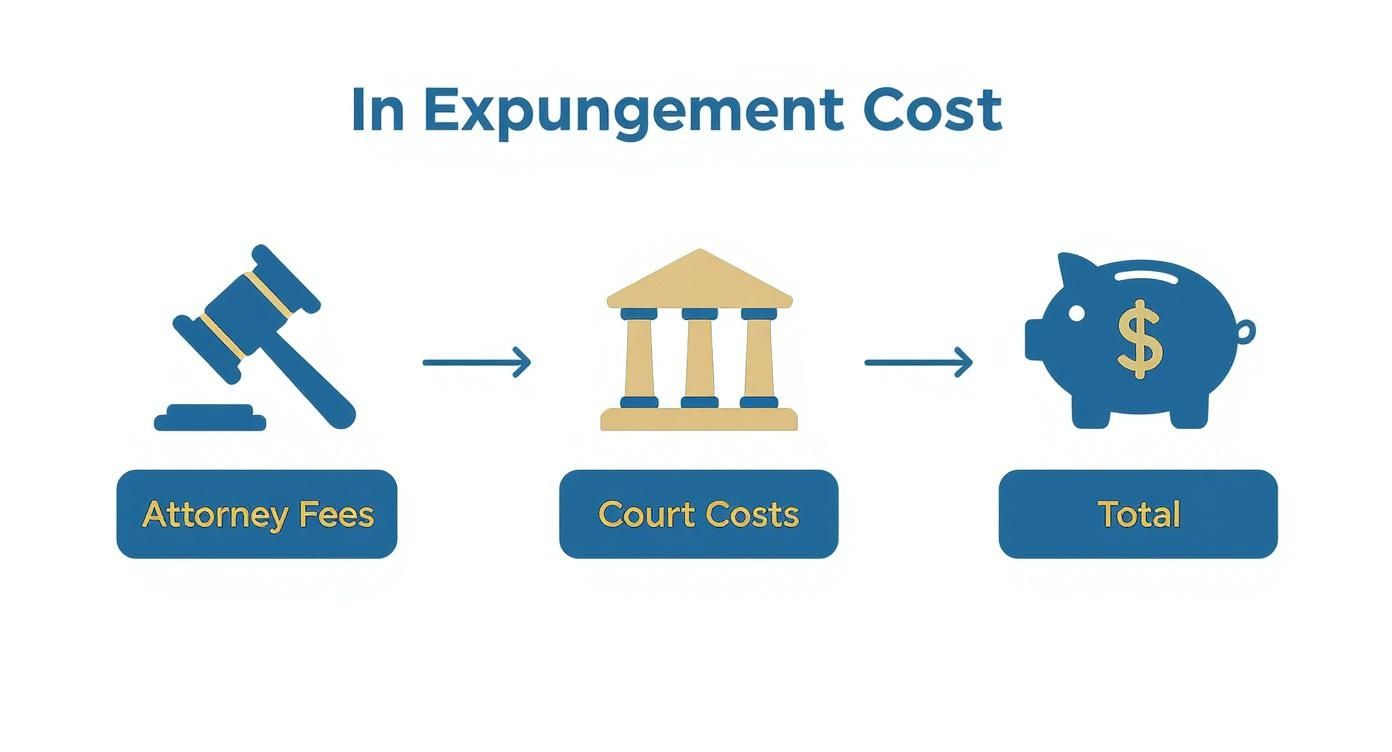
As you can see, attorney fees make up the largest slice of the pie. This covers the expertise and hands-on work required to navigate the legal system correctly and effectively.
The Value of Legal Expertise: Attorney Fees
The biggest—and most important—part of the cost of expungement in Texas is the attorney's fee. This isn't just for filling out paperwork. It covers the time, deep legal knowledge, and meticulous effort required to steer your case through a complex legal landscape. Hiring an experienced attorney is about making sure every single step is done right to avoid costly delays or, even worse, an outright denial.
When you invest in a skilled attorney, here’s what you’re paying for:
-
In-Depth Eligibility Analysis: The first thing a good lawyer does is a deep dive into your criminal history and the specific facts of your case. They'll confirm you meet the strict eligibility rules under the Texas Code of Criminal Procedure, saving you from wasting money on a case that was never going to succeed.
-
Precise Legal Drafting: The Petition for Expunction is a detailed legal document that has to be drafted perfectly. It must list every single agency that has a record of your arrest and include very specific legal language. One small mistake here can get your whole case thrown out.
-
Strategic Case Management: Your attorney handles all the back-and-forth with the court, the District Attorney's office, and every law enforcement agency involved. This coordination is critical and incredibly time-consuming, freeing you from the stress of trying to manage it all yourself.
-
Court Representation: Sometimes, the District Attorney might object to the expungement, which means you'll need a court hearing. Your attorney will prepare your case and argue on your behalf before a judge, presenting a strong legal argument for why your record deserves to be cleared.
Think about Mark, a young father who was arrested for a minor offense years ago that was later dismissed. He tried to file the expungement paperwork himself to save a little money. He accidentally left one small local agency off the petition. Months down the road, his petition was denied over that technicality, forcing him to start all over again and pay new filing fees.
Mark’s story is a tough but powerful reminder that the legal fee is an investment in certainty and peace of mind. It ensures the job is done right the first time, preventing the emotional and financial drain of making a mistake. You're paying a professional to meticulously guide your case from start to finish, maximizing your chances for that fresh start you and your family deserve.
How Texas County Lines Can Change Your Total Cost
Here in Texas, the old saying "everything is bigger" can sometimes apply to legal headaches, and one of the most surprising factors in the cost of an expungement is geography. It seems strange, but where your original case was filed can have a huge impact on the final price tag. Filing for an expungement in a major hub like Harris County (Houston) is a completely different ballgame than doing it in a smaller, rural county.
This isn't just some random quirk; it’s tied directly to the legal ecosystem of each county. From local court fees to the sheer volume of cases clogging the system, the specific county where your record lives plays a major role in how much it costs—and how complicated it is—to clear it.

Why Location Matters for Your Bottom Line
Getting a handle on these regional differences is the key to budgeting for your expungement and setting realistic expectations. The main things driving these cost variations are the local court systems and, just as importantly, the policies of the District Attorney’s office in that specific jurisdiction.
Here's what really makes the price swing from one place to another:
- Wildly Varying Court Filing Fees: Every single Texas county sets its own schedule for court filing fees. Densely populated urban counties have higher operational costs, and you guessed it—that often means higher fees for filing a Petition for Expunction compared to more rural areas.
- Big City Bureaucracy: Larger counties like Dallas, Harris, or Travis are dealing with an unbelievable volume of cases. This creates more complex administrative hoops to jump through and a greater chance for bureaucratic delays, which can demand more of an attorney's time just to navigate.
- The District Attorney's Stance: The attitude of the local D.A.'s office can dramatically change the game. Some are more than willing to agree to expungements, making the process smooth and quick. Others are more likely to fight them, which can force a formal court hearing.
If a hearing becomes necessary, the legal work—and the cost—goes up. Your attorney now has to prepare legal arguments, gather evidence, and represent you in front of a judge. What could have been a straightforward administrative filing suddenly becomes a contested legal battle.
The Strategic Advantage of Local Experience
Picture this: a family is trying to help their son clear a dismissed charge from a small West Texas county. They hire a sharp lawyer from a big city hours away. That attorney, while skilled, might not know the local court’s unwritten rules, the specific clerk’s filing preferences, or how that particular D.A. usually responds to expungement petitions. This lack of local insight can easily lead to delays, mistakes, or unnecessary complications.
Now, imagine they hired an attorney who is in that specific county courthouse all the time. This lawyer knows the local landscape like the back of their hand. They have working relationships with the court staff and know exactly how to frame the petition in a way that aligns with the local prosecutor’s expectations.
This is why hiring a firm with deep experience across Texas counties isn’t just a nice-to-have—it’s a real strategic advantage. It can directly impact the efficiency, success, and ultimate cost of your expungement, saving you both time and money.
The variation in costs across Texas is significant, influenced by everything from case volume and local court fees to the specific policies of the prosecutor's office. In big metropolitan areas, for example, court filing fees are almost always higher, and the procedural requirements are more complex simply because of the heavy caseload. This is where local expertise becomes invaluable.
Understanding these nuances is also crucial when you're looking at different ways to clear your record. For example, the process of sealing a criminal record—legally known as an order of nondisclosure—also requires navigating these county-specific systems. While it’s a different legal remedy than an expungement, the same principles of local knowledge apply. You can learn more about how to seal criminal records in our detailed guide.
Expungement vs. Nondisclosure: Which Path Is Right for You?
When you decide to clear your record in Texas, you'll quickly discover it’s not a one-size-fits-all process. The legal system gives you two main paths: a full expunction (record destruction) and an order of nondisclosure (record sealing).
Understanding the difference is critical. This choice directly impacts your eligibility, the final outcome, and ultimately, the complexity and cost of the whole process.
Think of it this way: an expungement is like completely erasing a mistake from a whiteboard. Once it's gone, it's gone for good—as if it never happened. A nondisclosure, on the other hand, is like covering that mistake with a permanent shield. It’s hidden from public view, but it still exists for law enforcement and certain government agencies to see if they need to.

The Power of a Full Expunction
An expunction, also called an expungement, is the gold standard for clearing a criminal record in Texas. It legally destroys all records of your arrest and case.
After a successful expunction, you can legally deny the arrest ever occurred on applications for jobs, housing, or loans. This is a powerful remedy, but it comes with strict eligibility requirements.
Generally, you can only get an expunction if your case ended in one of these outcomes:
- You were acquitted (found not guilty) at trial.
- Your case was dismissed by the prosecutor.
- You were arrested but never formally charged with a crime.
- You received a pardon from the Governor.
Because an expunction completely erases the record, the legal process is more demanding. It requires filing a detailed petition and notifying every single agency that might have a record of your arrest. This complexity often translates to a higher cost of expungement in Texas compared to sealing a record.
When Nondisclosure Is the Right Option
What if your case didn't end in a dismissal or acquittal? Many people in Texas resolve their cases through deferred adjudication. This is a type of community supervision where you plead "guilty" or "no contest," but the judge puts off a finding of guilt.
If you successfully complete your probation, the case gets dismissed—but it doesn't automatically qualify for an expunction.
This is where an order of nondisclosure comes in. It seals your record from public view, hiding it from potential employers, landlords, and private background check companies.
Consider a young adult, we'll call him Alex, who was charged with a misdemeanor. He completed his deferred adjudication successfully, paid all his fines, and stayed out of trouble. While he can't get a full expunction, an order of nondisclosure would prevent potential employers and landlords from ever seeing that charge. For Alex, this is the key to moving forward with his life.
The process for getting an order of nondisclosure in Texas is a specific legal path with its own set of rules and costs. While it's generally less expensive than an expunction, it still requires precise legal work to ensure the court grants it.
To make the differences even clearer, here's a side-by-side comparison of the two legal remedies available in Texas.
Comparing Expungement vs Nondisclosure in Texas
| Feature | Expungement (Expunction) | Order of Nondisclosure |
|---|---|---|
| Outcome | Destroys the criminal record permanently. | Seals the criminal record from public view. |
| Who Can See It | Virtually no one. You can legally deny the arrest. | Law enforcement and certain government/licensing agencies. |
| Typical Eligibility | Arrests that did not result in a conviction (dismissal, acquittal, pardon). | Cases resolved through deferred adjudication community supervision. |
| Legal Status | You can legally state you were never arrested for the offense. | You cannot deny the arrest, but it is not publicly accessible. |
| Complexity | More complex; requires notifying all agencies with records. | Generally more straightforward but still a formal legal process. |
| Relative Cost | Typically higher due to administrative and legal complexity. | Typically lower than an expunction. |
This table shows why determining eligibility is the first and most important step. Choosing the wrong path can lead to a denied petition and wasted money.
How This Choice Impacts Your Cost
The path you are eligible for—expunction or nondisclosure—is one of the biggest factors that will determine your total cost.
An expunction is often more complex because the law requires notifying a wider range of state and local agencies, each of which must be properly served. This drives up administrative costs (like certified mail fees) and the attorney's time needed to manage the case. A nondisclosure petition, while still a formal legal process, can sometimes be more straightforward.
Choosing the right path isn't just about cost; it's about what you legally qualify for. An experienced attorney can analyze your case history to determine your eligibility and give you a precise quote based on the correct legal remedy for your situation.
Navigating the Financials and Reducing Your Costs
For many Texas families, the idea of clearing a criminal record is a beacon of hope, but the potential cost can feel like a major roadblock. We get it. The financial side of this is a huge concern for most people.
The good news is that there are ways to manage the costs, making sure a fresh start is actually within reach for those who need it most.
Seeking a Waiver for Court Costs
Our legal system knows that not everyone is on the same financial footing. If the court filing fees feel like a genuine hardship for you and your family, you might be able to get them waived entirely. This is done by filing a specific legal document with the court.
This document is called a Statement of Inability to Afford Payment of Court Costs, but most people just call it a "pauper's affidavit." It's a sworn statement where you lay out your financial situation—your income, what you own, and who depends on you.
You could be eligible for a fee waiver if you meet certain criteria, such as:
- Receiving government benefits like SNAP or Medicaid.
- Being represented by a free legal aid organization.
- Having an income that falls at or below 125% of the federal poverty guidelines.
If the judge signs off on your statement, you won't have to pay the court filing fees, which can easily save you several hundred dollars. It's a compassionate provision designed to ensure everyone has access to justice, regardless of their bank account.
Legislative Changes to Control Costs
On top of individual options like fee waivers, Texas lawmakers have also stepped up to make the cost of expungement in Texas more predictable and affordable for everyone. Recent legislation has targeted some of the fees that used to vary wildly and create unexpected expenses.
A key reform is the C.S.S.B. 1667 bill, which establishes a standardized $25 fee per entity for cases where electronic service of expungement notices is not available. By mandating free electronic service where possible and capping fees for mail service, this law brings much-needed cost predictability to the process.
This change is a huge step forward. It prevents your costs from spiraling out of control just because your petition needs to be sent to a dozen different government agencies. You can review the full analysis of this legislative update to see exactly how it helps people seeking an expungement.
The Value of Professional Legal Guidance
While options like fee waivers and legal aid clinics exist, it’s also important to think about the value of investing in a dedicated law firm. For many families, an expungement is a one-shot opportunity to secure a better future, and making sure it's done right the first time is everything.
Think about someone like Maria, a single mom who qualified for a fee waiver but had no idea how to handle the complex legal petition herself. She was terrified of making a small mistake that could get her case denied. By working with a firm that offered a clear payment plan, she was able to afford expert legal help.
Her attorney handled every single detail, from drafting the petition perfectly to communicating with the District Attorney's office, ensuring everything went smoothly. For Maria, this investment bought her more than just a clean record—it bought her priceless peace of mind. A dedicated firm provides the personalized attention and legal strategy to navigate the complexities, making sure your investment leads to the fresh start you deserve.
It's Time to Take the First Step
You've seen that the cost of an expungement in Texas isn't just an expense—it's a smart, powerful investment in your family's future. The legal road might look complicated from the outside, but with the right guide, it's a path you can absolutely walk.
We understand the knot-in-your-stomach feeling that comes with a criminal record hanging over your head. A mistake from your past can feel like a shadow that follows you everywhere, creating obstacles for job applications, housing, and even volunteering at your child's school. It’s a heavy weight to carry for any parent, but you don’t have to do it alone.
Your Path Forward Starts Right Now
Our firm is here to help Texans just like you find a way forward. Don't let confusion or worry stop you from taking back your life. The peace of mind that comes with a truly clean slate is something you can't put a price on, and making that first call is usually the hardest part.
Imagine applying for your dream job with total confidence, knowing a background check will come back clean. Think about the relief of knowing your past won't get in the way of your family's opportunities. This isn't a fantasy—it's achievable.
The journey to a clean slate is more than just a legal process; it's personal. It’s about restoring your name, protecting your family, and finally opening doors that have been shut for too long.
We invite you to reach out to The Law Office of Bryan Fagan for a free, confidential consultation. There’s no obligation and no pressure, ever. We will listen with compassion, analyze your specific situation, and give you a clear, actionable plan.
Let us help you turn the page. Call us today and let's start your next chapter.
Common Questions About the Cost of Clearing Your Record in Texas
Walking into the legal system can feel like stepping into a different world, and it's completely normal to have questions when you're thinking about clearing your record. To help you get a clearer picture, we've put together answers to the questions we hear most often from families about the process and the cost of expungement in Texas. Getting these final details sorted out can give you the confidence to take the next step.
How Does the Timeline Affect the Cost?
The timeline for an expungement can definitely move the needle on the overall cost, mostly when it comes to attorney fees. Think of it this way: a straightforward case, where the District Attorney quickly agrees to the expungement, can be wrapped up in just a few months. That kind of efficiency keeps the legal costs predictable and contained.
But what if complications pop up? If a prosecutor objects to your petition, for example, a court hearing becomes unavoidable. This stretches out the timeline and means your attorney has to put in more hours on legal research, preparing arguments, and representing you in the courtroom. Naturally, this additional work can drive up the total cost, which really underscores the value of having a skilled lawyer managing things efficiently from day one.
What Happens If My Petition Is Denied?
This is a tough one. If an expungement petition is denied, the court filing fees are gone for good—they're non-refundable. This is precisely why it is absolutely critical to make sure you are eligible before you ever file. Filing a petition for a case that legally doesn't qualify is a costly mistake that wastes both your time and your money.
When you hire an experienced law firm, a good chunk of the attorney's fee is for that initial, deep-dive analysis of your case. This is the most important first step, as it confirms you meet the strict Texas criteria for an expunction and protects your investment. While a denial is always a possibility in a contested case, starting with a rock-solid eligibility check minimizes that risk as much as humanly possible.
Can I Expunge a Federal Crime in Texas?
This is a very common point of confusion. Expungement is a state-level legal process, governed entirely by Texas law. Because of this, you cannot use the Texas state court system to get a federal criminal charge expunged. Federal law has its own set of rules for clearing records, and they are much, much more limited—a full expungement is incredibly rare.
The costs and procedures for dealing with a federal record are a completely different ballgame and are far more complex than a state-level expungement. You’ll need to speak with an attorney who has specific experience in federal law to even begin to understand your options.
Are Payment Plans Available for Attorney Fees?
Yes. Many law firms, including ours, understand that legal services are a significant investment for any family. Here at The Law Office of Bryan Fagan, we firmly believe that financial worries shouldn't stand in the way of getting a fresh start. We are proud to offer flexible payment plans to help you manage the attorney fees for your expungement. We're committed to working with you to find a solution that fits your family's budget.
Don't let unanswered questions keep you from reclaiming your future. The team at The Law Office of Bryan Fagan is here to give you the clear answers and compassionate guidance you need. Contact us today for a free, confidential consultation to talk about your case and learn how we can help you get the clean slate you deserve.