Skip to content
That sharp, unexpected knock on the door can make your heart leap into your throat. When you open it to find a Child Protective Services (CPS) investigator standing on your porch, it feels like the ground has fallen out from under you. For any parent in Texas, this moment is the start of a confusing, intimidating, and deeply personal journey: a CPS investigation. The fear and confusion can be overwhelming.
What follows is a blur of interviews, home inspections, and a process designed to determine one thing—is your child safe? But understanding what’s happening and knowing your rights is your very first line of defense. This guide provides practical, reassuring guidance based on Texas law to help you navigate this difficult time.
The Phone Call That Puts an Investigator on Your Doorstep
The sudden appearance of a CPS investigator almost always starts with a report made to the Texas Department of Family and Protective Services (DFPS) abuse and neglect hotline. Texas law requires anyone who suspects a child is being harmed to make a report. This includes professionals like teachers, doctors, and therapists, but it can also be a neighbor, a family member, or even a disgruntled ex-spouse looking to cause trouble.
Once that call is made, it doesn't mean an investigation is a sure thing. Intake specialists at DFPS first screen the report to see if the allegations, if true, would meet the legal definition of abuse or neglect. If they do, the report is forwarded to a local Child Protective Investigations (CPI) unit and assigned a priority level.
How Quickly Will CPS Respond?
Not all reports are treated with the same urgency. The priority level given to your case dictates how fast an investigator has to make face-to-face contact.
- Priority I: These are the most urgent cases, typically involving claims of serious physical injury, sexual abuse, or immediate danger. An investigator must try to see the child within 24 hours.
- Priority II: These reports involve allegations of neglect or lower-risk abuse. Here, the investigator has 72 hours to make that first contact.
This system is meant to get help to children in immediate peril as fast as possible. But for you, the parent, it means a CPS worker can show up with almost no warning, which only adds to the shock and confusion.
How an Everyday Accident Can Turn into an Investigation
Think about this—you’re a busy Houston mom, and your toddler takes a tumble at the playground, ending up with a big, ugly bruise on his forehead. It happens. But a concerned bystander who doesn’t know you or your child decides to call the CPS hotline. The next day, you’ve got an investigator at your door asking to see your son and look around your home. Your heart is pounding, you feel defensive, and a wave of panic sets in, even though you’ve done nothing wrong. This kind of misunderstanding is incredibly common and shows just how easily a normal part of life can trigger a formal investigation.
Lawmakers have tried to curb the number of false or malicious reports. For example, House Bill 63, which took effect in September 2023, ended anonymous reporting in Texas. While the state has seen a welcome decline in the number of children entering state care since 2022, other statistics are more concerning. Recidivism rates—where a family has another confirmed case within 12 months—have seen a slight uptick, showing the risks families can face even after a case is closed. You can dig into these trends yourself in recent state performance reports.
The single most important thing you can do in that first moment is to stay as calm as possible. How you react in those first few minutes can set the tone for the entire investigation. Be polite, but also be firm. You are not required to let them into your home without a court order, and you have the right to speak with an attorney before you start answering their questions. This is where you begin to take back some control.
How you handle this first encounter is absolutely critical. Your goal is to be cooperative without signing away your fundamental rights. In the sections that follow, we’ll break down exactly what those rights are and how you can protect your family while navigating this difficult process.
When a CPS investigator shows up at your door, it’s easy to feel like your world is spinning out of control. Their job, as defined by the Texas Family Code, is to come into your life and assess the safety of your children. This process can feel deeply invasive, but understanding their role—and more importantly, your own rights—is the first step toward regaining your footing.
The investigator is on a fact-finding mission. Their one and only goal is to figure out if your child is at risk. To do that, they’ll want to ask questions, look around your home, and talk to other people who know your family. Every single thing they observe, from a comment you make off-hand to the amount of food in your fridge, becomes a piece of evidence in their official case file.
What an Investigator Is Allowed to Do
A CPS investigator arrives with a checklist of things they need to accomplish, and they often operate with a sense of urgency, especially in high-priority cases. They will try to gather as much information as they can, as quickly as possible.
Here’s what that typically involves:
- Interviewing the parents or caregivers: They will ask you direct questions about the specific allegations, your family life, and how you parent your children.
- Interviewing the children: For most parents, this is the most stressful part. The law gives an investigator the power to interview your child without your consent, and they often do it at school or daycare where the child might feel more comfortable speaking freely.
- Inspecting the home: The investigator will want to do a walk-through of your home. They’ll look at where the kids sleep, check for adequate food, and scan for anything they might consider a safety hazard.
- Contacting collateral sources: This means they can reach out to almost anyone connected to your family—your child’s doctor, teachers, therapists, and even your neighbors or relatives—to get a fuller picture.
This process, from the initial report to the investigator's arrival, happens fast.
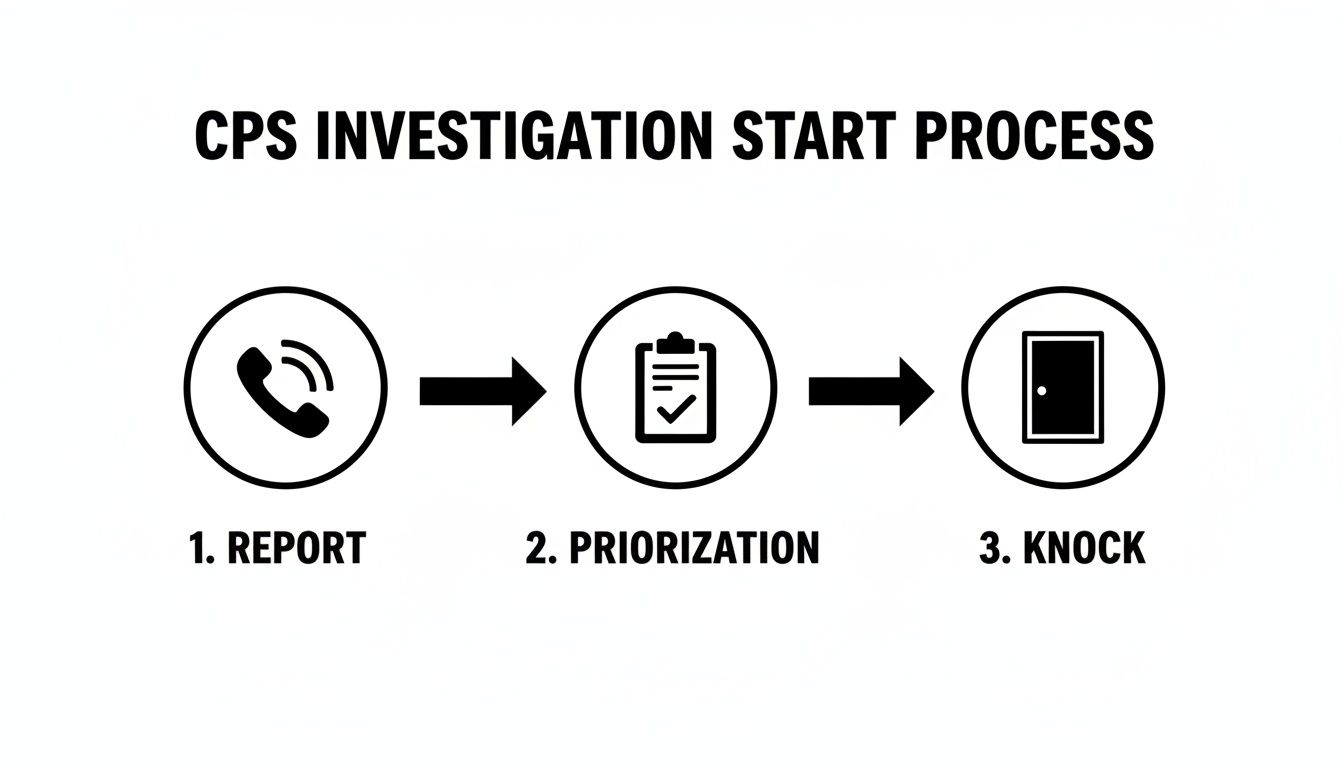
As you can see, once a report is accepted and prioritized, the direct interaction with your family begins almost immediately. This is why being prepared is so critical.
A Real-Life Scenario: Asserting Your Rights
Let’s imagine a single dad, Mark. A CPS investigator visits his home after a neighbor reported hearing loud arguments. The investigator immediately asks to come inside and speak with his teenage daughter.
Instead of panicking, Mark calmly steps outside, closes the door behind him, and politely tells the investigator he is happy to cooperate. However, he states that he needs to speak with his attorney first before allowing a home search or any interviews.
Mark then calls a lawyer, who advises him on the next steps. He schedules a formal interview for a later time when his attorney can be present. By staying calm and knowing his rights, Mark prevented a "fishing expedition" and made sure the process was handled formally. This approach ultimately led to the closure of a baseless case. It’s a perfect example of cooperating without giving up your constitutional rights.
You have the absolute right to not speak with an investigator without an attorney present. Politely stating, "I want to cooperate, but I will not answer any questions until I have spoken with my lawyer," is a powerful and legally protected statement.
Know Your Fundamental Rights as a Parent
While an investigator has a job to do, you have fundamental rights that cannot be ignored. Knowing them is your shield.
- You have the right to refuse entry without a court order. Unless the investigator shows you a warrant or another type of court order giving them access, you are not legally required to let them into your home.
- You have the right to an attorney. You can and should have a lawyer with you during any interactions with CPS. An attorney can give you crucial advice on how to answer Texas CPS questions in an interview.
- You have the right to record interactions. In Texas, it is legal for you to record your conversations with a CPS investigator. This recording can be an invaluable piece of documentation.
Understanding these rights isn’t about being difficult or uncooperative. It’s about ensuring the process is fair and that your family is protected. A CPS investigation is a serious legal matter, and you need to treat it that way from the very first moment.
Your Rights and Responsibilities Under Texas Law
When a CPS investigator arrives at your door, it can feel like the world is spinning out of control. Suddenly, you're expected to navigate a complex legal system while your family is in crisis. The Texas Family Code is a dense and complicated document, but you don't need a law degree to understand the fundamental rights that can protect your family.
Here's the most important thing to remember: you have rights. Knowing them isn't just helpful—it's your first line of defense. This process isn't about what you feel is fair; it's about what the law—specifically the Texas Family Code—says. These statutes are the rulebook that CPS must follow, outlining everything from how an investigation should proceed to the drastic step of terminating parental rights.
Requests Versus Requirements
One of the most common and dangerous points of confusion for parents is the difference between a caseworker's request and an actual legal requirement. An investigator might ask you to do many things, often phrasing them in a way that makes them sound mandatory. They usually aren't, at least not without a judge's signature on a court order.
Understanding this distinction can completely change the direction of your case. For example, an investigator will often ask you to sign a "Parental Child Safety Placement" (PCSP) or another type of "Safety Plan." These are presented as a way to "keep your kids safe," but they are voluntary contracts. Signing one can have devastating consequences, like forcing you to leave your own home or preventing you from seeing your children. You are not required to sign anything, especially without having an attorney review it first. You can learn more in our detailed guide on your rights during a CPS investigation.
It's a high-stakes game of "Simon Says," and you need to know when you can—and should—say no. The table below breaks down some common requests to help you understand where the law draws the line.
Your Rights vs CPS Requests During an Investigation
This table clarifies the difference between a CPS investigator's request and a legally mandated requirement, helping parents understand where they can and should assert their rights.
| CPS Request | Is It Legally Required? | Recommended Action |
|---|---|---|
| Enter and search your home | No. You have a Fourth Amendment right against unreasonable searches. | Politely refuse entry by saying, "I do not consent to a search of my home without a court order." |
| Take a drug or alcohol test | No. You cannot be forced to submit to a test without a court order. | Politely refuse the request and state you will only comply if ordered by a judge. A refusal can be used against you, but it forces CPS to prove its necessity to a court. |
| Sign a Safety Plan or PCSP | No. These are voluntary agreements. | Never sign any document without your attorney reviewing it. These plans can severely limit your parental rights. |
| Release medical or school records | No. You are not required to sign releases for private information. | Decline to sign any releases. The investigator can try to get these records through other means, but you should not volunteer them. |
Knowing your rights is crucial, but it's only half the battle. You also have to know how to use them strategically.
The Power of Documentation
From your very first conversation with CPS, you need to become your own private investigator. Every phone call, every home visit, every word exchanged is potential evidence. The file that the CPS investigator is building is designed to support their case, which is often a one-sided narrative against you. Your job is to build a parallel file that tells your side of the story, backed by facts.
Think of it this way: The CPS file is the prosecution's evidence. Your file is your defense. Walking into a legal battle without it is like showing up to a gunfight with a water pistol.
Grab a notebook or start a digital document immediately. Log every single interaction with precise detail:
- Date and Time: Don't be vague. Write it all down.
- Who Was Involved: Get the investigator's full name, title, and contact information. Note anyone else present.
- What Was Said: Summarize the conversation. What questions did they ask? How did you answer?
- What Was Done: Did they inspect a room? Did they hand you a business card or any documents? Take pictures.
- Your Impressions: Did you feel threatened, pressured, or misled? Write it down while it's fresh in your mind.
This log will become an invaluable resource for your attorney. It helps challenge inaccuracies in the investigator's official report, shows your attempts to cooperate, and preserves the truth when your memory of these stressful events starts to fade. Strategic cooperation—being polite and responsive while firmly asserting your rights and documenting everything—is how you actively defend your family and protect your future.
Navigating Safety Plans and Child Removals in Texas
Few things are more terrifying during a CPS investigation than the moment an investigator pressures you to sign a "Safety Plan" or you're faced with the unthinkable: the emergency removal of your child. These are high-stakes, high-pressure situations, often clouded by confusion and bad information. Understanding what's really happening, what your rights are, and what CPS legally has to prove is the first step toward protecting your family.
Understanding Safety Plans and Their Dangers
When an investigator decides they've found a potential risk to your child, they might pull out a document called a Parental Child Safety Placement (PCSP), more commonly known as a Safety Plan. At its core, this is a voluntary agreement—think of it as a contract—that lists all the things you must agree to do to supposedly keep your child safe.

These plans often feel like a quick fix, a way to make the whole nightmare go away. But by signing, you could be agreeing to completely life-altering conditions. You might agree to leave your own home, have zero contact with your children, or place them with a relative for an indefinite period.
Never sign a Safety Plan or any other document from CPS without having an experienced attorney review it first. These are legally binding contracts that can be used against you in court, and you may be signing away fundamental parental rights without realizing it.
The Pressure to Sign and Its Consequences
Let’s look at a common scenario. After a neighbor reports loud arguing, an investigator shows up and tells a Houston couple that one of them has to leave the home right now, or CPS will take the kids. Terrified, the father agrees to move out and signs a PCSP that bans him from seeing his children.
He thinks he’s doing the right thing to end the investigation. Instead, he just voluntarily gave up his right to live in his own home and see his kids. CPS can now hold up that signed agreement in court as proof that he’s a risk. He made a huge decision under immense pressure, with no legal advice, and it needlessly tore his family apart.
When CPS Can Legally Remove Your Child
The most extreme step CPS can take is to remove your child from your home without your permission. This is called an emergency removal or an ex parte removal. But an investigator can’t just show up and decide to take your children. Under Texas Family Code Chapter 262, they must have a court order to do so.
To get that order, CPS has to convince a judge that there is an immediate danger to the physical health or safety of the child. This is a very high legal bar to clear. It’s not about vague possibilities; it requires specific, credible evidence that the child is in actual peril if they remain in your home.
If a judge does grant the order, you will be served with a lawsuit, and your child will be placed in foster care or with a relative. After the removal, the law demands a hearing be held within 14 days. This is often called the "14-day hearing" or "show cause hearing" as defined in Chapter 262. Here, a judge will hear evidence from both sides—CPS and you—to decide if a danger still exists. This is your first, and most critical, opportunity to fight for your child's return. To learn more about this urgent process, you can explore our guide on what happens during a CPS emergency removal.
Unfortunately, the stakes are incredibly high. The 2025 DFPS Sunset Review shows that even with a recent drop in child removals, tragic outcomes are still far too common. For families in Houston, Dallas, or Austin who are also dealing with criminal accusations like DWI or domestic violence, this data highlights just how quickly things can escalate.
If your child is removed, treat it as the absolute emergency it is. You must contact an attorney immediately to start preparing for that crucial 14-day hearing. The moves you make in those first few hours and days will have a massive impact on your ability to bring your child back home.
Possible Outcomes of a Texas CPS Investigation
After what can feel like an eternity of sleepless nights and gut-wrenching worry, the end of a CPS investigation brings a moment of truth. An official letter from the investigator will arrive, laying out their formal finding. This isn't just a piece of paper—it’s the decision that could either close this painful chapter or swing open the door to a much larger legal fight.
For any Texas parent, understanding what each outcome truly means is everything. The difference between a "Ruled Out" finding and a "Reason to Believe" can feel like the difference between breathing a sigh of relief and facing complete devastation. That single finding dictates everything that comes next.
The Four Types of CPS Findings
Once the caseworker wraps up their interviews, document reviews, and home inspections, they are required by law to make a formal disposition. In Texas, the investigation will be closed with one of four specific findings.
Ruled Out: This is the best news you can get. It means the investigator found no credible evidence to support the claims of abuse or neglect. The case is closed. While a record of the report exists, it’s confidential and can’t be held against you.
Unable to Determine: This one feels unsatisfying. It means the investigator couldn't find enough evidence to either confirm or deny the allegations. The case is still closed, but it can leave a frustrating cloud of suspicion over families who know they did nothing wrong.
Reason to Believe (RTB): This is a very serious finding. It means the investigator decided it was more likely than not that the alleged abuse or neglect occurred. An RTB finding creates a permanent record for you in the DFPS central registry, which can have massive consequences and often leads to court action or mandatory services.
Administrative Closure: This is a procedural closure. It happens when an investigation has to be shut down for reasons like the family moving out of Texas or being impossible to locate.
Receiving a "Reason to Believe" finding can be a crushing blow. It can impact your ability to work with children, volunteer at your kid's school, or even adopt a child down the road.
What Happens After an RTB Finding
A "Reason to Believe" finding doesn't just fade away. It kicks off a chain reaction that can have profound and lasting effects on your family. If your children are still living at home, CPS will likely push you into a program called Family-Based Safety Services (FBSS), which involves things like counseling, parenting classes, and other required interventions.
If you get a Reason to Believe finding, you have the right to fight it. You can request an Administrative Review of Finding (ARF), which is an internal review of the case file. This is your first and often best shot at getting an incorrect finding overturned before it escalates.
Worse still, an RTB finding frequently crosses over into the criminal justice system, especially in cases with accusations of assault or drug use. The stakes are incredibly high, as data shows these situations can tragically repeat. In a staggering 50 percent of all confirmed child deaths and near-deaths, either the child or the person responsible had a prior history with CPS, which explains the agency's intense focus on preventing repeat incidents. You can learn more about how legislative changes are trying to address these lifelong impacts by reading the Texas Child Maltreatment Fatalities and Near Fatalities Annual Report.
Trying to challenge a finding or navigate the services that come with an RTB determination is not something you should ever do alone. An experienced attorney can guide you through the ARF process and fight fiercely for your rights, working to ensure one investigator's opinion doesn't get to unfairly define your family's future.
Why an Experienced Family Law Attorney Is Your Best Ally
When Child Protective Services (CPS) opens an investigation into your family, it can feel like you’re suddenly standing alone against a massive government agency. The emotional weight of potentially losing your children is almost unbearable, and you shouldn't have to carry it by yourself. Hiring an experienced family law attorney isn’t just a good idea—it is an absolutely essential move to protect your family and start regaining some control.

Think of your attorney as both a shield and a guide. They immediately step in to become the main point of contact for CPS, which means you can stop worrying about every phone call or what you might say under pressure. This simple step prevents you from making missteps and ensures every conversation is handled strategically and professionally.
A Lawyer Protects Your Rights and Builds Your Defense
From that very first interview to a potential courtroom battle, your attorney’s job is to make sure your rights under the Texas Family Code are respected at every turn. They dig into the allegations, challenge weak evidence, and start building a strong defense that actually tells your side of the story.
This becomes even more critical when a CPS case crosses paths with criminal allegations. For instance, if an investigation is triggered by a domestic dispute or a DWI arrest, the stakes are suddenly sky-high. You could find yourself fighting for your children in family court while simultaneously defending your freedom in criminal court. Our firm has deep experience in these complex cases and understands how one can domino into the other. We build a unified strategy to protect you on all fronts.
An attorney is your advocate, your advisor, and your defender. Their presence alone sends a clear message to CPS: you are taking this seriously, and your rights will not be overlooked or trampled on.
Ultimately, hiring an attorney is an investment in your family's future. They bring the legal knowledge and emotional support needed to see you through this incredibly stressful and disorienting time.
We understand the fear and uncertainty you're facing. You don’t have to go through this alone. Taking the first step to get legal help is the first step toward getting your life back. Contact The Law Office of Bryan Fagan today for a compassionate and confidential consultation to discuss your case and learn how we can help protect your family.
Frequently Asked Questions About Texas CPS Investigations
When a Child Protective Services (CPS) investigator shows up at your door, your mind can instantly flood with a thousand urgent questions. The shock and uncertainty are completely normal, but getting straight answers is the first step to navigating this difficult situation.
Let's walk through some of the most common questions we hear from Texas parents the moment they find themselves dealing with CPS.
Can I Refuse to Let CPS in My Home?
Yes, you have the right to refuse to let an investigator into your home if they don't have a court order. Your home is your private space, protected by the Fourth Amendment from unreasonable searches.
The best way to handle this is to politely but firmly step outside to speak with them, close the door behind you, and say, "I am happy to speak with you out here, but I do not consent to a search of my home without a court order." While the investigator might note your refusal in their report, this action forces them to go to a judge and legally justify why they need to enter your home.
How Long Does a CPS Investigation Take in Texas?
In Texas, CPS aims to complete most investigations within 30 to 45 days. Think of this as their standard timeline.
However, life and legal cases are rarely that simple. If the case is particularly complex, or if the investigator is having trouble reaching everyone they need to interview, the timeline can be extended. If this happens, you have a right to be notified about the extension.
Can CPS Interview My Child Without My Permission?
Yes, and for many parents, this is the most gut-wrenching part of the entire process. The Texas Family Code gives investigators the authority to interview your child without your consent or even your presence. This often happens at your child's school or daycare center.
While you can't prevent the interview, you absolutely can prepare your child. Let them know that a grown-up might ask them some questions, and the most important thing is to always, always tell the truth. Above all, reassure them that they are safe, you love them, and nothing will change that.
What Happens if I Refuse a CPS Drug Test?
You have the right to refuse a request for a drug test if CPS doesn't have a court order making you take one. But this is a decision with immediate consequences. The investigator will absolutely document your refusal.
Down the road, they will likely argue in court that your refusal means you had something to hide. A better approach is to politely decline the request and state that you will comply with any direct order from a judge. This puts the burden back on CPS to prove to the court why the test is truly necessary.
Trying to navigate the complexities of a CPS investigation is an incredible weight to carry, but you don't have to do it by yourself. The attorneys at The Law Office of Bryan Fagan, PLLC have spent years protecting families across Texas. Contact us today for a free, confidential consultation to understand your rights and start building the strongest defense for your family's future.