Skip to content
That unexpected knock on the door or the jarring phone call from Child Protective Services can shatter your world in an instant. For a mother, the fear that follows is primal and overwhelming: "Are they going to take my children?" In that moment, your sense of normalcy is gone, replaced by a flood of confusion and panic. This is the start of a CPS case against a mother in Texas. While it feels like your life is spinning out of control, this guide is here to provide the clear, practical, and compassionate advice you need to navigate this journey and fight for your family.
The First 24 Hours: Your Most Critical Moment

The second a CPS caseworker introduces themselves is heart-stopping. Your mind starts racing: What did I do? Who would report me? Are they going to take my children? This isn't just a friendly chat; it's the start of a formal investigation that can completely upend your family's life. How you handle this initial interaction can either help de-escalate the situation or accidentally make it much worse.
Your gut reaction might be to get defensive or angry—that's a completely normal human response. But it's so important to take a deep breath, stay as calm as possible, and think strategically. Remember, the caseworker is only there because someone filed a report. That report could be entirely false, a simple misunderstanding, or based on a legitimate concern. Your job isn't to win an argument on your doorstep. It's to navigate this interaction safely and protect your parental rights from the very first minute.
A Scenario That Could Happen to Any Parent
Let's walk through a common, relatable situation. You're a single mom in the kitchen making dinner. Your three-year-old, who just figured out how to unlock the back door, slips into the fenced backyard for a minute while you turn to grab something from the fridge. A neighbor glances over, sees your child alone, and immediately calls the CPS hotline to report neglect. Just like that, a caseworker is at your home, asking questions.
This is the kind of everyday accident that could happen to any parent. It doesn't mean you're a bad mother, but it’s exactly the type of incident that often triggers a CPS investigation. The caseworker’s job is to assess if your child is safe, and every word you say from this point on matters immensely.
Key Takeaway: Your initial response should be cooperative but cautious. You have the right to understand why CPS is there and what the specific allegations are. You are not required to let them into your home without a court order, though refusal can sometimes be used against you. This is why contacting an attorney immediately is your safest first step.
What to Say—and What to Avoid
When the caseworker starts asking questions, your words carry immense weight. Everything you say will be documented in their case file.
Here’s how to handle that crucial initial conversation:
- Be Polite and Calm: Greet the caseworker, ask for their name and business card, and maintain a respectful tone. Answering the door with anger instantly puts them on the defensive and creates an adversarial relationship.
- Ask About the Allegations: Politely ask, "Can you please tell me the specific allegations that were made against me?" You have a right to know what you're being accused of.
- Keep Your Answers Short and Factual: Don't volunteer extra information, give rambling explanations, or bring up past problems. If they ask if your child was outside alone, a simple, "My child was in our fenced backyard for a moment while I was in the kitchen," is sufficient. Avoid getting emotional or defensive.
- Never Sign Anything on the Spot: Caseworkers might hand you forms like a "Parental Child Safety Placement" or a "Safety Plan." Do not sign anything without talking to an attorney first. Signing these documents can mean you're waiving important rights and could be seen as an admission of fault.
This first meeting is all about information gathering. For a deeper look at what caseworkers are trained to look for, you can learn more about what to expect during a CPS home visit in Texas. Knowing their playbook helps you prepare yours. The fear and anxiety you’re feeling are real and valid. But in this moment, you must shift from panic to a proactive mindset. Your goal is to show that your home is safe and your children are well-cared-for, all without giving up your legal rights. The best way to ensure your rights are protected from day one is to contact an experienced family law attorney immediately.
The CPS Investigation and Your Rights as a Mother

After the initial shock of that first contact, the formal investigation begins. This is where CPS tries to determine if there's any truth to the allegations. A CPS case against a mother in Texas feels incredibly personal and invasive, making it absolutely critical to understand what caseworkers are looking for and what your rights are under the Texas Family Code.
The caseworker’s job is to gather information from all available sources. They'll want to inspect your home and interview you, your children, and anyone else they deem relevant—your partner, your parents, your children's teachers, their doctor, or even your neighbors.
It’s a terrifying thought, but under Chapter 262 of the Texas Family Code, caseworkers have the legal authority to interview your child at school or daycare without you even knowing, let alone consenting. For most mothers, this is one of the most painful and frightening parts of the entire process. While the agency justifies this as a way to get an unbiased statement, it leaves parents feeling completely powerless and cut out of the loop.
What Caseworkers Look For
When a caseworker steps into your life, they’re trained to look for and document very specific things. They aren't just searching for obvious signs of harm; they're piecing together a picture of your home's overall safety and your parental capacity.
Here’s what’s on their checklist:
- Physical Safety: Is the home free of hazards? Is there adequate food and access to clean water? Are the utilities on?
- Child's Condition: They’ll observe your child’s physical appearance, their emotional state, and how they interact with you.
- Parental Capacity: They are assessing your ability to provide a safe environment, how well you understand your child’s needs, and whether there are risk factors like substance abuse, family violence, or untreated mental health conditions.
It’s important to know you are not alone in this. In 2022, Texas CPS screened in 207,429 referrals for a response, which led to the confirmation of 54,207 child victims. For mothers, who are often primary caregivers, neglect is the most frequent allegation, making up 74.8% of all maltreatment types. Many families have been in your shoes and successfully navigated this process.
Knowing and Asserting Your Rights
Understanding your rights is your strongest shield. You don’t have to blindly agree to every request a caseworker makes. You have constitutional rights that they must respect.
Crucial Insight: You have the right to refuse to let a caseworker into your home if they do not have a court order. You also have the right to have an attorney present during any conversation or meeting with CPS. Asserting these rights politely is not an admission of guilt; it's a sign that you take the situation seriously.
A real-life example makes this clear. A single mother in Houston was reported for neglect after her son broke his arm on the monkey bars at a public park. The caseworker showed up, demanding an immediate home inspection and an interview. Frightened but remembering some advice she'd found, the mother politely but firmly said, "I want to cooperate, but I will not allow you inside or answer any more questions until I have spoken with my attorney."
She hired a lawyer immediately, who then handled all communication. The attorney ensured the home visit was scheduled at a reasonable time and was present for the interview. The mother documented every phone call and saved every email. This firm, legally sound approach prevented the situation from spiraling and showed she was taking it seriously. The case was eventually closed with no further action. You can learn more about protecting yourself in our guide on your rights during a CPS investigation.
When you bring a lawyer into a CPS investigation, it’s vital to understand the protections of attorney-client privilege rules. This legal shield keeps conversations between you and your lawyer private, allowing you to be completely open and honest. This honesty is exactly what your attorney needs to build the strongest possible defense to protect you and your family.
Navigating the Texas CPS Court System
When CPS decides the risk is too high to leave your child at home, they will file a lawsuit. This is the moment a CPS case against a mother in Texas officially enters the formal family court system. The thought of going to court is terrifying for any parent, but understanding the process and key hearings can restore a sense of control. This isn't just about showing up; it's about preparing to fight for your family within a structured legal world governed by strict timelines.
Think of the court process as a marathon, not a sprint. It’s made up of a series of hearings, each with a specific purpose. Every hearing is a critical opportunity to demonstrate to the judge that you are a loving, capable parent committed to providing your child a safe home. The entire process is dictated by rules in the Texas Family Code, especially Chapter 263.
The First Major Hurdle: The Adversary Hearing
Within 14 days of your child being removed, the court must hold an Adversary Hearing. This is, without a doubt, one of the most important hearings in your case. Its purpose is for the judge to hear evidence and decide two things: Did CPS have an urgent and immediate reason to remove your child, and is there an ongoing danger that prevents your child from returning home right now?
This hearing moves quickly. CPS will present its case, and your attorney gets the chance to challenge their evidence and present your own. The judge will listen to testimony and review documents. As you get deeper into the Texas Family Court System, a key part of the legal fight involves understanding deposition transcripts, which are official records of sworn testimony that can be powerful tools in these hearings.
For the judge to keep your child in foster care, they must find that there is a "continuing danger" and that it is "contrary to the child's welfare" to return home. Your lawyer’s job is to create doubt, challenge the State's evidence, and show the judge that you are not a danger to your child.
From Check-Ins to the Final Trial
After the Adversary Hearing, your case moves into a series of Status Hearings, usually held every 60 to 90 days. These are check-ins with the judge to monitor your progress on your service plan and your child's well-being. These are your opportunities for your attorney to showcase your progress—like a certificate from a parenting class or a series of clean drug tests.
A Mother's Goal in Court: Every time you enter that courtroom, your objective is the same: present yourself as a calm, cooperative, and committed parent. Dress respectfully, speak only when your attorney advises, and keep your emotions in check. The judge is watching everything.
All CPS cases in Texas operate on a tight schedule. The law, under Chapter 263 of the Texas Family Code, demands that the case conclude within about one year, though it can be extended for six months in extraordinary circumstances. This ticking clock leads to the most serious hearing of all: the Final Trial.
At the Final Trial, the judge makes a permanent, life-altering decision. The main options on the table are:
- Return the children to your care (reunification).
- Place the children permanently with a relative.
- Name CPS as the permanent managing conservator.
- Terminate your parental rights completely.
Termination of parental rights is the legal death penalty for a family. Under Chapter 161 of the Texas Family Code, CPS has to prove two things by the high standard of "clear and convincing evidence": first, that you committed a specific act listed in the law (a "predicate ground"), and second, that termination is in the child's best interest. This is why having a seasoned attorney isn't a luxury; it's an absolute necessity to protect your family from that devastating outcome.
Key Stages of a Texas CPS Court Case
| Court Hearing | Typical Timeline From Removal | Purpose and A Mother's Goal |
|---|---|---|
| Adversary Hearing | Within 14 days | To determine if CPS was justified in removing the child. Your goal is to show the judge it's safe for your child to come home immediately. |
| Status Hearing | Every 60-90 days | A "check-in" to monitor progress on your service plan. Your goal is to demonstrate compliance and commitment to the plan. |
| Initial Permanency Hearing | Within 180 days | To review the child's permanent plan and placement. Your goal is to show significant progress toward resolving the issues that led to removal. |
| Subsequent Permanency Hearings | Every 120 days after the initial one | Continued monitoring of the case. Your goal is to maintain momentum and move closer to reunification. |
| Final Trial | Within 12 months (with a possible 180-day extension) | The final decision on the child's future is made. Your goal is reunification, proving you provide a safe and stable home. |
This table lays out the roadmap, but every case is unique. Your attorney is your best resource for understanding how these stages will play out for you and your family.
Creating a Path to Reunification with Your Service Plan
If the judge decides your child cannot safely return home after the initial hearing, the court will order you to complete a Family Plan of Service, often called a service plan. When you first see this document, it can feel like a mountain of impossible demands. It’s natural to feel completely overwhelmed.
But I need you to shift your mindset. This isn't a list of punishments. It’s your official, court-approved roadmap to getting your kids back where they belong—with you.
How you tackle this plan, document every single step, and communicate your progress is everything in a CPS case against a mother in Texas. Your commitment to these services is the most powerful evidence you can present to a judge that you are a safe, capable, and loving parent.
What Is in a Typical Service Plan?
Every service plan is tailored to the specific allegations against you. The services are designed to address whatever issues CPS claims put your child at risk. While no two plans are identical, they often include a mix of core requirements.
Most plans will include some combination of these services:
- Parenting Classes: To learn and demonstrate effective skills for discipline, communication, and understanding child development.
- Individual Counseling: To work through personal challenges like past trauma, anger management, or mental health struggles.
- Substance Abuse Treatment: This can range from outpatient counseling and random drug tests to a more intensive inpatient program.
- Maintaining Stable Housing and Employment: You'll need to prove you can provide a safe and stable home environment.
- Attending All Scheduled Visitations: Showing up for your child is non-negotiable. This proves your commitment to maintaining your parent-child bond.
Juggling appointments while dealing with the heartbreak of separation is incredibly difficult. This is where getting organized becomes your superpower. We advise every client to get a dedicated binder or create a digital folder for every certificate, sign-in sheet, and progress report.
A Proactive Mindset: Don't just check the boxes. View every class you complete and every clean drug test as another brick you’re laying in the foundation of your case for reunification. Each step forward is one more reason for the judge to send your children home.
A Real-Life Scenario: Mastering the Plan
Let me give you an example. A mother, let's call her Jessica, had her children removed because of neglect allegations tied to her ex-partner's substance abuse. Her service plan was hefty: parenting classes, individual therapy for codependency, and proof of steady income. Her first reaction was hopelessness.
But instead of giving up, she and her lawyer mapped out a strategy. Jessica found a court-approved parenting class on Saturdays so she wouldn't miss work. She sent her caseworker a weekly email summarizing what she'd worked on in therapy and attached a digital copy of her paystub every other week. When her car broke down and she had to miss a therapy session, she immediately called to reschedule, then sent a quick email to her caseworker and her attorney explaining the situation.
That proactive communication made all the difference. By the next Status Hearing, her lawyer walked in with a thick binder detailing all of Jessica's progress. She didn’t just do the services; she proved she was doing them and took total ownership of the plan. That powerful display of commitment was a major factor in the judge's final decision to return her children. You can get more details on how these plans work in our guide on the CPS Family Service Plan in Texas.
The Court's Timeline for Your Case
This timeline gives you a bird's-eye view of a CPS court case, showing the major hearings where the judge will review your progress on the service plan.
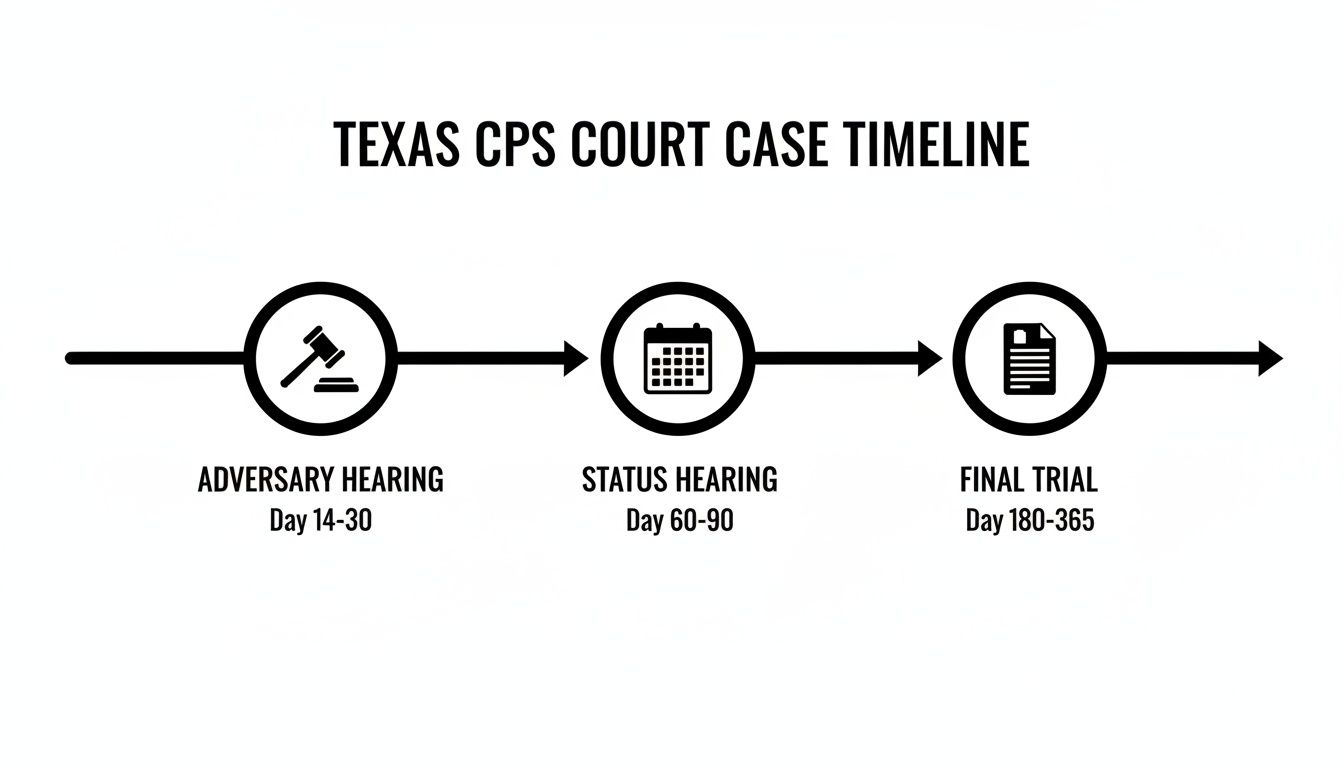
As you can see, the court operates on a strict one-year statutory deadline. Your service plan is the main event at every single court date.
Setbacks happen. A missed appointment or a moment of frustration isn’t the end of the world, but how you respond is critical. Talk to your attorney immediately, address the problem, and keep pushing forward. Your service plan is your opportunity to prove to the court, to CPS, and most of all, to yourself, that you are ready and able to give your children the safe, loving home they deserve. It's your path back to them.
When CPS and Criminal Charges Collide
It’s a nightmare scenario many mothers can’t even imagine: a CPS investigation and a criminal case hitting you at the exact same time. These two legal worlds operate on separate tracks, but they are deeply and dangerously connected.
What you say to a CPS caseworker—even when you think you’re just clearing your name—can be handed over to a prosecutor and used against you in criminal court. On the flip side, a criminal charge can become the single piece of "evidence" CPS uses to justify removing your children.
This overlap creates a legal minefield. A heated argument with your spouse that leads to a family violence call, or a DWI charge with your kid in the back seat, can trigger both a police arrest and a CPS report. All of a sudden, you're not just fighting for your freedom; you're fighting for your family.
Navigating this two-front war demands a unified legal strategy. You absolutely have to understand your rights in both arenas, especially your Fifth Amendment right to remain silent.
The Fifth Amendment: Your Most Important Shield
The Fifth Amendment protects you from being forced to incriminate yourself. This is beyond critical because anything you tell a CPS investigator can be twisted and used by a district attorney to build a criminal case against you.
Let's say you're under investigation for neglect related to substance use. You admit to the caseworker that you sometimes use marijuana to deal with stress, thinking your honesty will help show you're cooperative. That admission, however, can be passed directly to law enforcement and become the basis for a drug possession charge.
Crucial Warning: You must operate under the assumption that anything you say to a CPS worker can and will be shared with the police and prosecutors. You have the right to politely decline to answer their questions until you've spoken with an attorney who understands both criminal defense and CPS law.
A Scenario: An Integrated Defense in Action
Let’s look at a real-world example. A mother, we'll call her Sarah, gets into a loud argument with her teenage son. A neighbor hears the shouting and calls the police. The officers arrive and end up charging Sarah with a Class C misdemeanor for assault. Because a child was involved, a report is automatically sent to CPS, opening an investigation into the cps case against mother texas.
Sarah is now trapped in two legal battles:
- A criminal charge that could lead to fines and a permanent criminal record.
- A CPS case where the agency might try to remove her son based on the family violence allegation.
Without a coordinated defense, Sarah could make a mistake that costs her everything. She might talk to the CPS worker and try to explain the fight, accidentally admitting to the very actions that would prove the criminal assault charge. Or, she could take a quick plea deal in her criminal case just to make it go away, not realizing that plea can be used by CPS as definitive proof that she is a danger to her child.
Her attorney, however, understands the whole picture. The lawyer immediately instructs Sarah not to speak with CPS and takes over all communication. In criminal court, the attorney fights the misdemeanor charge, eventually getting it dismissed due to a lack of evidence. Since the criminal charge was dismissed, CPS loses its primary piece of evidence and is forced to close its investigation.
The system can be incredibly harsh. In 2022, Texas CPS investigated a staggering 166,187 reports. Even more alarming, a 2023 report found that 63% of families with confirmed abuse or neglect received no follow-up services, leaving them wide open to future reports and re-entry into the system. You can learn more about these Texas child welfare statistics and see just how vital it is to get strong legal help early on.
When your parental rights and your personal freedom are both on the line, you can't afford a defense strategy that only looks at one piece of the puzzle. You need a legal team that sees the entire board.
We Hear You: Answering Your Most Pressing CPS Questions
If Child Protective Services is in your life, your mind is probably racing with a thousand questions, fears, and worst-case scenarios. It’s an incredibly isolating and frightening place to be. We get it.
Over the years, we’ve sat across from countless mothers just like you. Here are the honest, straight-to-the-point answers to the questions we hear most often when it comes to a CPS case against mother Texas.
Can CPS Talk to My Child at School Without My Permission?
Yes, they can. For most mothers, hearing this is one of the most gut-wrenching parts of the entire process. Texas law allows CPS investigators to interview your children at school or daycare without you being present or even giving consent.
Their official reason is to get what they consider an "unfiltered" statement, away from any potential influence. But to you, it feels like a massive violation of your parental rights—because it is. The key is how you respond. You should immediately inform the school and the caseworker, in writing, that you do not consent to any future interviews without your attorney present. An experienced lawyer can then draw a firm legal line, ensuring any conversations happen in a way that protects your child and respects your rights.
What if I Was Falsely Accused by an Ex-Partner?
It’s an ugly reality we see far too often: false allegations being used as a weapon in a bitter custody fight or after a bad breakup. It feels profoundly unfair, but the most powerful thing you can do is remain calm and focus on the facts, not the drama.
Don't get dragged into a he-said-she-said mudslinging match with your ex. Instead, put all your energy into proving what you already know—that you are a great parent.
- Cooperate with the investigation, but do it smartly and with your rights firmly asserted.
- Start gathering evidence of your good character. Think letters from teachers, your child’s pediatrician, or a sports coach.
- Document absolutely everything.
Your strongest defense is hiring an attorney right away. A lawyer can work to expose the accuser's motivations, counter their narrative with facts and evidence, and keep the system from being twisted against you.
Will I Lose My Children Forever if They Are Removed?
The moment your children are taken is a parent’s worst nightmare. But it is not a life sentence for your family. The primary goal of CPS in Texas is, by law, the safe reunification of families.
Terminating your parental rights is considered the "death penalty" of family law. It requires an incredibly high burden of proof—what’s known as “clear and convincing evidence”—that you pose a danger and that termination is in the child’s best interest. Your actions from this moment forward are what truly matter. Committing to your service plan and having a skilled lawyer fighting for you at every single hearing are the two most critical factors in bringing your children home.
How Can I Clear My Name After the Case Is Over?
Even when a case is closed, the record of the allegation can linger, casting a shadow over your life. If CPS determined the allegations were "ruled out" or "unsubstantiated," you have the right to petition to have your name removed from the child abuse central registry.
This isn’t an automatic process, and it involves navigating specific administrative hurdles. Working with an attorney can make all the difference in getting the paperwork filed correctly and ensuring your record is cleared, allowing you to finally close this chapter and move on.
The fear and uncertainty of a CPS case can be paralyzing, but you do not have to face this fight alone. You are a mother, and your love for your children is the most powerful force there is. At The Law Office of Bryan Fagan, we see that strength, and we are here to stand with you. We offer the compassionate guidance and aggressive legal defense you and your family deserve. Contact us today for a free, confidential consultation to talk about your case and learn how we can help protect what matters most—your family.