Skip to content
Of all the calls a parent can receive, one from Child Protective Services (CPS) is perhaps the most frightening. It's a moment that throws your world into a tailspin, leaving you feeling defensive, confused, and completely isolated. When a caseworker brings up a CPS family service plan, it’s natural to feel like you’re being handed a punishment.
But it’s crucial to see this for what it truly is. A service plan isn't a sentence. Think of it as a formal, court-supervised roadmap created to address the specific issues that brought CPS to your door and guide your family back together.
Your Guide to the Texas CPS Family Service Plan
The phrase "Child Protective Services" is enough to make any parent's heart pound. Suddenly, your life is under a microscope, and your very ability to care for your children is being called into question. You’re likely wrestling with a storm of questions: What did I do wrong? Will they take my children? How do I even begin to fix this?
We've walked countless Texas families through this exact fire. We know the fear and the uncertainty you're facing. That’s why it’s so important to understand that a family service plan isn't designed to punish you. Under the Texas Family Code, it’s a structured, legal document with a single, primary goal: to give you a clear, actionable path to resolve the concerns and bring your children back home.
A Blueprint for Reunification
It helps to think of the service plan as a blueprint for rebuilding a house. If an inspector finds a crack in the foundation, they don't just condemn the whole structure. They create a detailed plan to repair that specific weakness and make the house safe again. Your service plan works the same way.
It will list concrete, specific actions you must take. Each one is designed to show the court and CPS that you are building a safe and stable home for your children.
For instance, consider a parent struggling with substance abuse after a difficult life event. A CPS investigation is launched, and their world feels like it's crumbling. A service plan in this situation is not about shame; it’s about solutions. It would likely include services such as:
- Substance Abuse Assessment: To determine the level of support needed.
- Individual Counseling: To address the root causes of the substance use and develop healthier coping strategies.
- Parenting Skills Classes: To reinforce positive parenting techniques and build confidence.
Each service you complete is like pouring fresh concrete and reinforcing the foundation of your family. It provides the court with tangible proof of your commitment. This guide is here to translate the confusing legal requirements into steps you can actually take, empowering you to protect your rights, understand the process, and work confidently toward bringing your children home. The path ahead is challenging, but you don't have to walk it alone.
When CPS hands you a document called a “Family Service Plan,” the formal tone and legal jargon can be incredibly intimidating. But it's crucial to see this document for what it really is—not just a list of chores from a caseworker, but a legally binding plan that could decide the future of your family.
A CPS Family Service Plan in Texas is a formal document, created under the Texas Family Code. Its entire purpose is to lay out a clear path for resolving the specific issues that brought CPS into your life in the first place.
Think of it as the official blueprint for getting your children back home. Every single task, whether it’s a parenting class, counseling, or proving you have a stable job, is a step toward showing the court that you can provide a safe and stable home.
Creating the Blueprint for Your Family
Many parents mistakenly believe that CPS dictates the entire service plan on their own. That’s simply not true. Texas law gives you the right to have a say in creating your own plan. It's designed to be a collaborative process that brings several key people to the table:
- You (the Parent): Your input is non-negotiable. You understand your family's strengths and struggles better than anyone.
- Your Attorney: A skilled CPS attorney acts as your advocate, fighting to ensure the plan’s requirements are fair, reasonable, and directly linked to the accusations you're facing.
- The CPS Caseworker: They will be there to represent the Department of Family and Protective Services (DFPS) and explain the agency's concerns and what services they recommend.
- Other Relevant Parties: This can include anyone from your child’s therapist to counselors or other professionals who are part of your case.
This collaborative approach isn't just a formality. The goal is to build a plan that actually works for your family—one that sets you up for success, not for failure.
At its core, the process is designed to move your family from the initial point of concern toward the goal of reunification, with the service plan acting as the bridge.
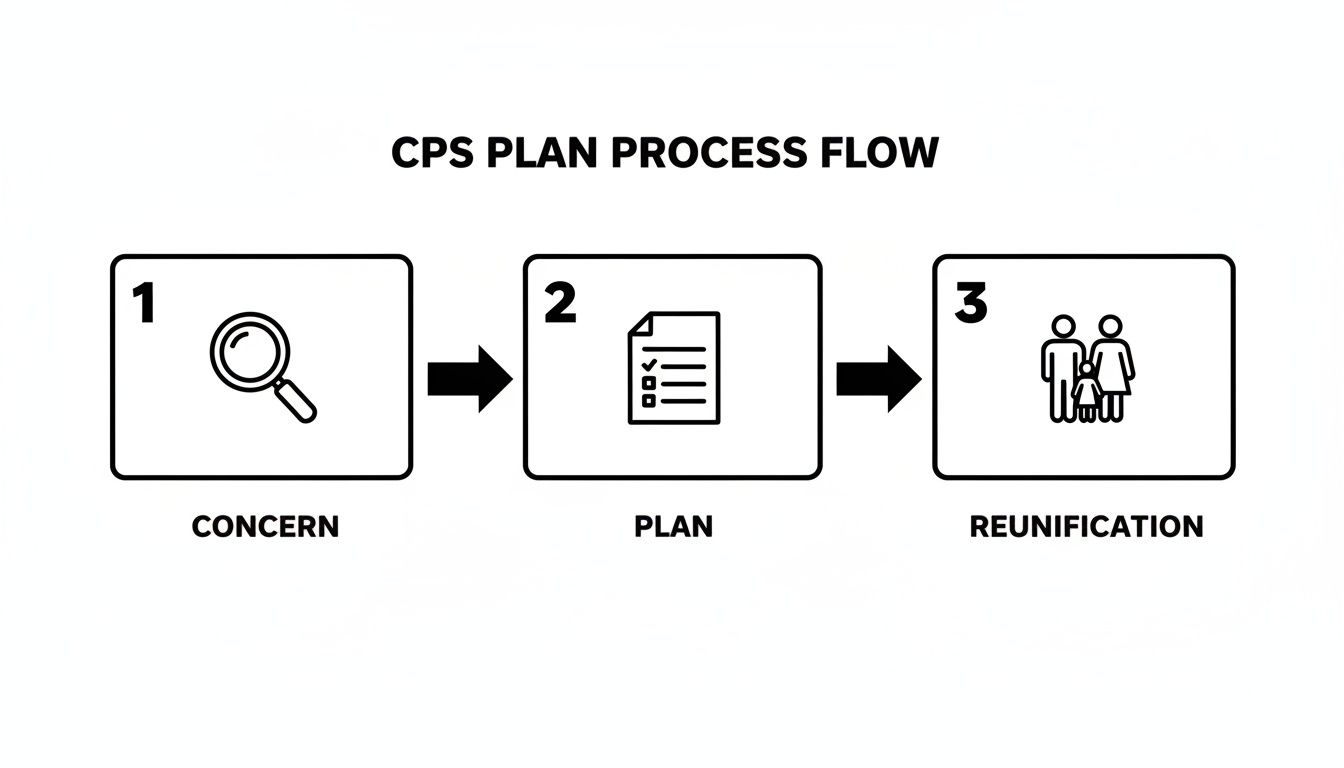
This visual simplifies the journey, showing how the plan is the central tool used to navigate from a reported concern to a safe family reunion.
To help you understand what to expect, every service plan generally contains the same core elements. This table breaks down what you'll find in a court-ordered plan.
Key Components of a Texas CPS Family Service Plan
| Component | Description and Purpose |
|---|---|
| Identified Problems | This section explicitly states the specific issues or risk factors that led to CPS involvement, such as allegations of neglect, substance abuse, or domestic violence. Its purpose is to define the problem the plan is meant to solve. |
| Goals | These are the broad outcomes you are working toward. The primary goal is almost always to create a safe environment for the child, which will lead to reunification. |
| Required Services | This is the "to-do list." It details the specific actions and programs you must complete, such as therapy, drug testing, parenting classes, or stable employment. Each service must be directly related to the identified problems. |
| Responsibilities | The plan will outline the responsibilities of everyone involved, including you, the other parent, and CPS. This clarifies who is supposed to do what. |
| Timelines | Each service or task will have a deadline. These timelines are critical for showing the court you are making timely progress. |
| Consequences | The plan must state the potential consequences of failing to comply, which can include a delay in reunification or, in the most serious cases, the termination of your parental rights. |
Understanding these components helps demystify the document. It's not just a random list of demands; it's a structured agreement with a clear objective.
The Critical 45-Day Timeline
The Texas Family Code is very clear about the timing. After a child is removed from the home under Chapter 262, the service plan must be created and filed with the court within 45 days. This isn't a suggestion; it's a hard deadline.
That tight timeframe highlights just how urgent the situation is. It's a critical window where you need to move fast, secure a lawyer, and start engaging with the process.
Your involvement during these first 45 days can make a massive difference in the final terms of your plan, helping make it more reasonable and relevant to your life. When you see the plan as a tool for your family's future—not a punishment—you put yourself back in the driver's seat, ready to prove your commitment and get your children back home where they belong.
Common Requirements in a Service Plan
When that CPS family service plan first lands in your hands, the list of tasks can feel like a mountain to climb. It’s easy to get overwhelmed. The key is to break down what these tasks are and, more importantly, why CPS and the court are asking you to do them. Each requirement is a specific tool meant to address a specific concern, giving you a clear path to show you’re committed to providing a safe home.
Think of it like this: when a doctor figures out what's making you sick, they prescribe a specific medicine to treat that illness. A service plan works the same way. The services are the "medicine" prescribed to heal the issues that brought CPS into your life in the first place. The goal isn't to punish you; it's to give you new skills and resources to move forward.

While every single plan is tailored to the family, most include a mix of the same core services. Getting a handle on what they are is the first real step toward getting your life back on track.
Core Services and What Success Looks Like
Every service on your plan has a clear purpose and a definition of what "successful completion" actually means. It's not just about checking a box or showing up. It’s about being an active participant and proving you’ve learned something you can apply in real life. Let’s walk through some of the most common requirements.
- Parenting Classes: These courses are all about teaching positive ways to discipline, understanding what's normal for kids at different ages, and building better communication skills. Success isn’t just getting the certificate. It’s being able to talk about and actually use these new skills during supervised visits with your child.
- Individual Therapy or Counseling: This is your space to work on underlying personal struggles—like past trauma, depression, or anger—that might be affecting your parenting. You show success through consistent attendance and being able to explain to your caseworker how you’re using new coping strategies in your day-to-day life.
- Substance Abuse Assessment and Treatment: If drugs or alcohol played any part in the CPS case, you’ll be ordered to get a professional assessment. Based on those results, you might have to complete an outpatient or even an inpatient treatment program. Completion means doing everything they recommend, from going to meetings to providing clean drug tests on demand.
- Domestic Violence Intervention Courses (BIPP): If family violence has been alleged, you will almost certainly be ordered to a Batterer's Intervention and Prevention Program (BIPP). These are intensive programs that focus squarely on taking accountability and changing abusive behaviors.
A Real-Life Scenario: Imagine a single father gets reported to CPS after a neighbor calls the police during a loud argument with his ex-partner. He's arrested for a DWI later that same night. His CPS family service plan in Texas would be built around those specific events. It would likely require him to complete a BIPP course to learn better conflict resolution, get a substance abuse assessment, and follow all treatment recommendations—including regular, random drug and alcohol testing. Every clean test and class certificate he turns in becomes a powerful piece of evidence proving he's taking real steps to create a stable, conflict-free home for his child.
Proving Stability and Progress
Beyond classes and counseling, your service plan will also drill down on your ability to provide a stable foundation for your child's life. These requirements are often the most fundamental.
- Maintaining Stable Housing: You have to prove you have a safe and consistent place for your child to live. This means showing a signed lease, proof of rent or mortgage payments, and letting the caseworker visit to see for themselves that the home is clean and safe.
- Maintaining Stable Employment: CPS needs to know you can support your child financially. Success here is straightforward: provide recent pay stubs or other documentation that shows you have a steady source of income.
For a deeper dive into the structure and legal weight of these plans, you can read more about breaking down CPS plans of service. Each item you complete on your plan is another step toward reunification. It's your chance to build a strong case and prove to the court, with your actions, that you are the capable and loving parent your child needs.
Understanding Your Rights and Responsibilities
When you're pulled into a CPS case, it’s natural to feel overwhelmed and powerless. But knowledge is your first and best line of defense. Getting a firm grip on your rights and responsibilities under a CPS family service plan in Texas is the single most important thing you can do right now.
You are not just supposed to follow orders. You are an active participant in your family's future, and you have legal protections to ensure your voice is heard.
Just as crucial, however, is understanding what's expected of you. The Texas Family Code gives the court tremendous authority, and failing to follow a court-ordered service plan can lead to the worst possible outcome. This is the time to be diligent, strategic, and proactive.
Your Fundamental Rights in the Service Plan Process
The law is designed to make sure you aren’t left in the dark. You have specific, guaranteed rights when it comes to creating and carrying out your service plan. Knowing these rights—and using them—is absolutely critical.
The Right to Participate: You have a legal right to be part of the conversation when your service plan is created. CPS can't just hand you a list of non-negotiable demands. It should be a collaborative effort where your input is genuinely considered.
The Right to Clear Explanations: Every single task and requirement in your plan has to be explained to you. You have the right to keep asking questions until you understand exactly what’s expected, why it’s being required, and what it looks like to successfully complete it.
The Right to an Attorney: This is your most important right. You are entitled to have an experienced lawyer represent you at every single stage, from hashing out the plan's terms to fighting for you in court.
These aren't just suggestions; they're your legal shield. A good attorney will make sure your plan is fair, that the requirements are directly tied to the original accusations, and that the judge hears your side of the story.
Your Critical Responsibilities
While you have rights, you also have incredibly serious responsibilities. The court’s number one priority is the safety and well-being of your child. Your service plan is the ruler they use to measure your commitment to providing that safety. Your duties are clear and you can't afford to ignore them.
The stark reality is that failing to comply with a court-ordered service plan can be used as a primary reason to terminate your parental rights. Under Texas Family Code § 161.001(b)(1)(O), a parent’s failure to follow the plan can be grounds for the permanent loss of their child.
This makes following the plan your most critical job. Your actions—or your failure to act—will directly shape your family’s future.
Actionable Advice: Document Everything and Be Proactive
Your best defense is to build a mountain of evidence that proves your progress. Never, ever rely on your caseworker to keep a perfect record for you. You have to become the chief historian of your own case.
- Keep Every Certificate: Save every piece of paper you get for completing parenting classes, therapy sessions, or intervention programs.
- Collect Every Test Result: Keep copies of every single clean drug test result you receive.
- Log Every Appointment: Use a calendar to track every meeting, class, and appointment. Note the date, who you met with, and what you talked about.
This pile of paperwork becomes undeniable proof of your hard work and commitment. When you can walk into court and present a binder overflowing with certificates, clean tests, and attendance logs, you are building a powerful case for getting your child back.
If a plan feels impossible or includes requirements that seem unfair, that is the exact moment you need an attorney. An experienced lawyer can step in to negotiate more reasonable terms and help ensure your plan is a realistic roadmap to success, not an impossible setup for failure.
The Two Paths: Reunification vs. Termination
When you're caught in a CPS case, it feels like you're standing at a crossroads with two very different roads stretching out before you. Every CPS family service plan in Texas will ultimately guide you down one of these paths. One leads to reunification, bringing your children back home where they belong. The other, a much harder road, can end in the termination of your parental rights.
Knowing this isn't meant to scare you—it's meant to empower you. You are not just a passenger on this journey. Every single action you take, from the classes you attend to the appointments you keep, directly steers your family toward one of these two outcomes.
The High Stakes of Your Service Plan
The Texas Family Code gives the court a clear standard to use when making decisions about your family's future: the "best interest of the child." A judge’s primary tool for measuring this is your progress—or lack thereof—on the court-ordered service plan.
If the court feels you haven't made "significant and demonstrable progress," CPS has the legal opening it needs to argue that keeping the children in your care is not in their best interest. This is the argument that can lead to termination under Chapter 161. Your commitment to that plan is the most powerful evidence you have to counter this and build your case for bringing your family back together.
Think of your service plan as the roadmap to getting your kids home. By completing every task, showing real, changed behavior, and working closely with your attorney, you are building a powerful case that your children's best interest is to be with you. Success is within reach, and your actions are what will get you there.
The Path to Success is Paved with Progress
Building a strong case for reunification is about more than just checking off boxes on a list. It’s about demonstrating genuine, lasting change. It's like you're creating a portfolio of your progress, and each completed task is another piece of evidence that proves you are a safe, capable, and loving parent.
Here’s how your efforts become powerful proof for the court:
- Completing Services: Every certificate from a parenting class, every note from your therapist, and every clean drug test becomes a tangible exhibit that shows your hard work.
- Showing Changed Behaviors: When you have supervised visits, put the skills you've learned into practice. Show the caseworker and the court that you can manage stress in a healthy way and communicate effectively with your children.
- Working with Your Attorney: A skilled attorney will make sure all your progress is documented correctly and presented persuasively to the judge, turning your hard work into a solid legal argument for reunification.
For many families working toward reunification, a key part of the process involves understanding and building secure attachments. If past trauma or difficult relationships are a factor in your case, learning about different relational dynamics, like the anxious avoidant attachment style, can be a vital component of your therapy and personal growth.
Navigating Roadblocks and Staying on Course
Even with the best of intentions, the path forward isn't always a straight line. It's a tough truth that many families don't always get the support they truly need to succeed. This is exactly why you have to be your own best advocate. Document everything. If you hit a roadblock—whether it’s not having childcare for a required class or a scheduling conflict with work—tell your attorney immediately. They can step in and ask for reasonable accommodations. The goal is to show the court that you're doing everything you can to comply, even when things get tough.
Ultimately, getting through a CPS case is a marathon, not a sprint. To get a better idea of what this journey might look like, you can read our guide on the CPS reunification timeline, its factors, and expectations. With focus, good record-keeping, and the right legal team in your corner, you can get through this chapter and prove that the best place for your children is at home with you.
How an Experienced Attorney Makes a Difference

Trying to handle a CPS investigation on your own is a risk you simply can’t afford to take. The stakes—your children, your rights, and your family's entire future—are just too high. An experienced attorney does so much more than just show up to court; we become your strategist, your voice in negotiations, and your strongest defender through every overwhelming step.
Navigating a CPS family service plan in Texas without a lawyer is like trying to find your way out of a thick forest in the dark without a map. The path is confusing, it’s full of traps you can’t see, and one wrong move can leave you completely lost. Our job is to be your guide, lighting the way and making sure you stay on the clearest path back to your family.
Shaping a Fair and Achievable Plan
One of the first and most critical places an attorney makes an impact is during the creation of your service plan. It's common for CPS to hand parents a long list of services that are overly broad, have nothing to do with the actual allegations, or are simply impossible for a working parent to complete.
This is where we step in. We fight to negotiate the terms of your plan, making sure that every single requirement is reasonable, relevant, and realistic for your life.
For example, a caseworker might demand you attend three different classes a week that all conflict with your job. We can push back, advocating for online options, different class times, or a more sensible timeline. We work to set you up for success from day one, not for failure.
This negotiation is absolutely vital. The Texas Legislature recognized that far too many plans were poorly written, contradictory, or full of unreasonable demands. Having a lawyer protects you from these exact pitfalls.
Your Advocate and Your Shield
Beyond just negotiating the plan, we serve as an essential buffer between you and the caseworker. We handle the stressful communications, help you document every step of your progress, and connect you with qualified service providers who know exactly what the court expects to see. This kind of comprehensive support is central to navigating the complexities of Family Law when your children's future is on the line.
Our role includes:
- Challenging Unreasonable Demands: If a caseworker starts adding new verbal "requirements" that aren't in the official court order, we step in immediately to set the record straight about your actual obligations.
- Building Your Case for Court: We don't just tell the judge you're doing well; we prove it. We meticulously gather your class certificates, therapy reports, and clean drug tests, weaving them into a powerful and cohesive story of your commitment and progress.
- Handling Legal Crossovers: Many CPS cases don't exist in a vacuum. They might start because of another legal issue, like a DWI or a protective order. Our firm is deeply experienced where family and criminal law meet, offering you seamless representation for all your legal challenges.
We are not just your lawyers; we are your partners in this fight. We understand the incredible fear and anxiety that come with a CPS case, and our mission is to lift that legal burden from your shoulders so you can focus on what matters most—healing your family and bringing your children home.
It can be empowering to know exactly what a lawyer can do for you. To learn more about this, discover what a juvenile dependency lawyer does for Texas families and how they work to protect your rights.
If CPS has entered your life, please do not wait. The sooner you have an experienced advocate in your corner, the more control you'll have over the outcome. Contact the Law Office of Bryan Fagan today for a free, confidential consultation. Let us stand with you and fight for your family.
Frequently Asked Questions About Service Plans
When you’re staring down a CPS case, the questions and worries can feel endless, often keeping you up at night. The sheer uncertainty is usually the hardest part. Here at the Law Office of Bryan Fagan, we hear the same urgent questions from parents just like you every single day. We've gathered some of the most common ones here, with the kind of clear, practical advice that can help you get your feet back on solid ground.
Can I Refuse to Sign the CPS Family Service Plan?
This is a question we get all the time, and it's not a simple yes or no. You can't be physically forced to sign the plan, but digging in your heels and refusing can easily be painted as being uncooperative when you get in front of a judge.
A much smarter approach is to bring in an attorney to help you negotiate the terms of the plan before you put your name on it. An experienced lawyer can push back on unreasonable demands and argue for changes that make the plan something you can realistically accomplish. It's always better to sign a plan you helped shape than to have a judge order you to follow one you had no say in at all.
How Long Do I Have to Complete My Service Plan in Texas?
CPS cases in Texas move on a surprisingly strict schedule outlined in Chapter 263 of the Texas Family Code. From the day your child is removed, the court typically sets a deadline of about 12 months for you to complete your service plan. This is often called the "dismissal date," and it comes up faster than you’d think.
In some situations, this timeline can be extended for up to six months, but only if you can show the court you've made real progress and have a good reason for the delay. It is absolutely essential to start working on your plan from day one, because these deadlines are taken very seriously by the courts.
What Happens If I Miss a Drug Test or a Class?
Missing a single appointment can feel like a total catastrophe, but what you do next is what really counts. One missed class or a diluted drug test isn't an automatic failure, but it can definitely create a negative impression. The key is to be proactive and completely honest about it.
The moment you know you've missed something, tell your attorney and your caseworker what happened and why. If you had a legitimate conflict—a medical emergency, a work crisis you couldn't avoid—get documentation. Your lawyer can help frame the situation for the court. A pattern of missed appointments, however, is a different story. That will be seen as non-compliance and can put your entire case in jeopardy.
A Critical Legal Update: The Texas Legislature has started to recognize that many service plans are unfair or even impossible for parents to complete. As a result, they have repealed the law that allowed a parent's rights to be terminated solely for failing to follow a service plan. This important change, effective September 1, 2025, shows that even the courts are acknowledging the system's flaws. But be warned: failing to make progress can still be used against you under other legal arguments, which makes your consistent, documented effort as important as ever.
Your actions and your open communication are your best defense. Every service you complete, every effort you document, and every honest conversation you have with your legal team helps build the case for bringing your family back together.
The path through a CPS family service plan in Texas is loaded with legal hurdles and emotional trials, but you do not have to walk it by yourself. The dedicated attorneys at the Law Office of Bryan Fagan have the experience and compassion to guide you through every step, protect your rights, and fight for your family’s future. We understand the fear you’re facing, and we are here to provide the reassuring guidance and strong advocacy you need. For a free, confidential consultation to discuss your case, contact us today.