Skip to content
The moment a Child Protective Services (CPS) caseworker contacts you, your world can feel like it's spinning out of control. Fear, confusion, and a powerful instinct to protect your children take over. You love your kids, but suddenly you are under a microscope, facing a process that threatens the very core of your family. This guide is here to demystify the cps case timeline texas, providing the clear, practical guidance you need to navigate this journey with confidence and hope.
Understanding the legal timeline, which is primarily governed by the Texas Family Code, is your first step toward regaining control. From the initial report to the final court decision, knowing what comes next can transform your fear into a focused, actionable plan.
Your First Encounter With Texas CPS
A knock on the door from a Child Protective Services (CPS) caseworker can make your entire world grind to a halt. In that one, heart-stopping moment, it’s easy to feel overwhelmed by fear, confusion, and a profound sense of helplessness. You know you’re a good parent, you love your child, but now you’re suddenly facing an investigation that strikes at the very heart of your family.
This initial encounter is incredibly disorienting, but understanding what’s happening—and knowing your rights—is the first step toward getting your feet back on solid ground.
Imagine this: You get a call from your child’s school about a minor scrape on the playground. A few hours later, a CPS caseworker is at your home, explaining they’ve received a report of neglect. Your mind races. You feel defensive, angry, and terrified all at once. That reaction is completely normal. The key is to not let that initial wave of panic dictate how you respond.
What Happens When a Report Is Made
Every single CPS case starts with a report made to the Texas Department of Family and Protective Services (DFPS). These reports can come from anyone, but a huge number are made by “mandatory reporters”—people like doctors, teachers, or therapists who are legally required to report any suspicion of child abuse or neglect.
Once DFPS gets a report, it's sorted by urgency:
- Priority 1 (P1): These are the most serious allegations, where there's a belief a child is in immediate danger. CPS must try to see the child face-to-face within 24 hours.
- Priority 2 (P2): These reports involve serious concerns, but they aren't considered immediately life-threatening. The response time here is within 72 hours.
The caseworker's primary job during this first visit is to figure out if your child is safe right now. They'll want to see your child, look around your home, and talk to you, your child, and anyone else living there.
It’s absolutely critical to understand that you are not legally required to let a caseworker into your home or speak with them without a court order. While you should always stay calm and polite, firmly asserting your rights isn't an admission of guilt—it's a smart, protective step for your family.
Actionable Advice for the First Interaction
How you handle these first few hours can set the tone for everything that comes next. Your gut instinct might be to over-explain everything or get defensive, but the most powerful thing you can do is take a calm, measured approach.
Here’s what you should do in that first interaction:
- Stay Calm and Polite: Don't raise your voice or get confrontational. A good practice is to step outside to talk, closing the door behind you to maintain your family's privacy.
- Ask for Identification: Ask for the caseworker's name, ID number, and their office information. It's a good idea to take a quick photo of their credentials.
- Ask for the Allegations: Politely ask, "What are the specific allegations that were made?" They might not give you every detail, but you have a right to know the general nature of the complaint.
- Protect Your Rights: You can calmly and firmly say, “I am happy to cooperate, but I cannot allow you into my home or answer any questions until I have spoken with an attorney.”
This initial phase of the cps case timeline texas really does set the stage for the entire case. Your very first call should be to a lawyer who specializes in CPS defense. An attorney can step in immediately, communicate with CPS for you, and make sure your rights are protected from the very beginning. You do not have to walk through this fire alone.
Emergency Removal and the First Critical Court Hearings
Of all the stages in a Texas CPS case timeline, this is the one that strikes the most fear in a parent's heart. An emergency removal is exactly what it sounds like: CPS physically taking your child from your home, often with little to no warning.
While the initial investigation is stressful, a removal throws your family into an immediate legal crisis. The situation shifts from an unsettling inquiry to a full-blown legal sprint where every single day—every hour—matters. The rules for this sprint are laid out with strict, urgent deadlines in Chapter 262 of the Texas Family Code.
When CPS takes a child without getting a court order first, they have to prove that "exigent circumstances" existed. This is a high legal bar. It means they must genuinely believe your child is in immediate danger of physical harm or is in a situation that threatens their safety right now.
A suspicion isn't enough. CPS has to be ready to walk into a courtroom and convince a judge that leaving your child in the home, even for a few more hours, would have been an unacceptable risk. Think of a report about drug use where the caseworker shows up to find drugs in plain sight and a parent clearly too impaired to look after a toddler. That's the kind of immediate danger the law is talking about.
The Initial Show Cause Hearing
As soon as CPS removes a child, the clock starts ticking. They must immediately go to a judge—usually within one business day—to get an order that retroactively approves their actions. This first, quick hearing is often called a Show Cause Hearing.
The judge reviews a sworn statement (an affidavit) from the caseworker. To keep the child in CPS custody, the judge has to agree there's a "continuing danger" and that it was against the child’s best interest to stay in the home. You might not even know this hearing is happening, but it officially starts the countdown to the most important hearing in your case.
This timeline gives you a sense of how quickly a report can escalate to a caseworker visit and the start of this urgent court process.
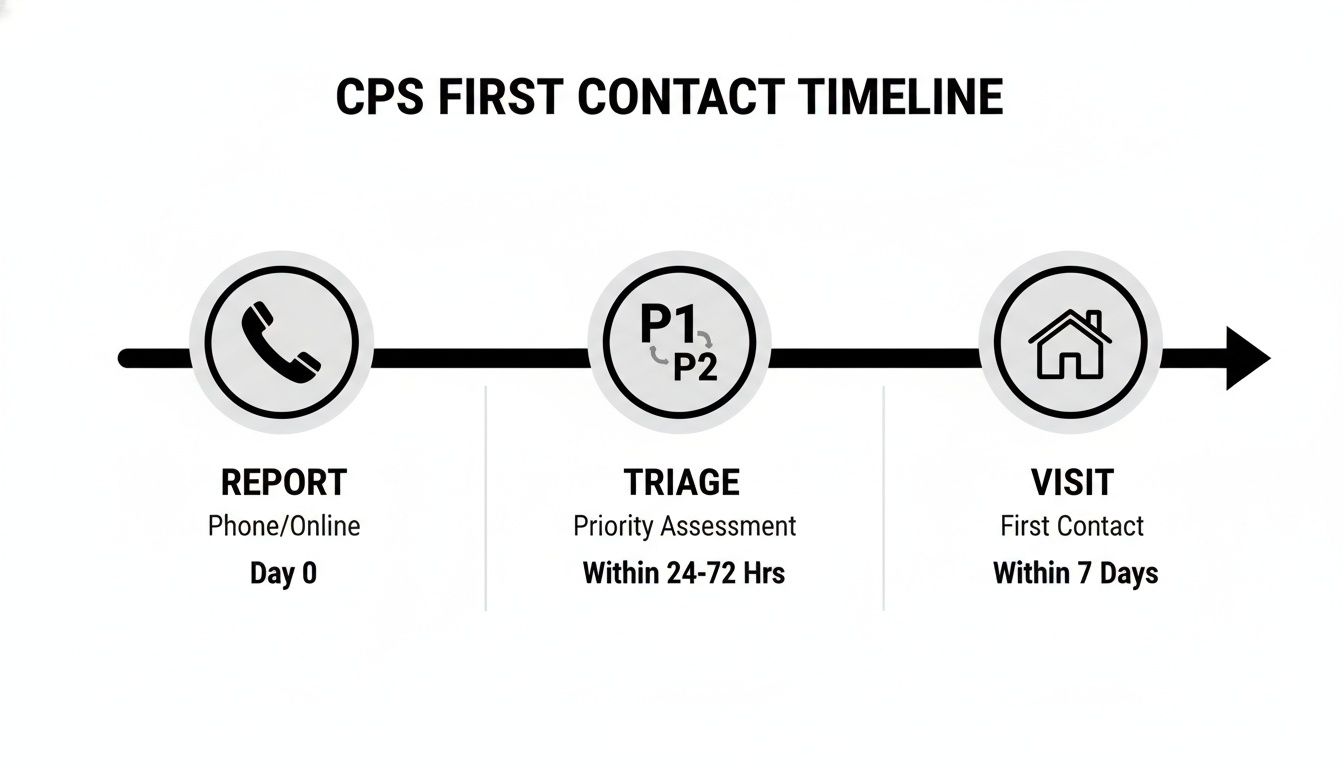
The sheer speed of it all underscores why you need a lawyer in your corner the moment a removal happens.
The timeline for these initial court dates is non-negotiable and moves incredibly fast. Below is a quick breakdown of what to expect in the days immediately following a removal.
Initial CPS Court Hearing Timeline After Removal
| Hearing Type | Statutory Deadline | Primary Purpose and What to Expect |
|---|---|---|
| Show Cause Hearing | Within 1 business day of removal | This is a quick review where a judge looks at the caseworker's affidavit to validate the removal. Parents are often not present for this initial step. |
| Adversary Hearing | No later than 14 days after removal | This is the main event. It's a "mini-trial" where CPS must prove there was a danger. This is your first and best chance to present your side and fight for your child's immediate return. |
These two hearings set the entire tone for the rest of your case, making the first two weeks absolutely critical.
The Critical 14-Day Adversary Hearing
Under the Texas Family Code § 262.201, a full court hearing, called the Adversary Hearing, must happen no later than 14 days after your child was taken. This is your first, and frankly, your best opportunity to fight to get your child back home immediately.
Think of it as a mini-trial. CPS has the burden of proof here. They have to bring evidence and witnesses to convince the judge of two key things:
- There was a real danger to your child's physical health or safety.
- The child's welfare was at risk by remaining in the home.
This is absolutely not a hearing you should attend alone. An experienced attorney will cross-examine the caseworker, challenge the evidence CPS presents, and build a strong case for your side. We can introduce your own evidence—like text messages, photos, or school records—and call witnesses who can speak to your character and parenting.
The goal of the Adversary Hearing is simple: to bring your child home. If that doesn't happen, the hearing still shapes the entire future of the case, determining where your child will be placed and what comes next.
If the judge decides to keep your child in state custody, CPS will be named the Temporary Managing Conservator. From there, the court will start putting together temporary orders and a service plan aimed at eventual reunification. You can get more details on this early stage in our guide to understanding an emergency removal in a Texas CPS case.
The two weeks after an emergency removal are an intense legal battleground. Having an experienced attorney from The Law Office of Bryan Fagan by your side from the very beginning ensures your rights are defended and your voice is heard when it matters most.
Crafting Your Family Service Plan and Temporary Orders
Once the whirlwind of emergency hearings has passed, the CPS case enters a new, more structured phase. If you've felt like you're just reacting to one crisis after another, this is where things slow down a bit—and where the real work of getting your child home begins. This part of the cps case timeline texas is all about two key documents: Temporary Orders and the Family Service Plan.
It can feel like you’re being handed an impossible list of demands, but I want you to see these documents differently. They are your roadmap. Understanding them is the key to creating a clear, manageable path back to your child.

Think of this phase less like a punishment and more like a high-stakes project with one goal: bringing your family back together, safely. The court, CPS, and your attorney will now work together to create the blueprint you need to follow.
What Are Temporary Orders?
If the judge decided at the Adversary Hearing that your child can't come home just yet, the court will issue Temporary Orders. These aren't suggestions; they are legally binding court orders that will govern almost every aspect of your life—and your child’s—until the case is resolved. Following them to the letter is non-negotiable.
Temporary Orders will typically spell out:
- Conservatorship: This is the legal term for who gets to make decisions for your child. CPS is almost always named the Temporary Managing Conservator.
- Visitation: The orders will dictate exactly how often, where, and under what conditions you can see your child. In the beginning, these visits are often supervised.
- Child Support: You will almost certainly be ordered to pay child support to help cover the cost of your child's care while they are in the state's custody.
- Specific Rules: These orders can also include other very specific rules, like no-contact orders with certain people or even restrictions on where you can live.
The Family Service Plan: Your Roadmap to Reunification
The Family Service Plan (FSP) is the absolute heart of the reunification process. It’s a formal contract between you and CPS, signed off on by the judge, that lists every single task you must complete to prove you are a safe parent and get your child back. This plan is specifically designed to address the issues that brought CPS to your door in the first place.
A Family Service Plan is not meant to be a punishment. It's a court-ordered tool designed to give you the services and support needed to create a safe, stable home for your child. The best thing you can do is get involved early to help shape a plan that is fair and achievable.
Common requirements you'll see in a Family Service Plan include:
- Individual or couples counseling
- Parenting classes
- Drug or alcohol assessments and any recommended treatment
- Random drug testing (urine or hair follicle tests)
- Maintaining stable housing and income
- Psychological evaluations
Your plan might direct you to services like individual counseling or family therapy to work on underlying issues and improve how your family functions. This is a critical time for actionable advice: stay organized, document everything you do, and communicate any struggles to your lawyer immediately.
Having an experienced attorney in your corner is so critical at this stage. Your lawyer can negotiate the terms of your service plan, fighting to make sure the requirements are reasonable, accessible, and actually relevant to your family’s unique situation. We've put together a guide specifically for breaking down CPS Plans of Service to help you get a better handle on what to expect.
Seeing a long list of services can be incredibly intimidating, but it doesn't have to be a dead end. With the right legal support, that overwhelming plan becomes a series of concrete, achievable steps. At The Law Office of Bryan Fagan, we help parents do this every day—transforming a daunting list into a winning strategy.
Navigating Status Hearings and Permanency Hearings
Once the court has issued Temporary Orders and you have your Family Service Plan in hand, your case enters what can feel like a marathon. This part of the cps case timeline texas is a long stretch of court dates that might seem repetitive, but don't be fooled. Every single hearing is a critical opportunity to show the judge that you’re making real progress and are serious about bringing your child home.
The two main types of hearings you’ll face during this time are Status Hearings and Permanency Hearings, both outlined in Chapter 263 of the Texas Family Code.
Think of these hearings as scheduled check-ins with the court. They aren't surprise attacks. Everyone involved—you, your lawyer, the CPS caseworker, and the attorney representing your child—gathers to update the judge on everything that’s happened since the last time you were all in court. This is your chance to get your progress down on the official record.
Understanding the Status Hearing
About 60 days after the court officially names CPS as the Temporary Managing Conservator, you'll have your first Status Hearing. Just like the name implies, the whole point is to check the "status" of the case.
The judge will want answers to a few key questions:
- How is your child doing in their current placement?
- Are you actually showing up and participating in the services from your plan?
- Are there any roadblocks getting in the way of you completing your services?
- Is the visitation schedule working for everyone?
This is a huge moment for you and your attorney to shine a spotlight on your hard work. If you’ve attended every class, passed every drug test, and are putting in the effort in therapy, this is when your lawyer makes absolutely sure the judge hears about it. It’s also the right time to bring up problems, like if a required service is too far away or clashes with your work schedule.
The Importance of Permanency Hearings
While Status Hearings are important progress reports, Permanency Hearings carry a lot more weight. The first Permanency Hearing must happen within 180 days (roughly six months) of the day your child was removed. From there, you'll have one every few months until the case is closed.
These hearings are all about one central question: What is the long-term, permanent plan for this child? The court’s number one goal is always reunification—getting your child back home with you. But, the judge also has to start considering other "permanency goals" if it looks like reunification isn't on track.
Those other goals usually fall in this order:
- Reunification with a Parent: This is the top priority and what everyone is supposed to be working toward.
- Permanent Placement with a Relative: If you can't be reunited, placing the child permanently with a grandparent, aunt, or other family member is the next best thing.
- Adoption: If no family options are viable, the goal may shift toward terminating parental rights so the child can be adopted by someone else.
Every Permanency Hearing is a test of your progress. The judge will meticulously review your compliance with the Family Service Plan. Consistent, documented progress is the single most powerful tool you have to keep reunification as the primary goal.
Let’s look at a real-world scenario. A mom, we'll call her Sarah, had her child removed because of substance abuse issues. At her first Permanency Hearing, her attorney came prepared. He had documents proving Sarah found a sober coach, attended every single recovery meeting, and passed every random drug test. He also presented a powerful letter from her counselor detailing her commitment to therapy.
Because of that well-documented progress, the judge didn't just keep reunification as the main goal. He also agreed to increase Sarah's visitation from supervised to unsupervised. That's a massive step forward, and it happened because she took her service plan seriously and her lawyer knew how to present her success to the court.
Each hearing is a building block, creating a long-term record of your commitment. Showing up, doing the work, and having an attorney who can skillfully present your achievements are the keys to turning this part of the timeline in your favor.
The Final Stages: Dismissal or Termination
As your Texas CPS case moves toward its final chapter, you’ll find yourself standing at a fork in the road. One path leads to dismissal and the reunification you've been fighting for. The other leads to the permanent, heartbreaking outcome of Termination of Parental Rights (TPR). This is the culmination of everything you've done over the past year or so, and understanding both potential destinations is absolutely critical.
Every step you’ve taken—every class you’ve completed, every visit you’ve attended, every bit of progress on your Family Service Plan—is about to be weighed against the state’s original reasons for getting involved. Whether this long journey ends in a celebration or in sorrow, knowing the legal goalposts will give you the clarity to face whatever comes next.

The One-Year Clock: Texas's Strict Statutory Deadline
Texas law, specifically Texas Family Code § 263.401, puts a strict timeline on every CPS case. A judge is required to make a final decision—either dismissing the case or terminating parental rights—within 12 months of the date the court first got involved.
This deadline exists for a good reason: to keep children from getting stuck in the foster care system indefinitely. While the law allows for a single extension of up to 180 days in "extraordinary circumstances," you should never count on it. That one-year clock puts immense pressure on parents to get to work and show real, measurable progress from day one.
This tight timeline means you can't afford to waste a single day. Every service you complete, every visit you attend, and every positive step you take builds the case for reunification before time runs out.
The Powerful Moment of Dismissal and Reunification
For the families who put in the work and successfully complete their service plan, the final hearing can be a moment of overwhelming relief and pure joy. When that judge signs an order dismissing the case and returning your child to your care, it means you did it. You proved you could provide a safe, stable, and loving home.
A dismissal order officially ends CPS's involvement in your life. It restores all your parental rights and closes the courthouse doors for good. Just imagine walking out of that hearing, finally free from caseworker visits and court dates, with your only job being to rebuild your life with your child.
This outcome isn't about luck; it's the direct result of hard work and commitment. It happens when parents take their Family Service Plan seriously, stay in close contact with their attorney, and consistently show the court they are dedicated to their child. It's the proof that family preservation isn't just a hopeful idea—it's an achievable reality.
The Devastating Reality of Termination of Parental Rights
No parent ever wants to think about this, but it’s a legal reality we have to address. Termination of Parental Rights is often called the "death penalty" of family law for a reason: it permanently and irreversibly severs the legal ties between a parent and child. It's the most drastic measure a court can take, and because of that, the law sets an incredibly high bar for CPS to clear.
Under Texas Family Code Chapter 161, CPS can't just tell a judge they think termination is a good idea. They have to prove two specific things by "clear and convincing evidence," a much stricter standard than in most other civil cases:
- A Statutory Ground for Termination: CPS must prove you committed at least one of the specific acts or omissions listed in the law. This could be anything from endangering the child to failing to complete your service plan or relapsing into drug use.
- The Child’s Best Interest: On top of proving a ground, CPS must also prove that terminating your rights is in your child's best interest. This is a separate finding, and it’s just as important.
The judge won't take this decision lightly. They will look at the entire picture—your progress, the stability you can offer, your bond with your child, and your ability to provide a safe home long-term.
The final stage of a CPS case is emotionally draining and legally intense. Whether you’re working to get your case dismissed or fighting to protect your rights from termination, you need a skilled and compassionate advocate in your corner. We at The Law Office of Bryan Fagan understand exactly what's at stake.
Frequently Asked Questions About the Texas CPS Timeline
When you're caught in the middle of a CPS case, it feels like a hundred urgent questions are swirling in your head all at once. The process is a maze of legal jargon and unforgiving deadlines, which is completely overwhelming when all you want is to get your family back on solid ground. We've heard these questions from parents just like you, and we're here to give you the clear, direct answers you need to feel a little more in control.
Think of this as a quick guide to some of the most pressing concerns. Just remember, every family's situation is different, and nothing here can replace a one-on-one conversation with an attorney about your specific case.
Can I Refuse to Let a CPS Caseworker Into My Home in Texas?
Yes, you can. The Fourth Amendment of the U.S. Constitution protects your home from unreasonable searches, and that includes a CPS caseworker who shows up without a court order or warrant. How you handle this moment is incredibly important.
The best way to approach this is to be polite but firm. Step outside to speak with the caseworker, and gently close your front door behind you. You can say something calm and clear like, "I absolutely want to cooperate, but on the advice of my attorney, I can't let you in or answer questions without them present."
It is perfectly okay to ask, "Do you have a warrant?" If the answer is no, you can stand your ground without being aggressive. The most crucial thing to do right then and there is to call an experienced family law attorney immediately. This single action protects your rights without making the situation worse.
How Long Does a CPS Case Take in Texas From Start to Finish?
Texas law is incredibly strict on this. The Texas Family Code sets what's often called the "one-year clock." This means a judge is required to make a final ruling on your case within 12 months from the day your child was removed and the court got involved.
This clock is not a suggestion; it's a hard deadline designed to keep children from languishing in the foster care system. There is a small window for one extension of up to 180 days, but only if the court agrees that "extraordinary circumstances" justify it. This pushes the absolute maximum timeline to around 18 months for most cases. Keep in mind, this doesn't even include the initial investigation phase, which can take 30 to 60 days before a lawsuit is ever filed.
What Happens if I Cannot Complete My Family Service Plan in Time?
Falling behind on your Family Service Plan (FSP) feels scary, and it is a serious problem that can jeopardize your chances of reunification. But the absolute worst thing you can do is stick your head in the sand and hope it goes away.
If you're struggling to get your services done—maybe you can't afford them, your work schedule conflicts, or you can't find a provider—you have to speak up. Tell your attorney right away. Your lawyer can then go to court for you, explain the hurdles you're facing, and ask the judge to modify the plan. This might mean finding a low-cost counseling service, adjusting deadlines, or swapping one requirement for another that accomplishes the same goal.
Taking the initiative to solve problems with your service plan shows the judge you're engaged and acting in good faith. It's always better to ask for help than to have to make excuses for why you didn't comply.
Will My Child Be Adopted if My Rights Are Terminated?
This is one of the most painful questions a parent can ask. A Termination of Parental Rights (TPR) order is a final, legal step that permanently ends your relationship with your child. Once that happens, your child becomes legally available for adoption, but it isn't an automatic process.
After a TPR, the court's main goal is to secure a permanent, loving home for the child. If your child has been living with grandparents, an aunt, or a foster family who wants to adopt, that process will usually start right away. If there isn't an immediate adoptive family lined up, your child will stay in the state's care while CPS works to find one. While TPR closes your legal chapter, it marks the beginning of a separate legal journey for your child toward a new permanent family.
The CPS timeline is a marathon, not a sprint, and it’s emotionally draining. But you don't have to run it alone. Having a smart, compassionate attorney in your corner can change everything. The team at The Law Office of Bryan Fagan is committed to protecting parental rights and fighting to bring families back together. If you’re facing a CPS investigation, we're here to offer the strong advocacy and strategic advice you need. Contact us today for a free, confidential consultation to talk about your case and let us help you fight for the best possible outcome for your family.