Skip to content
When Child Protective Services (CPS) hands you a document labeled a "service plan," it can feel like your entire world is closing in. Fear, confusion, and a sense of judgment can be overwhelming. But it’s essential to understand that this document, created by the Texas Department of Family and Protective Services (DFPS), is not a punishment. It is a roadmap—a formal, legally significant guide that outlines the exact steps you need to take to resolve the agency’s safety concerns and bring your children home, or prevent them from being removed in the first place.
Understanding this plan is the first step toward taking back control. It transforms vague worries into a clear set of actions. This guide is designed to help you, a Texas parent, navigate this process with knowledge and confidence, turning fear into focused action for your family's future.
What a CPS Service Plan Means for Your Family

Let's be honest: receiving any formal document from Child Protective Services can trigger a wave of fear and confusion. The legal language feels intimidating, and the weight of what’s at stake is enormous. But the first step to taking back control is understanding what a service plan in a Texas CPS case truly represents.
Think of it like a detailed treatment plan from a doctor. After a diagnosis, a doctor gives you clear instructions—medication, physical therapy, lifestyle changes—all aimed at healing you. A CPS service plan works the same way, but it’s for your family's health and stability.
A Roadmap, Not a Punishment
At its core, the service plan’s goal is to give you a structured path that directly tackles the agency’s concerns. It takes vague allegations and turns them into concrete, measurable actions. This plan is your single best opportunity to prove your commitment to providing a safe home for your kids.
For instance, let’s imagine a couple, Maria and David, who had CPS called on them due to concerns about substance use and domestic disputes. They felt overwhelmed, attacked, and unfairly judged. Their service plan, however, broke the overwhelming problem down into manageable steps:
- Substance Abuse Assessment: Both parents were required to get an assessment to see if treatment was necessary.
- Counseling: They were asked to attend individual counseling for anger management and couples counseling to work on communication.
- Parenting Classes: The goal was to learn new, constructive ways to handle conflict in front of their children.
- Stable Housing: They needed to prove they could maintain a safe home environment, free from conflict.
By treating the plan like a checklist for healing their family, Maria and David shifted their mindset from fear to focus. They started to see it not as a list of everything they did wrong, but as a guide to rebuilding trust—with the agency and, more importantly, with each other. For a deeper look at this, you can learn more by breaking down CPS plans of service in our related article.
Under the Texas Family Code, the service plan exists to resolve the underlying issues creating risk for a child. It's meant to provide you with the services and support you need to correct those conditions and prove you can be a protective parent.
This process is your chance to show CPS you are capable and willing to do whatever it takes to protect your children. It is your most direct path to closing the case and bringing your family back together. Facing this document with a clear head empowers you to navigate the system with confidence, not panic.
Here at The Law Office of Bryan Fagan, we know just how much anxiety a CPS investigation can cause. We are here to translate the legal jargon, stand with you, and make sure your rights are protected every step of the way. If you’ve been given a service plan, contact us for a free consultation. We can help you understand exactly what’s required and build a strong strategy for success.
When CPS hands you a service plan, it's easy to see it as just a list of chores. But it’s so much more than that. This document isn't a suggestion; it’s a legally binding paper that gets its power straight from the Texas Family Code, the set of laws that spell out exactly when and how the state can step into a family's life to protect a child. Getting a handle on this legal backbone is the first and most important step you can take.
Think of the service plan as a contract between you and the state of Texas. It has two main jobs: first, to spell out exactly what concerns or risks led CPS to your door, and second, to give you a clear, measurable roadmap of tasks to complete to fix those issues and get CPS out of your life for good. At its heart, it’s all about ensuring your child is safe.
Two Paths, One Goal
It’s really important to know which of the two main types of service plans you’re on. While they come from different situations, they both share the same ultimate goal: getting your child into a safe, stable, and permanent home.
- Family Based Safety Services (FBSS): This is the more common route. With an FBSS plan, your kids stay in your home with you while you work through the required services. The whole point is to provide support—like parenting classes or counseling—to strengthen your family and avoid the trauma of removal.
- Children in Foster Care: If a judge decides your child can't remain safely at home, they will be placed in the temporary care of the state (foster care). The service plan then becomes your legal guide, outlining everything you must do to have your child returned to you.
Recent numbers show a big push towards keeping families together. Since FY22, the number of children removed and placed in state conservatorship has been dropping, and that trend is continuing into FY25. This tells us that CPS is trying to use interventions like FBSS first, giving families a chance to resolve problems without the devastating step of removing a child.
You Have a Right to Participate
Under the Texas Family Code, you don't just have to passively accept whatever plan is handed to you. You have a legal right to be part of creating it. This should be a team effort between you, your caseworker, and your attorney. You are a key player in this process, not a bystander.
This means you can—and absolutely should—speak up. Tell them what services you think are needed, what’s realistic for your schedule, and what feels achievable. For example, if the plan demands you attend a class that’s only offered while you’re at work, you have the right to ask for a different class or a more flexible option. The law is clear: the plan must be tailored to your family's unique circumstances. For a deeper look at the laws governing this process, you can check out our guide on understanding the legal framework of child welfare.
A service plan is legally binding, and its terms can have enormous consequences. To thoroughly understand the precise terms and implications of your service plan, utilizing an AI legal contract analyzer can be a powerful asset for your legal counsel to review every detail.
The state’s official goal, laid out in Texas Family Code Chapters 262 and 263, is to provide services that target and resolve the specific issues that put a child at risk. The ultimate end game is always "permanency"—a legal term that simply means a safe, stable, permanent home for your child. The state’s first choice is for that home to be with you. But if you don't complete your plan, the state will start looking for other permanent options, which can include the termination of your parental rights under Chapter 161. This makes engaging with your service plan not just important, but absolutely critical to your family's future.
Common Requirements in a Texas CPS Plan
When CPS hands you a service plan, that long list of requirements can feel like a mountain you’re expected to climb overnight. It’s natural to feel overwhelmed and ask, "What exactly do they want me to do?" While every service plan in a Texas CPS case is tailored to the specific concerns that brought the agency into your family's life, most plans share a common foundation of services and tasks.
Getting a handle on these common requirements can go a long way in easing your anxiety. It helps you see the road ahead more clearly. The tasks you're assigned will almost always connect directly back to the original allegations. If the issue was an unsafe home, your plan will focus on proving your home is safe and stable. If substance abuse was involved, you'll see requirements for assessments, treatment, and proving your sobriety.
The path forward generally follows one of two tracks, depending on whether your child is at home with you or has been placed in foster care.
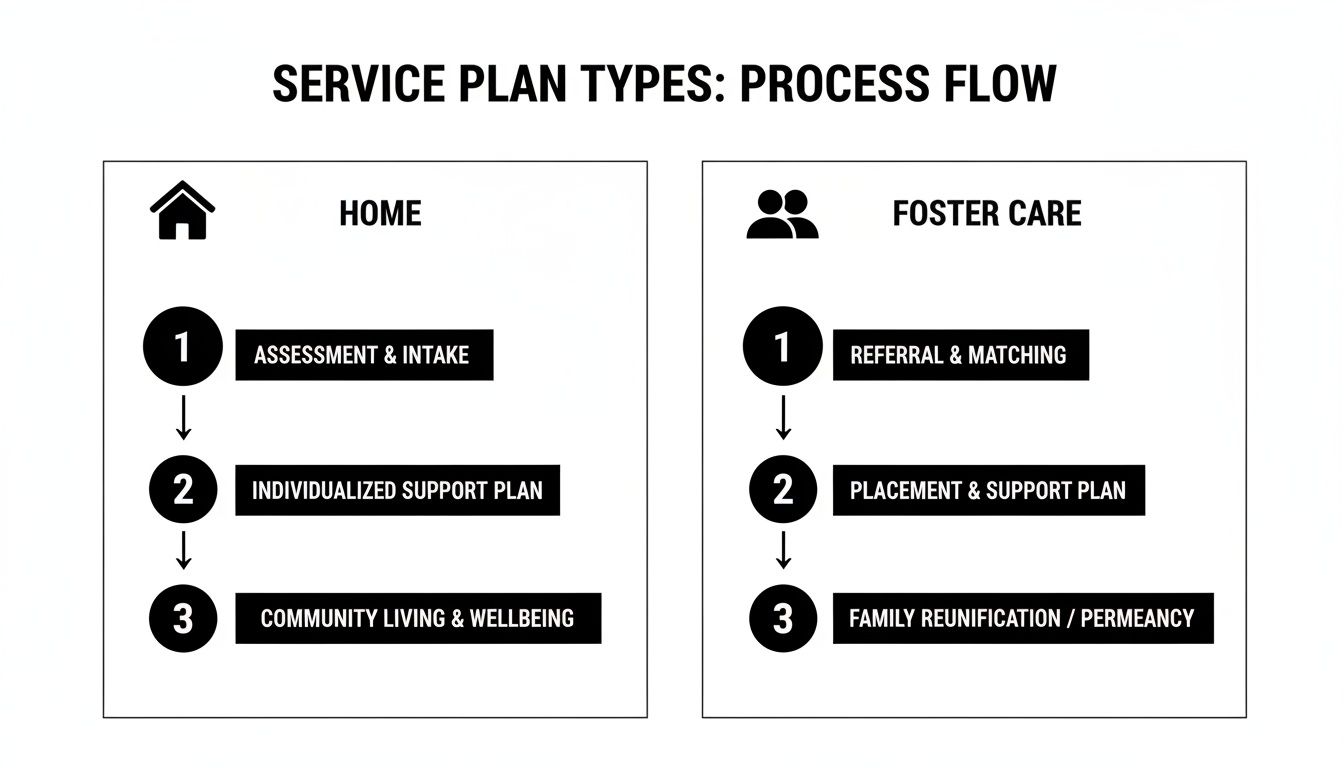
As you can see, regardless of where your child is living, the core process is the same. It starts with an assessment, moves into participating in services, and ends with you demonstrating real, positive change.
Common Services and Evaluations
Most service plans kick off with a combination of professional evaluations and ongoing services. These are meant to give CPS a clearer picture of your family's circumstances and, just as importantly, to give you new skills and resources to succeed.
Some of the most common requirements include:
- Psychological Evaluation: This is an appointment with a licensed psychologist. They’ll assess for any underlying mental health issues—like depression, anxiety, or past trauma—that might be impacting your ability to parent. It’s not about judging you; it’s about understanding what support could help.
- Substance Abuse Assessment: If drugs or alcohol were mentioned in the allegations, you can bet this will be on your list. An assessment will determine if a substance use disorder is present and recommend the right level of care, which could range from outpatient counseling to a more intensive inpatient program.
- Parenting Classes: This is one of the most frequent requirements for a reason. These classes teach practical skills like effective, non-physical discipline, understanding what’s normal for a child’s age, and how to build a nurturing, stable home.
The following table breaks down some typical service plan components to give you a clearer idea of what to expect.
| Service Category | What It Involves | Common Reason for Requirement |
|---|---|---|
| Psychological Services | An evaluation by a psychologist, followed by individual or family counseling sessions. | Allegations of family violence, mental instability, or to address trauma affecting parenting. |
| Substance Abuse Services | An initial assessment, random drug/alcohol testing (UAs), and participation in treatment like AA/NA or a formal rehab program. | Allegations of drug or alcohol abuse that puts a child at risk of harm or neglect. |
| Parenting Education | Attending a structured course that teaches positive parenting strategies, child development, and non-physical discipline. | General neglect allegations, concerns about discipline methods, or for young/inexperienced parents. |
| Homemaker/Safety Services | Learning skills for budgeting, home organization, and maintaining a clean, hazard-free living environment. May include unannounced home visits. | Allegations of physical neglect, an unsanitary or unsafe home, or lack of basic necessities like food. |
| Stable Employment/Housing | Providing proof of steady income and a safe, stable place to live. | Concerns about transiency, homelessness, or an inability to provide for the child's basic needs. |
Understanding these categories helps demystify the plan. Each one is a building block designed to address a specific concern and help you prove you can provide a safe home.
Showing a Safe and Stable Life
Beyond just attending classes or appointments, a huge part of your service plan is about demonstrating—in the real world—that you can provide a safe and stable life for your child. It's about taking what you learn and putting it into practice every single day.
A service plan isn't a checklist you just tick off. It’s about creating lasting change. The ultimate goal is to prove to the court and CPS that the original risks are gone and you can provide a safe, permanent home for your child.
Think about it this way. Let's say a mom, "Jessica," has a CPS case because of neglect allegations tied to poor housing and a past DWI. Her service plan isn't just a piece of paper; it's a roadmap with very specific, real-world tasks.
Her plan would likely require her to:
- Keep a Safe and Clean Home: Jessica would have to agree to let her caseworker make unannounced home visits. This is so the caseworker can see for themselves that the house is consistently clean, free of dangers, and stocked with food.
- Prove Sobriety: This usually means submitting to random drug and alcohol tests (often called UAs). A consistent string of clean tests is powerful, undeniable evidence that you're holding up your end of the bargain.
- Get Counseling and Support: She might be ordered to attend individual therapy to work through the stress that contributed to the neglect, and also to participate in support groups like AA or NA.
If another parent's substance use is a factor, your plan might require you to show how you'll protect your child. This could mean learning new strategies for dealing with an alcoholic spouse or co-parent to ensure your child is never put in a risky situation. As you complete these tasks, your progress is reviewed by a judge at regular court dates. You can learn more about what to expect in a Texas CPS status hearing right here on our site.
Protecting Your Parental Rights in the Process
When you're navigating a service plan in a CPS Texas case, knowledge is your best defense. It's all too easy to feel overwhelmed and powerless, but it's crucial to remember you have significant legal rights throughout this entire process. Standing up for these rights isn't about creating conflict—it’s about being an active, engaged parent who is committed to reuniting your family.
You have a right to understand exactly what CPS is asking of you, plain and simple. You also have a legal right to be part of the conversation when the plan is created and to push back on any part you feel is unfair, irrelevant, or just plain impossible. Most importantly, you have the right to have an attorney with you at every single meeting, hearing, and decision point.
Your Right to Understand and Participate
The Texas Family Code makes it clear that a service plan is not supposed to be a one-sided list of demands from a caseworker. It’s meant to be a collaborative effort. You have a legal right to give your input as it’s being created. This is your opportunity to make sure the plan is realistic for your situation and actually targets the specific issues that brought CPS into your life.
If a task seems random or disconnected from the original allegations, you are well within your rights to ask, "How will this service help me be a safer parent for my child?"
A major change is coming to Texas law. A bill set to take effect on September 1, 2025, gets rid of a section in the Family Code that allowed for terminating parental rights just for failing to follow a service plan. This new law acknowledges that these plans were often poorly written, had conflicting rules, or demanded services that were either unavailable or had nothing to do with the case. This makes it more important than ever to have a lawyer who can fight unfair terms from the very start.
Don't be afraid to speak up. If a mandatory class clashes with your work hours, ask if there’s another option. If getting to a required service is a real problem because of transportation, document that hardship and ask for a provider closer to home. Your active involvement is essential for creating a plan you can successfully complete.
Proactive Strategies to Safeguard Your Rights
Knowing your rights is one thing; protecting them requires action and organization. From the very first day, you need to become the head record-keeper for your own case. This detailed documentation will become your most powerful proof of compliance.
Here are some concrete steps you need to start taking immediately:
- Always get it in writing. Never go by what a caseworker tells you verbally. Insist on getting a physical or digital copy of your signed service plan CPS Texas document.
- Start a case binder. Buy a three-ring binder with dividers. This is where you will keep every single piece of paper related to your case: the service plan, completion certificates, attendance sheets, letters, emails, and any receipts for services.
- Document every single conversation. After any phone call or meeting with your caseworker, send a short, polite email summarizing what you talked about. This creates a paper trail and keeps everyone on the same page.
Challenging Unreasonable Requirements
So, what do you do if your plan includes something that is truly unfair or impossible to complete? Let's look at a real-world example. A single father, "Mark," was ordered to attend a specialized therapy group. The problem? It only met on Tuesday mornings in a city a two-hour drive away. This meant he would have to lose a full day's pay every week, putting the very job his service plan required him to keep in jeopardy.
Feeling trapped, Mark called an attorney. His lawyer didn't waste any time and immediately filed a motion with the court, arguing that the travel requirement was unreasonable and actually worked against the plan's goals. The attorney showed the court Mark's work schedule and even found a qualified therapist in his own city who had evening appointments.
The judge saw the logic and agreed. The service plan was officially changed, allowing Mark to get the therapy he needed locally without risking his job. This is a perfect illustration of how a lawyer does more than just give advice; they take legal action to make your service plan workable. Without that help, Mark could have easily been labeled "non-compliant" for failing to do something that was set up for failure from the start.
Common Mistakes and Why Legal Counsel Is Crucial

Successfully completing a service plan in a Texas CPS case is about so much more than just ticking boxes on a checklist. This is a high-stakes legal process where even the smallest stumble can have life-altering consequences for your family. The path to closing your case and bringing your children home is riddled with potential pitfalls, and knowing what they are is your best defense.
One of the biggest mistakes we see is parents treating the service plan like a simple to-do list rather than the legally binding mandate it is. It's easy to underestimate just how strictly CPS and the courts scrutinize every single action. A missed class, a single late document, or even a simple misunderstanding about a requirement can be twisted into a narrative of "non-compliance," putting your parental rights in immediate jeopardy.
Navigating the Minefield of Non-Compliance
Even when you have the best intentions, it's frighteningly easy to make a misstep that CPS can and will use against you. These aren't always big, dramatic failures. More often, they are simple human errors or logistical hurdles that quickly spiral into major legal problems.
Here are a few common mistakes that can put your entire case at risk:
- Poor Communication: This is a huge one. Failing to keep your caseworker in the loop about your progress—or, just as importantly, not telling them about a problem before it leads to a missed deadline.
- Incomplete Documentation: Not getting hard proof of every single class you attend, every test you take, and every appointment you complete. Without that paper trail, it often becomes your word against theirs.
- Misunderstanding Requirements: Not having a crystal-clear understanding of what a service actually involves or what "successful completion" truly looks like in the eyes of the court.
- Giving Up: Feeling so buried and overwhelmed by the sheer volume of demands that you simply stop trying. This is an understandable feeling, but it's the most dangerous reaction you can have.
The danger here is that CPS can frame any of these actions as a lack of commitment to your child's safety and well-being. This is precisely why having an experienced attorney in your corner isn't a luxury—it is an absolute necessity.
The Role of an Attorney as Your Shield and Advocate
An experienced family law attorney from a firm like The Law Office of Bryan Fagan becomes your shield and your guide through this intimidating system. Our job goes far beyond just showing up for you in court. We act as your strategic partner, working to make sure you sidestep the common mistakes that could lead to the termination of your parental rights under Texas Family Code Chapter 161.
An attorney's value is clear from the very beginning:
- Negotiating Fair Plan Terms: We get involved before you sign anything. We meticulously review the proposed service plan to ensure every single requirement is reasonable, directly relevant to your case, and actually achievable. We fight to get impossible or unfair demands thrown out.
- Managing Communications: We take over as the primary point of contact with CPS. This stops misunderstandings before they start and ensures every interaction is professional and documented. It prevents your words from being twisted or used out of context.
- Presenting Your Progress: We help you gather and organize all your documentation into a powerful narrative that demonstrates your progress and commitment. We then present this evidence effectively to the judge at every single hearing, making sure your hard work gets the recognition it deserves.
Your attorney is your advocate, your project manager, and your spokesperson all in one. We make sure your story gets told the right way and that your efforts are seen and valued by the court, protecting you from being defined by one minor slip-up.
For instance, the situation gets critically complex when a parent is also dealing with a criminal charge like a DWI or assault. Your actions in the criminal case can directly blow back on your CPS case, and vice-versa. An attorney with deep experience in both family and criminal law is essential to build a unified strategy that protects both your freedom and your family.
This kind of holistic, strategic approach is more important than ever as Texas works to reform its child welfare system. Starting around 2021, state lawmakers began overhauling the training for CPS investigators to focus more on procedural fairness and less on bureaucratic box-checking. Investigators are now tasked with connecting families to resources right away, which is a major shift from how things used to be. The results have been encouraging, showing historic lows in repeat cases and major drops in the number of kids in foster care. You can read more about this child welfare revolution in Texas and see how it's changing the landscape for families.
But even with these positive changes, the system remains incredibly difficult to face on your own. An attorney ensures you can take full advantage of these reforms while still being shielded from the dangers that remain.
If you are facing a service plan CPS Texas case, the stakes are simply too high to go it alone. The fear and confusion are real, but you are not powerless. Contact The Law Office of Bryan Fagan today for a free, confidential consultation. Let us stand with you, protect your rights, and help you build the strongest possible case for bringing your family back together.
Your Questions Answered About CPS Service Plans
When CPS hands you a service plan, it's natural for your mind to start racing with a thousand questions. The fear and confusion can be paralyzing, making it feel impossible to get a straight answer. We've been there with countless Texas families, and we want to cut through that noise. This section gives direct, clear answers to the most common questions we hear from parents just like you.
How Long Does a Service Plan Last in Texas?
A service plan in a Texas CPS case usually runs for about six to twelve months. In some situations, a judge can extend that timeline if they feel more time is needed.
The clock is almost always tied to the court's review schedule. The Texas Family Code gives parents a window of about one year to make real, lasting changes based on their service plan. After that, the state can begin the process of terminating parental rights.
The specific length of your plan will hinge on the allegations, how fast you can get through the required services, and how quickly you can prove the original safety concerns are gone. An experienced attorney can map out your specific timeline and build a strategy to hit every deadline, which is crucial for getting your case closed successfully.
What Happens if I Disagree With My Service Plan?
You absolutely have the legal right to challenge any part of your service plan that you feel is unfair, doesn't apply to your situation, or is simply impossible for you to complete.
Your first step should be to tell your caseworker, clearly and professionally, what your objections are. It is vital to do this in writing—a simple, polite email is perfect. This creates a documented record of your disagreement in your case file.
But, and this is critical, do not just refuse to do the services while you are disagreeing. CPS will almost certainly see this as non-compliance, which can do serious damage to your case. This is a point where you need to talk to a lawyer. An attorney can formally fight for you in court, negotiate for a fairer plan, and make sure your objections are seen as reasonable requests, not defiance. Trying to handle this kind of dispute alone is a huge risk.
Can I Get My CPS Case Closed Early?
Yes, it is possible to get a CPS case closed early. This typically happens when you have diligently finished every single task on your service plan ahead of schedule and can show both CPS and the judge that the risks that started the case are completely resolved.
To make this happen, you need to be your own best advocate. Keep meticulous records. Give your caseworker certificates of completion, attendance sheets, and any other proof for every service you complete.
More importantly, getting a case closed early almost always requires your attorney to file a formal motion with the court. Your lawyer can ask for a special hearing to present your outstanding progress and argue that the state no longer needs to be involved to ensure your child’s safety. An attorney knows exactly how to frame your compliance to give you the best shot at this outcome.
A major legislative change is on the horizon. A bill passed by the Texas Legislature is set to repeal the part of the Family Code that allows parental rights to be terminated just for failing to follow a service plan. This change, effective September 1, 2025, is a recognition that these plans were often poorly written or included unreasonable tasks. This makes it more important than ever to have a lawyer who can challenge unfair terms from the very beginning.
Does a Criminal Charge Automatically Mean I Lose My Kids?
No, a criminal charge doesn't automatically mean you will lose your children. However, it makes your CPS case significantly more complicated. Any criminal accusation—especially things like DWI, drug possession, or any type of assault—is a major red flag for CPS and will bring intense scrutiny.
The two legal matters, your criminal case and your CPS case, will proceed at the same time and can directly affect one another.
This is a scenario where it is absolutely essential to have a law firm with deep experience in both criminal defense and family law. An attorney who understands how these two systems interact can create a unified defense strategy. They will work to ensure the actions you take in your criminal case don't hurt your CPS case, and vice versa. A coordinated defense is your best hope for protecting both your freedom and your parental rights.
The path forward might seem overwhelming, but you do not have to walk it by yourself. Having a skilled and compassionate attorney in your corner can change everything. At The Law Office of Bryan Fagan, we are dedicated to defending your parental rights and walking with you through every part of the CPS process. If you're facing a service plan and need help, contact us today for a free, confidential consultation.