Skip to content
When CPS calls about a child in your family, the first feeling is usually fear. The second is urgency. You want to know where the child is, whether they are safe, and what you can do right now.
For many Texas families, the answer may involve cps kinship placement texas. That means asking CPS to place the child with a relative, or sometimes a close family friend, instead of in a traditional foster home. If there is also a criminal case, an old arrest, a pending charge, or a protective order in the background, the situation can feel even harder to untangle.
It is still possible to move forward. Texas law gives family placement real importance. The process is stressful, but it is not random. There are steps, standards, and ways to advocate for the child and for your family.
The Phone Call That Changes Everything
The call often comes at the worst possible moment. You are making dinner, leaving work, or trying to get through a normal day. Then a CPS caseworker says your grandchild, niece, or nephew has been removed from home, or may be removed very soon.
A grandmother may hear that her daughter was arrested after a domestic dispute and that CPS is looking for a safe placement tonight. An uncle may learn that his brother is in jail on drug charges and the children cannot stay where they are. An aunt may get told there is a protective order in place, and CPS needs to know whether she can care for the children.
None of that feels orderly when it is happening to your family.

The most common reaction is panic. People worry they will say the wrong thing. They worry a past mistake will keep them from helping. They worry CPS has already made up its mind.
Those fears are understandable, but they are not the end of the story.
What families usually want to know first
In those first hours, most relatives ask the same questions:
- Where is the child right now: Ask the caseworker whether the child is in emergency care, with another relative, or awaiting placement.
- Can I be considered: Tell CPS clearly that you want to be evaluated as a kinship placement.
- What do you need from me today: Ask what documents, identification, or household information the caseworker needs immediately.
- Will my past record stop me: If there is any criminal history or protective-order issue, ask how CPS plans to review it rather than guessing.
Tip: If you want the child placed with you, say so plainly and early. Do not assume CPS will automatically know you are willing.
A calmer first step
Start with three practical moves. Write down the caseworker’s name and phone number. Make a list of every adult who lives in your home. Gather basic records such as ID, proof of address, and any paperwork related to prior criminal matters or protective orders.
You do not need to solve the entire case that night. You need to show that you are available, cooperative, and serious about giving the child a safe place to land.
That first call feels like chaos. It does not have to stay that way.
Understanding Kinship Placement in Texas Law
Texas treats family placement as more than a preference in ordinary conversation. It is built into the legal process. Under Texas Family Code Chapter 262, CPS must actively search for and prioritize relatives before moving to traditional foster care.

That matters because children do better when they can stay connected to familiar people, routines, and culture. In plain terms, kinship placement tries to keep a child’s safety net intact even when the parents are in crisis.
Who counts as kinship
A kinship placement usually means a child is placed with:
- A relative: Such as a grandparent, aunt, uncle, adult sibling, or another family member connected by blood, marriage, or adoption.
- Fictive kin: A person who is not biologically related but has a meaningful, family-like relationship with the child, such as a longtime family friend.
Readers often get stuck here. They think “kinship” only means grandparents. It does not. Texas CPS may also consider other relatives and, in some situations, fictive kin.
Why the law leans toward family
Think of kinship placement like moving a child from one branch of the same tree rather than uprooting the tree altogether. The child may still be frightened, confused, or grieving. But they are more likely to know the caregiver, recognize the home, or stay tied to school, family traditions, and siblings.
Texas data reflects how strongly this approach shapes placement decisions. By fiscal year 2025 year-to-date, Texas CPS achieved a kinship placement rate of 42.8% for children with relatives or fictive kin, surpassing the national rate of 38%, with 7,139 children in such placements as of May 31, 2025, according to the DFPS FY2025 Relative and Other Designated Caregiver Report.
What Chapter 262 means in real life
When CPS removes a child, Chapter 262 affects what the agency should do next. Caseworkers should ask parents for names of relatives and other trusted adults. They should look for family-based options before treating foster care as the default.
That does not mean every relative will be approved. Safety still comes first. But it does mean family placement is supposed to get real consideration.
A more detailed breakdown of that legal framework appears in this guide on kinship care vs foster care.
To make the legal picture easier to absorb, this short video gives helpful background on the topic.
Where Chapters 263 and 161 come in
Families also hear other chapter numbers and get lost fast.
Here is the simple version:
| Chapter | Why it matters |
|---|---|
| Chapter 262 | Removal and emergency action. Kinship placement becomes important immediately in this phase. |
| Chapter 263 | Ongoing court reviews, permanency planning, and whether the child returns home or stays elsewhere long term. |
| Chapter 161 | Termination of parental rights in the most serious cases. |
If you are trying to understand cps kinship placement texas, keep those chapters in order. Chapter 262 starts the crisis response. Chapter 263 governs what happens while the case moves through court. Chapter 161 becomes important if the case shifts toward permanent separation from a parent.
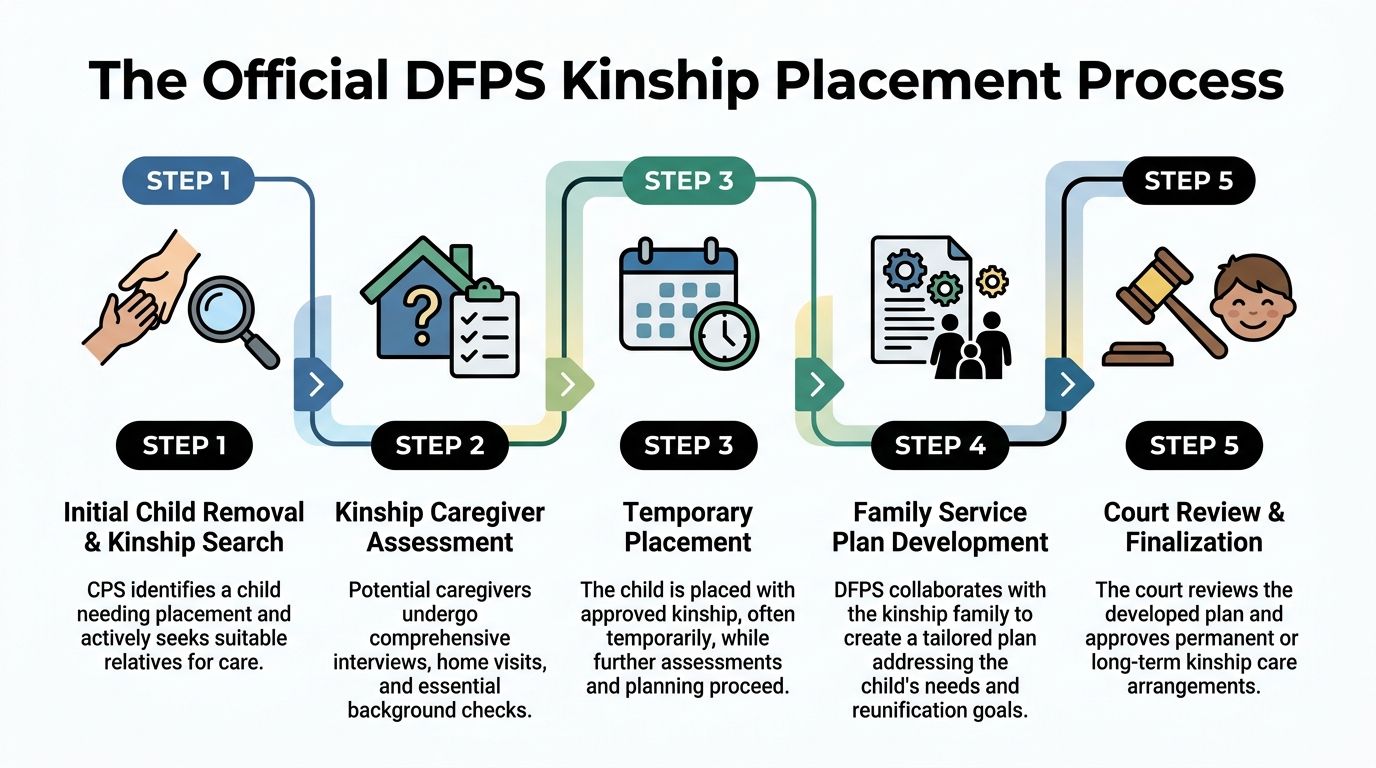
The Official DFPS Kinship Placement Process
Once you tell CPS you want to be considered, the process becomes practical very quickly. Names, addresses, forms, home visits, and background checks all start to matter.
Texas law requires CPS to prioritize relatives. The process begins with a Preliminary Kinship Caregiver Home Assessment, Form 6587, within 48 hours of a proposed placement, followed by a full Kinship Safety Evaluation, including criminal background checks, before a final decision is made, as described in this discussion of Texas kinship care procedures.
The first search for family
At the beginning, CPS usually asks the parents for names of relatives and close family connections. Caseworkers may also contact grandparents, aunts, uncles, adult siblings, or trusted family friends directly.
At this point, families sometimes lose momentum. A relative assumes someone else already gave CPS their name. Or they wait for a second call that never comes. If you are willing to take the child, tell the caseworker clearly and follow up.
The preliminary home assessment
The Preliminary Kinship Caregiver Home Assessment, often called Form 6587, is an early screening tool. It is not the final word on your home. It is the first look.
A caseworker may review questions like these:
- Who lives in the home: Every adult in the household matters.
- Is the home physically safe: Sleeping space, utilities, general condition, and immediate hazards are all relevant.
- Can the child stay here right away: CPS is trying to decide whether temporary placement is possible.
- Are there urgent safety concerns: Prior abuse history, violence, or active criminal concerns may trigger deeper review.
The full safety review
If the placement keeps moving forward, CPS conducts a more complete Kinship Safety Evaluation. This usually feels more formal and more detailed.
Expect scrutiny in several areas.
Home environment
CPS is not looking for a perfect house. They are looking for a safe one. The home should be stable, clean enough for a child, and free from obvious dangers.
Household adults
Every adult living in the home may be reviewed. Many families are surprised here. A caregiver may be personally suitable, but another adult in the home creates concerns CPS cannot ignore.
Background checks
Criminal background checks are standard. That includes checking adults in the household, not only the person volunteering to care for the child.
If there is a pending charge, an old conviction, probation history, or a protective order, the agency will want more information. That does not always mean automatic denial, but it does mean the issue should be addressed directly.
Practical advice: Do not let CPS discover a record before hearing it from you. Honest disclosure gives your explanation a chance to land before suspicion does.
The paperwork that often confuses families
A big part of cps kinship placement texas is paperwork. Forms can make families feel like they are failing some hidden test, but most of the forms exist to document consent, placement terms, and safety steps.
The process may involve forms such as:
- Form 6587: Preliminary Kinship Caregiver Home Assessment.
- Form 2279 Placement Summary: Used at placement and signed by all unsupervised adults in the home.
- Form 0696 Kinship TANF Program Letter: Helps explain possible support options.
- Form 0695 Kinship Caregiver Agreement: Outlines expectations for the caregiver.
You may also receive manuals or written guidance from DFPS. Read them. Families often miss important details because the paperwork feels repetitive and stressful.
What happens after placement starts
A child may be placed with you before every long-term decision is settled. That is common. Temporary placement does not mean the court case is over.
After placement, several things usually continue:
- Court hearings under Chapter 263 continue while the judge reviews safety, services, and permanency.
- CPS monitoring continues. The caseworker may visit, ask questions, and check how the child is adjusting.
- Parent visits may continue unless the court orders otherwise.
- Service planning develops around reunification, another permanency option, or in some cases a more lasting custody arrangement.
Why criminal and family issues can complicate timing
Kinship cases become more layered when there is another legal matter in the background. A parent may have pending assault charges. A caregiver may have an old DWI. A family member may be involved in a protective-order case.
Those issues can affect how quickly CPS feels comfortable moving. The caseworker may need court papers, police reports, dismissal records, or proof that an old case is resolved. If the criminal issue is current, the agency may wait for more facts before making a final recommendation.
That delay is frustrating, but families can often reduce it by being organized.
A simple preparation list helps:
| Item to gather | Why it helps |
|---|---|
| Photo ID and proof of address | Confirms who you are and where the child would live |
| List of all household members | Allows background reviews to start promptly |
| Court records for old criminal cases | Helps explain what happened and whether the matter is resolved |
| Protective order paperwork | Shows whether there are active restrictions affecting the home |
| School and medical information if already available | Helps the transition once the child arrives |
When relatives understand the process, they usually feel less powerless. The timeline may still move fast, but it stops feeling mysterious.
Qualifying as a Kinship Caregiver in Texas
Families often assume qualification turns on one question. “Do they like me or not?” In reality, CPS looks at a cluster of issues. Safety, stability, household history, and the child’s needs all matter.
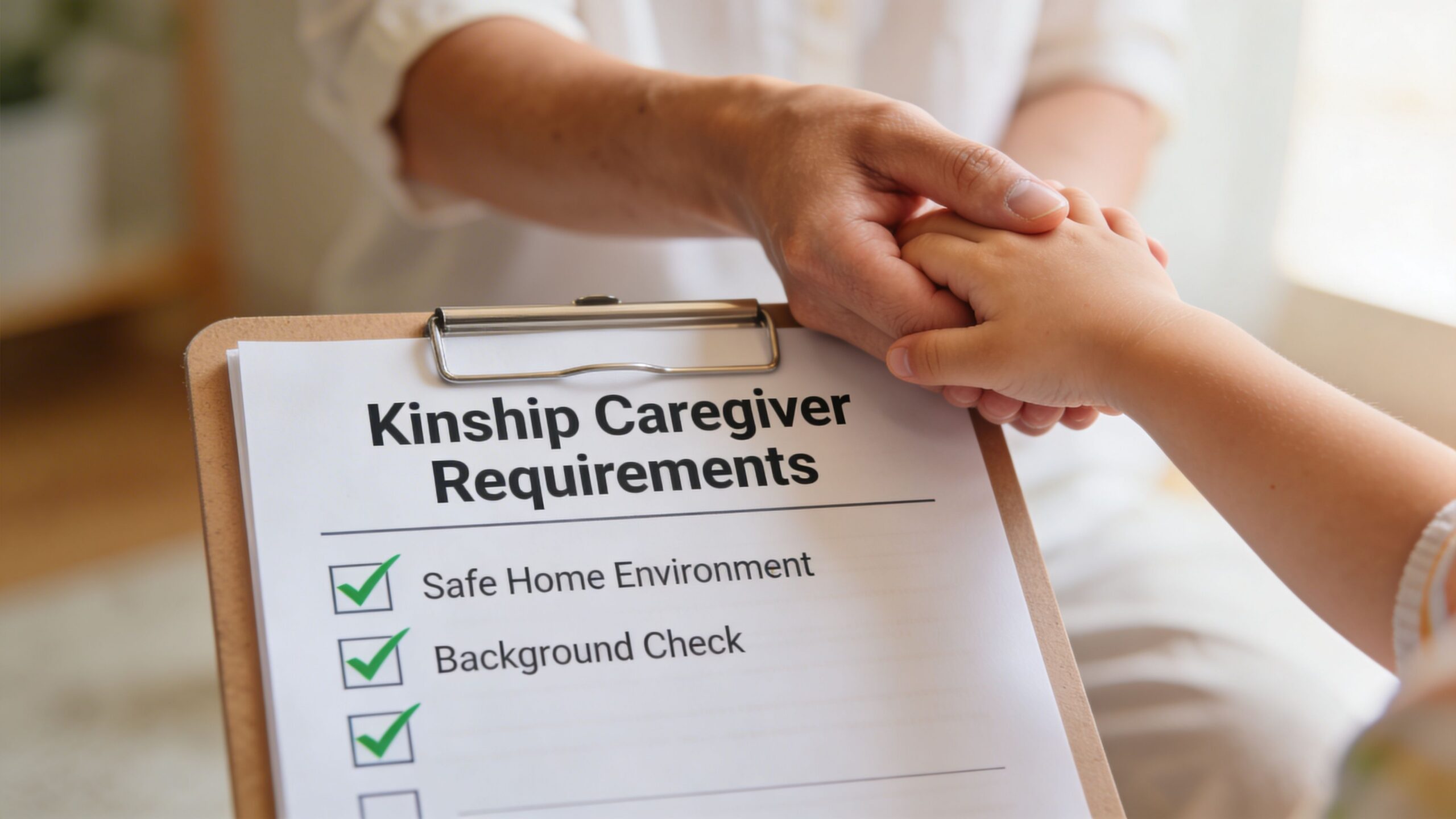
For formal kinship foster care licensing, caregivers must be at least 21, show financial stability, and pass criminal and abuse background checks for all adults in the home. DFPS policy also requires a home study, CPR and First Aid certification, and compliance with a non-physical discipline policy, according to the DFPS CPS handbook guidance.
What CPS usually wants to see
Even when a family is seeking placement before full licensing, these same themes often guide how the home is evaluated.
A safe place to live
The house or apartment does not need to be large or expensive. It needs to be safe, workable, and appropriate for the child.
Stable day-to-day life
CPS wants to know whether you can manage school routines, medical appointments, meals, transportation, and supervision.
A household without hidden problems
A strong caregiver can still face difficulty if another adult in the home has unresolved criminal issues, violence concerns, or an abuse history.
Criminal history and protective orders
Many good relatives panic at this point.
An old charge does not always end the conversation. But CPS will care about the details, including what the offense was, how long ago it happened, and whether it suggests current risk to a child. Violence-related allegations, child endangerment concerns, or active legal restrictions usually draw more scrutiny than minor, older matters.
Protective orders can also raise questions fast. If there is an active order involving someone in the home, CPS may worry about contact, safety, or instability. If the order protects you from someone dangerous, that may tell a very different story than an order based on allegations against you.
A practical way to think about eligibility
This table reflects how families can organize their thinking when legal issues overlap with CPS review:
| Issue | Why CPS cares | What helps |
|—|—|
| Old nonviolent offense | CPS will consider whether it affects present safety | Certified court records, proof of completion, honest explanation |
| Pending criminal case | Unresolved facts may create uncertainty | Prompt disclosure and updated court information |
| Active protective order | CPS must understand who is protected, restricted, and living where | Full order, service status, and clear household plan |
| Another adult with a record | Every adult in the home may be reviewed | Accurate household list and documentation |
Key takeaway: Silence is risky. Clear records and a direct explanation usually help more than trying to minimize the issue.
What relatives can do before the home visit
The strongest candidates often do ordinary things well.
- Clean and organize the home: Focus on safety, sleeping arrangements, medication storage, and obvious hazards.
- Gather legal paperwork: Old judgments, dismissal papers, probation discharge records, or protective-order documents can answer questions before they become obstacles.
- Plan your explanation: If CPS asks about your past, answer truthfully.
- Think about household members: If someone in the home may create problems, get legal advice before the assessment.
A more detailed discussion of practical steps appears in this guide on how to get kinship custody.
A Real-Life Kinship Placement Scenario in Houston
Maria lives in Houston and works full time. One evening she gets a call that her brother has been arrested, and CPS has removed his two children because there is no safe parent available that night.
Maria’s first answer is immediate. Yes, the children can stay with her.
Her second thought is fear. Ten years ago, she had a minor criminal charge from a bad period in her life. It was not a case involving children or violence, but she is sure CPS will reject her the moment they see it.
That fear is common. It also causes people to make mistakes.
Maria almost decides not to mention the old case unless someone asks. Instead, she takes the better path. She tells the caseworker she wants to be considered, explains that there is an old matter in her record, and says she can provide paperwork.
The caseworker schedules a home visit. Maria cleans the spare bedroom, makes sure medications are put away, and writes down the names of every adult who may be in the home. She also gathers the court documents showing the old case was resolved years ago.
At the first court hearing, the children’s placement is still being sorted out under Chapter 262. Maria learns quickly that temporary placement is only part of the story. Chapter 263 will guide the later hearings while the court watches the parents’ progress and decides whether reunification is possible.
Maria also has to manage family tension. The children’s mother objects to the placement at first because she is angry at Maria’s brother and does not want his side of the family involved. That objection matters emotionally, but the court still focuses on the children’s safety and best interest.
The old charge does not disappear. CPS reviews it. But Maria’s honesty helps. The paperwork shows it was resolved, unrelated to child safety, and not part of a current pattern. Her home is stable. Her employer confirms her schedule is flexible. The children already know and trust her.
The placement is approved.
That does not mean the case becomes easy. Maria still works with CPS, helps the children settle into school, and prepares for more hearings. But she moves from panicked relative to recognized caregiver because she acted quickly, told the truth, and treated the process seriously.
That is the part many families need to hear. A past problem is not always the same thing as a present danger.
Your Rights and Responsibilities as a Caregiver
When a child is placed with you, life changes overnight. You may be buying clothes, dealing with school enrollment, arranging counseling, and answering hard questions from a frightened child before you have even slept.
Kinship placement comes with both authority and limits.
What you may be able to do
Your day-to-day role often includes practical decision-making. Depending on the court orders and placement terms, you may be able to help with school matters, routine medical care, transportation, and the child’s daily supervision.
You also have the right to ask questions. Ask the caseworker what authority you have for medical treatment, school records, extracurricular activities, and travel. Do not guess. A misunderstanding can create avoidable trouble later.
What CPS still expects from you
Being a relative does not remove CPS from the picture while the case is open. The agency will still expect cooperation.
That usually includes:
- Working with the caseworker: Keep appointments, return calls, and provide updates when asked.
- Supporting the child’s needs: School attendance, counseling, medical care, and routines matter.
- Following court orders about contact: Parent visits and sibling contact may be required unless restricted by the court.
- Respecting the service plan: Reunification may still be the primary goal in many cases under Chapter 263.
Practical reminder: Your job is not to win an argument with the parents. Your job is to provide safety and stability for the child.
The financial reality many relatives do not expect
Kinship caregivers often assume the state support will look similar to foster care support. That is not always true.
As of 2024, verified kinship foster parents in Texas receive about $12.67 per day per child, which is less than half the $27.07 daily rate for non-kinship foster parents, according to Every Texan’s discussion of kinship care in Texas. That gap can create real strain for relatives who step in quickly.
Families may also hear about programs such as TANF or Permanency Care Assistance. Eligibility and timing depend on the case posture, the type of placement, and whether the home becomes formally verified or licensed.
A simple rights and duties comparison
| You may have | You are also expected to handle |
|---|---|
| Day-to-day care authority | Keeping the child safe and supervised |
| A voice in the case | Cooperating with CPS and the court process |
| Possible access to support programs | Managing the child’s practical needs even when money is tight |
| Input on long-term planning | Helping maintain lawful family contact when ordered |
Grandparents often ask whether placement can eventually turn into a more stable custody arrangement. This overview on whether grandparents can get custody from CPS may help clarify that path.
One more hard truth deserves to be said plainly. Love may be the reason a relative steps in, but love does not erase fatigue. If you become a kinship caregiver, ask early about school support, medical consent, counseling resources, and financial programs. Families do better when they ask for help before they are overwhelmed.
Challenging a Denied or Contested Placement
A denial from CPS can feel final. It often is not.
Sometimes the issue is fixable. The agency may need missing records, a clearer explanation of an old criminal matter, or a different safety plan for the home. In other cases, a parent may contest the placement even though the relative is appropriate.
When a denial deserves a second look
A denied placement may still be worth challenging if:
- The concern is based on incomplete information: Missing court papers or misunderstood case details can distort the review.
- The problem relates to an old matter rather than a current safety risk: Context matters.
- The household issue can be corrected: Sometimes a living arrangement, sleeping setup, or contact problem can be addressed.
- A parent’s objection is emotional rather than safety-based: The court focuses on the child’s best interest, not family politics.
What to do next
Start by asking for the reason in writing if possible. Specific reasons matter more than broad statements such as “not approved.”
Then gather documents that answer the exact concern. That may include criminal case dispositions, proof that a charge was dismissed, records showing probation was completed, or paperwork explaining a protective order and who it restricts.
If the CPS case is active in court, relatives may also need to present the issue through motions, hearings, or conservatorship requests rather than through informal conversations alone. In some situations, filing for custody relief in family court may matter just as much as the agency review.
The Law Office of Bryan Fagan PLLC handles criminal and CPS-overlap matters in Texas, including situations where arrests, protective orders, or criminal records affect a relative’s effort to secure placement.
Why procedure matters
Families sometimes focus only on persuading the caseworker. That is not always enough. Courts, filings, and deadlines shape these cases.
If you need to confirm that legal papers were properly delivered in a contested matter, a professional process server can be part of that logistics chain. That kind of step is not dramatic, but it can matter when a hearing is approaching and notice issues are being disputed.
Important: A “no” from CPS should be evaluated, not automatically accepted. The question is whether the denial reflects a true safety risk or a problem that can be clarified, corrected, or challenged.
When parents object, the same principle applies. Their views matter, but they do not override the court’s duty to protect the child. If you are a safe relative, your position can still carry significant weight.
You Don't Have to Handle This Alone
A kinship case can begin with one terrifying phone call, then quickly expand into home studies, court hearings, service plans, and questions about criminal records or protective orders. That is a lot for any family.
But there is still room for clarity and progress. If you are trying to protect a child you love, your willingness to step in matters. So does getting accurate legal guidance early, especially when CPS and another legal system are colliding.
If your family is facing a Texas CPS case and kinship placement is on the table, contact Law Office of Bryan Fagan PLLC for a free consultation. We can help you understand your options, prepare for the process, and address criminal or protective-order issues that may affect placement.