Skip to content
It’s a moment no parent is prepared for: a knock on the door, and a stranger with a clipboard introduces themselves as an investigator from Child Protective Services (CPS). The rush of fear, confusion, and defensiveness is completely normal. What you do in these first few minutes can set the tone for the entire investigation, and having an experienced CPS lawyer in Texas on your side from this very first interaction can be a game-changer. This guide is for Texas parents facing that moment, offering the practical, reassuring guidance you need to protect your family and navigate this challenging time with hope.
The Unsettling Knock: What to Do When CPS Arrives

When a CPS caseworker shows up unannounced, it feels like a deep, personal intrusion. Your instinct might be to either slam the door or over-explain every detail of your life to prove you’re a good parent. The best path, however, is a calm, professional middle ground. Your goal is simple: be polite, cooperate within reason, and protect your family's legal rights. We’ve seen too many cases where a parent’s understandable panic turns a simple misunderstanding into a major legal battle. Remember, the caseworker is a government official, and everything you say and do is being documented.
First Steps During an Unexpected Visit
When that caseworker introduces themself, your first job is to gather information. You are absolutely entitled to know why they are there before you answer a single question or let them cross your threshold. This isn't being difficult—it's being an informed parent. You have every right to ask for their identification. Write down their name, title, and office contact information. You should also politely ask what the allegations are about. They may not give you every detail, but they should provide a general idea of the concerns.
Here’s what to do in those first critical moments:
- Stay Calm and Be Professional: Take a deep breath. Your demeanor says a lot. A calm, respectful attitude shows you’re taking this seriously without being defensive or aggressive.
- Don’t Let Them In (Just Yet): You are not legally obligated to let a caseworker into your home without a court order. Politely step outside to speak with them, closing the door behind you.
- Identify Yourself: You can confirm your name and that your children live with you, but you don't need to volunteer any more personal information at this point.
- Ask Questions: Find out what the specific allegations are and who the report concerns. Write down everything they tell you.
Key Takeaway: The Fourth Amendment protects your home from unreasonable searches. Unless a CPS caseworker has a court order or you give them voluntary consent, you can politely decline to let them enter.
A Real-Life Scenario: "Inadequate Supervision"
Imagine it’s a Tuesday afternoon, and you get that knock on the door. A caseworker says they received a report of "inadequate supervision" because your seven-year-old was playing in the front yard alone. Your heart sinks—you were just inside for a few minutes making lunch.
Instead of getting angry, you step outside. You politely ask for the caseworker's ID and jot down her name. You calmly explain that you were within earshot the entire time but that you understand their concern. Then you say, "I am happy to cooperate, but I’m not comfortable allowing you inside or answering detailed questions until I can speak with an attorney."
This measured response accomplishes several things. You’ve shown you are a cooperative parent. You've also avoided an invasive home inspection based on a vague report and, most importantly, you’ve bought yourself time to get legal advice. This initial exchange sets a professional tone and stops the situation from spiraling out of control while you find a CPS lawyer in Texas. To better prepare, you can learn more about what to expect and how to handle a CPS home visit in Texas.
Knowing Your Rights When DFPS Is Investigating

When you're up against the Texas Department of Family and Protective Services (DFPS), it’s easy to feel overwhelmed and powerless. The fear of having your family turned upside down can be paralyzing. But here’s something you must hold onto: you are a citizen with constitutional rights, and those rights don't vanish the moment a CPS case number is assigned to your family. Understanding and calmly asserting your rights is your first line of defense. The moment you learn about an investigation, you have the right to an attorney. Getting a lawyer isn't an admission of guilt—it’s a proactive step to protect your family. A CPS lawyer in Texas can act as your shield and your voice, making sure your words aren’t twisted and your rights aren't overlooked.
Can CPS Enter My Home or Talk to My Child Without My Permission?
This is one of the biggest questions we hear from panicked parents. The simple answer is that you have a Fourth Amendment right protecting you from unreasonable searches, and that absolutely includes your home. In nearly all situations, a caseworker cannot legally walk through your front door without either your clear, voluntary permission or a court order signed by a judge.
You can, and often should, politely refuse to let them in. You can simply say, "I'm not comfortable letting you in right now, but I'm happy to talk with you out here." This isn't being difficult; it's you exercising a fundamental right. The caseworker might imply that refusing entry makes you look guilty, but standing your ground is crucial.
Of course, there are a couple of major exceptions:
- Court Order: If they hand you a valid, signed court order that specifically authorizes them to enter your home, you must comply.
- Exigent Circumstances: This is a legal term for a true, life-or-death emergency. It applies when there is a credible, immediate belief that a child is in imminent danger of serious injury or death. A vague, anonymous tip from a disgruntled neighbor usually doesn't meet this high standard.
Likewise, caseworkers generally need your permission to interview your child. The law, however, does give them the ability to interview a child at their school or daycare without your consent if they believe it's necessary to ensure the child’s safety.
Initial CPS Contact: Your Rights vs. Caseworker Requests
Here is a quick-reference guide to help you understand your rights when you first interact with a CPS caseworker.
| Caseworker Request | Your Rights & Recommended Action |
|---|---|
| "Can I come inside to look around?" | You have the right to refuse entry without a court order. Politely say no and offer to speak outside. |
| "Can I speak with your child alone?" | You can refuse if the interview is at your home. However, they may interview your child at school without your consent. |
| "I need you to sign this Safety Plan." | Do not sign anything. State that you will not sign any documents until your attorney has reviewed them. |
| "Can you take a drug test for me right now?" | You can refuse. Agreeing to a test without a court order can have serious consequences. Consult an attorney immediately. |
| "Who else lives here? Where do they work?" | You have the right to remain silent. You are not required to provide personal information about yourself or others. |
| "If you don't cooperate, I'll have to take your kids." | This is often a pressure tactic. Remain calm. Reiterate that you will cooperate with the help of your legal counsel. |
Remember, your goal is to be firm and respectful, not confrontational. Asserting your rights is the smartest way to protect your family.
The Dangers of a CPS "Safety Plan"
During an investigation, the caseworker might pull out a document called a "Parental Child Safety Plan" or something similar. They often present it as a quick, informal way to resolve their concerns and close the case. You should never sign a Safety Plan without having an experienced CPS attorney review it first.
These documents look harmless, but they are legally potent. By signing, you may be agreeing to move out of your own home, place your child with a relative, or submit to a long list of services and evaluations.
Signing a Safety Plan can be interpreted as an admission that your child is in danger, a point CPS will absolutely use against you later in court. It can devastate your parental rights before you even have a chance to appear before a judge.
Think about this scenario: CPS is investigating a report about arguments between you and your spouse. To "cool things down," the caseworker pressures you to sign a Safety Plan where one of you agrees to leave the home "temporarily." Once that document is signed, it becomes a powerful tool they can use to keep you away from your home and children for weeks or months, making it incredibly difficult to fight the allegations.
A knowledgeable lawyer can negotiate the terms of any plan to protect you or advise you to refuse to sign it altogether. Understanding your rights isn't about being uncooperative—it's about ensuring the investigation is fair. You have the right to remain silent and the right to an attorney. Using those rights is the best thing you can do for your family's future.
It’s a common—and dangerous—misconception that you only need a lawyer if CPS actually files a lawsuit to remove your children. The single most effective time to hire an experienced CPS lawyer in Texas is right at the beginning, often within hours of that first intimidating phone call or knock on the door.
Trying to navigate the initial stages on your own is a huge gamble. You have to remember, caseworkers are trained investigators. It's their job to look for problems. A simple miscommunication, a statement born of nervousness, or an offhand comment can easily be misinterpreted and become a formal allegation in their report. Getting legal guidance from the start can head off these misunderstandings and, in many cases, prevent a full-blown lawsuit before it ever gets filed.
The Problem of Waiting
Delaying legal help puts you at a massive disadvantage. By the time CPS files a lawsuit, they’ve already spent weeks, sometimes months, building their case against you. They've compiled notes, reports, and interview summaries that all paint a very specific—and usually one-sided—picture. If you wait until you're served with court papers, you're starting on the defense, trying to undo damage that's already been cemented in their file.
When a lawyer steps in from day one, the entire dynamic shifts. They immediately establish a professional line of communication with the caseworker, sending a clear message that your rights will be protected at every turn. This simple act often encourages a more respectful and by-the-book investigation from the agency.
Having a lawyer from day one doesn't make you look guilty—it makes you look serious. It tells CPS that you are a responsible parent who is proactively engaging with the process to protect your family.
A lawyer who lives and breathes DFPS procedures and the Texas Family Code can start crafting your defense the moment they're hired. They'll advise you on how to handle every request, from home inspections to interviews, making sure you don’t accidentally sign away your rights or agree to something that could be used against you later.
A Scenario Where Early Help Makes All the Difference
Let's look at a situation we see all too often: a family is facing neglect allegations. The report claims the children don't have their own beds and the refrigerator is often bare. On paper, it looks bad. But the reality is the father just got laid off, and the family is scraping by. It’s a case of poverty, not neglect.
Without an attorney, the parents might panic. They might sign a "Safety Plan" that sends the kids to live with a relative while they're forced to complete a long list of often irrelevant services. That separation is traumatic for everyone and only reinforces the agency’s mistaken belief that the parents are at fault.
Now, imagine that same family hires a CPS lawyer in Texas immediately. The attorney communicates to CPS that the root issue is financial hardship, not a lack of care. Instead of pushing for removal, the lawyer helps connect the family with community resources—food banks, job assistance programs, and local charities that provide furniture. The lawyer shows CPS that the parents are taking action. More often than not, the case is closed without the trauma of removal. That’s the power of early intervention.
The Shortage of Qualified Attorneys Puts Families at Risk
What makes this even more urgent is a critical problem facing Texas: there's a severe shortage of attorneys qualified to handle these complex cases. A startling report showed that in a single year, DFPS investigated over 140,000 families. At the same time, one in four Texas counties has six or fewer attorneys available to take on all CPS appointments. This creates a huge bottleneck, leaving parents who wait scrambling to find competent legal help, especially since the financial burden for court-appointed representation falls on individual counties.
This scarcity means that if you wait until you have a court date, you may not be able to find a skilled private attorney. You might be left with an overworked court-appointed lawyer who has very little time to get up to speed on your case. The best family defense attorneys are retained quickly. By acting fast, you give yourself the best possible chance to secure a dedicated advocate who can give your family the attention you deserve. For more guidance on this, you can check out our guide on how to find a CPS lawyer near you.
Don't wait for the storm to make landfall. The moment you are contacted by CPS is the moment you should be contacting an attorney. That one decision can be the difference between a quickly resolved misunderstanding and a long, painful, and expensive legal battle for your children.
Navigating the Texas CPS Court System
If CPS files a lawsuit against you, the world can feel like it’s moving in fast-forward. This is no longer just an investigation; it's a formal court case where a judge will decide the future of your family. The fear and confusion are completely normal, but this is the moment where knowledge and a strong legal strategy become your most powerful tools.
The second a suit is filed, a strict legal clock starts ticking. This entire process is tightly controlled by the Texas Family Code, especially Chapter 262, which dictates the procedures for emergency removals and the first hearings. Successfully getting through the Texas CPS court system means hitting every single deadline, something an experienced lawyer manages with solid legal docketing practices.
From this point on, having an experienced CPS lawyer in Texas isn't just a good idea—it is absolutely critical to protecting your parental rights.
The Critical First Court Dates
Often, the very first hearing is an "ex parte" hearing. This means it happens without you even being there. A judge hears only from CPS and makes a snap decision on whether there's an immediate danger that justifies removing your child. If they decide to do so, you'll be served with legal papers, and the countdown begins for one of the most important dates in your entire case: the 14-Day Adversary Hearing.
This hearing is your first real chance to stand before the judge and tell your side of the story. The Texas Family Code requires it to happen within 14 days of your child's removal. At this hearing, the judge has two choices:
- Send your child back home with you.
- Keep your child in the state's temporary custody while the case moves forward.
A good lawyer will start preparing for this hearing the moment they're hired. They'll be gathering evidence, lining up witnesses, and building a case to poke holes in the reasons CPS gave for taking your child in the first place.
A common situation we encounter is a removal based on a single, unconfirmed report. For instance, a child might say something to a school counselor that gets taken out of context, triggering an emergency removal. At the Adversary Hearing, we can bring in evidence—like testimony from other relatives or medical records—to give the judge the full picture and show that the removal was a massive overreaction.
Understanding Who Is in the Courtroom
Walking into a CPS courtroom for the first time can be incredibly intimidating. There are a lot of attorneys, and it’s important to know who is who.
- The DFPS Attorney: This lawyer works for the state agency (CPS). Their only client is the department, and their job is to argue for the department’s position, which is almost always to keep your child in state custody and force you to complete a service plan.
- The Ad Litem Attorney: The court appoints this lawyer to represent the "best interests" of your child. They don't work for you or for CPS. They will talk to your child, the caseworkers, and you before making their own independent recommendation to the judge.
- Your Defense Attorney: This is your CPS lawyer. They are the only person in that entire room whose job is to fight for you and protect your parental rights. They are your strategist, your advocate, and your shield against the state's powerful legal machine.
The infographic below shows the key moments when getting legal help becomes essential.
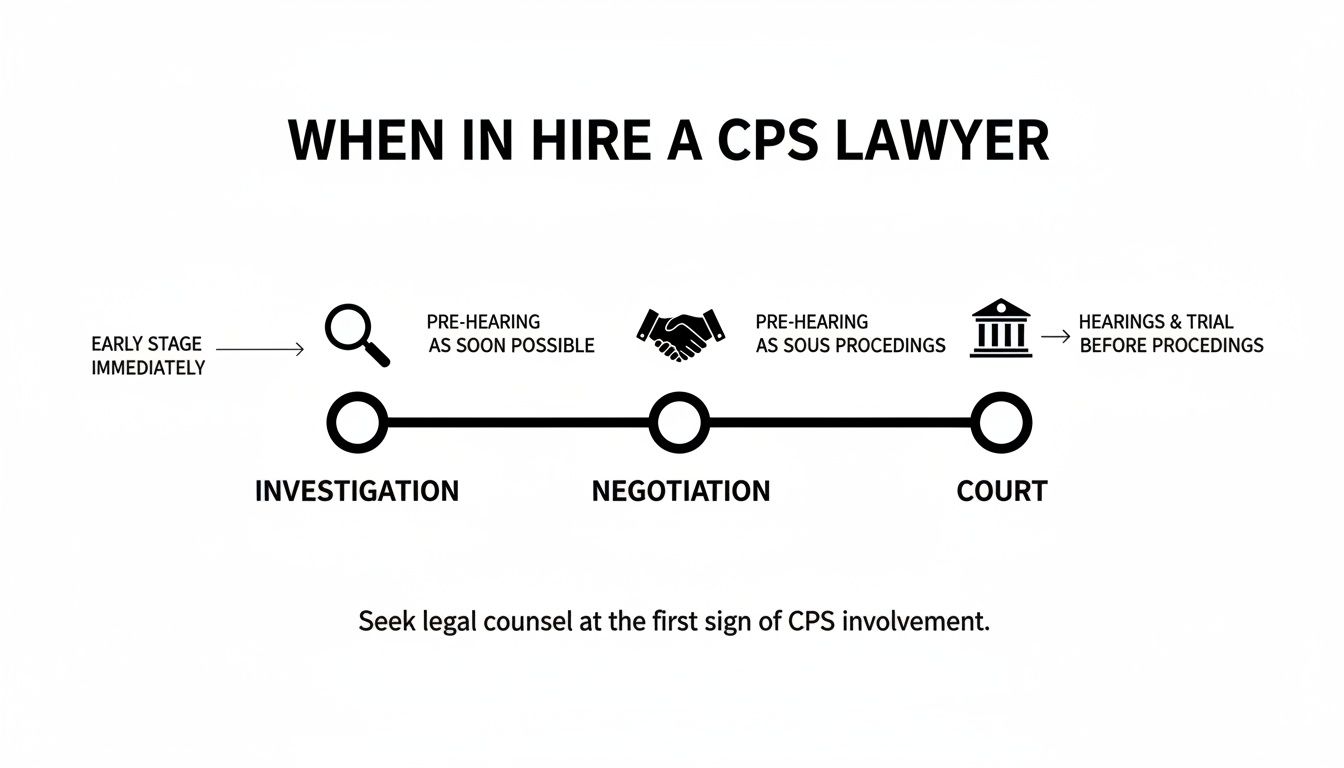
While legal advice is helpful during the initial investigation, this timeline makes it clear that it becomes absolutely non-negotiable once your case hits the courthouse.
As the case moves along, it falls under the rules of Texas Family Code Chapter 263. This chapter sets a strict, fast-paced timeline for resolving the case—usually within one year. It also lays out the requirements for status hearings and permanency hearings, where the judge will check on your progress with your service plan. If reunification doesn’t happen, CPS's ultimate goal can be the termination of your parental rights under Chapter 161.
This is precisely why you can't afford to go through the court system by yourself. Every hearing you attend, every document you sign, and every deadline you miss can have permanent, devastating consequences for your family. A proactive legal strategy is your best and only hope for bringing your child back home where they belong.
Building Your Defense and Working Toward Reunification

When you're fighting for your children, the best defense is a proactive one. It's not enough to just react to what CPS throws at you. The real goal is to build a powerful case that showcases what you already know: you're a safe, capable, and loving parent. This means rolling up your sleeves and working closely with your CPS lawyer to strategically gather your own evidence and tackle the requirements CPS will inevitably put in front of you. Every single thing you do from this point forward should be a step toward the ultimate goal—reunification. This part of the process is your chance to show your strengths and your unwavering commitment to putting your family back together.
Gathering Your Own Evidence
Let's be clear: CPS is actively building a case against you. You have every right, and frankly, every reason, to build a case of your own. The evidence you gather is the single most important counterbalance to the often one-sided, negative story a caseworker might be creating. Your attorney will guide you, but you are the number one expert on your own family.
Start collecting anything and everything that paints an accurate picture of your life as a parent. This can include:
- Photos and Videos: Take pictures and videos of your home. Show that it’s a clean, safe, and normal place for a child to live. Dig up photos from family vacations, birthday parties, and even just quiet weeknights that show a happy, loving family.
- Character Witnesses: Make a list of credible people who can vouch for your parenting. Think about teachers, doctors, neighbors, family friends, or church members who have actually seen you with your children and can speak to your character.
- Communications: Don't delete anything. Save texts, emails, and social media messages that are relevant to your case. These communications can provide crucial context or even disprove false claims that a caseworker might be running with.
Your real life is your best evidence. The day-to-day moments that show you caring for your child—making them breakfast, helping with homework, tucking them in at night—are the most powerful counter-narrative to the sterile allegations made by CPS.
Understanding and Navigating the Service Plan
If your case goes to court, you can bet that CPS will create something called a "Family Service Plan." This is a court-ordered to-do list of tasks and services you must complete before a judge will even consider returning your children. These plans are required under Texas Family Code Chapter 263 and essentially become the roadmap for the rest of your case.
Looking at a service plan can feel overwhelming and, honestly, insulting. But it's critical to see it for what it is: a checklist you have to complete to get your kids back. Typical items include:
- Parenting classes
- Individual or family counseling
- Drug and alcohol assessments and testing
- Anger management courses
- Maintaining stable housing and employment
Your first reaction might be to fight back against services that seem pointless or unrelated to the allegations. While those feelings are completely valid, fighting the plan is almost never the fastest way home. Compliance is.
This is where your lawyer plays a vital role. Their job is twofold: first, to help you stay on track and diligently complete every single item on that list, and second, to challenge any requirements that are truly unreasonable or have nothing to do with your case. For example, if the only allegation against you was a messy house, it makes zero sense for CPS to demand you complete a six-month intensive substance abuse program. An experienced CPS lawyer in Texas can file a motion asking the court to remove that requirement, freeing you up to focus on what actually matters.
With a smart, dedicated approach, you can turn this frustrating process into a clear demonstration of your commitment. You can prove you are a fit parent and work toward that day when your family is finally whole again. For many parents, just understanding the process is a huge first step, which is why our firm offers detailed information on how to get your child back from CPS.
Frequently Asked Questions from Texas Parents
When you’re suddenly thrown into a Child Protective Services (CPS) investigation, your mind races with urgent, terrifying questions. The fear and uncertainty can feel completely paralyzing. As experienced attorneys who have guided countless families through this, we've heard it all. Here are clear, direct answers to the most pressing concerns we hear from parents across Texas.
Can I Refuse to Let a CPS Caseworker Into My Home?
Yes. In fact, you often should. Your Fourth Amendment rights protect you from unreasonable searches, and your home is given the highest level of protection under the law.
A caseworker cannot legally enter your home without a court order or your clear, voluntary consent. The only exception is a true, life-threatening emergency, legally known as "exigent circumstances."
You can handle this situation calmly and politely. Step outside, close the door behind you, and state firmly, "I am not giving you consent to enter my home right now. While I want to cooperate, I need to speak with an attorney first." This is not an admission of guilt—it's a smart, legal way to protect your family.
Will Hiring a CPS Lawyer Make Me Look Guilty?
Not at all. While this is a common fear, the reality is just the opposite. Hiring a lawyer signals to CPS that you are taking the investigation seriously and are prepared to engage with them in a professional and informed manner. It shows them you know your rights and intend to protect them.
Your attorney is your professional advocate, making sure all communication is handled correctly and that your words aren't twisted. When navigating the complexities of a CPS case, parents often ask about the specific legal expertise required; typically, seeking counsel from specialized family law firms is the most effective approach to ensure you have the right kind of advocate on your side.
How Much Does a Private CPS Lawyer in Texas Cost?
The cost of a private CPS lawyer in Texas can vary a great deal, mostly depending on how complex your case is. Most attorneys who handle these cases work on a retainer basis. This is an up-front payment, often ranging from a few thousand to several thousand dollars, that the lawyer bills their hourly work against.
While the cost is a major consideration for any family, you have to weigh it against the devastating, lifelong cost of not having an expert on your side—which could include the termination of your parental rights. A skilled attorney can often get a case resolved more quickly and with a better outcome, saving you incredible heartache and expense in the long run.
A Note on CPS Investigations: It is a sobering fact that many families face these intrusive investigations without ever having abused or neglected a child. Statewide, fewer than 1 in 4 child abuse and neglect investigations result in a finding of abuse. With more than 136,000 cases investigated in a single recent fiscal year, it's clear that thousands of Texas families, often struggling with issues tied to poverty, are put through this process unnecessarily. You can find more details about Texas CPS investigation patterns and understand why legal help is so vital.
What Happens If CPS Finds 'Reason to Believe'?
A "Reason to Believe" finding is a serious turning point. It means the CPS investigator has decided it is more likely than not that abuse or neglect occurred. This finding can trigger severe consequences, including placing your name on the Central Registry and giving CPS the justification to file a lawsuit to take custody of your children.
At this stage, having a lawyer is no longer just a good idea—it is absolutely essential to fight the finding and build a powerful defense for you in court.
FAQ
| Question | Answer |
|---|---|
| Can I refuse to let a CPS caseworker into my home? | Yes, you have a Fourth Amendment right against unreasonable searches. A caseworker needs a court order or your voluntary consent to enter your home unless there's an immediate, life-threatening emergency (exigent circumstances). Politely state that you are not providing consent at this time and would like to speak with an attorney. |
| Will hiring a CPS lawyer make me look guilty? | Absolutely not. Hiring a lawyer is a sign that you are taking the situation seriously and protecting your family's rights. It shows CPS that you are proactive and prepared to engage with the process responsibly. An attorney acts as your professional advocate, ensuring communication is clear and your rights are upheld, which often streamlines the process. |
| How much does a private CPS lawyer in Texas cost? | Costs vary significantly. Private family law attorneys who handle CPS cases typically work on a retainer basis, which could be several thousand dollars. This is different from court-appointed attorneys whose fees are paid by the county. While the cost is a major consideration, the long-term cost of not having expert representation—including the potential loss of your children—is far greater. The Law Office of Bryan Fagan offers free consultations to discuss your case and provide clarity on the legal process and potential costs. |
| What happens if CPS finds the allegations to be 'Reason to Believe'? | A 'Reason to Believe' finding means the caseworker concluded that abuse or neglect more likely than not occurred. This can have serious consequences. Your name may be placed on the central registry, and CPS can keep your case open for services or file a lawsuit to seek custody of your children. This is a critical stage where a lawyer is essential to challenge the finding and defend you in court if necessary. |
Having these answers is a start, but every case is unique. The best step you can take is to get professional legal advice tailored to your specific situation. The journey through a CPS case is one of the most difficult a parent can endure, but you do not have to walk it alone. The Law Office of Bryan Fagan, PLLC is here to provide the authoritative guidance and compassionate support your family deserves. If CPS has contacted you, don't wait. Contact us now for a free, confidential consultation to understand your rights and protect your family. Call us today at (281) 810-9760 or visit our website at https://texascpslawyer.net.