Skip to content
When a Texas family is drawn into the justice system, whether through a criminal charge or a CPS investigation, the fear and confusion can be overwhelming. The legal jargon alone is enough to make anyone feel lost. Words like "parole" and "probation" are often used interchangeably, but understanding their distinct meanings is the first, most critical step in protecting your family and finding a path forward. The core distinction comes down to timing: probation is a sentence served in the community instead of going to prison, while parole is an early, conditional release from prison. Getting this right from the start can change everything.
Your First Step: Understanding the Critical Difference
The moment you or a loved one faces criminal allegations, the weight of the future presses down hard. For Texas parents, this stress is magnified by the fear of how a case could impact your children and your ability to keep your family together. Knowing the difference between parole and probation is not just about legal definitions; it’s about understanding the two very different roads your family might travel and preparing for the journey ahead.
Think of it this way: probation, which Texas officially calls "community supervision," is an alternative to incarceration. A judge decides to allow a person to remain in their community, with their family, under a strict set of rules. This is often the primary goal in cases where a parent is facing charges that could lead to removal by CPS.
Parole, on the other hand, is not an option until someone has already been sentenced to prison and has served a portion of their time. It’s a potential opportunity for early release, but it comes with intense supervision.
This infographic breaks down the core idea: probation is a courthouse decision, while parole starts at the prison gates.
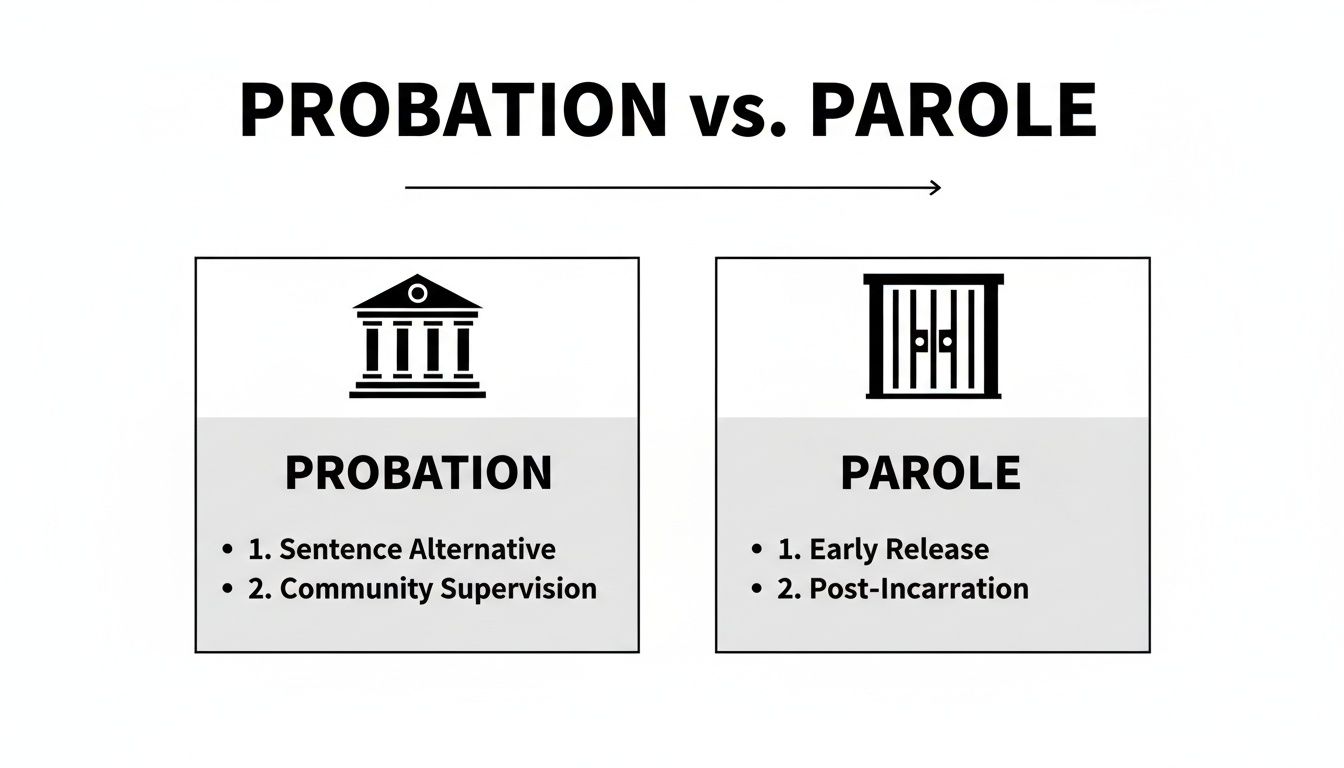
This visual highlights a fundamental truth: the fight for probation happens in court, where a skilled attorney can advocate for your family. Parole is a separate process that begins only after a conviction and incarceration. The stakes are incredibly high, as community supervision programs in Texas oversee far more people than our prisons do. In 2020, there were over 442,000 people under some form of supervision, with the vast majority on probation. You can explore these statistics further with data from the Texas Center for Justice and Equity.
Facing a criminal charge is a deeply personal and stressful experience. Knowing whether you are fighting for probation in court versus preparing for a future parole hearing defines your entire legal strategy.
To make this even clearer, let's break down exactly how each one works in the Texas justice system.
Quick Comparison: Probation vs. Parole at a Glance
For a quick, high-level summary, this table cuts straight to the core differences between probation and parole in Texas.
| Key Aspect | Probation in Texas | Parole in Texas |
|---|---|---|
| When It Happens | At sentencing, as an alternative to jail/prison. | After serving part of a prison sentence. |
| Who Grants It | A judge in a courtroom. | The Texas Board of Pardons and Paroles. |
| Purpose | To punish and rehabilitate without incarceration. | To reintegrate an individual into society post-incarceration. |
| Common For | Misdemeanors and less severe felonies. | More serious felony convictions. |
This at-a-glance view helps lay the foundation, but the real story is in the details of how each system operates and what it means for the person involved.
Who Decides Your Fate and When?

One of the most stressful parts of facing the justice system is feeling powerless—not knowing who’s in charge or when the critical decisions about your life will be made. The difference between parole and probation becomes crystal clear when you look at who holds the authority and the timing of their decisions.
Understanding this distinction isn’t just academic; it fundamentally shapes your legal strategy from day one, especially when keeping your family intact is the highest priority.
The Judge's Call: Probation
Probation, which Texas law calls community supervision, is a sentence handed down by a judge right there in the courtroom. It’s a direct outcome of your criminal case, decided at the time of sentencing. This is the moment where having an experienced attorney is non-negotiable.
Your lawyer's job is to advocate fiercely on your behalf. They’ll negotiate with the prosecutor and present a compelling case to the judge to grant probation instead of sending you to jail or prison. For a parent involved with CPS, a probation sentence can be the key to fulfilling the requirements of a Family Service Plan and achieving reunification. A judge can offer "straight" probation or a special kind called deferred adjudication in Texas, which may offer a path to avoid a final conviction entirely. The key is that this all happens in court, before any prison time is served.
The Board's Decision: Parole
Parole operates in a completely different arena, far removed from the courtroom where the original sentence was decided. The decision to grant parole is made exclusively by the Texas Board of Pardons and Paroles, an administrative body whose members are appointed by the governor.
This decision only comes into play after a person has been convicted, sentenced to prison, and served a required minimum portion of that sentence. This is often a heartbreaking reality for families hoping for reunification, as incarceration creates a significant barrier. Board members review an inmate's case file, may conduct an interview, and assess their rehabilitation efforts and potential risk to the community.
Unlike probation, which is a fight to avoid prison, parole is a request for early release from it. Your legal strategy has to shift from a courtroom defense to preparing a persuasive package for the parole board.
This process highlights a crucial difference:
- Probation is about convincing one person—the judge—at one specific time—sentencing.
- Parole is about convincing a panel of board members, often years after the original conviction.
Each path demands a unique, compassionate approach. For probation, the focus is on mitigating the facts of the alleged crime and showing you’re a good candidate for community supervision. For parole, the focus shifts to demonstrating rehabilitation and a solid plan for re-entering society and family life.
Comparing the Daily Realities of Supervision
On the surface, probation and parole might sound similar—both involve supervision, rules, and regular check-ins. But in reality, the day-to-day experience of someone on probation can be worlds apart from someone on parole. Knowing what life actually looks like under each system is crucial for preparing yourself and your family for what’s ahead.
The core difference between parole and probation really boils down to risk and intensity. Parole conditions are almost always stricter because the person has already been incarcerated for a more serious offense. The Texas Board of Pardons and Paroles designs these conditions to closely monitor individuals as they re-enter society. Probation conditions, set by a judge, can often be tailored more to the specific person and offense, with a focus on rehabilitation.
What to Expect on Probation
Probation is often framed as a second chance—a chance to keep your job, live at home, and be there for your family while serving your sentence. But that freedom comes with immense responsibility.
Consider this scenario: a parent is charged with a non-violent offense and is also working through a CPS case. A judge grants them probation. The conditions might require them to complete specific services ordered by both the criminal court and the family court under Texas Family Code Chapter 263, such as parenting classes, substance abuse counseling, and maintaining stable housing and employment. Their probation would look something like this:
- Monthly check-ins with a probation officer.
- Completing all court-ordered services for both the criminal case and the CPS case.
- Paying fines and court costs.
- Regular drug testing.
These requirements are serious, but they are designed to be manageable and often align with the goals of a CPS service plan, providing a clear path toward keeping the family together. For a closer look, you can learn more about how probation works in Texas.
The Stricter World of Parole
Life on parole is a much more tightly controlled existence. You're moving from total incarceration to a very conditional form of freedom, and the rules reflect that public safety is the top priority. For a parent being released on parole, the challenges of reunification can be immense.
For instance, someone paroled after serving time for a felony drug offense will face a demanding set of rules, such as:
- Weekly reporting to a parole officer.
- Mandatory employment and proof of income.
- Wearing a GPS ankle monitor tracking their location 24/7.
- Rigid curfews and restrictions on who they can associate with.
- Frequent, unannounced drug tests.
- Strict rules against visiting certain places or associating with anyone with a criminal record.
Parole is not simply freedom; it is a highly controlled period of reentry. Every rule is non-negotiable, and the supervision is designed to be far more intensive than what most people experience on probation.
Failing to follow even one of these rules can mean being sent right back to prison, which can be devastating for a family trying to reconnect.
Comparing Daily Life on Probation and Parole in Texas
To really see the difference, it helps to put the daily requirements side-by-side. While every case is unique, this table gives you a clear picture of what to generally expect from each.
| Condition or Aspect | Typical for Probation | Typical for Parole |
|---|---|---|
| Supervising Authority | Community Supervision and Corrections Department (CSCD) under the authority of a judge. | Texas Department of Criminal Justice – Parole Division under the authority of the Board of Pardons and Paroles. |
| Reporting Frequency | Usually monthly check-ins with a probation officer, which can become less frequent with good behavior. | Often weekly or even daily check-ins initially, especially for high-risk individuals. Can be reduced over time. |
| Travel Restrictions | Must get permission from the probation officer to leave the county or state. | Extremely limited. Travel outside the county is highly restricted and requires explicit, pre-approved permission. |
| Electronic Monitoring | Less common. Sometimes used for specific offenses like DWI (ignition interlock) or house arrest. | Very common. GPS ankle monitors are frequently required to track location 24/7. |
| Employment | Encouraged and often required, but with more flexibility in job searching. | Mandatory. Parolees must find and maintain employment, often with requirements to provide pay stubs as proof. |
| Substance Abuse Testing | Can be required, often scheduled in advance or based on suspicion. | Frequent and random. Unannounced drug and alcohol testing is a standard condition. |
| Curfews | Not always a condition, but can be imposed by the judge if deemed necessary. | Almost always a standard condition. Strict curfews requiring the parolee to be home by a certain time are common. |
| Associational Rules | May be told not to associate with victims or co-defendants. | Prohibited from associating with any known felons or individuals engaged in criminal activity. |
This breakdown shows just how different the levels of scrutiny and restriction are. While both paths demand compliance, parole is fundamentally a more intensive and demanding supervisory system.
The Consequences of Violations and Revocation
For any Texan on community supervision, the biggest fear is that one mistake will send them right back behind bars. It’s a valid anxiety because the stakes of a violation are incredibly high. For parents, a revocation can jeopardize everything, potentially leading to the termination of parental rights under Texas Family Code Chapter 161.
Violations fall into two categories: technical violations (breaking a rule, like missing a meeting or failing a drug test) and new law violations (being arrested for a new crime). While any violation is serious, the process of revocation—the complete cancellation of your supervision—is where the difference between parole and probation becomes painfully clear.
The Revocation Process for Probation
If you’re on probation and accused of a violation, your case goes back to court. A judge, usually the same one who granted you probation, will preside over a "Motion to Revoke" hearing.
At this hearing, a prosecutor must prove it's more likely than not that you violated a condition. This is your chance to have an attorney defend you, challenge the evidence, and make a case for a second chance. The judge has several options:
- Continue your probation, perhaps with stricter conditions.
- Modify your probation, which might mean adding some jail time.
- Revoke your probation entirely and impose the original jail or prison sentence.
A minor slip-up doesn’t automatically mean revocation, but you must act quickly.
A violation is not an automatic failure. It is a critical moment where swift, skilled legal intervention can mean the difference between staying in the community and being sent to prison.
The Revocation Process for Parole
The parole revocation process bypasses the court system entirely. Here, the Texas Board of Pardons and Paroles holds all the power.
If your parole officer believes you’ve violated your conditions, they can issue a warrant for your arrest. You'll then face an administrative revocation hearing. If the Board finds you violated parole, the decision is often blunt: you’re sent back to prison to finish your original sentence.
There's far less leniency here. The parole board’s primary concern is public safety, and they see a violation as a serious breach of trust. This is why understanding every rule is so vital. Research shows that simple technical violations are a massive driver of prison admissions, accounting for 20–45% of all prison admissions according to some studies. You can learn more about the impact of supervision violations from The Pew Charitable Trusts. Proactive communication with your attorney is your best defense.
How a Defense Attorney Can Shape Your Outcome
Trying to face the Texas justice system on your own is an overwhelming and deeply isolating experience. Whether you’re staring down a new charge or trying to make sense of the complex rules of supervision, the path ahead is loaded with potential traps. This is not a journey you should ever take by yourself. An experienced defense attorney is so much more than a legal representative; they are your advocate, your strategist, and your partner in protecting your freedom and your family.
Strategic, compassionate legal guidance makes a real, tangible difference at every stage. A skilled lawyer doesn't just react—they work proactively to shape the situation in your favor, ensuring your rights are protected and your voice is heard.
Navigating Probation with an Attorney
If you’re facing a criminal charge, the most critical moment is often at sentencing. The number one goal is to keep you out of jail and with your family. An attorney does this by:
- Negotiating for Probation: Your lawyer will advocate for you, negotiating directly with the prosecutor to argue that community supervision is a more appropriate and constructive sentence than incarceration.
- Arguing for Fair Conditions: They will fight to ensure your probation terms are reasonable and achievable—not designed to set you up for failure.
- Defending Against Violations: If you're accused of a probation violation, your attorney is your shield. They will represent you at the revocation hearing, challenge the state's evidence, and argue for a second chance.
Having an advocate who understands the system can be the one thing that separates a minor stumble from a full-blown revocation and a trip to prison.
Securing a Future Through Parole Advocacy
For families with a loved one behind bars, the parole process can feel like a maze with no clear exit. An attorney provides both the map and the guidance you need. Their job is to assemble a powerful and persuasive parole packet for the Board of Pardons and Paroles.
This packet tells a human story—a story of rehabilitation, remorse, and a person's readiness to successfully rejoin society and their family. It will include letters of support, proof of completed programs, a detailed reentry plan, and a convincing argument for why release is the right decision.
An experienced lawyer acts as your champion, making sure the Parole Board sees a complete person, not just an inmate number. Their goal is to maximize the chances of a favorable vote.
Reclaiming Your Life After Supervision
Successfully finishing supervision is a monumental achievement, but a criminal record can cast a long shadow. An attorney is a vital resource for helping you truly move forward by guiding you through an expunction or an order of non-disclosure to seal your record from public view.
This step is crucial for securing housing, finding a good job, and fully reclaiming your life. For legal professionals, understanding modern client outreach is key; you can learn more about effective strategies for lawyer lead generation to see how the best firms reach families in need.
Choosing the right legal partner is arguably the most important decision you will make. To help you in this process, we have a guide on how to choose a criminal defense attorney that provides practical advice for finding the right fit for your case.
Common Questions About Probation and Parole in Texas

Navigating community supervision feels a lot like walking a tightrope. One misstep can have serious consequences, so it's only natural to have questions about what you can and can't do while trying to complete your term and finally move forward. Below, we've tackled some of the most common questions we hear from clients in Texas, offering clear, direct answers about the practical realities of probation and parole.
Can I End My Probation or Parole Term Early?
Yes, early termination is possible in Texas for both probation and parole, but it is never a guarantee. It demands a perfect track record and a proactive legal strategy.
To be considered for early release, you generally must meet several criteria:
- Complete at least one-third to one-half of your total supervision term.
- Pay all court-ordered fines, fees, and restitution in full.
- Successfully finish all required classes, counseling, or treatment programs.
- Maintain a clean record with zero violations.
For probation, an attorney files a formal motion with the original court. For parole, your lawyer presents a compelling case directly to the Board of Pardons and Paroles, arguing that your early release is deserved and you are not a risk to the community.
Does My Criminal Record Get Cleared After I Finish?
This is a critical point of confusion for many families. No, successfully finishing probation or parole does not automatically clear your criminal record. The conviction remains on your history and will appear on background checks.
However, you may be eligible to have the record sealed from public view through an order of non-disclosure. This legal process blocks most private employers and landlords from seeing the offense. An attorney can analyze your case to determine if you qualify and guide you through the petition process from start to finish.
"Completing supervision is a huge milestone, but it's only the first step. Taking action to seal your record is the next crucial move toward truly reclaiming your future and closing this chapter for good."
Can I Travel Out of State While on Supervision?
Traveling is heavily restricted and always requires advance permission from your supervising officer. You cannot just leave the county or state for a vacation or family emergency. Doing so is a serious violation that could lead to your supervision being revoked.
You must submit a formal travel request to your probation or parole officer well in advance of your trip, including your exact destination, dates, and the reason for travel. Approval is entirely at the discretion of your officer and depends on your compliance history and offense. It is never guaranteed.
Navigating the complexities of probation, parole, or criminal charges that impact your family can feel isolating and terrifying. You do not have to face this alone. The dedicated attorneys at The Law Office of Bryan Fagan, PLLC are here to protect your rights, fight for your future, and provide the compassionate guidance your family deserves. For a strategic defense aimed at achieving the best possible outcome, contact us today for a free, confidential consultation. https://texascpslawyer.net