Skip to content
When you get that dreaded late-night call about your child's or partner's arrest, the terms "DUI" and "DWI" get thrown around almost interchangeably. The immediate fear and confusion are overwhelming. You’re not just worried about the legal trouble; you're terrified of what this means for your family's future, your child's reputation, and the stability you’ve worked so hard to build. This confusion only compounds the panic, leaving you unsure of what your family is truly up against.
Our goal is to cut through that noise and give you immediate clarity. Understanding the fundamental divide between a Texas DUI and a DWI is the first, most critical step in protecting your loved one and navigating the path forward with confidence and a clear strategy.
The Bright Line: Age is Everything
So, what's the most critical difference between a Texas DUI vs DWI? It all boils down to the driver’s age.
- A DUI (Driving Under the Influence) is a charge aimed squarely at minors under the age of 21 who have any detectable amount of alcohol in their system.
- A DWI (Driving While Intoxicated) applies to adults 21 and over who are caught operating a vehicle while legally intoxicated, which usually means having a Blood Alcohol Concentration (BAC) of .08% or higher.
Think of it this way: Texas has a zero-tolerance policy for underage drinking and driving. For anyone under 21, the law is incredibly strict. The mere presence of alcohol is enough to land them in legal trouble. For adults, however, the state has a much higher bar to clear—they have to prove actual intoxication.
DUI vs. DWI: The Legal Standard
Let's break down exactly what separates these two charges, as understanding this is key to building a defense.
-
Driving Under the Influence (DUI): This charge is exclusively for drivers under 21 years old. There's no need for the prosecutor to prove the driver was drunk or impaired. If a breathalyzer or blood test shows any detectable amount of alcohol—even a BAC as low as .01%—that minor can be charged with a DUI.
-
Driving While Intoxicated (DWI): This is the charge for adults 21 and older. To get a conviction, the state must prove the driver was legally intoxicated. That means showing they either had a BAC of .08% or higher or had lost the normal use of their mental or physical faculties because of alcohol or drugs.
Here’s a real-life scenario that makes the distinction painfully clear for many families. Imagine your 19-year-old son, a college student, is pulled over after having a single beer at a friend’s house. The breathalyzer shows a BAC of just .02%. He’s now facing a DUI charge that could impact his scholarships and future. But if his 22-year-old sister was driving with the exact same BAC, she'd be well under the legal limit and likely free to go home. The difference in age completely changes the outcome.
Texas DUI vs DWI At a Glance
To make it even simpler, here's a quick side-by-side comparison that highlights the core differences between a DUI and a DWI charge in Texas.
| Key Factor | Driving Under the Influence (DUI) | Driving While Intoxicated (DWI) |
|---|---|---|
| Applicable Age | Exclusively for minors under 21 | Primarily for adults 21 and older |
| BAC Threshold | Any detectable amount of alcohol | .08% or higher, or proven impairment |
| Proof Required | Presence of alcohol in the system | Proof of legal intoxication |
| Typical Charge | Class C Misdemeanor (first offense) | Class B Misdemeanor (first offense) |
It’s worth pointing out that Texas is one of only a handful of states that uses the DWI label for adult offenses while reserving DUI specifically for minors. Thanks to the state’s zero-tolerance stance, that 19-year-old with a minimal BAC gets hit with a Class C misdemeanor, which is treated like a serious traffic ticket. This is fundamentally different from the more severe charges an adult would face. You can learn more about how Texas DWI laws are unique compared to other states.
Grasping this core difference is the first, most important step in navigating the road ahead and protecting your family's future.
Comparing Penalties and Consequences for Your Future
Knowing the legal definitions of a Texas DUI and DWI is one thing. Understanding the real-world impact—how these charges can completely alter the course of a person’s life—is another entirely. For parents, this is what keeps you up at night. The penalties diverge significantly, and knowing exactly what’s at stake is the first step for any family facing this situation.
A DUI charge for a minor, while absolutely serious, is often treated by the law as a corrective measure rather than a deeply punitive one. A DWI for an adult, on the other hand, immediately brings severe consequences into play, including jail time, massive fines, and lasting damage to your reputation and career.
The Consequences of a Minor's DUI Charge
Texas has a zero-tolerance policy for underage drinking and driving, which is why a DUI for anyone under 21 is a Class C misdemeanor. While this is on the same level as a serious traffic ticket, it’s still a criminal charge that creates a permanent record that can haunt a young person.
For a first-offense DUI, a minor can typically expect:
- Fines: Up to $500.
- License Suspension: Loss of their driver's license for 60 days.
- Community Service: A court order to complete between 20 and 40 hours of service.
- Alcohol Awareness Education: Mandatory completion of an alcohol awareness course.
Even though these penalties seem lighter than a DWI, that criminal record can throw a wrench in everything from college admissions and scholarship applications to future job opportunities. It's a mistake that can follow them for years unless handled correctly.
The Heavier Weight of an Adult DWI Conviction
Once you’re 21, the game changes completely. A DWI charge is a much more serious legal battle from the very beginning. A first-offense DWI, even with no other complicating factors, is a Class B misdemeanor—a huge jump from the Class C misdemeanor DUI.
The standard penalties for a first-time DWI conviction are steep:
- Jail Time: A mandatory minimum of 72 hours in county jail, with a maximum of up to 180 days.
- Fines: A fine of up to $2,000.
- License Suspension: Loss of your driver’s license for up to one full year.
- Annual Surcharges: Hefty state fees, often totaling thousands of dollars, required to keep your license for three years after the conviction.
This chart breaks down the baseline differences between a standard, first-offense DUI and a DWI.
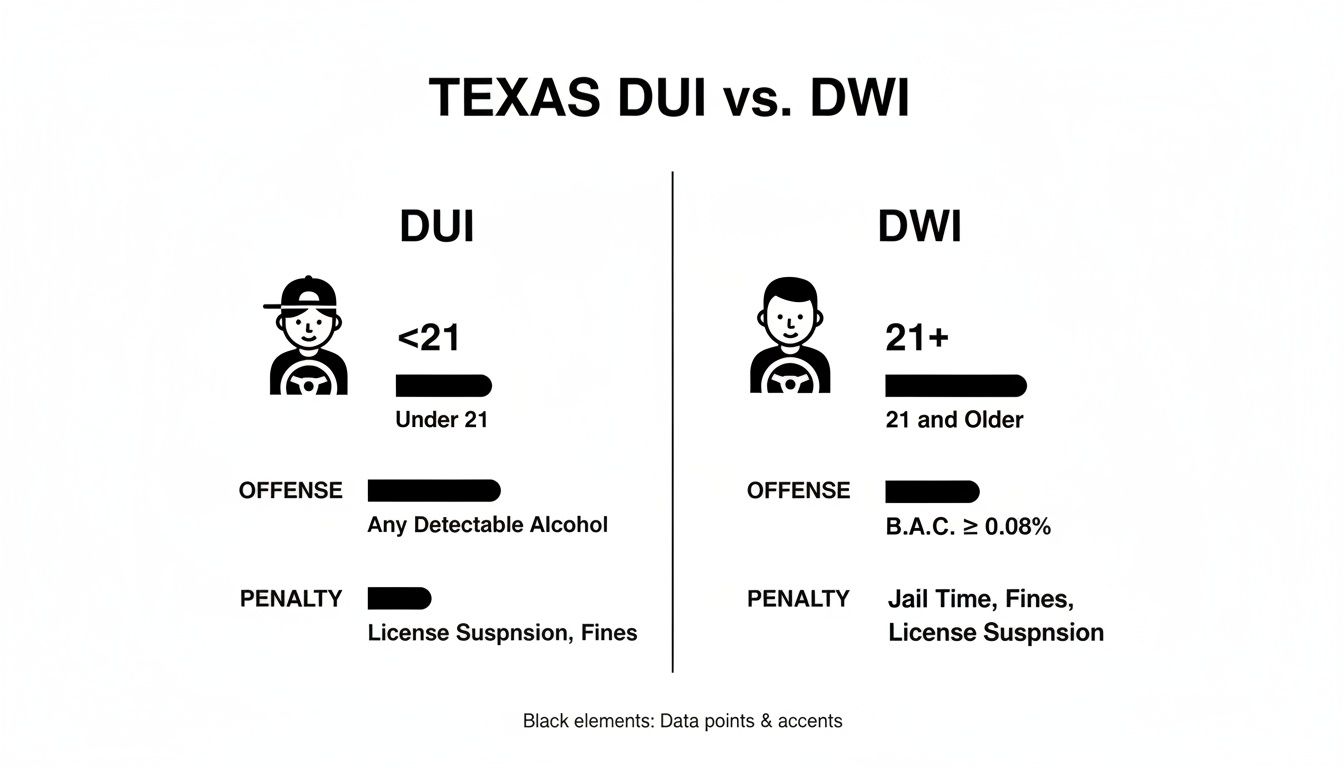
As you can see, while a DUI creates significant legal hurdles for a minor, a DWI conviction immediately puts an adult at risk of jail time and crushing financial costs.
When DWI Charges Escalate Quickly
The penalties for a DWI can get much worse, very quickly. Certain circumstances, known as aggravating factors, can elevate a misdemeanor charge to a felony, bringing with it life-altering consequences. This is especially true when children are involved.
A standard DWI is a serious charge, but the presence of a child passenger turns a bad situation into a catastrophic one. Under Texas Family Code Section 161, a DWI with a child in the car can be used as grounds for CPS involvement and even the termination of parental rights. The stakes are raised immediately, and you could face state prison time.
Here are just two common factors that enhance DWI penalties:
- High BAC Level: If your Blood Alcohol Concentration (BAC) is .15 or higher, the charge is bumped up to a Class A misdemeanor. This doubles the potential jail time to one year and the maximum fine to $4,000.
- Child Passenger: Driving while intoxicated with a passenger under the age of 15 in the car is an automatic state jail felony. A conviction means 180 days to two years in a state jail facility and a fine of up to $10,000. This can also trigger a CPS investigation under Chapter 262 of the Texas Family Code, putting your family at risk.
These enhancements show just how seriously the state of Texas treats impaired driving, especially when it puts children in danger. To get a full picture of the escalating consequences, you can learn more about the complete range of Texas DWI penalties in our detailed guide.
Navigating the Legal Journey From Arrest to Courtroom
That moment the handcuffs click is terrifying. For parents and families, the fear for a loved one’s future can feel overwhelming. The legal system that follows often seems cold and confusing, but this section is your roadmap. It’s here to demystify the entire process, from the flashing lights of the traffic stop to the solemnity of a courtroom, providing clarity when you need it most.
The journey starts with the arrest. From that point on, two separate legal tracks start running at the same time: a civil case dealing with driving privileges and a criminal case that will decide fines, potential jail time, and what goes on the permanent record. You must understand both to protect your rights and your family.

The First Battle: Your Driver's License
Right after a DWI arrest, you're up against an urgent deadline that has nothing to do with the criminal charge itself. This is the Administrative License Revocation (ALR) process.
If you refused a breath or blood test—or if you failed one by providing a sample of .08 BAC or higher—the Texas Department of Public Safety will move to suspend your driver's license automatically. You have only 15 days from the date of your arrest to request an ALR hearing and challenge this suspension.
This 15-day deadline is absolute and unforgiving. If you miss it, your loved one faces an automatic license suspension, often for 90 to 180 days, no matter what happens in their criminal case. It also means losing a critical opportunity for your attorney to question the arresting officer under oath before the criminal trial.
The ALR hearing is your first and best chance to gather evidence and start poking holes in the state’s case. It's a vital strategic step that can seriously influence how your criminal proceedings unfold down the road.
The Criminal Court Timeline Explained
While you're dealing with the ALR process, the criminal case is moving forward on its own schedule. The path through the court system can be long, but it generally follows a set of predictable stages. Knowing this timeline can help ease the anxiety that comes from facing the unknown.
-
Arraignment: The Formal Start. This is the first official court appearance. A judge will read the formal charges, and a plea—almost always "not guilty" at this stage—will be entered. It’s a crucial early step, and understanding the purpose of an arraignment hearing in Texas can give you a better sense of what to expect.
-
Pre-Trial Hearings and Discovery. This is where the real legal work happens. Your attorney will file motions and obtain all the evidence the prosecutor has, a process called "discovery." This includes police reports, body cam footage, and even breathalyzer maintenance records. Several pre-trial hearings will take place where your attorney negotiates with the prosecutor, which could lead to a plea bargain or even a dismissal.
-
The Trial: The Final Stage. If an agreement can't be reached, the case goes to trial. You have the right to have your case heard by either a judge or a jury. For a conviction, the prosecution must prove guilt "beyond a reasonable doubt." This is similar to the high standard of evidence required in CPS termination cases under Texas Family Code Chapter 161.
As you prepare for this complex legal journey, finding the right legal representation is paramount. Insights into how legal professionals utilize SEO to connect with clients can be valuable in your search for a defense attorney. Each step, from the ALR hearing to the final verdict, demands a careful strategy and deep knowledge of Texas law.
How Your Location in Texas Can Impact a DWI Case
Getting a DWI charge in Texas might seem like a standard legal problem, but the truth is, the outcome can hinge on a factor most people never even consider: geography. The county where the arrest occurred plays a massive role in how everything unfolds, from the initial traffic stop all the way to the final verdict. This isn't just a small detail; it's a critical variable that can completely change your future.
Different counties simply operate with different mindsets. What might be a routine plea bargain in one jurisdiction could be unthinkable just one county over. That’s why a generic, one-size-fits-all defense strategy is often doomed from the start when you're trying to navigate the difference between a Texas DUI vs DWI.
Why County Lines Matter in a DWI Defense
While the penal code is the same across the state, how it's applied can vary dramatically. Major metro areas like Harris (Houston), Dallas, Bexar (San Antonio), and Travis (Austin) counties all have their own unwritten rules and tendencies. These differences are often shaped by the priorities of the elected District Attorney, the sheer volume of cases clogging the courts, and the general attitude local judges have toward DWI offenses.
For example, some DA's offices have a strict "no-refusal" policy during holiday weekends, which means they’ll actively seek a warrant for a blood draw if you refuse the breathalyzer. Others might be more willing to negotiate a DWI charge down to a lesser offense, like obstruction of a highway, just to keep their dockets moving. A seasoned local attorney knows these nuances like the back of their hand.
The most important thing to understand is that your DWI case isn't just about the facts—it's also about the specific courthouse where it will be heard. An attorney who knows the local prosecutors and judges by name has a significant advantage over one who doesn't.
A Tale of Two Counties: DWI Statistics
This isn't just talk; the data shows clear disparities in how DWI cases are handled across Texas. A look at first-offense, non-injury DWIs reveals a stark contrast. In Dallas County, estimated dismissal rates can be around 18–25%, whereas in Harris County, that number often drops to between 10–15%. Reductions in charges are also common, with Dallas seeing about 25–35% reduction rates and Harris seeing 30–40%. This leads to a non-conviction resolution in roughly 45–55% of Dallas cases and 40–50% of Harris cases. You can dig deeper into these Texas DWI statistics to see just how much outcomes can vary by location.
These numbers tell a crucial story: where you are arrested directly impacts your chances of a favorable outcome.
This is precisely why local expertise isn't a luxury—it's an absolute necessity. An attorney who is deeply familiar with a specific county’s legal landscape can see the prosecution's moves coming, build a defense tailored to the tendencies of local judges, and use their relationships to negotiate more effectively. They know which arguments work with which judges and which prosecutors are more likely to cut a deal. That kind of localized knowledge can be the single most important factor in protecting your record and your future.
Building a Proactive and Strategic Defense
Let’s get one thing straight right away: an arrest is not a conviction. That single, powerful truth is the bedrock of any solid defense against a DWI or DUI charge here in Texas. We know the moments after an arrest are filled with uncertainty and fear, but it's critical to understand that the prosecution's case often isn't as airtight as it first seems.
A proactive and strategic defense begins the second you decide to fight back. This is a partnership between you and your attorney. Your side of the story, your memory of what happened, and your active participation are absolutely vital. Every single detail matters—from the moment you saw those flashing lights to exactly how that breathalyzer test was given. An actionable first step is to write down everything you remember as soon as possible, while the details are fresh.

Questioning Every Piece of Evidence
A skilled defense attorney never just accepts the state's evidence at face value. Instead, we meticulously pull apart every single aspect of their case, hunting for procedural mistakes, constitutional violations, and factual weak spots. This is all about protecting your rights at every turn.
We start by challenging the fundamentals:
- The Initial Traffic Stop: Did the officer even have a legitimate, legally valid reason (reasonable suspicion) to pull you over in the first place? If the stop was bad, any evidence they gathered afterward could get thrown out.
- Field Sobriety Tests: These tests are notoriously subjective and are frequently administered incorrectly. Simple things like a medical history, what shoes were being worn, or even the slope of the road can cause a "failure" that has nothing to do with intoxication.
- The Arrest Itself: Was the arrest handled by the book? Were Miranda rights properly read before any questioning started?
An arrest is merely the beginning of the legal process, not the end. A thorough defense investigates every step the officer took, because a single procedural mistake can be the key to having a charge reduced or even dismissed entirely.
Scrutinizing the Chemical Tests
So many people assume that a breathalyzer or blood test result is undeniable scientific proof. That is simply not the case. These machines and their operating procedures are riddled with potential errors, and challenging their reliability is a cornerstone of any strong DWI or DUI defense.
Your attorney should be digging into critical questions about the so-called "scientific" evidence, such as:
- Breathalyzer Calibration: Was the machine properly maintained and calibrated according to state regulations? We can subpoena the maintenance logs to find out.
- Operator Certification: Was the officer who administered the test actually trained and certified to operate that specific piece of equipment?
- Proper Procedure: Did the officer follow the strict 20-minute observation period required by Texas law before administering the breath test? This is done to ensure no outside factors could contaminate the sample, and it's a step that’s often skipped.
Each of these points is an opportunity to challenge the validity of the state's most powerful piece of evidence. When building a proactive and strategic defense, getting skilled legal counsel on your side is non-negotiable. For those curious about how legal professionals connect with clients, some interesting insights can be found in discussions on Law Firm Marketing Strategies. Ultimately, a strong defense is built by a team that meticulously investigates every fact, protects your constitutional rights, and works tirelessly to secure the best possible outcome for you and your family.
Protecting Your Future by Sealing Your Record
The consequences of a DUI or DWI charge don’t just vanish when the court case is over. A criminal record can cast a long, persistent shadow, creating unexpected hurdles long after you've paid the fines and completed probation. For parents and families, the fear that one mistake will unfairly define a loved one's future is a heavy burden—affecting everything from job applications and professional licenses to simply renting an apartment.
This is a journey we understand deeply. The anxiety of having a permanent mark on your record is real, but it's important to know that Texas law provides a path forward. There are powerful legal tools designed to offer a clean slate, allowing you and your family to move on from this difficult chapter with hope and security.
Understanding Your Options for a Clean Slate
When a criminal charge pops up on a background check, it can close doors before you even get a chance to explain your side of the story. Fortunately, Texas law offers two primary remedies to handle a past arrest or charge: expunction and an order of nondisclosure. While they might sound similar, they offer very different levels of relief.
-
Expunction (or Expungement): This is the gold standard for clearing your record. An expunction legally erases the arrest from your history as if it never happened. It authorizes the complete destruction of all records related to the incident held by government agencies.
-
Order of Nondisclosure: This remedy essentially seals your record from public view. While law enforcement and certain state agencies can still access the record, it becomes invisible to the general public, including potential employers, landlords, and educational institutions.
Knowing which option you qualify for is the first and most critical step toward reclaiming your future and your peace of mind.
The Power of an Expunction
Think of an expunction as a complete and total erasure. It is, without a doubt, the most powerful tool available for clearing a criminal record in Texas. Once an expunction is granted, you can legally deny that the arrest ever even occurred.
You might be eligible for an expunction if your case ended in one of the following outcomes:
- You were acquitted at trial (found "not guilty").
- Your case was dismissed by the prosecutor.
- You successfully completed a pre-trial diversion program.
- You were convicted but later received a pardon from the governor.
For families, an expunction means true finality. It ensures a past mistake won't suddenly surface during a background check for a volunteer position at your child's school or when you're applying for a loan to buy a family home.
Sealing Your Record with Nondisclosure
So, what happens if your case didn't end in a dismissal or an acquittal? Many people who complete deferred adjudication probation for a first-time DWI may still qualify for an order of nondisclosure. This process effectively seals the record, hiding it from public sight.
An order of nondisclosure provides a crucial second chance. It prevents a past charge from being a public barrier, allowing you to truthfully state on most job applications that you have not been convicted of a crime.
While the record isn’t destroyed, it is hidden from the companies that run background checks. This is a critical distinction that can make all the difference when you're trying to secure a new job or advance in your career. The process itself can be complex, and understanding the specific waiting periods and eligibility requirements is key. Navigating the legal steps for how to seal a criminal record in Texas is a detailed process where experienced guidance can make a significant difference.
Common Questions About Texas DUI and DWI Charges
When a family gets thrown into the chaos of a DUI or DWI arrest, the questions and fears start flying immediately. In those first few high-stress moments, you don't need legal jargon; you need direct, clear answers. This section is built to tackle some of the most urgent concerns we hear from families, giving you the immediate guidance you need to get your bearings.
The moments after an arrest are disorienting, and it’s easy to feel like you've lost all control. But understanding your rights and the legal road ahead is the first step toward taking that power back.
Can I Refuse a Breathalyzer Test in Texas?
Yes, you absolutely have the right to refuse a breath or blood test in Texas. But—and this is a big but—that decision comes with immediate and automatic consequences. It's all thanks to the state's "implied consent" law, which you agree to just by having a Texas driver's license.
If it's your first time refusing, you're looking at an automatic 180-day driver's license suspension. This isn't a criminal penalty; it's an administrative one handled by the DPS, completely separate from whatever happens in court. To make matters worse, the prosecutor can (and almost always will) use your refusal against you, arguing to the jury that it's proof you knew you were intoxicated. It's a critical decision you have to make under immense pressure.
What Is an ALR Hearing and Why Is It So Important?
The Administrative License Revocation (ALR) hearing is your one and only chance to fight that automatic license suspension. It’s a civil proceeding, totally separate from your criminal DWI or DUI case. Here’s the catch: you have to request this hearing within 15 days of your arrest. Miss that deadline, and it's gone for good. Your license will be suspended without a fight.
The ALR hearing is about more than just saving your license. It's a crucial strategic opportunity. It allows your attorney to get the arresting officer under oath, locking them into their story early on. This is often where we find weaknesses and inconsistencies that can be used to dismantle the criminal case later.
Forfeiting the ALR hearing by missing the 15-day deadline means giving up one of the most powerful defensive tools in your arsenal. It’s a mistake that can send negative ripples through your entire case. This is an actionable step you must take immediately to protect your rights.
How Could a DWI or DUI Affect My Child Custody Case?
A DWI or DUI charge can absolutely wreak havoc on a child custody case. Texas family courts are required by law to prioritize the "best interest of the child," and you can bet the opposing party will use a recent arrest as evidence of poor judgment, instability, or even endangerment. If CPS becomes involved, the stakes become even higher.
This can prompt a judge to put some very restrictive orders in place, such as:
- Requiring you to have supervised visitation with your own children.
- Mandating the use of an alcohol monitoring device, like an ankle bracelet or in-home unit.
- Ordering you to undergo substance abuse evaluations and follow any recommended counseling, similar to requirements in a CPS safety plan under Chapter 262 of the Texas Family Code.
Because a criminal charge can bleed so heavily into family law, it is vital to have a legal team that truly understands both sides. You need a coordinated strategy to protect your parental rights while simultaneously fighting the criminal charge and minimizing its fallout on your family.
The aftermath of an arrest is a confusing and terrifying time, but you don't have to navigate it alone. At The Law Office of Bryan Fagan, PLLC, we understand that a legal problem for one person is a crisis for the entire family. We are here to provide the clear answers, compassionate guidance, and strategic defense your family needs. We know what’s on the line, and we are committed to protecting your rights, your family, and your future. For a free and confidential consultation to discuss your case and learn how we can help, contact us today at https://texascpslawyer.net.