Skip to content
When a phone call in the middle of the night brings news of a drunk driving charge, a parent's world can stop. The fear, confusion, and anxiety are immediate. You're suddenly faced with a complex legal system, trying to decipher terms like DWI and DUI, all while worrying about your child's future or how this will impact your family. Many people use these terms interchangeably, but under Texas law, they are distinct offenses with different rules, penalties, and long-term consequences that can even touch on family law matters like Child Protective Services (CPS) involvement.
For parents in Texas, understanding this distinction is the first critical step in navigating this crisis. The core difference boils down to a single, simple factor: the age of the person behind the wheel.
The Defining Line Between DWI And DUI Charges In Texas
Think of it as a fork in the road. For adults, the law is concerned with actual intoxication. For minors, it's about a zero-tolerance policy for any alcohol consumption whatsoever. This distinction shapes the entire legal battle ahead, from the evidence the prosecutor needs under the Texas Penal Code to the penalties a judge can impose, and it's essential for parents to grasp what their family is up against.
This decision tree gives you a clear visual of how Texas law immediately separates these charges based on the driver's age.
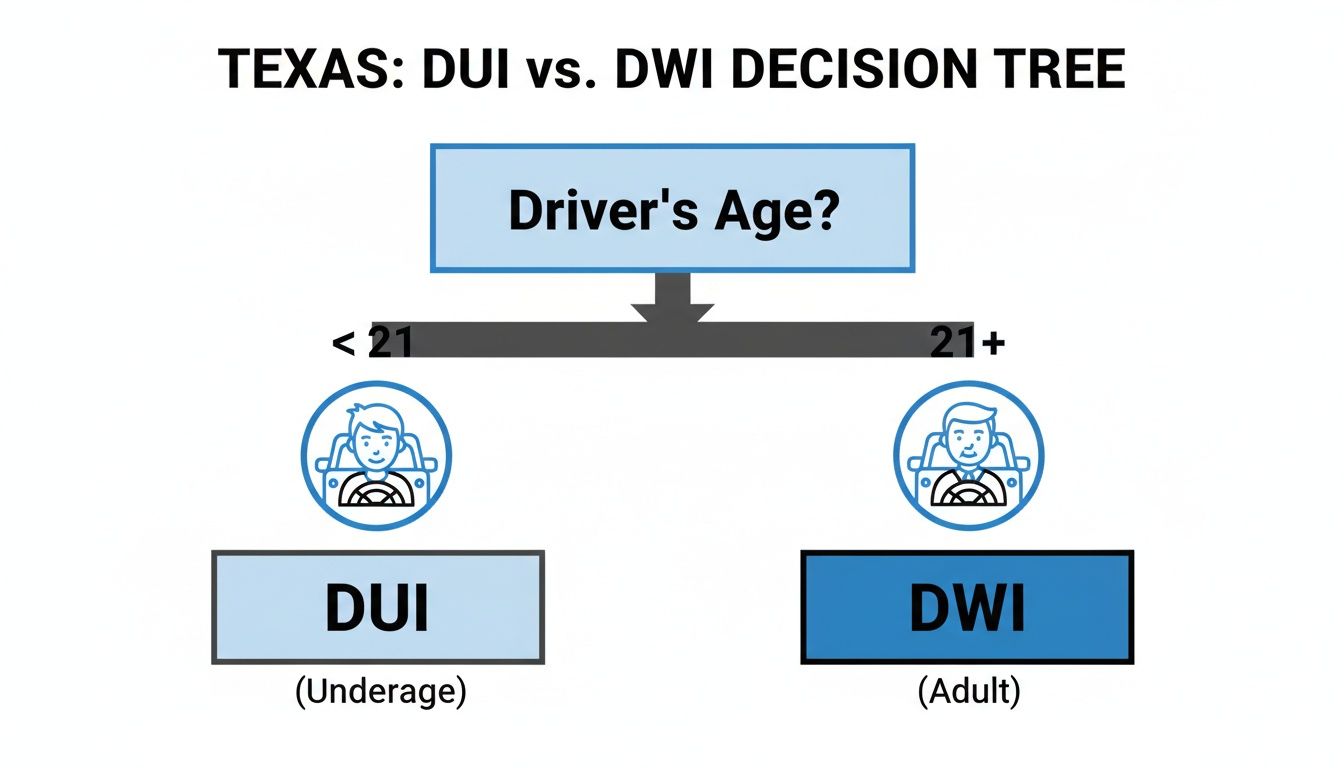
As you can see, the legal path splits the moment an officer determines the driver's age. This is the crucial first step in understanding the kind of fight your family is facing.
Understanding The Core Legal Differences
A Driving While Intoxicated (DWI) charge is what most people think of when they hear "drunk driving." Governed by Texas Penal Code § 49.04, this applies to adults 21 and older who operate a motor vehicle in a public place while legally intoxicated.
The state has two ways to prove intoxication for a DWI:
- Showing a blood alcohol concentration (BAC) of 0.08% or higher.
- Proving the driver lost the normal use of their mental or physical faculties because of alcohol or drugs, even if their BAC is below 0.08%.
On the other hand, a Driving Under the Influence (DUI) charge is specifically for minors under the age of 21. Texas enforces a strict zero-tolerance policy for underage drinking and driving. This means a minor can be charged with a DUI for having any detectable amount of alcohol in their system. The prosecutor doesn’t have to prove the minor was impaired or "drunk"—only that alcohol was present.
To make this distinction crystal clear, let's break it down side-by-side.
Texas DUI vs. DWI: A Clear Comparison
This table quickly outlines the fundamental differences between DWI and DUI charges under Texas law, focusing on age, the legal standard, and the primary offense type.
| Key Aspect | DWI (Driving While Intoxicated) | DUI (Driving Under the Influence) |
|---|---|---|
| Applicable Age | Adults aged 21 and over | Minors under the age of 21 |
| Legal Standard | Impairment OR a BAC of 0.08% or higher | Any detectable amount of alcohol |
| Primary Offense | Typically a Class B Misdemeanor | Typically a Class C Misdemeanor |
This fundamental separation impacts every single aspect of a case, from the traffic stop to the potential sentence. For a deeper dive into these nuances, explore our detailed guide on the differences between DWI and DUI in Texas. Knowing which charge applies is the first and most important step in protecting your family's future.
What Legally Constitutes Intoxication In Texas
To really get a handle on the seriousness of a DWI charge in Texas, you first have to understand what the law actually considers "intoxicated." It’s a common myth that you’re only in legal trouble if your Blood Alcohol Concentration (BAC) hits 0.08% or higher. While a 0.08% BAC is definitely one way for the state to prove you were intoxicated, it’s far from the only way.
Texas law gives prosecutors three different angles to define intoxication. A person is legally considered intoxicated if they don’t have the normal use of their mental or physical faculties because they've consumed alcohol, a controlled substance, a drug, or any other substance. This is a critical distinction—it means an officer’s subjective observations on the side of the road can be enough to land a conviction, even if your BAC is technically under the limit.

The Three Paths To Proving Intoxication
Under Texas Penal Code § 49.01(2), the state can make its case for intoxication based on any one of these three criteria:
- Loss of Normal Mental Faculties: This is all about your cognitive abilities. An officer might testify that you had slurred speech, seemed confused, couldn't follow simple instructions, or were unable to answer basic questions.
- Loss of Normal Physical Faculties: This one zeros in on your coordination and motor skills. Evidence here could be anything from stumbling or swaying to fumbling for your driver's license or performing poorly on Field Sobriety Tests (FSTs).
- A BAC of 0.08% or Higher: This is the most black-and-white, "per se" definition. If a valid chemical test—either breath or blood—shows your BAC at or above this level, you are, by definition, legally intoxicated. No further proof of impairment is needed.
This three-pronged definition gives prosecutors a ton of flexibility. They can build an entire case on a police officer's testimony about your behavior, even if a BAC reading doesn't back it up.
How Law Enforcement Builds A Case For Impairment
Let’s look at a relatable scenario. Imagine a father, "Mark," gets pulled over for swerving slightly after a late night at work. He’s had a couple of beers with colleagues over several hours and feels perfectly fine to drive. He agrees to a breathalyzer, and it comes back 0.06%—well below the legal limit.
Case closed, right? Not so fast.
During the traffic stop, the officer noted that Mark fumbled with his wallet, his speech was a little slurred from exhaustion, and he had trouble keeping his balance during the one-leg stand test. The officer’s bodycam footage and sworn report about Mark's "loss of normal physical and mental faculties" could still be enough to trigger a DWI charge and even lead to a conviction. If Mark had his child in the car, this situation could escalate and even attract the attention of CPS.
Key Takeaway: A DWI conviction in Texas doesn’t always hinge on a number from a machine. It can be built entirely on an officer’s opinion that you were impaired, which makes every single thing you say and do during a traffic stop a critical piece of evidence.
Different BAC Limits For Different Drivers
While 0.08% is the standard BAC limit for most adult drivers, Texas law sets a much lower bar for certain people to promote public safety. It’s crucial to know which limit applies to you, as it can change depending on your age or your job.
- Commercial Drivers: For anyone with a Commercial Driver's License (CDL), the standard is much stricter. When operating a commercial vehicle, their legal BAC limit is just 0.04%.
- Minors (Under 21): As we’ve covered, Texas has a zero-tolerance policy for underage drinking and driving. A minor can be charged with DUI if they have any detectable amount of alcohol in their system.
This tough enforcement is a direct response to a tragic problem. Texas leads the nation in alcohol-impaired driving fatalities, a grim reality that highlights just how seriously these offenses are taken. With 1,699 such deaths recorded in 2023, the state's aggressive stance is aimed at stopping a preventable loss of life. You can find more of these sobering statistics from the National Highway Traffic Safety Administration. The entire legal framework is designed to hold all drivers accountable, with standards tailored to the level of responsibility they carry on the road.
Comparing Penalties For Adult DWI And Minor DUI Convictions
When your family is faced with a drunk driving charge, the fear of the unknown can be overwhelming. Questions about jail time, fines, and the long-term impact on your future can feel crushing. Getting a handle on the specific penalties for an adult DWI versus a minor's DUI is the first step toward facing this challenge with clarity and a solid defensive plan. The goal isn't to cause more fear, but to give you an honest, clear-eyed view of what’s at stake so you can protect your family.
The legal system treats these two offenses very differently. The penalties reflect the distinct nature of each charge. For an adult, the consequences are designed to punish impairment. For a minor, they focus on education and intervention under Texas's zero-tolerance policy.
Penalties For A Minor's First-Time DUI
Because a DUI applies to minors under 21 with any detectable amount of alcohol, the penalties for a first offense are typically handled as a Class C Misdemeanor. While this is the lowest level of criminal offense in Texas and doesn't usually involve jail time, the consequences are still significant for a young person just starting out.
A first-time DUI conviction for a minor generally includes:
- A fine up to $500, which is a considerable amount for a young adult or their family.
- A driver's license suspension for 60 days.
- Between 20 and 40 hours of community service, often related to alcohol awareness or prevention.
- Mandatory attendance in an alcohol awareness education program, which the minor—and sometimes a parent—must complete.
Imagine a 19-year-old college student pulled over after having a single beer at a friend's house. She feels completely sober, but the officer detects alcohol on her breath. A DUI charge follows, and a conviction means she loses her license for two months, making it tough to get to her part-time job and classes. This one mistake now complicates her entire semester and creates a criminal record that could affect future opportunities. For her parents, it's a stressful ordeal of court dates, fines, and worrying about their daughter's future.
Escalating Penalties For Adult DWI Convictions
For adults 21 and over, a DWI charge carries much more severe penalties that escalate dramatically with each subsequent offense. A first-time DWI is a serious matter, but a third offense can lead to a decade or more in prison, fundamentally altering a person's life and tearing a family apart.
A DWI conviction isn't just a one-time punishment. It creates a permanent criminal record that can follow you for life, impacting employment, housing, and even professional licenses. The stakes are incredibly high from the very first arrest.
The legal system is built to impose increasingly harsh consequences to deter repeat offenses. The penalties aren't just about fines and jail; they're about taking away your freedom and your ability to provide for your family. For a detailed breakdown of what to expect, our guide on Texas DUI penalties offers further insights.
To help you visualize what this escalation looks like, the table below breaks down the standard criminal penalties for DWI convictions in Texas.
Texas DWI Criminal Penalties By Offense Level
This table outlines the escalating criminal penalties for DWI convictions in Texas, including jail time, fines, and license suspension for first, second, and third offenses.
| Offense | Criminal Classification | Potential Jail Time | Maximum Fine | License Suspension Period |
|---|---|---|---|---|
| 1st DWI | Class B Misdemeanor | 3 to 180 days | Up to $2,000 | Up to 1 year |
| 2nd DWI | Class A Misdemeanor | 30 days to 1 year | Up to $4,000 | Up to 2 years |
| 3rd DWI or More | 3rd Degree Felony | 2 to 10 years in prison | Up to $10,000 | Up to 2 years |
As you can see, the jump from a first to a second offense is significant, but the leap to a third offense is life-changing, turning a misdemeanor into a felony. This progression underscores the urgent need for a strong legal defense at the earliest possible stage to prevent one mistake from defining your family's entire future.
Understanding Aggravating Factors That Enhance DWI Penalties
A standard DWI charge is already a serious event that can throw your family's life into chaos, but certain circumstances can elevate it from a misdemeanor to a felony in an instant. These are known as "aggravating factors," and they completely transform the legal landscape, dramatically increasing the potential penalties and the long-term impact on your future. For families, these enhanced charges often carry consequences that extend far beyond the courtroom, sometimes leading to CPS involvement.
These factors essentially tell the court that the circumstances of the offense were far more dangerous than a typical DWI. Prosecutors pursue these enhancements aggressively, and a conviction can lead to years in prison, devastating fines, and a permanent felony record you can't escape.
High BAC: A Class A Misdemeanor Enhancement
One of the most common aggravating factors is a high Blood Alcohol Concentration (BAC). While the legal limit for intoxication is 0.08%, if a chemical test shows your BAC was 0.15% or higher, the charge is automatically enhanced.
A first-time DWI with a BAC of 0.15% or more gets bumped from a Class B Misdemeanor to a Class A Misdemeanor. This means the potential penalties essentially double:
- Maximum Fine: Increases from $2,000 to $4,000.
- Potential Jail Time: Jumps from 180 days to up to one full year.
This enhancement exists because the law presumes that a significantly higher level of intoxication presents a much greater risk to public safety. It's a clear line in the sand drawn by the state.
The Critical Charge: DWI With A Child Passenger
For any parent, this is one of the most frightening scenarios imaginable. If you are arrested for DWI while a child under the age of 15 is in your vehicle, the charge becomes a State Jail Felony. This is a life-altering offense with severe consequences that directly threaten your family structure.
A conviction for DWI with a Child Passenger carries:
- Jail Time: Up to two years in a state jail facility.
- Fines: Up to $10,000.
- Driver's License Suspension: A lengthy suspension period.
Crucially, this charge will almost certainly trigger an investigation by Child Protective Services (CPS), as outlined in the Texas Family Code. The state may view the act as child endangerment under Chapter 262, leading to a separate and equally terrifying legal battle to maintain your parental rights and keep your family together. This could involve court-ordered services under Chapter 263 or even termination proceedings under Chapter 161 in the most severe cases.
The moment a DWI involves a child passenger, it stops being just a criminal case. It becomes a family law crisis that requires a defense strategy addressing both the felony charge and the potential CPS intervention.
Intoxication Assault And Intoxication Manslaughter
The most severe DWI-related offenses occur when someone's driving causes injury or death. These charges are serious felonies that carry the possibility of spending decades in prison.
- Intoxication Assault: If your driving causes "serious bodily injury" to another person, you can be charged with this third-degree felony. A conviction carries a sentence of 2 to 10 years in prison.
- Intoxication Manslaughter: If your driving results in someone's death, the charge is a second-degree felony, punishable by 2 to 20 years in prison.
These charges are particularly prevalent in major metropolitan areas where traffic density is high. Texas DWI arrest volumes vary dramatically by county, with urban centers seeing the most enforcement. Harris County, for example, processes more DWI cases than many entire states, reflecting the intense focus of law enforcement in high-population zones. You can learn more about the arrest statistics across major Texas counties to understand the legal environment where your case will be heard. These statistics highlight the sheer volume of cases courts handle, making a strategic defense even more critical to stand out and protect your rights.
How The Administrative License Revocation Process Works
When you get arrested for DWI or DUI in Texas, you're immediately fighting a war on two fronts. The first is the criminal case—the one everyone knows about, where the state is trying to prove you're guilty and hit you with fines and jail time. The second is a civil case that kicks off instantly, and it's a fight just for your right to drive.
This second fight is the Administrative License Revocation (ALR) process. It’s a completely separate action handled by the Texas Department of Public Safety (DPS) to suspend your driver's license, and it moves at lightning speed compared to the criminal case. Getting this part wrong can cost you your driving privileges long before a judge ever hears your criminal case, so you have to take it seriously.
The Critical 15-Day Deadline
The clock starts ticking the moment you're arrested. From the date you're given notice of suspension—which is almost always the day of the arrest—you have only 15 days to request an ALR hearing. This isn't a suggestion; it's a hard, non-negotiable deadline.
If you miss that 15-day window, your license will be automatically suspended on the 40th day after your arrest. It doesn't matter if you are eventually found not guilty in your criminal case; the suspension happens anyway.
Key Takeaway: The ALR clock is unforgiving. Missing the 15-day deadline to request a hearing means you’ve lost your first and best chance to stop an automatic license suspension.
What Happens At An ALR Hearing
Requesting the hearing is your way of hitting the pause button on that automatic suspension. It forces the DPS to actually prove its case against you. This hearing isn't a criminal trial; it's an administrative proceeding run by an Administrative Law Judge, and the bar for the DPS to win is much, much lower than in criminal court.
The DPS only needs to show a "preponderance of the evidence"—meaning it's just more likely than not that:
- The officer had a valid reason (reasonable suspicion) to pull you over.
- The officer then had probable cause to arrest you for DWI.
- You either refused to give a breath or blood sample, or you provided a sample with a BAC of 0.08% or higher.
For your attorney, this hearing is an invaluable first look at the state's case. It’s often the very first opportunity to get the arresting officer on the record and under oath, which can expose all sorts of weaknesses—like sloppy police procedures during the stop or improperly administered field sobriety tests.
Why The ALR Hearing Is More Than Just About Your License
Think of the ALR hearing as a dress rehearsal for your criminal case. Your lawyer can use it to gather critical evidence, lock the officer into their testimony, and map out a defense strategy. What we learn here often becomes powerful leverage for negotiating with the prosecutor or getting evidence thrown out in the criminal trial.
For instance, if the officer admits during the ALR hearing that they didn't follow the proper protocol for a sobriety test, that admission can be used to torpedo their credibility later on. A lot of people don't realize you have the right to refuse a breathalyzer, though doing so is what triggers the ALR process. You can learn more about your rights and the consequences by reading our guide on refusing a breathalyzer test in Texas.
Protecting your ability to get to work, take your kids to school, and just live your life is obviously critical. The ALR process is your first line of defense, and the most important thing you can do in the days after an arrest is take immediate, decisive action by requesting that hearing.
Protecting Your Family After A DWI Or DUI Arrest
An arrest for a DWI or DUI is a gut-punch. It doesn't just affect you; it sends shockwaves through your entire family, leaving everyone scared, confused, and unsure of what happens next. In these first few hours and days, the decisions you make are absolutely critical. This isn't just about a traffic ticket—it's about protecting your freedom, your job, your reputation, and most importantly, your family. The path forward has to be calm and deliberate.
The single most important step you can take right now is to contact an experienced attorney who understands both criminal defense and family law. Immediately. Don't wait for your first court date, and don't try to handle these first steps alone. An attorney can give you immediate guidance, protect you from saying something that could hurt your case, and start building your defense from day one.
Immediate Steps To Take After An Arrest
After an arrest, you might feel an intense pressure to explain yourself or cooperate fully, but your constitutional rights are there to protect you when you are most vulnerable. Using them isn't an admission of guilt. It's the smart, necessary first step in your defense. Here is some actionable advice for what to do next:
- Exercise Your Right to Remain Silent: Politely refuse to answer any questions about where you were, what you drank, or any other details. Just say, "I wish to speak with my attorney."
- Contact a Defense Attorney: The sooner a lawyer gets involved, the better they can preserve evidence and manage crucial deadlines—especially the 15-day window to request your Administrative License Revocation (ALR) hearing.
- Document Everything You Remember: As soon as you can, write down every detail you can recall. Think about the traffic stop, the officer's questions, the field sobriety tests, and the arrest itself. Memories fade fast, and even small details can become vital evidence later on.
How A DWI Can Affect Your Family Life
A DWI conviction isn't just a criminal problem. It can have a profound impact on your family, especially if you have children. This is where criminal law and family law can collide, creating a complex legal battle that demands a comprehensive defense strategy.
For instance, a co-parent can use a DWI arrest as a reason to file for a modification of a child custody order. They might argue that the incident shows behavior that endangers the child, which could lead a court to order supervised visitation or other serious restrictions on your parenting time.
A DWI charge, particularly one with aggravating factors like a child passenger, can trigger a CPS investigation. Suddenly, you're not only fighting to stay out of jail but also fighting to keep your family together.
This is exactly why it's so important to work with a legal team that understands both sides of the coin. Your defense must address the criminal allegations while proactively protecting your parental rights. You are not alone in this fight, and you don’t have to navigate these interconnected legal systems by yourself. Taking decisive action now is the first step toward regaining control and protecting your family’s future. If you are facing a DWI or DUI charge, contact The Law Office of Bryan Fagan for a compassionate and confidential consultation.
Questions Families Often Ask About Texas DWI And DUI Laws
When a DWI or DUI charge hits your family, it can feel like a whirlwind of urgent, confusing questions. The legal system is complicated, and getting clear, straightforward answers is the first step toward finding your footing and making the right decisions. Here are some of the most common concerns we hear from families trying to navigate these tough situations.
Can I Refuse A Breathalyzer Test In Texas?
Yes, you absolutely have the right to refuse a breathalyzer or blood test in Texas. But you need to know that this decision isn't without immediate consequences. Because of the state's "implied consent" law—which you agree to just by having a driver's license—refusing triggers an automatic driver's license suspension.
This happens through a separate civil process called an Administrative License Revocation (ALR). While saying "no" to the test makes it tougher for the prosecutor to prove your Blood Alcohol Concentration (BAC) was over the limit, they can still charge you with DWI. They’ll use other evidence, like the officer’s observations of your driving and how you performed on field sobriety tests.
Will A DWI Arrest Affect My Child Custody Agreement?
A DWI arrest, and especially a conviction, can definitely put a child custody order at risk. A family court judge might see the incident as a sign of behavior that could endanger a child's physical or emotional well-being, and that can have serious repercussions for your parental rights.
If your co-parent finds out about the arrest, they could file a motion to modify your custody arrangement. A judge might then order supervised visitation, require you to undergo alcohol testing, or place other restrictions on your time with your children. If CPS becomes involved, the stakes become even higher, potentially leading to a court-ordered safety plan or removal. It’s critical to talk about this with an attorney who has experience in both criminal defense and Texas family law.
Is It Possible To Get A DWI Charge Dismissed In Texas?
Yes, getting a DWI charge dismissed or reduced to a lesser offense is possible. However, the outcome hinges entirely on the specific facts and evidence of your case. A successful defense comes down to a meticulous investigation of every single detail of the arrest.
An experienced attorney will scrutinize every piece of evidence, from the legality of the initial traffic stop and the administration of field sobriety tests to the calibration and maintenance records of the breathalyzer machine. Finding procedural errors or challenging the state's evidence can create the leverage needed for a dismissal or a more favorable plea agreement.
What Is An Occupational Driver's License?
If your license gets suspended after a DWI arrest, you might be eligible for an Occupational Driver's License (ODL). This is a special, restricted license that a judge can grant, allowing you to drive for essential, court-approved reasons.
An ODL lets you legally drive to and from work, school, and necessary household errands like grocery shopping or taking your kids to appointments. An attorney can help you petition the court for an ODL to minimize the disruption to your family's life while your criminal case is pending.
The moments after an arrest are overwhelming, but you do not have to face this alone. At The Law Office of Bryan Fagan, PLLC, we understand the fear and uncertainty that a DWI or DUI charge brings to a family. We are here to provide compassionate, strategic defense for families across Texas, protecting not only your criminal record but your rights as a parent. If you or a loved one is facing a DWI or DUI, contact us for a free, confidential consultation to protect your rights and your future.