Skip to content
A simple drive home can turn into a nightmare in an instant. The flashing red and blue lights in your rearview mirror send a wave of panic through you. For Texas parents and families, this moment can be the start of a terrifying legal journey, one that threatens your freedom, your job, and even your relationship with your children.
You might think it’s just a misunderstanding, but then the officer discovers a mistake from your past—maybe a DWI from your college days. Suddenly, the situation escalates. What was a misdemeanor is now a felony DWI in Texas. The fear is immediate and crushing, not just for your own freedom, but for your family, your job, and everything you've built.
This is a moment of crisis where understanding your rights is everything. When a DWI charge escalates to a felony, it can even trigger an investigation by Child Protective Services (CPS), adding another layer of fear and confusion. It's critical to remember that an arrest is not a conviction, and you don't have to face this fight on your own.
When a DWI Charge Becomes a Life-Altering Felony
While a first-time DWI is usually charged as a Class B misdemeanor, certain aggravating factors automatically upgrade the charge to a felony. The Texas Penal Code lays out several scenarios where this happens, and they generally fall into one of these categories:
Repeat Offenses: This is the most common way a DWI becomes a felony. If you have two or more prior DWI convictions on your record, your third DWI is automatically charged as a third-degree felony. It doesn't matter how much time has passed since the prior offenses.
DWI with a Child Passenger: Driving while intoxicated with a passenger under the age of 15 in the vehicle is an immediate state jail felony, even if it’s your first offense. This charge, under Texas Penal Code §49.045, can also trigger a CPS investigation, adding another layer of legal complexity for your family.
Intoxication Assault: If an intoxicated driver causes an accident that results in “serious bodily injury” to another person, they will face a third-degree felony known as Intoxication Assault.
Intoxication Manslaughter: This is the most severe charge. Intoxication Manslaughter is a second-degree felony filed when an intoxicated driver causes an accident that results in someone’s death.
To make it clearer, here’s a quick breakdown of how these circumstances change the game.
How a Texas DWI Becomes a Felony
| Circumstance | Resulting Felony Classification | What It Means |
|---|---|---|
| Third DWI Offense | Third-Degree Felony | Two prior DWI convictions on your record will automatically make a third arrest a felony, regardless of when the priors occurred. |
| DWI with a Child Passenger | State Jail Felony | Having a passenger under the age of 15 in the car while driving intoxicated is a felony, even for a first-time offender. |
| Intoxication Assault | Third-Degree Felony | Causing an accident that results in "serious bodily injury" to another person while you are intoxicated. |
| Intoxication Manslaughter | Second-Degree Felony | Causing a fatal accident as a result of driving while intoxicated. This is one of the most serious charges you can face. |
Facing a felony DWI means you’re up against the full force of the state's prosecutors, who will be pushing for lengthy prison sentences, crippling fines, and a permanent criminal record that follows you forever. Building a strong, strategic defense from the moment of your arrest is the single most important step you can take to protect your family and your future.
How Prior Convictions Can Escalate a New DWI Charge
For many Texas families, the most common path to a felony DWI charge is paved by past mistakes. The state has a long memory when it to comes to driving while intoxicated, and what might feel like a distant error from your twenties can suddenly reappear, threatening your entire future. Texas law treats repeat DWI offenses with increasing severity, and it's this escalation that catches so many people completely off guard.
Imagine this: you had two DWI convictions years ago. You learned your lesson, built a career, started a family, and moved on with your life. Then, more than a decade later, you have a couple of glasses of wine at a work dinner and get pulled over on your way home. In that single moment, those old charges come roaring back. What would have been a misdemeanor for a first-time offender is now an automatic felony charge for you.
This scenario is terrifyingly common. The state’s approach is designed to penalize repeat offenders harshly, and the law generally doesn't care how much time has passed between offenses. This is why understanding exactly how prior convictions impact a new charge is so critical.
The Escalating Penalties for Repeat DWI Offenses
Texas law makes it crystal clear: a third DWI is a felony, period. This is often what people mean when they talk about a "three strikes" approach to DWI. While the first and second DWIs are typically misdemeanors (though a second DWI brings much tougher penalties), the third one crosses a critical legal line.
Once you’re charged with a third DWI, you are no longer facing county jail time. You're facing a state prison sentence.
A third DWI charge is automatically classified as a third-degree felony DWI in Texas. This elevates the potential consequences from a maximum of one year in county jail to a possible 2 to 10 years in a state prison and a fine of up to $10,000.
The jump in severity is profound. A felony conviction brings with it a lifetime of collateral consequences, impacting your right to vote, own a firearm, find a good job, and even secure housing. For a parent, it can also create serious problems in family law matters, especially custody disputes, potentially leading to CPS involvement.
The diagram below breaks down the primary ways a DWI can become a felony in Texas.
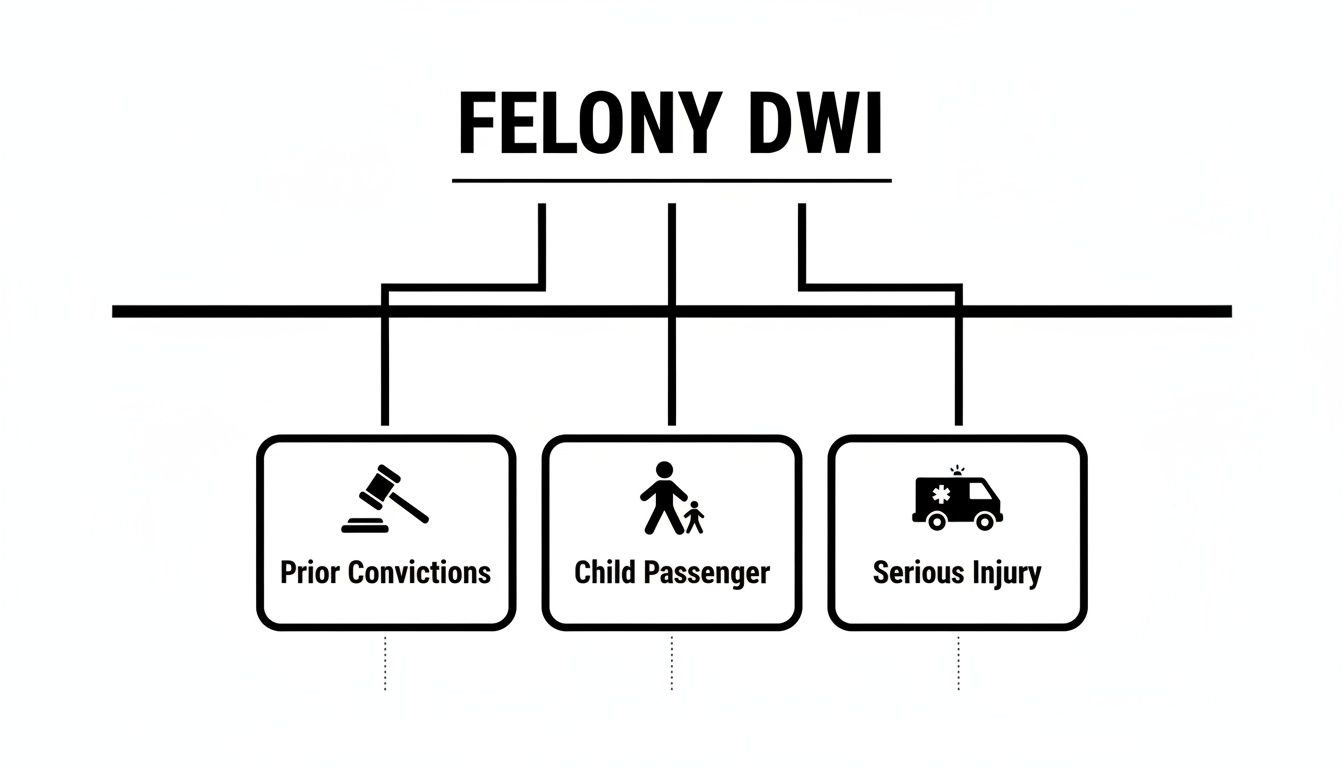
As you can see, while things like having a child passenger or causing an accident can lead to a felony, prior convictions are a distinct and unfortunately common pathway to this serious charge.
What Happens After the Third DWI
The penalties just keep climbing with each subsequent offense. A fourth DWI, for instance, is typically charged as a second-degree felony, which can double the potential prison time. You can learn more about how prior convictions affect sentencing by exploring information about the three-strike law in Texas.
Here’s a quick breakdown of how the statutory penalties escalate:
- Third DWI (Third-Degree Felony): Potential punishment includes 2 to 10 years in prison, fines up to $10,000, and a driver's license suspension of up to two years.
- Fourth DWI (Second-Degree Felony): The potential prison sentence jumps to 2 to 20 years, with fines remaining up to $10,000.
These enhancements are spelled out in Texas Penal Code Chapter 49.09. This section details how prior intoxication-related convictions can be used to elevate a new charge to a third-degree felony or higher, each carrying severe imprisonment terms and heavy financial penalties.
Because the state can and will use decades-old convictions against you, it's absolutely vital to have an experienced attorney examine your record. A skilled lawyer can challenge the validity of prior convictions by investigating whether your constitutional rights were protected in those earlier cases. If a prior conviction can be proven invalid, it can't be used to enhance your current charge—a distinction that could mean the difference between a misdemeanor and a life-altering felony.
When a First-Time DWI Becomes a Felony
It's a dangerous and all-too-common myth that you only have to worry about a felony DWI charge in Texas if you're a repeat offender. The hard truth is that under certain circumstances, a single mistake—one bad judgment call—can instantly escalate a first-time DWI into a life-altering felony. These situations, known as "aggravating factors," can bring the devastating possibility of prison time and a permanent criminal record crashing down on you in the blink of an eye.
For parents, the implications are especially terrifying. Imagine this: you've just driven your child and their friend home from a birthday party. You only had a couple of drinks over several hours and felt perfectly fine to drive, but a momentary lapse—a slightly wide turn or forgetting to signal—catches an officer's attention.
Suddenly, what you saw as a responsible act becomes a potential state jail felony. Having a child in the car, even for a first-time DWI, can trigger not only a felony arrest but also a full-blown investigation by Child Protective Services (CPS), threatening the very fabric of your family. This is how fast a dwi felony in texas can become your reality, even with a completely clean record.

Driving with a Child Passenger
Under Texas law, the single most common reason a first DWI turns into a felony is having a child in the car. The statute is crystal clear and unforgiving: operating a vehicle while intoxicated with a passenger under the age of 15 is an automatic state jail felony. It makes no difference if you have a perfect driving history; this act alone crosses a critical legal line.
To get a conviction, the prosecutor just needs to prove two things beyond a reasonable doubt:
- You were operating a motor vehicle in a public place while legally intoxicated.
- A child under 15 years old was in the vehicle with you at the time.
A conviction for this offense comes with severe penalties that can shatter a family’s stability.
A DWI with a Child Passenger is a state jail felony, punishable by 180 days to 2 years in a state jail facility, a fine of up to $10,000, and a mandatory driver's license suspension.
These penalties are truly life-altering. The conviction leaves a permanent felony record that makes it incredibly difficult to find a job, secure housing, or even volunteer at your kid’s school. And the battle doesn't just end in criminal court; it can easily spill over into family court, putting your custody rights in jeopardy.
Intoxication Assault Causing Serious Bodily Injury
Another way a first-time DWI can become a felony is if your actions behind the wheel cause serious harm to someone else. In the eyes of the law, this offense, called Intoxication Assault, transforms a driving mistake into a violent crime.
Intoxication Assault happens when an intoxicated driver, by accident or mistake, causes "serious bodily injury" to another person. The Texas Penal Code defines this as an injury that creates a substantial risk of death or causes serious permanent disfigurement or long-term loss or impairment of any body part or organ. Think broken bones, severe burns, or traumatic brain injuries.
The charge is typically a third-degree felony, carrying even harsher penalties than a DWI with a child passenger.
- Prison Sentence: A conviction for Intoxication Assault can land you in a Texas state prison for 2 to 10 years.
- Financial Penalties: Fines can soar up to $10,000, not including court costs and potential restitution payments to the victim.
- Other Consequences: You'll also face a long driver's license suspension and the lifelong stigma of being a convicted felon.
If the injured person happens to be a firefighter, emergency medical personnel, or a police officer, the charge gets bumped up to a second-degree felony, doubling the potential prison time to 20 years.
Intoxication Manslaughter Causing a Fatality
The most tragic and severe DWI-related felony is Intoxication Manslaughter. This charge is filed when an intoxicated driver causes an accident that results in someone's death. As a second-degree felony, you can be sure prosecutors will pursue these cases with the full force of the state's resources.
For a conviction, the state has to prove your intoxication was the direct cause of the fatal accident. It doesn't matter that you never intended to hurt anyone; the law holds you responsible for the final outcome. The consequences of an Intoxication Manslaughter conviction are absolutely devastating and permanent.
The punishment for this second-degree felony includes 2 to 20 years in a state prison and a fine up to $10,000. If the victim was a first responder, the charge is elevated to a first-degree felony, which carries a sentence of 5 to 99 years, or life in prison.
Facing any of these charges is a terrifying experience. A single poor decision can trigger a catastrophic chain of legal, financial, and personal consequences that will impact not just you, but your entire family, for years to come.
Navigating the Texas Felony DWI Legal Process
Navigating the Texas Felony DWI Legal Process is, without a doubt, a disorienting and frightening experience. The language, the procedures, and the sheer weight of the state's power can feel absolutely crushing. Our goal here is to pull back the curtain on this journey, giving you a clear roadmap of what to expect after an arrest for a felony DWI in Texas. Just knowing the path ahead can help dial down the anxiety and empower you to take an active role in your own defense.
The whole process kicks off the second you're taken into custody. From that moment, a series of critical legal steps will unfold, each with its own set of rules and potential fallout. This is not a journey you should ever try to make alone.
From Arrest to Arraignment
Right after the arrest, you'll be taken to a police station or county jail for booking. This is the part you've seen in movies: fingerprinting, the mugshot, and recording your personal information. Soon after, you'll see a magistrate judge for an arraignment, which is your very first official court appearance.
During this brief but crucial meeting, the judge will:
- Formally tell you what felony charges you're facing.
- Read you your constitutional rights, including the all-important right to an attorney.
- Set your bail amount—the money you have to pay to get out of jail while your case is sorted out.
This is the first moment where having an attorney becomes absolutely essential. A skilled lawyer can jump in immediately to argue for a reasonable bail amount. That single action can be the difference between waiting for your court date at home with your family or stuck behind bars.
The Grand Jury and Indictment
Because a felony is such a serious charge, a prosecutor can't just decide to take you to trial on their own. They first have to get approval from a grand jury. This is a group of citizens who meet in secret to hear the prosecutor's evidence and decide if there's enough "probable cause" to formally charge you with a crime.
It's critical to understand that the grand jury only hears one side of the story—the prosecutor's. Your defense attorney isn't in the room to challenge witnesses or present your side of things.
If the grand jury believes there's enough evidence to proceed, they issue an "indictment." This is the formal legal document that officially charges you with the felony DWI. Once you're indicted, your case is set for trial in a District Court, and the real legal battle begins. An indictment isn't a verdict of guilt; think of it as the starting pistol for the next phase of the process.
Pretrial Hearings and Building Your Defense
Once the indictment is issued, the pretrial phase kicks into high gear. This is where your attorney does the heavy lifting to build your defense. They'll start by filing motions to get all of the prosecution's evidence against you, a process known as discovery. We're talking about police reports, witness statements, and the results from any breath or blood tests.
Your lawyer will then comb through every single piece of evidence, looking for cracks in the state’s case. They might file pretrial motions to:
- Suppress Evidence: Argue that key evidence was gathered illegally—maybe from an unlawful traffic stop—and should be thrown out of court.
- Challenge Test Results: Question the accuracy of a breath or blood test because of sloppy procedures, uncalibrated equipment, or human error.
- Negotiate a Plea Bargain: Open a dialogue with the prosecutor to see if a resolution is possible, like getting the charge reduced to a misdemeanor.
This entire process, from the flashing lights of the arrest all the way through these pretrial motions, highlights why getting a lawyer involved immediately is so vital. An experienced attorney is your shield and your advocate, protecting your rights, challenging the state's case at every turn, and building the strongest defense possible long before a jury is ever called. In a system that can feel unbeatable, they are your best and most important ally.
The Lifelong Consequences of a Felony DWI Conviction
When a judge hands down a sentence for felony DWI, the prison time and thousands of dollars in fines are just the opening act. The real consequences unfold over a lifetime, casting a long shadow that touches every part of your family's world long after you've served the official sentence. It becomes a permanent brand, a massive roadblock to rebuilding the life you worked so hard to create.
The first shock is often the loss of rights we all take for granted. If you're incarcerated or on parole for a felony, you can't vote in Texas elections. Even more jarring is the permanent loss of your Second Amendment rights. A felony conviction means you are forever barred from legally owning or possessing a firearm under both state and federal law. This isn't a temporary slap on the wrist; it's a lifelong ban.
While those are significant losses, it's the daily, practical hurdles that often feel the most crushing for parents and providers. That conviction pops up like a giant red flag on every background check, leading to a cascade of closed doors and lost opportunities.
The Everyday Burdens of a Felony Record
Trying to keep your family stable with a felony conviction attached to your name becomes an uphill battle. Here are the struggles we see families face most often:
- Employment Challenges: Finding a good job becomes a nightmare. Many employers have blanket policies against hiring convicted felons, especially for roles that demand trust or a professional license. The search for work that can actually support your family can feel frustratingly hopeless.
- Professional License Revocation: If your career requires a state license—think nursing, teaching, real estate, or even a commercial driver's license—a felony DWI conviction can trigger an automatic suspension or outright revocation. Just like that, your career could be over.
- Housing and Loan Denials: Landlords and mortgage lenders almost always run background checks. A felony record is often an automatic "no" when you're trying to rent a safe apartment for your family or get a loan to buy a home.
- Skyrocketing Insurance Rates: Your auto insurance premiums will go through the roof. Some companies might refuse to insure you at all, making it a struggle to even legally drive to a new job if you manage to find one.
- Educational Barriers: A felony drug or alcohol conviction can block your path to higher education, making it difficult to get into certain college programs or qualify for federal student aid.
These aren't isolated incidents. DWI cases are incredibly common in Texas's biggest metro areas. Statistics show Harris County leading the pack with 11,985 charges in 2023, with Dallas County not far behind at 6,832. You can dig into the numbers yourself in this Texas DWI report summary.
The Broader Impact on Your Family
These consequences don't just land on you; they create immense strain for your entire family. The financial instability, the blow to your professional identity, and the constant stress can wear down family relationships and create a world of uncertainty for your kids. We cover this in more detail in our guide on the overall consequences of a DWI in Texas.
A felony DWI conviction is more than just a legal punishment; it's a social and economic sentence that can last a lifetime. It underscores why mounting an aggressive defense from day one is not just about avoiding jail time—it's about protecting your family's entire future.
Beyond the courtroom, many people facing a felony DWI will also need to explore alcohol treatment options, either as a condition of their sentence or as part of their own recovery journey. Tackling the root cause is often a critical step toward rebuilding your life. The path forward is tough, but with the right legal and personal support, it is possible to overcome these obstacles and protect the life you’ve built.
Building a Strong Defense Against a Felony DWI
When you're facing a felony DWI charge, it can feel like the walls are closing in. But it is absolutely critical to remember that an arrest is not a conviction. The prosecution has the entire burden of proving its case against you, and a skilled defense attorney has many opportunities to challenge their evidence and protect your future.
Empowering yourself starts with understanding you have options. A strong defense is built by scrutinizing every single detail of your case, from the moment the police lights flashed in your rearview mirror to the chemical test results. The goal is simple: find the weaknesses in the state’s case and use them to your advantage.
Questioning Every Step of the Process
A successful defense often begins long before you were even asked to get out of the car. An experienced attorney will launch a deep investigation into the facts, focusing on key areas where law enforcement errors commonly happen.
Common defense angles include:
- Challenging the Traffic Stop: Did the officer have a legitimate, legal reason to pull you over in the first place? If not, any evidence they gathered after that illegal stop could get thrown out.
- Disputing Field Sobriety Tests: These tests are notoriously subjective and difficult to perform perfectly even when you're completely sober. We can question how the tests were administered and whether your medical conditions or even the road conditions could have affected your performance.
- Attacking the Breath or Blood Test: Breathalyzers can be unreliable if they aren't properly calibrated and maintained. In the same way, blood samples can be contaminated or improperly handled, rendering the results invalid.
For instance, let's say an officer pulls you over for briefly weaving inside your lane. A sharp attorney might argue that this "weaving" wasn't enough reason for a stop, then file a motion to suppress all the evidence that came after. If the judge agrees, your entire case could be dismissed right there. Our guide on how to fight a DWI in Texas explores these strategies in much more detail.
Identifying Procedural and Constitutional Errors
Beyond the evidence itself, your constitutional rights must be protected at every single stage. Any procedural mistake made by law enforcement can become a powerful tool for your defense.
An arrest for a DWI felony in Texas is a serious and frightening event, but the government must follow the rules. When they fail to do so, it opens the door to a strong legal challenge that can protect your freedom and your future.
Did the officer properly read you your Miranda rights before questioning you? Were the chemical test warnings administered correctly? Was the chain of custody for your blood sample maintained without any gaps? Every single one of these questions represents a potential avenue to dismantle the prosecution’s case against you.
You are not just a case number; you're a parent, a provider, and a member of our community. Your story matters, and every detail of your arrest deserves to be examined. An aggressive, strategic defense is your best hope for protecting the life you have worked so hard to build.
Frequently Asked Questions About Felony DWI Charges in Texas
When you’re staring down something as serious as a DWI felony charge in Texas, your mind is probably racing with urgent, overwhelming questions. The uncertainty can be terrifying, especially when you start thinking about what this all means for your family's future. We get it. Below, we’ve put together some clear, straightforward answers to the questions we hear most often from clients in your exact situation.
Can a Felony DWI Be Reduced to a Misdemeanor in Texas?
Yes, it’s sometimes possible. Getting a felony DWI knocked down to a misdemeanor is a major goal, and an experienced attorney can often negotiate for it. This isn't a simple process, though. It usually means we have to find significant weaknesses in the prosecutor’s case—things like an unlawful traffic stop, sloppy evidence collection, or successfully challenging the validity of a prior conviction they're using against you.
A reduction can dramatically change the outcome. It means lesser penalties and, most importantly, helps you avoid the lifelong stain of a permanent felony record. Whether a reduction is possible depends entirely on the specific facts of your case and your lawyer's skill in finding and arguing those facts.
How Long Does a DWI Stay on Your Record in Texas?
Here’s the hard truth: in Texas, a DWI conviction stays on your criminal record forever. The only way it comes off is if it's successfully removed through an expunction or sealed with an order of nondisclosure.
Felony DWI convictions are generally not eligible for nondisclosure. This means the conviction will pop up on background checks for jobs, housing, professional licenses, and loans for the rest of your life. That permanence is exactly why fighting the charge aggressively from day one is so critical.
What Happens if I Refuse a Breathalyzer for a Felony DWI?
Refusing a breath or blood test in Texas kicks off a whole separate civil process called an Administrative License Revocation (ALR). This isn't part of your criminal case; it's an automatic penalty just for the refusal itself. For a third DWI offense (which is a felony), refusing that chemical test can lead to a painful two-year license suspension.
Now, while the refusal itself can't be used as direct proof that you were intoxicated, the prosecutor can absolutely tell the jury you refused. You can bet they'll argue that your refusal shows a "consciousness of guilt"—that you knew you were guilty and didn't want the evidence. You have the right to fight both the criminal charge and the license suspension, but you have to move fast. The deadline to request that ALR hearing is incredibly short.
The legal system is a maze, and the stakes in a felony DWI case couldn't be higher. You don’t have to walk through this fire alone. At The Law Office of Bryan Fagan, we understand the fear and uncertainty you are facing. We know that this isn't just a legal case; it's about protecting your family, your livelihood, and your future. We are here to listen to your story, explain your options, and build the strongest possible defense for you.
We invite you to contact us for a free, confidential consultation to discuss your case and learn how we can help.