Skip to content
The flashing lights in the rearview mirror, the sinking feeling in your stomach—a DWI arrest can feel like a nightmare. For many Texas families, it's a moment that throws everything into chaos. The fear and confusion are overwhelming, and the path forward seems dark and uncertain. What does this mean for your job? Your family? Your future? If you're reading this, chances are you or someone you love is grappling with these heavy questions. Please know this: an arrest is not a conviction, and this moment of crisis does not have to define your life. Taking swift, informed action is the first step toward regaining control.
Your First Steps After a Texas DWI Arrest
The hours and days following a DWI arrest are a blur of anxiety and unanswered questions. For many parents, the immediate worry isn't just about themselves, but about the stability of their family. How will you get to work? How will you take the kids to school? This is more than just a legal problem; it's a family crisis. The most important thing to remember is that you are not powerless, but you must act quickly to protect your rights and your family's well-being.
The first 48 hours after a dwi in texas first offense arrest are critical. Panic can lead to missed deadlines and costly mistakes. Instead, you need a clear, proactive plan. That plan begins with understanding the paperwork you received upon release and recognizing that you are now fighting two separate legal battles: a criminal case that could lead to jail time and an administrative case that threatens your driver's license.
Decoding Your Paperwork and Deadlines
Among the papers you were given is a document likely titled "Notice of Suspension/Temporary Driving Permit." This single piece of paper is incredibly important. It acts as your temporary license, but more critically, it starts a strict, non-negotiable countdown.
You have exactly 15 days from the date of your arrest to formally request an Administrative License Revocation (ALR) hearing. If you miss this deadline, your driver’s license will be automatically suspended by the Texas Department of Public Safety.
This ALR hearing is your one and only chance to challenge the administrative suspension of your license. For a parent, losing the ability to drive isn't just an inconvenience—it can disrupt your entire family's life, affecting your ability to work, care for your children, and manage daily responsibilities.
Immediate Priorities After a First-Offense DWI Arrest
| Action Item | Deadline | Why It Is Critical |
|---|---|---|
| Request an ALR Hearing | 15 days from arrest | This is your only opportunity to prevent an automatic driver's license suspension. Miss it, and you lose your license. |
| Hire a DWI Attorney | Immediately | An experienced attorney can handle the ALR request for you and begin building your defense for both cases right away. |
| Document Everything | First 48 hours | Write down every detail you can remember about the traffic stop, tests, and arrest while it's fresh in your mind. |
| Review Your Paperwork | Immediately | Understand the documents you received, especially the Notice of Suspension, to be aware of all deadlines and requirements. |
The Two Fronts of a DWI Case
It’s absolutely vital to understand that a DWI arrest kicks off two completely separate legal proceedings. This is fundamental to building a strong defense.
- The Criminal Case: This is what most people think of as a DWI. A prosecutor will try to prove your guilt in criminal court, which can lead to penalties like jail time, fines, and probation. This process is governed by the Texas Code of Criminal Procedure.
- The Administrative Case (ALR): This is a civil process focused solely on your driving privileges. It is handled by the State Office of Administrative Hearings (SOAH). The outcome of your ALR hearing is completely independent of the criminal case. You could win the hearing and keep your license but still be convicted criminally, or vice versa.
Consider a real-life scenario: A single mother working as a delivery driver is arrested for her first DWI. An automatic license suspension would mean immediate job loss, jeopardizing her ability to provide for her children. By requesting the ALR hearing within the 15-day window, her attorney not only fights to save her license and livelihood but also gets an early chance to question the arresting officer under oath—a critical advantage for the criminal case.
Understanding the Penalties for a First DWI
Hearing the words "DWI penalties" can send a wave of anxiety through any family. The legal system's language of Class B Misdemeanors and statutory surcharges can feel intimidating and confusing. But understanding exactly what you are facing is the first step toward regaining control and building a defense to protect your family's future.
A first-offense DWI in Texas isn't a single problem; it's a complex challenge with criminal, administrative, and financial consequences that all demand immediate attention.
Criminal Penalties for a First Offense
The severity of the criminal charge for a first DWI often hinges on your Blood Alcohol Concentration (BAC). This single piece of evidence can dramatically change the potential penalties.
For most first-time offenders with a BAC below 0.15%, the charge is a Class B Misdemeanor. Even at this level, a conviction carries serious consequences:
- Jail Time: A sentence ranging from 72 hours to 180 days in county jail.
- Fines: A criminal fine of up to $2,000.
- Probation: You may be eligible for probation (community supervision), which involves strict requirements but can keep you out of jail.
The situation becomes much more serious if your BAC was 0.15% or higher. The charge is then elevated to a Class A Misdemeanor, which carries significantly harsher penalties, essentially doubling the potential jail time and fines.
A BAC of 0.15% or more is a critical threshold in Texas DWI law. It automatically enhances the charge, signaling to the court that the offense is considered particularly dangerous and warrants more significant punishment.
Administrative and Financial Consequences
Beyond the criminal courthouse, you face another battle that can profoundly impact your daily life and your family's budget. The administrative penalties, handled by the Texas Department of Public Safety (DPS), revolve entirely around your driver's license. If you failed or refused a chemical test, you face an automatic license suspension unless you act within that 15-day window.
The financial fallout extends far beyond court-ordered fines. A conviction for a dwi in texas first offense triggers mandatory annual surcharges from the Texas DPS Driver Responsibility Program. These fees are substantial:
- $1,000 per year for three years for a first conviction.
- $1,500 per year for three years if your BAC was between 0.08% and 0.15%.
- $2,000 per year for three years if your BAC was 0.16% or higher.
When you add up court fines, license reinstatement fees, mandatory surcharges, and skyrocketing insurance premiums, the total financial cost can be staggering. For a deeper dive into the specific consequences, you can learn more about Texas DWI penalties in our detailed guide. Knowing what’s at stake empowers you to build a defense that addresses every aspect of the charge—from the courtroom to the DPS and your own family budget.
The Two Battles You're Facing: Your License vs. The Criminal Charge
For most families, the most immediate crisis after a DWI arrest isn’t the thought of jail; it’s the terrifying possibility of losing their driver’s license. Your ability to get to work, take your kids to school, and manage daily life depends on driving.
To address this, Texas law creates two parallel tracks. You have the criminal case, dealing with guilt and punishment. But you also have a fast-moving civil process called the Administrative License Revocation (ALR) hearing. This is your one and only opportunity to stop the Texas Department of Public Safety (DPS) from automatically suspending your license.
That 15-Day Deadline Is Not a Suggestion
Texas operates under an "implied consent" law. By accepting a Texas driver's license, you have already legally agreed to provide a breath or blood sample if an officer has probable cause to suspect you're intoxicated.
If you refuse that test, or if you take it and fail (with a Blood Alcohol Concentration of 0.08% or higher), the DPS immediately begins the process to suspend your license. You are not helpless, but you must act fast.
You have exactly 15 days from the date of your arrest to formally request an ALR hearing. If you miss this deadline, there are no extensions. Your license will be automatically suspended, typically for 90 days for a failed test or 180 days for a first-time refusal.
Requesting this hearing is a crucial strategic move. It pauses the automatic suspension, allowing you to continue driving until the hearing date. Just as importantly, it gives your attorney an early, official chance to challenge the evidence and cross-examine the arresting officer.
This decision tree shows how DWI penalties can differ based on your BAC level.
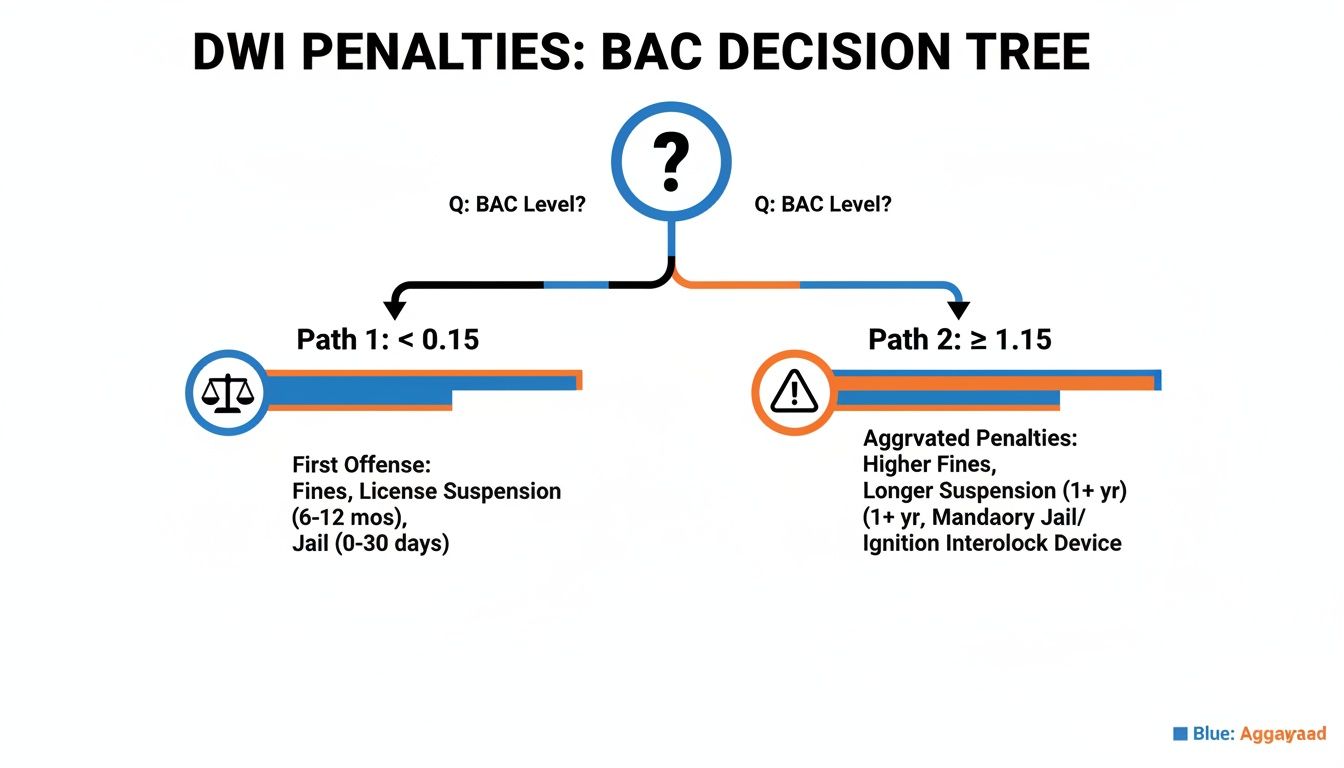
As you can see, hitting that 0.15% BAC mark is a game-changer, dramatically increasing the criminal penalties you could face.
What to Expect at an ALR Hearing
The ALR hearing is a formal but less intimidating setting than a criminal courtroom. It is held before an Administrative Law Judge, and its sole purpose is to decide the fate of your license.
The burden of proof is on the DPS. To suspend your license, they must prove:
- Reasonable Suspicion: The officer had a legal reason to stop you.
- Probable Cause: There was sufficient evidence to believe you were driving while intoxicated.
- Proper Procedure: You were lawfully arrested, informed of the consequences, and then either refused a test or provided a sample showing a BAC of 0.08% or higher.
A skilled DWI lawyer will scrutinize every detail. Was the traffic stop valid? Were the field sobriety tests administered correctly? Was the breathalyzer calibrated and functioning properly? Finding a weakness in the state's case can be enough to win the hearing and save your license.
Criminal Case Versus ALR Hearing Comparison
| Aspect | Criminal Court Case | Administrative License Revocation (ALR) Hearing |
|---|---|---|
| Purpose | To determine guilt or innocence for the DWI crime. | To determine if your driver's license should be suspended. |
| Who's Involved | Prosecutor vs. Defendant and their Attorney | Texas DPS Attorney vs. Defendant and their Attorney |
| Decision-Maker | Judge and/or Jury | Administrative Law Judge (ALJ) |
| Standard of Proof | "Beyond a reasonable doubt" (a very high standard). | "Preponderance of the evidence" (much lower standard). |
| Possible Outcomes | Conviction (jail, fines, probation) or Acquittal. | License suspension or no suspension. |
| Key Deadline | Varies, but the process takes many months. | You must request it within 15 days of your arrest. |
Your Lifeline: The Occupational Driver's License
Even if you lose the ALR hearing and your license is suspended, you are not necessarily stranded. Texas law provides a crucial safety net: the Occupational Driver's License (ODL).
An ODL, sometimes called an "essential need license," is a special, restricted license that allows you to drive for necessary reasons, including:
- Work: Commuting to and from your job.
- School: Driving to attend classes.
- Essential Household Duties: Grocery shopping, doctor's appointments, and taking your children to school or daycare.
Obtaining an ODL involves filing a petition with the court and securing a special type of insurance (SR-22). While it comes with restrictions, for most parents, an ODL is the critical lifeline that ensures a license suspension doesn’t completely destabilize their family's life.
How a Strong DWI Defense Strategy Is Built
The single most important thing to remember after a DWI arrest is this: an arrest is not a conviction. The State of Texas has the heavy burden of proving guilt beyond a reasonable doubt—the highest standard in our legal system. A compassionate and skilled DWI attorney does more than just file paperwork; they meticulously deconstruct the prosecution's case.
Building a strong defense for a DWI in Texas first offense requires a thorough investigation of every detail, from the reason for the traffic stop to the administration of chemical tests. Procedural errors, faulty equipment, and constitutional violations are more common than you might think, and any one of them can become the foundation of a successful defense.
Questioning the Initial Traffic Stop
Every DWI case begins with the traffic stop. Under the Fourth Amendment, a police officer cannot pull you over on a whim. They must have "reasonable suspicion" that you have violated a traffic law.
Your attorney will immediately scrutinize the officer's reason for the stop. Was it a clear violation, like speeding? Or was it something subjective, like "weaving within the lane"? If the stop was not legally justified, any evidence gathered afterward—field sobriety tests, breath samples, blood results—can be suppressed and thrown out of court.
Imagine this common scenario: A father is driving home late at night and his tire briefly touches the dividing line. An officer pulls him over and immediately launches a DWI investigation. If a judge determines that this minor deviation did not provide sufficient reasonable suspicion, the entire case could be dismissed before it even truly begins. This is just one example of why a thorough review of the stop is a critical first step.
Challenging Field Sobriety and Chemical Tests
Standardized Field Sobriety Tests (SFSTs) are often used to establish probable cause for an arrest. However, these tests are essentially physical challenges that many sober people would fail under ideal conditions, let alone on a dark roadside with the stress of a police encounter.
An effective defense puts these tests under a microscope:
- Were the instructions given correctly? Officers must follow precise protocols from the National Highway Traffic Safety Administration (NHTSA).
- Did medical or physical issues interfere? Balance problems, old injuries, age, and weight can make passing these tests nearly impossible.
- Was the testing environment fair? An uneven surface, poor lighting, or bad weather can invalidate the results.
The same intense scrutiny applies to chemical tests like the breathalyzer. These are complex machines that require constant maintenance and precise calibration.
A breathalyzer reading is only as reliable as the machine that produced it and the officer who administered the test. Any deviation from strict scientific and legal protocols can render the results inadmissible in court.
A dedicated defense attorney will demand maintenance logs, officer training records, and the "chain of custody" for any blood samples. Any error can create the reasonable doubt needed to win your case. To see a full breakdown of defense strategies, you can learn more about how to fight a DWI in Texas in our detailed guide.
Exploring Options to Keep a DWI Off Your Record
Facing a DWI charge can make you feel hopeless, as if a conviction is inevitable and a permanent stain on your record is a foregone conclusion. But for a first-time offense, Texas law offers several pathways that can protect your future and provide a second chance. These options focus on rehabilitation and responsibility, not just punishment.

For a DWI in Texas first offense, many prosecutors and judges understand that good people can make mistakes. This understanding opens the door to programs designed to help you move forward without a conviction weighing you down.
What Is a Pretrial Diversion (PTD) Program?
A Pretrial Diversion (PTD) program is often the best possible outcome. It is an agreement between you and the prosecutor's office. If you successfully complete specific requirements over a set period, the state agrees to dismiss the charge entirely.
A dismissal is a complete victory—it means no conviction. Eligibility for PTD programs varies by county but is typically reserved for those with a clean criminal history facing their first DWI.
Common PTD requirements include:
- Completing a DWI education class
- Performing community service
- Paying program fees
- Installing an ignition interlock device (IID) on your vehicle
- Abstaining from alcohol and submitting to random tests
Successfully finishing a PTD program is the ultimate goal because it allows you to pursue an expunction, which permanently erases the arrest record as if it never happened.
Understanding Deferred Adjudication
Another vital option is deferred adjudication. This is a form of probation where you plead "guilty" or "no contest," but the judge defers a finding of guilt. Instead of a conviction, you are placed on community supervision.
If you successfully complete all the terms of your deferred adjudication probation, the case is officially dismissed. This means you are never formally convicted of the DWI.
The impact of a dismissal cannot be overstated. It prevents the charge from appearing as a conviction on background checks, protecting your career and housing opportunities. The requirements are similar to PTD programs and may include classes, fines, and an ignition interlock device.
The Path to Sealing Your Record
A dismissal through deferred adjudication opens the door to the next crucial step: sealing your record. While the case is dismissed, the arrest itself remains. To shield it from public view, you can petition for an order of non-disclosure.
An order of non-disclosure prevents private entities—like potential employers, landlords, and loan officers—from seeing the arrest. It gives you a clean slate, allowing you to move forward without the stigma of a DWI. You can learn more by checking out our guide on how to get an order of nondisclosure in Texas. These favorable outcomes are not automatic; they require skilled negotiation by an experienced attorney who can advocate for your second chance.
The Hidden Costs of a Texas DWI Conviction
A DWI charge sends shockwaves through a family, reaching far beyond the courtroom. While your immediate focus may be on fines and potential jail time, the hidden, long-term costs of a conviction can be just as damaging. These collateral consequences can impact your finances, career, and personal life for years.
Understanding the full scope of what's at stake is not meant to frighten you, but to empower you. It highlights why fighting a dwi in texas first offense is so critical to protecting your family’s future.
Financial and Career Impacts
The financial strain of a DWI conviction extends well beyond court fines. One of the most significant impacts is on your car insurance. A single DWI on your record can cause your premiums to double or even triple, costing your family thousands of extra dollars over several years.
A conviction can also create serious professional roadblocks. Most employers conduct background checks, and a DWI can make it incredibly difficult to find a new job or even keep your current one, especially in fields that require:
- Driving: Commercial drivers (CDL holders), delivery personnel, or sales professionals.
- Professional Licenses: Nurses, teachers, pilots, and other licensed professionals may face disciplinary action from their state boards.
- Positions of Trust: Jobs in finance, security, or childcare could be at risk.
Personal and Family Consequences
The fallout from a DWI conviction can also impact your most important personal relationships. In family law cases, such as a child custody dispute, a recent DWI can be used by an opposing party as evidence of irresponsible behavior or a substance abuse issue. This could seriously harm your chances of securing a favorable outcome regarding your parental rights and visitation.
A DWI conviction is more than a legal problem; it's a life problem. The consequences can follow you for years, affecting your ability to provide for your family, pursue your career, and even maintain stable personal relationships.
Texas takes these cases seriously for a reason. Impaired driving contributed to 14,389 fatalities statewide over a recent ten-year period. This sobering statistic helps explain why even a first offense is treated with such gravity. You can explore more Texas DWI statistics for a broader perspective. For some, a DWI can also be a wake-up call, prompting them to address an underlying issue and learn how to detox from alcohol safely. Facing these hidden costs head-on is the first step toward minimizing their impact and protecting what matters most—your family.
Answering Your Urgent Texas DWI Questions
When you’re facing a DWI charge, your mind is flooded with questions and worries. The uncertainty can be overwhelming. This section provides clear, direct answers to the most common concerns we hear from families navigating a first-offense DWI in Texas. Our goal is to provide practical guidance and bring some clarity to a confusing time.
What Happens If I Refuse a Breathalyzer Test?
Refusing a breath or blood test triggers an immediate administrative process. Under Texas's "implied consent" law, a first-time refusal results in an automatic driver's license suspension of 180 days.
Crucially, you only have 15 days from your arrest to request an Administrative License Revocation (ALR) hearing to challenge that suspension. If you miss this deadline, the suspension is automatic and cannot be reversed.
Can I Get a DWI for Prescription Medication?
Yes, absolutely. In Texas, "intoxication" is legally defined as not having the normal use of your mental or physical faculties due to alcohol, a controlled substance, a drug, or any combination.
This means that even legally prescribed medications can lead to a DWI if they impair your ability to drive safely. It does not matter if you took the medication exactly as prescribed; if it affects your driving, you can be arrested and charged.
Will I Definitely Go to Jail for a First DWI?
While jail time is a real possibility, it is not guaranteed for a dwi in texas first offense. As a Class B Misdemeanor, a conviction carries a potential sentence of 72 hours to 180 days in jail. However, for a first-time offender with no aggravating factors (like an accident or an extremely high BAC), an experienced attorney can often negotiate alternatives, most commonly probation, which is called "community supervision" in Texas.
The outcome of a DWI case is never guaranteed. Factors like the specific facts of your case, the county where you were arrested, and the strength of your legal defense all play a huge role in whether jail time can be avoided.
Can I Still Drive to Work If My License Is Suspended?
For most people, the answer is yes. If your license is suspended, you can petition the court for an Occupational Driver's License (ODL). This is an "essential need" license that allows you to drive for specific, necessary purposes, such as getting to and from work, taking children to school, and performing essential household errands. For most families, securing an ODL is a critical step to maintaining stability while the DWI case proceeds.
A DWI arrest can make you feel lost and alone, but you do not have to navigate this challenging time by yourself. The right legal guidance can make all the difference in protecting your freedom, your license, and your family's future. The attorneys at the Law Office of Bryan Fagan PLLC understand what is at stake and are here to provide the compassionate, strategic defense you deserve. Contact us today for a free, confidential consultation to discuss your case and learn how we can help protect your family.
Contact the Law Office of Bryan Fagan PLLC for a Free Consultation