Skip to content
When Child Protective Services (CPS) enters your family’s life, the world can feel like it’s tilting off its axis. The fear, confusion, and sense of powerlessness are overwhelming. As you face a legal process that threatens the one thing you hold most sacred—your children—you will be asked to make a monumental decision: should your case be decided by a jury or by a judge alone?
At its heart, the difference between a jury trial and a bench trial comes down to one simple question: Who decides your family's future? In a jury trial, that power rests with a group of twelve ordinary citizens from your community. In a bench trial, it's in the hands of a single, experienced judge. The right choice for your family hinges on whether your story is better told to an audience that connects with human emotion and community values, or to a legal expert focused on the strict, technical application of Texas law.
Navigating Your CPS Case Trial Options
This decision is not just a legal checkbox to tick. It is a strategic choice that will fundamentally shape the entire defense of your parental rights. It dictates how your story is told, which evidence is highlighted, and who will ultimately hold your family's fate in their hands. Taking the time to understand the differences is the first, crucial step toward regaining some control in a process that often feels like it's spiraling away from you. This guide is here to provide you with the clarity and reassurance you need to navigate this critical decision.
Key Distinctions at a Glance
For any Texas parent facing a CPS lawsuit, getting a firm grip on these core differences is non-negotiable. These cases are governed by very specific parts of the Texas Family Code, from the timelines in Chapters 262 and 263 to the grounds for termination of parental rights found in Chapter 161.
In a CPS case, choosing between a judge and a jury means choosing your audience. A jury might connect with the deeply human story of your family, while a judge will be laser-focused on whether CPS has met its heavy legal burden under the Texas Family Code.
To make this critical choice a little clearer, here’s a straightforward comparison of the two trial types:
| Feature | Jury Trial | Bench Trial (Judge Only) |
|---|---|---|
| Decision-Maker | A panel of 12 citizens from the community. | A single, elected or appointed judge. |
| Verdict Rule | The jury's verdict must be unanimous to terminate parental rights. | The judge's decision is final (subject to appeal). |
| Primary Appeal | Appeals to emotion, fairness, and common sense. | Appeals to legal precedent and strict interpretation of the law. |
| Best For | Cases with strong emotional facts or where CPS actions seem unjust. | Cases involving complex legal or procedural arguments. |
| Legal Knowledge | Jurors have no legal training. | The judge is an expert in the Texas Family Code. |
Understanding the full picture of the road ahead is crucial, which is why we’ve also detailed the Texas CPS court hearings and timelines in this essential guide for parents.
How a Jury Trial Works in a CPS Case

Choosing a jury trial means you're putting your family's fate in the hands of twelve citizens from your own community. For parents who feel steamrolled by a CPS investigation, this option can feel more human. It’s a chance to tell your story to a group of peers who actually understand the messy, complicated reality of family life.
In a Texas CPS case, a jury trial isn't just a legal formality. It's an opportunity for powerful, heart-to-heart storytelling. A jury trial lets your attorney frame the case in a way that connects with shared values—fairness, family, and a parent's love for their child. Jurors aren't legal scholars; they are neighbors, parents, and people who bring their own life experiences into that courtroom. This can be a huge advantage when the facts of your case might shock an ordinary person, or when CPS's actions just seem fundamentally unfair.
The Jury Selection Process: Voir Dire
The trial kicks off with a critical step called voir dire, a French term meaning "to speak the truth." This is where your attorney and the lawyer for CPS question a pool of potential jurors to see who will be selected. The official goal is to find fair and impartial individuals, but it's also a deeply strategic opportunity for your legal team.
Your attorney will ask carefully crafted questions to uncover any hidden biases. For example, they might ask potential jurors about their own experiences with CPS or their beliefs about a parent's right to raise their own children. The objective is to find jurors who can empathize with your family’s situation and keep an open mind.
The power of a jury trial lies in its ability to introduce a fresh, unbiased perspective. While a judge may have heard hundreds of similar cases, a jury sees your family's story for the first time, offering a critical safeguard against case-hardened viewpoints.
Presenting Your Story to Your Peers
Once the jury is selected, the trial moves forward with opening statements, evidence, and witness testimony. In a jury trial, the way this evidence is presented is tailored to connect on a human level. Your attorney’s real job is to weave the cold facts into a compelling narrative that jurors can understand and relate to.
Real-Life Scenario: Imagine a single mom gets reported to CPS by a neighbor after her child, who has a medical condition causing easy bruising, takes a tumble at the playground. CPS, following its playbook, opens a case and tries to remove the child, pointing to the bruises as proof of abuse. To a judge who has seen countless legitimate abuse cases, these facts might fit a familiar, tragic pattern. A jury of peers, however, may be far more open to hearing the mother's side of the story. They can hear from the child's doctor, see pictures of the playground equipment, and listen to the mother’s emotional testimony about her child’s health struggles. The jury can connect with the fear and panic she felt, seeing the situation through the eyes of a fellow parent.
This is where the strategic power of a jury trial really shines:
- Emotional Connection: The jury can feel the true weight of what’s at stake—the potential separation of a loving mother from her child.
- Common Sense: They can apply everyday logic and ask whether the evidence truly points to abuse or just an awful accident made worse by a medical issue.
- Unanimous Verdict: In Texas, a jury’s decision to terminate parental rights must be unanimous. If even one juror has a reasonable doubt, your rights cannot be taken away.
Of course, ensuring the integrity of documents presented as evidence is critical in any trial. You can learn more about protecting legal documents from editing to see how digital files are secured for court. A jury trial can be a powerful shield, but it demands a legal strategy built on clear, persuasive, and relatable storytelling.
Understanding the Bench Trial Process

A bench trial puts the entire outcome of your CPS case into the hands of a single person: the judge. For many parents, that can sound far more intimidating than facing a jury of peers. But in very specific, often complex situations, an experienced family law judge can be the most strategic—and favorable—audience for your defense.
This choice shifts the focus away from emotional storytelling and squarely onto the cold, hard letter of the law. While a jury trial is often about connecting with people, a bench trial is about making a precise legal argument to an expert who lives and breathes the Texas Family Code every single day. When your defense hinges on intricate legal arguments, technical evidence, or exposing critical procedural mistakes made by CPS, a judge’s deep expertise becomes your greatest asset.
The Judge as a Legal Expert
Family court judges in Texas preside over hundreds of CPS cases. They have an expert-level understanding of the complex statutes that govern everything CPS does, from the initial removal to the final trial. This includes:
- Chapter 262 of the Texas Family Code: This chapter governs the procedures for emergency removal and the required hearings that must happen within strict timelines.
- Chapter 263 of the Texas Family Code: This lays out the deadlines and requirements for the final trial, often called the "one-year-and-a-day" rule.
- Chapter 161 of the Texas Family Code: This contains the specific legal grounds CPS must prove by "clear and convincing evidence" to terminate your parental rights.
A judge knows these statutes inside and out. They understand that if CPS misses a critical deadline or fails to follow proper procedure, it’s not just a minor slip-up—it’s a violation of the law that can be grounds for dismissing the case entirely.
A jury might not grasp the legal significance of CPS failing to hold a hearing on time, but a judge will. When your case is built on the law itself, you want a decision-maker who is an expert in that law.
A Real-World Example
Let's say CPS removes your children, and your attorney discovers that the department failed to serve you with the lawsuit papers according to the strict rules of legal procedure. This is a highly technical legal argument.
In front of a jury, explaining the nuances of "service of process" could be confusing and might not resonate emotionally. A jury might see it as a minor technicality and instead focus on the allegations CPS has made against you, regardless of the procedural error.
In a bench trial, your attorney can present a motion to the judge arguing that the case must be dismissed due to improper service. The judge will immediately grasp the legal gravity of this mistake. They will focus solely on the law: Did CPS follow the rules? If the answer is no, the judge has the power and legal obligation to rule in your favor based on that error alone, without ever getting to the emotional allegations.
Strategic Advantages of a Bench Trial
Opting for a judge to hear your case can offer several key benefits, especially when the facts are complicated or legally dense.
- Focus on Law, Not Emotion: Judges are trained to set aside emotional bias and focus strictly on whether the evidence presented meets the high legal standard required for termination. This is vital if the allegations against you are emotionally charged but the actual evidence is weak.
- Understanding Technical Evidence: If your case involves complex medical records, psychological evaluations, or expert witness testimony, a judge is far better equipped to analyze this information accurately than a lay jury.
- Efficiency and Speed: Bench trials are generally much faster than jury trials. There's no time-consuming jury selection process, and the presentation of evidence can be more direct and streamlined.
Choosing a bench trial is a strategic decision made when the clearest path to victory lies in the law itself. It requires an attorney who can build a powerful case grounded in statutory requirements and legal precedent—a defense made for an expert audience.
Comparing Key Strategic Differences
When you're fighting for your family in a Texas CPS case, one of the most critical decisions you and your attorney will make is whether to have your trial in front of a jury or a judge. This isn't just about choosing who listens to your story; it's about fundamentally aligning your entire defense strategy with the decision-maker who is most likely to understand it.
The choice forces you to look at the heart of your case. Is your story one of human emotion and fundamental fairness that will resonate with everyday people? Or is it a battle of legal technicalities, procedural errors, and the fine print of the Texas Family Code? We need to move beyond a simple pro/con list and dig into how a jury's capacity for empathy stacks up against a judge's deep legal knowledge—especially when facing an opponent like CPS, an agency that judges deal with day in and day out.
The Decision-Maker: Your Audience is Everything
The most obvious difference between a jury trial vs. a bench trial is your audience. In one scenario, you're making your case to twelve members of your community. In the other, you're speaking to a single legal expert who has likely heard hundreds of cases just like yours.
-
A Jury’s Point of View: Jurors are regular people. They bring their own life experiences, common sense, and emotional understanding into the courtroom. They are far more likely to connect with a parent’s fear, frustration, and fierce love for their children. If CPS's actions feel overbearing or simply unfair to an average person, a jury is your best shot at getting that injustice recognized. They are a fresh pair of eyes on a system that can often feel routine to those on the inside.
-
A Judge’s Point of View: A judge, on the other hand, brings years of legal training and direct, hands-on experience with the Texas Family Code. They’ve seen every tactic CPS has in its playbook, heard nearly identical allegations before, and deeply understand the state's very high burden of proof—"clear and convincing evidence." If your defense hinges on exposing procedural mistakes, challenging the admissibility of evidence, or making complex legal arguments, a judge is often the only person in the room equipped to grasp the full weight of your position.
The choice really boils down to this: Do you need someone who can feel the injustice in your family's story, or someone who can see the legal flaws in the state’s case? The answer to that question will shape your entire trial strategy.
Evidence and the Rules of the Courtroom
The way evidence is presented and handled also shifts dramatically between a jury trial and a bench trial. The rules of evidence are in place to ensure a fair fight, but they’re applied very differently depending on who is making the final call.
In a jury trial, these rules are enforced with extreme strictness. Here, the judge acts as a gatekeeper, shielding the jury from any information that could unfairly prejudice them. For instance, if CPS tried to bring up a past mistake you made that has zero relevance to the current case, your attorney would object. The judge would almost certainly prevent the jury from ever hearing it, ensuring their decision is based only on the legally admissible facts.
Things are a bit more relaxed in a bench trial. A judge is trained to filter out legally irrelevant information. They can hear potentially inadmissible evidence and are trusted to mentally "disregard" it when making a final decision. While this can make a bench trial faster and more efficient, it also means the judge might be exposed to negative information that a jury would have been shielded from entirely.
Timelines, Costs, and Practical Realities
Beyond the legal strategy, every family has to face the practical realities of time and money. A jury trial is, without a doubt, a longer and more expensive undertaking. The process starts with the time-consuming jury selection, involves more formal procedures throughout, and requires attorneys to spend significantly more time crafting arguments that connect on an emotional level. All these factors add up, increasing legal fees and dragging out the painful uncertainty your family is already enduring.
A bench trial is far more streamlined. With no jury to select or instruct, the trial itself is shorter and often wraps up much more quickly. This efficiency can lower legal costs and get your family a resolution sooner. While the number of trials is declining nationwide, understanding these mechanics is vital. A 2005 study of U.S. state courts confirmed that while jury trials were common, bench trials were resolved much faster. You can explore more about these civil trial trends from the Bureau of Justice Statistics.
Jury Trial vs. Bench Trial: A Strategic Comparison for CPS Cases
This table breaks down the critical strategic elements of jury and bench trials to help Texas families understand the real-world implications of their choice in a CPS case.
| Strategic Factor | Jury Trial (12 Jurors) | Bench Trial (Judge Only) |
|---|---|---|
| Primary Appeal | Emotional connection, fairness, and common-sense justice. | Legal precision, procedural accuracy, and strict application of the Texas Family Code. |
| Evidence Rules | Applied very strictly to prevent prejudice. The judge acts as a gatekeeper. | Applied more flexibly, as the judge can filter out inadmissible evidence. |
| Decision Speed | Slower, due to jury selection, instructions, and deliberation. | Faster and more efficient, leading to a quicker resolution. |
| Associated Costs | Higher, due to increased attorney time and trial complexity. | Lower, due to the streamlined and shorter process. |
| Best Suited For | Cases with strong human-interest facts or clear injustice that would resonate with peers. | Cases that hinge on complex legal arguments or technical evidence. |
Ultimately, choosing between a jury and a judge is a decision that requires a deep, honest assessment of your case's strengths and weaknesses. It's a conversation you must have with an experienced CPS defense attorney who can help you see the path forward.
When to Choose a Jury vs a Judge
Deciding between a jury trial and a bench trial is one of the single most important strategic moves you’ll make in your CPS case. This isn't just some legal theory; it's a gut-check decision that demands an honest look at your story, CPS’s evidence, and the very foundation of your defense. Your choice here sets the entire tone for the fight ahead. It dictates who hears your story and what kind of arguments will resonate.
Opting for a Jury When Your Story Needs to Be Heard
A jury trial is often the best path when your case has a powerful human element. You're putting your fate in the hands of 12 regular people from your community, asking them to listen, connect, and decide what’s fair.
Think about pushing for a jury trial in these kinds of situations:
- When the Allegations Feel Unjust or Overblown: If the charges against you seem completely out of proportion to what actually happened, a jury might be your best audience. Jurors bring common sense to the courtroom and can often spot when the government is overreaching.
- When Your Case Has a Strong Emotional Core: A compelling narrative is your best weapon. If you can clearly and sympathetically tell your side of the story, a jury of your peers is far more likely to be moved than a judge who has heard hundreds of similar cases.
- When the Facts are Simple and on Your Side: If your defense boils down to straightforward, easy-to-digest facts that point to your innocence or a clear misunderstanding, a jury can grab onto that without getting lost in legal weeds.
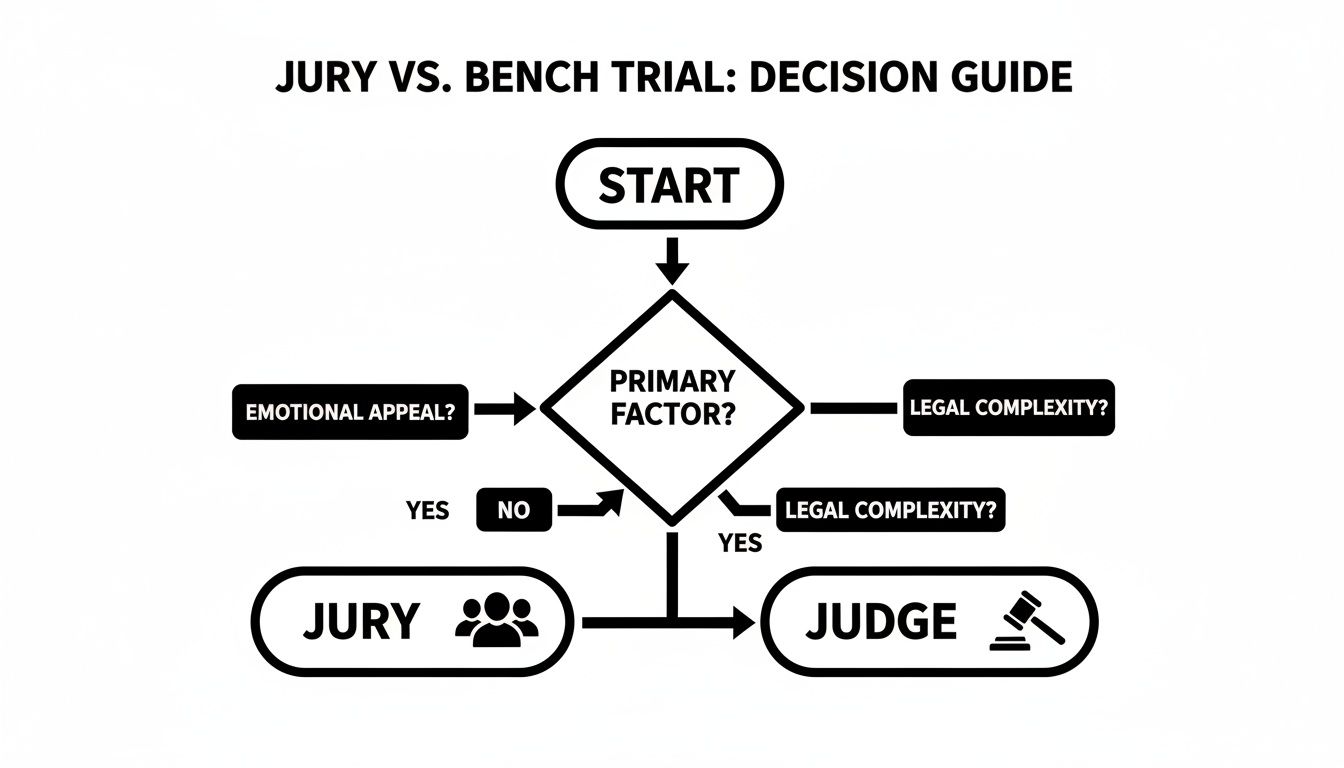
This visual guide simplifies the choice: cases built on powerful, human stories often belong before a jury, while those centered on legal technicalities are better suited for a judge.
Choosing a Judge for Legally Complex Defenses
On the flip side, a bench trial—where only a judge decides your fate—is the smarter play when your defense hinges on complex legal arguments or highly technical evidence. A judge is a legal expert, trained to dissect dense information without emotion.
A bench trial is often the right call under these circumstances:
- When Your Defense is Highly Technical: If your case is built on challenging CPS's failure to follow strict timelines under the Texas Family Code, the admissibility of evidence, or intricate procedural rules, a judge is the only one qualified to appreciate the nuances. A jury might see these as "technicalities," but a judge knows they are the bedrock of the law.
- When the Evidence Requires an Expert Eye: Is your defense centered on dissecting flawed medical reports, challenging complex psychological evaluations, or presenting detailed expert witness testimony? A judge can weigh that kind of evidence with a level of understanding a jury simply won't have.
- When You Need to Sidestep Emotional Bias: In cases where the allegations are particularly ugly or shocking but the state’s evidence is legally flimsy, a judge is better equipped to set aside the emotional noise and focus strictly on whether CPS has met its high burden of proof.
Ultimately, the decision comes down to a deep, honest analysis of your case's specific facts and legal footing. This is far too important to decide without expert legal advice.
Choosing your trial type is just one of many strategic forks in the road you'll face. Having the right legal partner to guide you is everything. If you need help finding the right fit for your situation, you can learn more about how to choose a criminal defense attorney who understands these complex dynamics.
The Power of Trial Preparation in Reaching a Resolution
While a trial—whether in front of a judge or a jury—feels like the ultimate destination in a CPS case, here’s a surprising truth: most cases never get that far. This reality isn't meant to discourage you, but to give you a clear-eyed view of how these legal journeys actually unfold.
Think of it this way: preparing for trial is a critical part of a much larger strategy. It’s about building the strongest defense possible to create leverage for negotiations. A sharp attorney is always getting ready for that courtroom battle, but they’re also working tirelessly to achieve the best outcome outside of it—which is almost always reuniting your family without needing a verdict.
Most CPS cases are resolved through negotiation and settlement, often in mediation. The goal is to reach a Mediated Settlement Agreement (MSA) or an agreed order that reunites your family while satisfying the court's concerns.
The most powerful tool you have is a lawyer who is both a fierce litigator and a savvy negotiator. Their ability to prepare a rock-solid trial defense is precisely what can force CPS to offer a favorable settlement, often making a trial unnecessary.
Every single step your attorney takes to get ready for a jury or bench trial—digging up evidence, deposing witnesses, filing motions—makes your negotiating position stronger. When CPS and their lawyers see that you are ready, willing, and able to present a formidable case in court, they become far more motivated to find a reasonable middle ground. You can learn more about how to prepare for mediation in our detailed guide.
The road through a CPS case is rarely a straight line to a verdict. It’s a winding path with many off-ramps and opportunities for resolution. Your legal team’s job is to be ready for every single one.
Common Questions About Texas CPS Trials
When your family's future is on the line, the court process can feel overwhelming and full of unknowns. Getting clear, straightforward answers is the first step toward regaining a sense of control. Here are some of the most pressing questions Texas parents ask us about CPS trials.
How Is a Jury Picked in a CPS Case?
The process of selecting a jury is called voir dire (a French term meaning "to speak the truth"). This is where the attorneys for both you and CPS get to question a large group of potential jurors to see who will be fair and impartial.
Your attorney's main job here is to root out anyone who might already have a bias against parents in CPS situations. Both sides get a certain number of "strikes" to remove potential jurors without giving a reason (peremptory challenges). They can also ask the judge to dismiss a juror "for cause" if that person admits they can't be unbiased. The first 12 people who remain after this filtering process become the final jury.
Can I Change My Mind After Picking a Bench or Jury Trial?
This is a critical point: once you waive your constitutional right to a jury trial, it's incredibly difficult to go back. Agreeing to a bench trial is a significant legal move.
If you change your mind later, you'll generally need permission from both the judge and CPS to switch back to a jury trial—and they rarely grant it. That's why the initial jury trial vs. bench trial decision is so foundational. It's a conversation you must have with your attorney, as it shapes your entire defense from day one.
Can the Final Decision from a Trial Be Appealed?
Yes, a final order in a CPS case can be appealed, whether it came from a judge or a jury. But it's crucial to understand what an appeal actually is.
An appeal is not a second chance to present new evidence. It is a review of the trial record to determine if significant legal errors were made that unfairly impacted the final outcome of your case.
An appellate court will review the trial transcript for legal mistakes, like the judge misinterpreting the Texas Family Code or allowing evidence that should have been excluded. The appeals process is complex, with very strict deadlines, and it requires a lawyer who specializes in appellate law.
The path through a CPS case is challenging, but you do not have to walk it alone. At The Law Office of Bryan Fagan, we understand the fear and uncertainty you are facing. We are committed to defending your parental rights with skill, compassion, and unwavering dedication. If you are facing a CPS investigation or trial, you need actionable advice and a powerful advocate in your corner. Let us help you understand your options and build the strongest possible defense for your family.
We are here to listen to your story, answer your questions, and fight for the outcome your family deserves. Please contact us for a free, confidential consultation today.