Skip to content
The first call from Child Protective Services—or that unexpected knock on the door—is enough to make any parent’s world stop turning. Facing accusations that strike at the very heart of who you are as a parent is a nightmare. The fear, confusion, and sense of injustice can be completely paralyzing. It's a situation no one is ever prepared for, especially when you know the claims are completely baseless.
When you're up against false CPS allegations in Texas, it's crucial to remember one thing: you are not powerless. You have rights, and a calm, strategic response is your best defense to protect your family and clear your name.
The Overwhelming Reality of a False CPS Accusation

That initial contact from a CPS investigator throws you into a state of shock, fear, and utter disbelief. One minute, you’re just living your life—making school lunches, helping with homework, planning a weekend trip. The next, you’re being forced to defend your character and your relationship with your children against a faceless accuser. It feels like the ground has disappeared from under you.
Unfortunately, this devastating experience is a reality for far too many Texas families. False reports often arise from bitter personal disputes, turning private arguments into legal battles that threaten to rip families apart.
A Common and Painful Scenario
Picture this: you're in the middle of a messy divorce or a heated custody battle. Tensions are running high. Your ex, looking for an edge, decides to make a call to the Texas Abuse Hotline. They twist a story about a simple moment of discipline or flat-out lie, claiming you neglect the kids by leaving them unsupervised.
Suddenly, a caseworker is on your doorstep, talking about a formal report and asking to interview your children—alone. Your mind starts racing. How do you prove something didn't happen? How can you possibly fight an allegation that was created out of malice, not fact? This isn't just a hypothetical. It's a tactic we see all the time, weaponizing the very system meant to protect children.
The emotional and financial toll of defending against false CPS allegations is immense. You aren't just fighting a legal case; you're fighting for your child, your good name, and your family's future.
This guide is meant to be your roadmap through that overwhelming uncertainty. At The Law Office of Bryan Fagan, we have seen this scenario play out time and again. We get the panic you're feeling, but we also know that a clear, strategic approach is your greatest asset. Here, we’ll provide the clarity, legal insight, and actionable steps you need to protect your parental rights and effectively fight back against false CPS allegations in Texas.
Your First 48 Hours: Navigating the Initial CPS Contact
A knock on the door from a CPS caseworker can send a jolt of pure panic through any parent. Your mind starts racing, and it’s completely natural to feel scared and overwhelmed. But what you do in these first 48 hours is absolutely critical. Your immediate actions can set the tone for the entire investigation, especially when you know the allegations are false.
Making calm, strategic moves under pressure is your best defense. The goal isn't to be hostile; it's to be smart and protect your family from common missteps that can have devastating, long-term consequences.
Immediate Do's When CPS Arrives
Your first response should be polite but firm, focused on protecting your rights without starting a fight. You don't have to answer every question right away or agree to every demand on the spot.
Here’s what you should do:
- Stay Calm and Respectful: Your demeanor is the first thing an investigator will note. Even if you're terrified or furious, staying calm and polite prevents them from twisting your emotions into "proof" of guilt or aggression.
- Identify and Document Everything: Ask the caseworker for their name, their supervisor's name, and their phone number. Write down the date, time, and the specific reason they give for showing up. This is the very first piece of evidence you’ll gather for your defense.
- Contact an Attorney Immediately: This is the single most important step. Before you answer any in-depth questions, sign a single piece of paper, or agree to anything, state calmly and clearly, "I am happy to cooperate, but I need to speak with my attorney first."
Exercising your right to legal counsel doesn't make you look guilty—it shows you’re serious about protecting your family.
Critical Don'ts to Avoid Common Pitfalls
What you don’t do in these first two days is just as important as what you do. Caseworkers might frame certain requests as standard procedure or even mandatory, but you have the right to say no until you've spoken to a lawyer.
We see this all the time: a caseworker shows up and says they need to interview your children alone. They might pressure you, saying, "If you have nothing to hide, this shouldn't be a problem." You feel backed into a corner and agree. The caseworker then interviews your anxious child, whose confusing answers get twisted and documented as "evidence." This mistake is incredibly common and can create a problem where one never existed.
To help you stay in control, here is a quick-reference checklist of what to do and what to avoid in those crucial first moments.
Immediate Response Checklist When CPS Contacts You
| Action to Take (Do) | Mistake to Avoid (Don't) |
|---|---|
| Remain polite and step outside to talk. | Do not let the caseworker into your home without a warrant. |
| Get the caseworker's information (name, office, supervisor). | Do not sign any documents, especially a "safety plan." |
| State that you will cooperate after speaking to your lawyer. | Do not allow your children to be interviewed without your attorney present. |
| Immediately call an experienced family law attorney. | Do not try to "explain away" the allegations or overshare details. |
| Write down everything that was said and done. | Do not argue, get angry, or make threats. |
This checklist isn't about being difficult; it's about setting firm, legal boundaries from the very beginning. By taking these smart, protective steps, you can prevent the situation from spiraling out of control.
Never sign any documents presented by CPS without your attorney reviewing them first. This includes a "Parental Child Safety Placement" or a "voluntary" safety plan. These are often legally binding contracts that can result in you "voluntarily" signing away your rights to see your children.
Here are other critical missteps to avoid:
- Do Not Let Them In Without a Warrant: You are not required to let a caseworker inside your home without a court order. You can step outside to talk and politely say you do not consent to a search. For a more detailed breakdown, you can learn more about your rights during a CPS home visit in Texas.
- Do Not Let Them Interview Your Children Alone: Politely refuse any request for the caseworker to speak with your children without your attorney present. A lawyer can make sure the interview is conducted fairly and that your child's words aren't manipulated.
- Do Not Try to "Explain" Everything: When you’re facing false allegations, it’s natural to want to prove your innocence by sharing every detail. Resist this urge. Any statement you make can be taken out of context. Keep your answers brief and defer to your attorney.
Successfully handling this initial contact is all about establishing boundaries. By staying calm, calling a lawyer, and firmly but politely asserting your rights, you take back control in a situation that feels designed to make you powerless. These first steps are the foundation for building a strong defense and protecting your family’s future.
How Does a Texas CPS Investigation Actually Work?
When you're facing a false CPS allegation, it feels like your world is tilting on its axis. To fight back effectively, you have to understand the system you’re up against. Knowledge is power, and knowing the process transforms fear into a clear, strategic response.
CPS investigators don't just make things up as they go. They operate on a specific set of rules outlined in the Texas Family Code. Let’s break down exactly what happens, from the moment that first call is made to the final letter you receive in the mail.
The First 72 Hours: Intake and Priority Levels
Every single CPS case begins with a call to the Texas Abuse Hotline. Anyone can make a report, and they can do it anonymously. That report goes to an intake center, where a worker screens the call to decide if the allegations, if true, would legally qualify as child abuse or neglect under Texas law.
If the report is accepted, it's assigned a priority level. This is all about how urgent CPS believes the situation is.
A Priority 1 (P1) case means there are allegations of immediate harm. CPS is required to make face-to-face contact and start their investigation within 24 hours. A Priority 2 (P2) case is considered less urgent, giving the caseworker up to 72 hours to show up at your door.
It's a system that, unfortunately, is flooded with false or unsubstantiated claims. In 2022, a staggering 12,473 anonymous reports were made in Texas. Of those, only about 1,000 resulted in confirmed findings of abuse. This data, which you can find on the Texas Department of Family and Protective Services website, shows just how many Texas families are put through invasive investigations based on tips that turn out to be nothing.
The Investigation Phase: What to Expect for the Next 30-45 Days
Once a case is assigned, the clock starts ticking for the caseworker. They typically have 30 to 45 days to complete their investigation, although this can be extended for more complex situations.
During this time, the caseworker is trying to gather as much information as possible. You can expect them to:
- Interview your child. This is usually their first move. Under Texas law, they can interview a child at their school or daycare without your permission or you even being there.
- Interview you. The caseworker will want to speak with both parents or caregivers. Remember, you have the right to have an attorney present for this interview. You should absolutely exercise that right.
- Talk to others in the home. This can include siblings, grandparents, or anyone else living with you.
- Contact "collateral" sources. They will reach out to people outside your home—teachers, doctors, therapists, neighbors, and family friends—to ask about your child and your family life.
The goal of all this is to determine if there is a "Reason to Believe" that abuse or neglect occurred. For a deeper dive into what this entails, we've put together a full guide on the Texas CPS investigation process.
A Quick Note on "Alternative Response": For some lower-risk cases, CPS might offer something called "Alternative Response" (AR). It's supposed to be a less combative approach that focuses on connecting families with services instead of making a formal finding. Even if your case is designated as AR, you still need to speak with an attorney to make sure your rights aren't being quietly signed away.
The Final Ruling: What Do the Findings Mean?
At the end of the investigation, the caseworker will issue a formal finding. This decision carries huge weight and can affect your family for years, so you need to know what each outcome means.
When that caseworker first makes contact, your immediate response sets the tone for everything that follows.
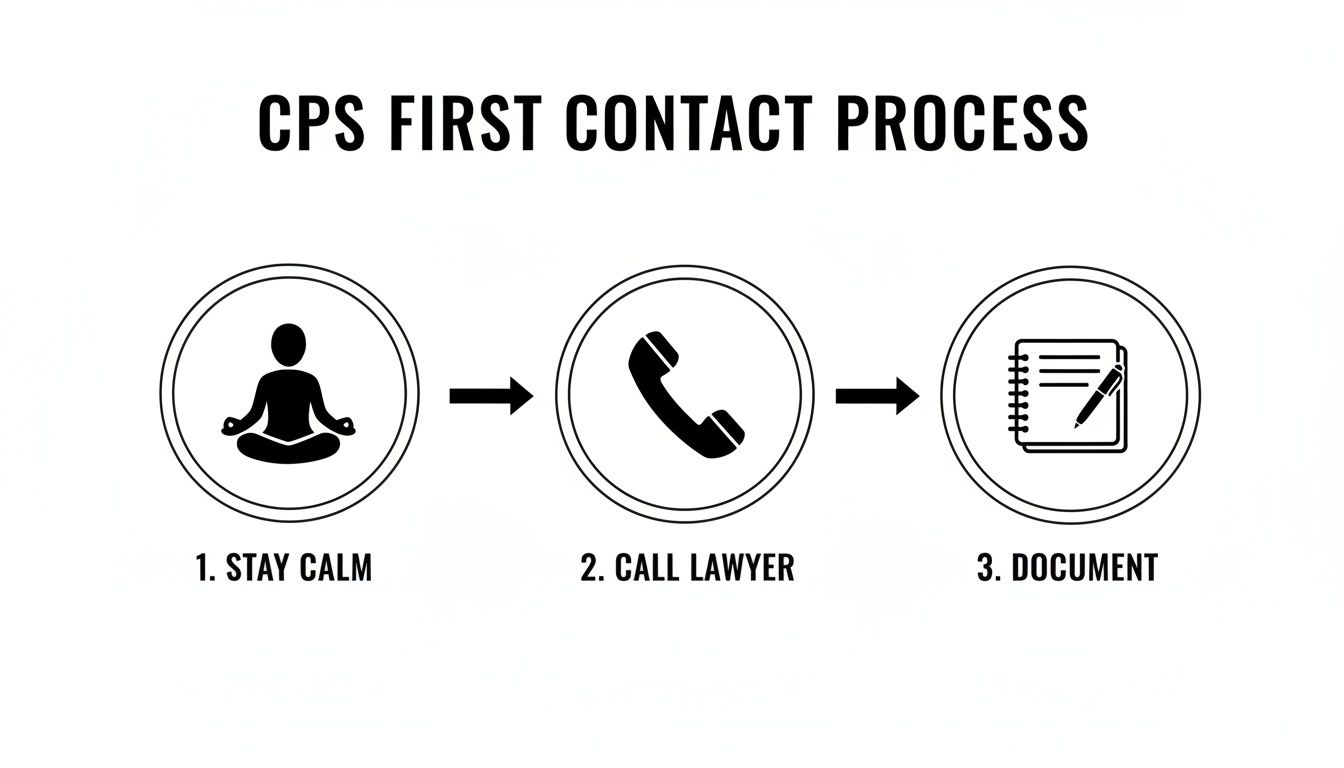
These three actions—staying calm, calling a lawyer, and documenting everything—are the bedrock of a solid defense.
Here are the possible findings you could receive:
- Reason to Believe (RTB): This is the one you don't want. It means the investigator decided it's more likely than not that abuse or neglect happened. An RTB finding can trigger a court case to remove your children and will place your name on the Child Abuse Central Registry.
- Ruled Out: This is the best-case scenario and our goal in every false allegation case. It means the investigator concluded the alleged abuse or neglect did not occur. The case is closed.
- Unable to Determine: This is a neutral finding. It means there wasn't enough evidence to either confirm or deny the allegations. While it's not a guilty verdict, it leaves a cloud of suspicion that can be unsettling.
- Administrative Closure: This means the case was closed for a procedural reason, like CPS being unable to locate the family.
When you're up against a false accusation, the only acceptable outcome is a "Ruled Out" finding. Understanding this entire process—from the anonymous call to the final determination—is how you start fighting back.
Building Your Defense Against False Allegations

After the initial shock of a CPS investigation wears off, it’s time to get to work. You can't just sit back and hope the truth will come out on its own. This is the moment to shift from defense to offense and start methodically building the case that proves your side of the story. Dismantling a false claim isn't about arguing—it's about presenting undeniable, organized proof that paints a true picture of your family.
When you’re up against a false allegation, your life essentially becomes an open book. Your job is to make sure you're the one writing the chapters. Every text message, email, photo, or even a simple grocery receipt can become a powerful piece of evidence that shows a loving, stable family life, directly contradicting the lies being told.
Preserve Every Piece of Digital Communication
So much of our daily life leaves a digital footprint, and right now, that trail is your most valuable asset. Your first move should be to preserve every piece of communication that shows your character, your relationship with your child, and the real context of your life.
- Text Messages and Emails: Start saving conversations with your child, the other parent, teachers, and family members. These exchanges often show the positive, everyday interactions that fly in the face of abuse or neglect claims.
- Social Media History: While you need to stop posting about your case immediately, go back through your old posts. Save photos, check-ins, and updates that show happy family moments, a clean and safe home, and a healthy parent-child bond.
- Photos and Videos: Your phone's camera roll is a goldmine. Gather personal photos and videos that show your child is happy, healthy, and well-cared-for. A timestamped video of your child playing in a clean house can single-handedly debunk an allegation of neglect.
Whatever you do, don't delete anything, even if it seems harmless or irrelevant. A quick text exchange you've long forgotten could be the very thing that unravels a lie.
Construct a Detailed Timeline of Events
False allegations often have one major weakness: they can’t stand up to a concrete timeline. Get a notebook or open a spreadsheet and start logging events, especially around the date and time the alleged incident was supposed to have happened. This timeline will become the spine of your defense, giving your attorney the tool they need to poke holes in the accuser's story.
Let’s say an ex-partner claims you left your child home alone last Tuesday night. If your timeline—backed up by a time-stamped H-E-B receipt, your phone's GPS location data, and a text you sent to a friend—proves you were both at the grocery store, the allegation collapses. Document your whereabouts, your child’s schedule, and every interaction you had.
The goal is to create a factual narrative that is so detailed and well-supported that it leaves no room for doubt. Vague accusations cannot stand up against specific, verifiable facts.
Identify and List Your Credible Witnesses
Digital evidence is crucial, but don't underestimate the power of human testimony. Your character and parenting skills are on trial, and you need good people to vouch for you. Brainstorm a list of individuals who have seen your family life firsthand and can speak honestly about your fitness as a parent.
Potential witnesses could be anyone who knows you and your child:
- Teachers and Daycare Providers: They observe your child regularly and can speak to their behavior, appearance, and overall well-being.
- Doctors and Dentists: Medical records can confirm your child is healthy and receiving proper care.
- Family Friends and Neighbors: People who witness your day-to-day interactions can provide powerful character testimony.
- Coaches, Tutors, and Clergy: Anyone involved in your child’s extracurricular activities helps complete the picture of a supportive family.
Once you have a solid list, give it to your attorney. They have the experience to approach these individuals correctly and gather supportive statements without putting anyone in an uncomfortable or difficult position.
Request and Analyze Your CPS File
Many people don't realize this, but you have a legal right to see the file CPS is building on you. An experienced attorney can file a request under the Texas Public Information Act to get a copy of your entire case file. This is a non-negotiable step. It lets you see exactly what the caseworker has documented—interview notes, photos, witness statements, and the specific allegations against you.
This is especially critical when you consider just how many Texas families get caught up in these investigations based on false or mistaken reports. The system is strained by a high volume of unsubstantiated claims. In 2022, for instance, DFPS data revealed that only about 8% of anonymous reports resulted in a confirmed finding of abuse. That means thousands of families were put through this nightmare for no reason. You can learn more about these abuse investigation statistics directly from the DFPS website.
Getting your hands on that file allows your lawyer to meticulously search for procedural mistakes, contradictions in statements, or evidence of bias—all of which can be used to challenge the investigation and build a rock-solid defense.
Building your defense is a methodical process of weaving together digital proof, a factual timeline, and human testimony. By taking these proactive steps, you are not just waiting for a decision; you are actively shaping the outcome.
Your Legal Rights and Options in a CPS Court Case

When CPS takes your case from an investigation to a formal court proceeding, it feels like you've been thrown into a terrifying new world. But here's the thing: the courtroom is also where your strongest protections finally kick in. The chaos of the investigation is replaced by the structure of the law.
The Texas Family Code, especially Chapters 262 and 263, lays out the specific rights and procedures designed to give you a fair shot at defending your family. Knowing what those rights are is your single most powerful weapon. This is the moment an experienced family law attorney becomes not just your advocate, but your champion.
The Critical 14-Day Adversary Hearing
If CPS takes the devastating step of removing your child from your home, a legal clock starts ticking. The Texas Family Code Chapter 262 is clear: the court must hold an Adversary Hearing within 14 days of the removal.
This isn’t the final trial, but it is your first—and most important—opportunity to get your child back home where they belong.
At this hearing, the burden is entirely on CPS. They have to prove to the judge that there's an "immediate danger to the physical health or safety" of your child and that leaving them with you is not in their best interest. That's a very high legal bar to clear, and this is where a skilled attorney can make all the difference.
Your lawyer will:
- Cross-examine the CPS caseworker, poking holes in their reasoning and evidence.
- Present your own evidence and witnesses to dismantle the allegations.
- Argue that returning the child home, maybe with a temporary safety plan, is the right call.
If the judge agrees that CPS hasn't met its burden, your child can be ordered back home immediately. This hearing sets the entire tone for the rest of the case, making it a battle you have to be ready to win.
Understanding Your Rights in Court
The courtroom can feel formal and intimidating, but it runs on rules—rules that give you a fighting chance. As a parent in a CPS case, you have fundamental legal rights that your attorney will fiercely protect.
Under the Texas Family Code, you have the absolute right to:
- Be present at every single hearing.
- Have a lawyer representing you.
- See all the evidence CPS plans to use against you.
- Present your own evidence, documents, and witnesses.
- Testify on your own behalf and tell your side of the story.
These rights ensure the process isn't a one-sided ambush. An experienced CPS lawyer in Texas knows exactly how to use these rules to pick apart the state's case and show the judge the loving, safe home you provide for your child.
A common trap we see involves CPS pressuring parents into a "voluntary" safety plan before a case even gets to court. By the time you get to a hearing, CPS will argue that you already admitted fault by signing it. An attorney ensures you don't get cornered like this, preserving your rights for the courtroom, where they matter most.
Holding a Malicious Accuser Accountable
There’s nothing more infuriating than facing false allegations that threaten to tear your family apart. While your first priority is winning your case, Texas law does provide a way to seek justice against someone who maliciously tried to harm your family.
The state takes this seriously. Texas Family Code § 261.107 makes it a state jail felony to knowingly make a false report of child abuse or neglect. The penalties are severe, showing that the state understands the trauma these actions cause.
Specifically, a first-time offender can face 180 days to 2 years in jail and a fine of up to $10,000. If they've done it before, the charge gets bumped up to a third-degree felony, carrying a prison sentence of 2 to 10 years.
On top of that, the law requires the person convicted to pay for the accused family's reasonable attorney fees and a civil penalty of $1,000 to the state. This provides some direct financial relief for what you've been put through. You can read more about these consequences on the official childwelfare.gov website.
While your attorney's primary focus will be on winning your CPS case, knowing this option exists can be empowering. It shows that the law gives you not only a shield to defend your family but also a sword to seek justice once your name is cleared.
Life After a False CPS Case: Your Path Forward
Winning your fight against false CPS allegations is a huge victory. The sense of relief can be overwhelming, but let's be honest—the emotional toll doesn't just disappear once the case is closed. The scars from an ordeal like this can stick around.
Now, the focus shifts. You’ve been in defense mode for so long, but it’s time to move toward healing and rebuilding. The same strategies that got you through the investigation—staying organized, documenting everything, and knowing your rights—are what will help you move forward with strength and confidence.
Clearing Your Name and Securing Your Well-being
One of the most important next steps is to clean the legal slate. Depending on how your case concluded, your attorney may be able to file for an expunction or nondisclosure. This legal process aims to have the records of the false allegation sealed or completely destroyed. It's a critical step in making sure this unjust chapter doesn’t follow your family into the future.
While you handle the legal side, don’t neglect your own mental and emotional health. The stress of a CPS case is immense. Many parents and families find that professional support for emotional recovery is incredibly helpful after going through something so traumatic.
The end of a CPS case isn't just a conclusion; it's a new beginning. It's an opportunity to reclaim your family's peace of mind and reinforce the loving, safe home you always provided.
The aftermath of false CPS allegations can feel isolating, but you don't have to figure it all out on your own. You have proven your strength and resilience. Now is the time to channel that strength into healing.
Answering Your Urgent Questions About False CPS Allegations
When a CPS caseworker is at your door or on your phone, your mind starts racing with a million questions. It's a scary, confusing time, and you need straight answers—fast. We've been in the trenches with Texas families for years, and we know the common worries that keep parents up at night.
Here are direct answers to some of the most pressing questions we hear from parents facing false allegations.
Can CPS Force Me to Take a Drug Test?
No, CPS absolutely cannot force you to submit to a drug test without a court order. They will almost certainly ask you to take one "voluntarily," but you need to understand that this is a strategic request, not a friendly one.
Agreeing to a test without consulting your lawyer is a huge risk. Before you say yes to anything, you need to speak with an attorney. They can help you understand the potential consequences and decide whether it’s a strategic move or if you should politely decline and make CPS get a court order.
Can I Refuse to Let a CPS Caseworker Into My Home?
Yes, you can and you should. You have a constitutional right to refuse entry to a CPS caseworker who doesn't have a warrant or a court order allowing them inside.
You can be polite but firm. Simply state that you will not let them in without a warrant and that you need to contact your attorney. Letting them in voluntarily can mean you waive some of your most important rights, so it’s critical to hold your ground.
How Long Does a CPS Investigation Take in Texas?
Officially, a standard CPS investigation in Texas is supposed to wrap up within 30 to 45 days. The reality? It can take much longer.
The timeline really depends on the complexity of the case, how heavy the caseworker's workload is, and a dozen other factors. An experienced attorney can be your best asset in making sure the investigation doesn't drag on unnecessarily, holding CPS accountable to their own deadlines.
It's essential to remember that you have the right to have an attorney represent you at every stage. This isn't an admission of guilt; it is a smart, protective measure to ensure the process is fair.
What if CPS Tries to Interview My Child at School?
This is a scenario that catches many parents off guard. Texas law does permit CPS to interview your child at their school without getting your consent first. However, you aren't powerless.
You can—and should—take proactive steps. As soon as you know you're being investigated, notify your child's school in writing that you do not consent to your child being interviewed by anyone, including CPS, unless you or your attorney are present. While the school is still legally required to comply with CPS, your written notice creates a powerful record that you've asserted your parental rights, which can be invaluable for your case.
The fear and confusion that come with false CPS allegations are immense, but you don't have to face this fight alone. The Law Office of Bryan Fagan, PLLC is here to stand with you, defend your rights, and protect your family. We understand what is at stake because we see it every day. If you are under investigation or facing a CPS court case, you need a compassionate and aggressive legal team on your side. Contact us now for a free, confidential consultation at https://texascpslawyer.net. We are ready to listen and help you build the strongest possible defense.