Skip to content
A felony DUI in Texas isn't just a legal misstep; it's a life-altering charge that can feel like a nightmare come true, especially when you have a family to protect. The moment you or a loved one is facing a felony DWI, the fear and confusion can be overwhelming. A conviction brings devastating consequences, including lengthy prison sentences, crushing fines, and the potential for Child Protective Services (CPS) to get involved, threatening the very fabric of your family. This escalation from a misdemeanor to a felony happens under specific circumstances, such as prior convictions, driving with a child in the car, or causing a serious accident.
The Devastating Phone Call: When a DUI Charge Becomes a Family Crisis
The moment that call comes—the one from a county jail telling you a loved one is facing a felony DUI charge—your world stops. It’s a gut-punch of fear and confusion. You’re left grappling with what this means for their freedom, your family's stability, and the future you planned together. That single call unleashes a wave of panic, leaving you feeling helpless and completely lost.

No family ever prepares for a moment like this, but you are not alone. This guide is here to cut through the panic with clarity and compassion. We know that behind every charge is a family—parents, children, and partners—whose lives have been thrown into turmoil. The legal system can feel cold and intimidating, but arming yourself with knowledge is the first step toward regaining some sense of control.
What You Will Learn
Our goal is to give you a foundational roadmap, empowering you with the information needed to navigate this incredibly difficult journey. We'll start by breaking down exactly what a felony DUI is and the common situations that lead to this severe charge.
- Understanding the Thresholds: We will clarify how a standard DWI, which is often a misdemeanor, can suddenly become a life-altering felony.
- Common Scenarios: We will look at real-world situations, like a third offense, driving with a child under 15, or causing an accident that results in serious injury.
- The Path Forward: This guide will outline the legal process, potential penalties, and crucial defense strategies you need to know about.
For many families, this is their first encounter with the criminal justice system. It's crucial to understand that while a first-time offense often results in misdemeanor penalties, certain circumstances can immediately elevate the charge. To get some context on how quickly things can escalate, you can read our guide on a DWI in Texas first offense.
The most important thing to remember is this: an arrest is not a conviction. You have rights, and there are options for building a strong defense to protect your family and your future.
While the situation is undoubtedly serious, you do not have to face it by yourself. The road ahead requires immediate and strategic action. This guide will provide the initial clarity you need, but the support of an experienced legal team is essential. At The Law Office of Bryan Fagan, we approach these cases with both legal skill and a deep understanding of the human element, fighting to protect what matters most—your family.
When a DWI Becomes a Felony: Crossing the Line
In Texas, a DWI arrest is always a serious ordeal that can turn your family's life upside down. But not all DWI charges are the same. While a first-time DWI is typically a Class B misdemeanor, certain situations can instantly escalate the charge to a felony. This isn't just a change in legal terminology; it's a completely different ballgame, with consequences that are far more severe and life-altering.
Think of it as crossing a legal tripwire. The Texas Penal Code lays out specific triggers that take a bad situation and make it a catastrophic one. For many parents, a single lapse in judgment can quickly spiral into a legal nightmare that threatens their freedom, their financial stability, and even their right to raise their own children.
The Role of Prior Convictions
One of the most common ways a DWI becomes a felony is through a history of repeat offenses. Texas law has what many call a "three strikes" rule when it comes to driving while intoxicated.
- First DWI Offense: Usually a Class B misdemeanor, assuming no other serious factors are involved.
- Second DWI Offense: The stakes get higher. This is typically a Class A misdemeanor with tougher penalties.
- Third DWI Offense: This is the tripwire. A third DWI conviction is automatically charged as a third-degree felony.
This rapid escalation means that mistakes from your past can come back to haunt you in a big way. A conviction from years ago, something you thought was long behind you, can suddenly resurface and turn a manageable charge into a fight to stay out of a state prison cell.
Driving with a Child Passenger
For any parent, this is the scenario that keeps you up at night. If you're arrested for driving while intoxicated with a child under the age of 15 in the car, it’s an immediate felony charge. This is true even if it’s your very first offense. The charge is known as a state jail felony.
The law is understandably designed to protect children, and you can bet that prosecutors will treat these cases with the utmost seriousness. Imagine you're driving home after a dinner out where you had a couple of glasses of wine, and your child is asleep in the backseat. A simple traffic stop for a broken taillight could snowball into a DWI investigation and, once the officer sees your child, an immediate felony arrest. This single event can launch not only a criminal case but also an investigation by Child Protective Services (CPS), putting your custody rights at serious risk.
A felony DUI conviction isn't just a legal problem; it's a family crisis. The fallout can include lengthy prison sentences, thousands of dollars in fines, and a permanent criminal record that follows you for the rest of your life.
Causing Injury or Death While Intoxicated
The gravest felony DUI charges are those that arise from an accident where someone gets hurt or killed. The severity of the charge is tied directly to the harm caused.
- Intoxication Assault: If an intoxicated driver causes an accident that results in "serious bodily injury" to someone else, they face a charge of Intoxication Assault. This is a third-degree felony, which can be bumped up to a second-degree felony if the injured person was a first responder.
- Intoxication Manslaughter: If an accident caused by an intoxicated driver leads to someone's death, the charge becomes Intoxication Manslaughter. This is a second-degree felony, one of the most serious charges a person can face, carrying a potential prison sentence of up to 20 years.
In Texas, these felony lines are clearly drawn in the law. A third DWI is a third-degree felony punishable by 2 to 10 years in prison and fines up to $10,000. A DWI that causes serious bodily injury, like Intoxication Assault, often jumps to a second-degree felony, carrying 2 to 20 years and up to $10,000 in fines. You can find more details about how Texas classifies these offenses by reviewing the 2025 DWI charge specifics. Knowing exactly what you're up against is the first critical step in building a defense for your family.
To truly grasp the gravity of a felony charge, it helps to see it side-by-side with a standard misdemeanor DWI. The difference isn't just in the potential jail time; it ripples through every aspect of your family's life, from finances to future opportunities.
Texas DWI vs Felony DUI Key Differences
| Factor | Misdemeanor DWI (First Offense) | Felony DUI (Examples) | Potential Impact on Family |
|---|---|---|---|
| Triggers | No prior convictions, no child passenger, no serious injury or death caused. | Third DWI offense, child passenger under 15, causing serious bodily injury (Intoxication Assault), causing a fatality (Intoxication Manslaughter). | A single mistake can trigger life-altering legal battles, creating immense stress and uncertainty for spouses and children. |
| Penalties | Up to 180 days in county jail, fines up to $2,000, license suspension up to 1 year. | 2 to 20+ years in state prison, fines up to $10,000, license suspension up to 2 years. | The potential for long-term incarceration means loss of income, emotional support, and a parent's presence in a child's life. Fines can cripple a family's budget. |
| Long-Term Consequences | Criminal record, increased insurance rates, potential employment issues. | Permanent felony record, loss of voting and firearm rights, severe employment and housing barriers, potential immigration consequences, possible CPS involvement. | A felony record creates a permanent stigma, limiting opportunities for the entire family and potentially leading to loss of custody or parental rights. |
As the table shows, the jump from misdemeanor to felony is a massive one. The consequences extend far beyond the courtroom, creating a lasting crisis that can destabilize a family for years to come. Understanding these distinctions is crucial for anyone facing a DWI charge in Texas.
Understanding the Severe Penalties of a Felony DUI
When a DWI charge gets bumped up to a felony, the consequences aren’t just about the initial arrest. They create a tidal wave that can crash through every part of your family’s life. The penalties for a felony DUI in Texas are more than just numbers on a legal document; they represent lost time with your children, crushing financial strain, and a future suddenly riddled with roadblocks. Understanding the true weight of what's at stake is the first step in mounting a proper defense.

The most immediate and frightening penalty is the very real possibility of significant prison time. Unlike a misdemeanor DWI, which might mean a stint in county jail, a felony conviction lands you in a Texas state prison. Just how long you could be away depends entirely on the specific charge.
- State Jail Felony (e.g., DWI with a Child Passenger): This could mean 180 days to 2 years in a state jail facility.
- Third-Degree Felony (e.g., a Third DWI Offense or Intoxication Assault): The stakes get higher, carrying a sentence of 2 to 10 years in prison.
- Second-Degree Felony (e.g., Intoxication Manslaughter): Here, the penalties jump dramatically to 2 to 20 years in prison.
- First-Degree Felony (e.g., Intoxication Manslaughter of a First Responder): This is the most severe charge, with a sentence ranging from 5 to 99 years or life behind bars.
For any parent, this isn't just a loss of freedom. It’s the loss of irreplaceable years with your kids—missing birthdays, school plays, and the simple, quiet moments of family life that you can never get back.
The Crushing Financial Burden on Your Family
Beyond the threat of prison, a felony DUI conviction unleashes a massive financial storm that can sink a family's budget for years to come. These aren't just one-time costs; they create a long-lasting drain on your household.
The fines alone are staggering, often climbing as high as $10,000. But that's just the tip of the iceberg. Families are also hit with a mountain of other expenses, like mandatory court costs, monthly probation fees, and the price of court-ordered substance abuse classes or counseling.
On top of all that, you'll be required to install an ignition interlock device in your vehicle at your own expense. This means paying for installation plus monthly monitoring fees, which can easily add up to hundreds or even thousands of dollars over time. For a deeper look at the financial and legal fallout, you can learn more about Texas DUI penalties in our detailed guide.
The Hidden, Lifelong Consequences
Maybe the most damaging penalties are the ones that stick with you long after you've served your time and paid every fine. A felony conviction is a permanent brand on your record, one that slams doors shut and limits your opportunities for the rest of your life.
A felony DUI conviction is more than a legal outcome; it's a permanent label that can fundamentally change your identity in the eyes of society and the law, impacting your ability to provide for and protect your family.
This permanent record carries severe collateral consequences that many families just don't see coming.
- Loss of Professional Licenses: Many careers—like nursing, teaching, or commercial driving—demand a clean record. A felony conviction can lead to your professional license being revoked, effectively ending your career.
- Employment Barriers: Nearly every employer runs background checks. That felony on your record can make it next to impossible to find a good job, creating long-term financial hardship.
- Loss of Civil Rights: In Texas, convicted felons lose the right to vote while incarcerated and on parole. You will also permanently lose your right to own or possess a firearm.
- Immigration Issues: For non-citizens, a felony DUI conviction can trigger deportation proceedings, no matter how long you've called the United States home.
These consequences don't just punish one person; they punish the entire family. The loss of a career, the struggle to find work, and the social stigma create a cycle of stress and instability that is incredibly difficult to break free from.
Navigating the Texas Criminal Justice System
When you see those flashing lights in your rearview mirror, your world can feel like it's grinding to a halt. An arrest for a felony DUI in Texas doesn't just put you in handcuffs; it throws you and your family into a legal maze that feels impossible to navigate on your own. Suddenly, you're dealing with confusing procedures, tight deadlines, and legal jargon you've never heard before.
The key to getting through this is understanding the road ahead. Knowing what's coming is the first step toward calming the anxiety and building a smart, effective defense. Let's walk through the Texas criminal justice process, step by step, and pinpoint the moments where your rights absolutely must be protected.
From Arrest to Your First Day in Court
Those first 24 to 48 hours are absolutely critical. After you've been taken into custody and booked, you'll be brought before a magistrate for what's called an arraignment.
- Arraignment: This is your first official court appearance. It's not a trial. A judge will read the charges filed against you, explain your constitutional rights, and set a bail amount.
- Bail or Bond: The judge sets bail to make sure you'll show up for future court dates. Getting released on bond is a top priority. It allows you to get back home to your family while the case unfolds, a process that can easily take many months.
It's so important to have an attorney involved right from this first step. A good lawyer can get to work immediately, arguing for a reasonable bond and making sure your rights are protected from the very beginning.
The Critical ALR Hearing Deadline You Cannot Miss
While the criminal case is just getting started, there's another clock ticking on a separate, civil process. This is the Administrative License Revocation (ALR) hearing, and it deals with one thing: the suspension of your driver's license.
You have only 15 days from the date of your arrest to request an ALR hearing. If you miss this deadline, your license will be automatically suspended, no questions asked.
This hearing is your one and only shot to fight the state's attempt to take away your driving privileges. It's also an incredibly valuable opportunity for your attorney to question the arresting officer under oath. We can often dig up key evidence and testimony here that can be used to poke holes in the criminal case against you down the road.
Grand Jury, Pre-Trial, and the Road Ahead
Once the arraignment is over, your case enters the pre-trial phase. This is where most of the heavy lifting happens. Since you're facing a felony, the prosecutor has to present the case to a grand jury.
- Grand Jury Indictment: A grand jury, made up of citizens, will hear the prosecutor's evidence and decide if there's enough probable cause to formally charge you with a felony DUI in Texas. If they vote "yes," they issue an indictment, and the case officially moves forward in felony court.
- Discovery and Pre-Trial Motions: This is where your defense attorney gets all the evidence the state has against you—what's known as "discovery." We will comb through every police report, lab result, and video recording, looking for weaknesses. We might then file pre-trial motions to get illegally obtained evidence thrown out, which can sometimes lead to charges being reduced or even dismissed entirely.
The Texas criminal justice system is a machine, and it's constantly churning. Big counties are swamped with DWI cases. In 2023 alone, there were over 70,000 DWI arrests across Texas, placing incredible pressure on prosecutors and courts. This makes having skilled legal representation essential—it’s the only way to ensure your case gets the serious attention it deserves.
From here, the case might be resolved with a plea agreement, or it could go all the way to a trial where a jury decides your fate. Every single step on this journey, from that 15-day ALR deadline to a potential trial, is a battleground where your family's future is on the line.
Building a Strong Defense Against a Felony DUI
Getting hit with a felony DUI charge in Texas is terrifying. It feels like your whole world is collapsing, but an accusation is not a conviction. That window of time—the moments, days, and weeks right after an arrest—is your best opportunity to build a defense that protects your family and your future.
It's overwhelming, I know. But it's critical to remember that the burden of proof is entirely on the prosecution. A sharp, experienced attorney knows exactly how to challenge their case every step of the way.
The absolute most important thing you can do after an arrest is exercise your constitutional rights. You have the right to remain silent, and you should use it. Other than giving your basic identification, you don't have to answer questions about where you were going, what you drank, or anything else. Anything you say will be used against you.
Just as crucial is your right to an attorney. The moment you can, state clearly and calmly, "I want to speak with my lawyer." As soon as you say those words, the police have to stop questioning you. This isn't admitting guilt; it's a smart, protective move that stops you from accidentally hurting your case before you have a legal advocate in your corner.
Challenging the Evidence Against You
A solid defense always starts with a deep dive into every single piece of evidence the state has. An experienced attorney knows exactly where the weak spots are, from procedural mistakes to violations of your rights. The goal is simple: dismantle the prosecution's case piece by piece and create the reasonable doubt needed for a better outcome.
Several key areas are often full of holes for a legal challenge:
- The Legality of the Traffic Stop: The police can't just pull you over on a hunch. They need "reasonable suspicion" that you've committed a traffic violation or are involved in something illegal. If that initial stop was unlawful, any evidence they gathered afterward—like sobriety tests and chemical samples—could be suppressed and thrown right out of court.
- Administration of Field Sobriety Tests: Standardized Field Sobriety Tests (SFSTs) are notoriously unreliable and often done wrong. Things like medical issues, being tired, bad weather, or even the officer giving improper instructions can make you "fail." A skilled lawyer will highlight these problems to discredit the results.
- Reliability of Breath and Blood Tests: These chemical tests are far from perfect. Breathalyzer machines need constant calibration and maintenance, and if the police can't produce the records, the results may be inadmissible. With blood tests, we scrutinize the entire chain of custody—from the moment the blood is drawn to the final lab analysis—to find any sign of contamination, mishandling, or improper testing.
The flowchart below gives you a bird's-eye view of how a typical DUI case moves through the Texas legal system, from the arrest to the critical court proceedings.
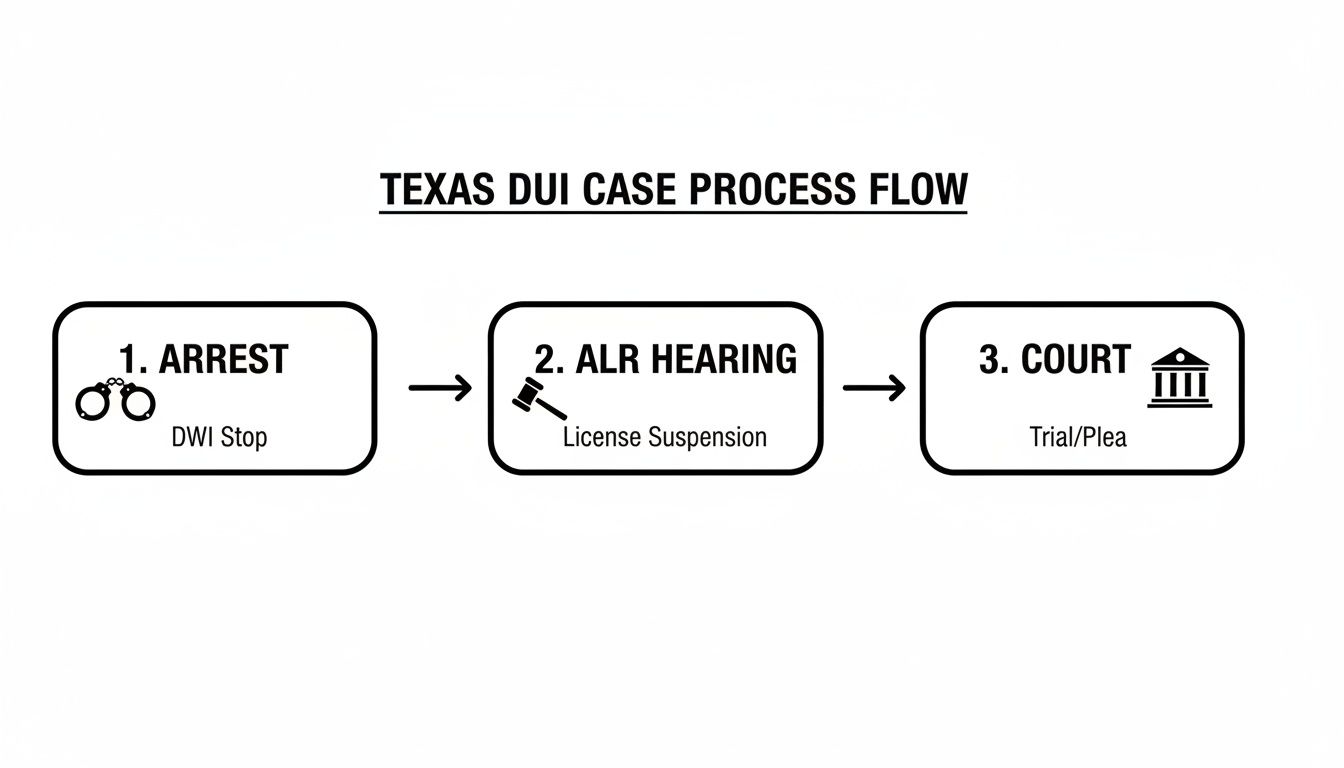
This process shows the multiple stages where a strategic defense is absolutely essential to protect what's at stake.
Why Acting Immediately Is Crucial
After a felony DUI arrest, time is working against you. Evidence gets lost, witnesses' memories fade, and critical legal deadlines—like the 15-day window to request an ALR hearing to save your driver's license—fly by. Hiring an attorney right away is the single most important move you can make to keep all your defense options on the table.
From day one, your legal team should be out there gathering evidence, talking to witnesses, and filing motions to protect your rights. This proactive approach shows the prosecution you're not rolling over; you're going to fight the charges aggressively.
A strong legal defense is about more than just showing up to court. It's about meticulous preparation for a battle on multiple fronts. To get a better sense of the specific strategies involved, you can read our comprehensive guide on how to fight a DWI in Texas.
An experienced attorney doesn’t just challenge the state's evidence; they tell your story. They present you as a person, a parent, a member of the community—not just another case file.
Facing a felony DUI is a deeply stressful experience, but you don't have to go it alone. The right legal team can give you the guidance, support, and aggressive defense you need to get through this. By understanding your rights and the defense strategies available, you can take back some control and fight for the best possible future for you and your family.
How a Conviction Impacts Your Family and Your Future
The weight of a felony DUI conviction in Texas doesn't just fall on you; it lands squarely on everyone you love. It’s a legal earthquake that sends shockwaves through your family’s emotional and financial stability. The consequences ripple far beyond the courtroom, creating a deeply personal crisis that can take years to mend.

This immense pressure can strain even the strongest relationships, creating an environment of constant stress, fear, and uncertainty. The emotional and psychological toll is profound, and exploring options for Trauma Counselling can be a crucial step toward healing for everyone involved.
The Threat to Your Parental Rights
For parents, the most terrifying consequence is the potential impact on your children. A conviction for a felony DUI in Texas, particularly a DWI with a child passenger, almost guarantees an investigation by Child Protective Services (CPS).
CPS is legally required to investigate any report of child endangerment. A felony DUI conviction is often seen as hard evidence that you are unable to provide a safe environment for your child, which can lead to severe outcomes:
- Custody Modifications: The other parent can use the conviction to argue for a change in custody, seeking to limit or even eliminate your possession and access rights.
- Safety Plans: CPS may force you to follow a strict "safety plan," which could mean supervised visits or even placing your children with a relative while your case is ongoing.
- Termination of Parental Rights: In the most extreme cases, especially with repeat offenses or severe endangerment, a felony conviction can be used as grounds to terminate your parental rights under Chapter 161 of the Texas Family Code.
A felony conviction creates a permanent shadow over your ability to parent. It becomes a central point in any family court proceeding, forcing you to prove your fitness as a parent against a backdrop of a serious criminal record.
Lasting Financial and Social Damage
Beyond the courtroom, a felony conviction carries a heavy social stigma and creates lasting financial hardship. The initial fines and legal fees are just the beginning. A permanent felony record can make it nearly impossible to find stable employment, secure housing, or even get a loan.
This financial strain puts immense pressure on a family already dealing with emotional trauma. The tragic reality is that impaired driving has devastating consequences across our state. In 2023, alcohol-impaired driving accounted for 40% of all motor vehicle fatalities in Texas, a statistic that underscores why these cases are prosecuted so aggressively. To understand the scale of this issue, you can review the findings in the FY 2025 Texas Impaired Driving Plan.
This is why protecting your family's future starts with an immediate and powerful legal defense.
Common Questions After a Texas Felony DUI Arrest
When the police charge you or someone you love with a felony DUI in Texas, your mind instantly starts racing with urgent, terrifying questions. The ground feels like it's shifting beneath your feet, and the uncertainty can be paralyzing. Getting straight answers is the first, most critical step toward fighting back and regaining some control. Let's tackle a couple of the most pressing concerns we hear from families in this situation.
Can a Felony DUI Conviction Be Wiped From My Record?
This is one of the first questions people ask, and unfortunately, the answer in Texas is almost always no. A felony DUI conviction is permanent. Unlike some lesser offenses, it generally cannot be expunged from your record. Expunction is a process reserved for cases that were dismissed or resulted in a "not guilty" verdict.
While some misdemeanor DWIs might eventually be sealed through an order of non-disclosure, this path is almost never an option for felonies. This is exactly why it’s so important to mount an aggressive defense from day one. The best way to avoid the lifelong shadow of a felony conviction—impacting your job prospects, housing applications, and even your civil rights—is to prevent that conviction from ever happening in the first place.
Do I Lose My Driver's License Immediately After a Felony DUI Arrest?
You don't lose it automatically, but the clock starts ticking the second you're arrested. You have to act fast. Separate from the criminal case, the state kicks off a civil process called an Administrative License Revocation (ALR). You have only 15 days from the date of your arrest to request a hearing to fight this suspension.
Miss that deadline, and your license suspension is automatic. It's a hard-and-fast rule with no exceptions. An experienced lawyer can handle this hearing for you, which does more than just try to save your license—it’s also a golden opportunity to question the arresting officer under oath and gather key evidence that can be used in your criminal defense.
The system moves incredibly fast, and missing a deadline like the 15-day ALR request can permanently impact your ability to drive. Taking immediate action is absolutely essential to protect your license and your rights.
When your family’s future is on the line, you cannot afford to wait. The fear and uncertainty you're feeling right now are valid, but you don't have to face this battle alone. You need a legal team that understands what's at stake—not just for you, but for your children and your entire family. The attorneys at the Law Office of Bryan Fagan PLLC are ready to provide the compassionate support and aggressive defense you need right now. We fight for parents. We protect families. Call us today for a free, confidential consultation to go over your case and find out how we can help protect what matters most.
Contact the Law Office of Bryan Fagan PLLC for a free consultation