Skip to content
When your family's safety is threatened, the fear and confusion can be overwhelming. It’s a paralyzing feeling, leaving you to question every decision, unsure of where to turn or who to trust. In these moments, which feel like the darkest hours for Texas families, please know you are not alone and there is a clear path toward safety. Taking the step to file for a protective order is an act of immense courage, not of aggression. It's about ending a cycle of fear and reclaiming your family's right to peace and security.
A protective order is a powerful legal tool designed to stop family violence, harassment, or threats. It's a direct command from a judge that makes it a criminal offense for an abuser to contact you or come near your family. This guide is here to walk you through the process, providing practical, reassuring guidance on how to use Texas law to build a shield around your loved ones.
Your First Step Toward Safety in Texas

The moment you realize your family’s safety is at risk is absolutely terrifying. That mix of confusion and fear can feel paralyzing, leaving you feeling isolated and completely unsure of what to do next.
Please know you are not alone in this. Taking action to protect yourself is an act of incredible courage. Filing a protective order isn't about starting a fight—it's about ending one and reclaiming your right to live without fear.
This guide is meant to be your first, steadying step. We'll walk you through the process, breaking down the legal jargon and giving you clear, practical advice. A protective order is far more than just a piece of paper; it is a direct command from a judge with serious legal consequences for anyone who violates it.
Understanding the Purpose of a Protective Order
A Texas protective order is specifically designed to prevent future acts of family violence. This is different from a restraining order, which usually handles civil disputes, like setting ground rules during a divorce. A protective order is for situations involving credible threats of harm.
Here’s what it can do:
- Prohibit an abuser from coming within a certain distance of your home, your job, or your children's school.
- Prevent all forms of contact, whether it's texts, phone calls, emails, or even messages sent through other people.
- Require the abuser to surrender any firearms they own or possess.
For an even broader safety net, especially if you're worried about threats spilling over into your professional life, it's wise to understand how to implement effective workplace violence prevention plans. This can add another crucial layer of protection.
Moving from Fear to Action
Think about this all-too-common scenario: a mother is going through a tough separation. Her ex-partner's behavior has escalated from angry voicemails to suddenly showing up at her house, terrifying both her and the kids. She feels trapped, worried that any move she makes might just make things worse, especially with Child Protective Services (CPS) potentially getting involved if the children witness the conflict.
This is exactly the kind of situation where a protective order creates a clear path forward. By filing, she establishes a legal boundary that police can enforce immediately. It shifts the power dynamic, replacing her constant fear with the authority of the court and demonstrating to CPS that she is taking proactive steps to ensure her children's safety.
To get a deeper sense of its legal weight, you can learn more about what a protective order in Texas is and how it really works.
You have the right to feel safe. Taking this step is a declaration that you are taking back control of your life and building a more secure future for your family. The road ahead might seem intimidating, but it all starts with this one, powerful decision.
Do You Qualify for a Protective Order?
When you’re living in fear, figuring out the legal system can feel like the last thing you have the energy for. But getting a protective order in Texas often boils down to one central question a judge will ask: has "family violence" occurred? Knowing what that term actually means under the law is the first real step toward getting the protection you need.
The Texas Family Code has a broad definition of family violence. It’s not just about physical harm. It’s also any act intended to cause physical harm, injury, or assault. Crucially, it also includes a threat that puts you in reasonable fear of imminent physical harm. This is designed to protect you from the intense, paralyzing fear that comes from threats and intimidation, not just from the visible bruises.
And remember, you don't have to be married to the person who is hurting you. The law covers a wide range of relationships.
Who Is Covered Under the Law?
The law is written to protect people in specific relationships where violence has taken place. This includes:
- Current or former spouses.
- Parents who have a child together, whether they were married or not.
- Family members related by blood or marriage, like parents, siblings, or even in-laws.
- People who are or were in a dating relationship.
- Members of the same household, which can include roommates.
Think about a real-world scenario we see all too often: A woman ends a dating relationship, but her ex-partner won’t let go. It starts with an endless stream of harassing texts. Then, he starts driving by her apartment at all hours of the night. Finally, he shows up on her doorstep, pounding on the door and screaming threats.
That clear pattern of escalating behavior—from digital harassment to a direct physical threat at her home—is a textbook example of a situation that absolutely warrants a protective order.
What a Texas Protective Order Can Do for You
A protective order isn't just a piece of paper; it’s a powerful legal tool that creates specific, enforceable rules to keep you safe. A judge has the authority to customize the order to fit the exact details of your situation, creating a legal shield for you and your family.
Here's a look at what a judge can put in place to protect you.
What a Texas Protective Order Can Do for You
| Type of Protection | What It Means for Your Safety |
|---|---|
| No-Contact Provisions | Prohibits the abuser from calling, texting, emailing, or contacting you through social media or even third parties. |
| Stay-Away Orders | Legally requires the abuser to stay a specific distance away from your home, your workplace, and your children's school or daycare. |
| Firearm Restrictions | A judge can order the abuser to surrender any firearms they own or possess, which dramatically increases your physical safety. |
| Child-Related Orders | Can temporarily modify custody arrangements, ordering no contact with the children or requiring supervised visitation to keep them safe. |
| Mandatory Counseling | The judge can order the abuser to attend and complete a battering intervention and prevention program. |
It's important to understand the goal here.
The purpose of these provisions isn’t to punish the abuser, but to prevent future violence. Each one creates a clear, legal boundary that, if crossed, results in immediate criminal consequences for the violator.
New Laws Are Expanding Eligibility
Texas law is constantly evolving to offer more comprehensive protections. For instance, a new law set to take effect on September 1, 2025, will expand who can get a protective order. It will now include victims of certain home burglaries where the intruder intended to commit another felony, theft, or assault.
This is a significant change. It recognizes that a terrifying home invasion can be just as traumatic as other forms of violence, especially with home burglary rates hitting 836 per 100,000 in 2022. You can explore the details of this legislative update to see how Texas is working to better protect its citizens.
At The Law Office of Bryan Fagan, PLLC, our experience isn't limited to just family law. We frequently handle cases where protective orders overlap with criminal defense matters like assault or DWI. This gives us a unique perspective, allowing us to support you across all the related legal challenges you might be facing. Understanding if you qualify is the first step, and we're here to give you the clarity you need to move forward.
Navigating the Texas Filing Process
Walking into a courthouse to deal with legal paperwork is intimidating on a good day. When you're already carrying the weight of fear and stress from a violent situation, it can feel downright impossible. We understand. Let's break down how to file a protective order in Texas into clear, manageable steps, turning this daunting task into a real path toward safety.
Your first step is a document called the "Application for Protective Order." This is where you tell your story to the court, and it is absolutely critical to be as detailed and specific as you can. Vague statements like "he was mean" simply don't have the legal weight to get an order granted.
Instead, you need to document specific dates, times, and clear descriptions of the violence or threats. For example: "On June 1st, at approximately 8 PM, he sent me a text message saying, 'You'll regret leaving me,' and then appeared outside my home 30 minutes later." This level of detail is what a judge needs to see.
This flowchart lays out the basic qualification process, from the act of violence to the moment you file.
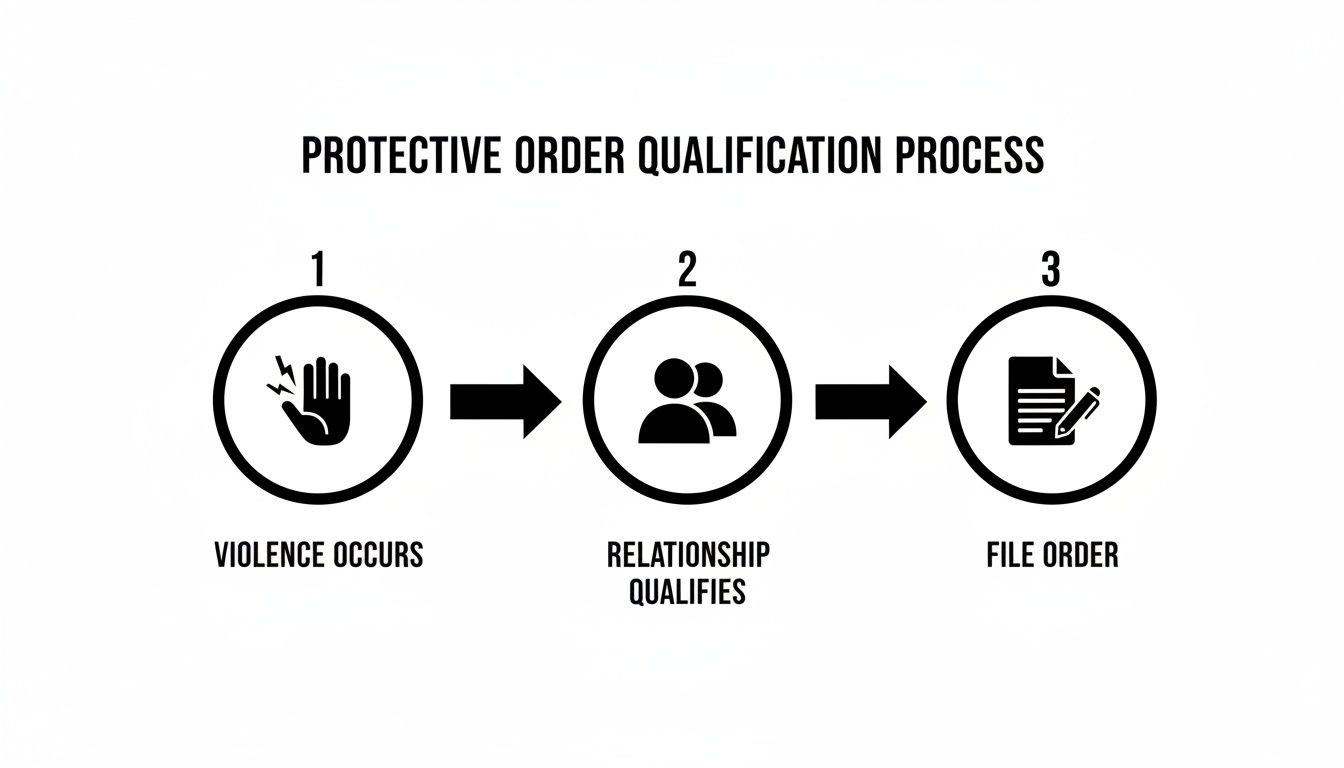
As you can see, the legal process is triggered by a specific event and a qualifying relationship. The filing itself is a direct response to that real-world threat.
Where and How to File Your Application
Once your application is filled out, you'll file it with the district or county court in the county where either you or the respondent (the person you're filing against) lives. Here's a critical piece of information: there are no court costs or filing fees for protective order applicants in Texas family violence cases. The law is designed so that money is never a barrier to your safety.
In many situations, the district or county attorney’s office can help you with this process, especially if there's a related criminal case. Their job is to represent the state's interest in preventing family violence, which perfectly aligns with your goal of getting protection. They can make sure your application is filled out correctly and filed in the right court.
Securing Immediate Protection with a Temporary Ex Parte Order
One of the most powerful parts of this process is the ability to get protection right away. When you file your application, you can ask the judge to grant a Temporary Ex Parte Order.
"Ex parte" is a legal term that just means the order is granted based on your side of the story alone, without the other person being present or even notified yet. It’s designed for emergency situations where there is a clear and present danger of family violence.
This temporary order can be put in place incredibly fast, sometimes even the same day you file. It provides immediate, legally enforceable protection that lasts for up to 20 days. During this time, the abuser is legally barred from contacting you or coming near you.
This 20-day window gives you a crucial period of safety while the rest of the legal process moves forward. If you're in an emergency situation where an arrest has already been made, you can learn more about an Emergency Protective Order in Texas, which is issued by a criminal court judge and works a bit differently.
The Importance of Proper Service and Notice
After the judge signs the Temporary Ex Parte Order, the next step is making sure the respondent is officially notified. This is not your job. A law enforcement officer, like a sheriff's deputy or constable, will personally deliver a copy of your application and the temporary order to them. This is called "service of process."
Proper service is vital for two big reasons:
- It makes the order legally enforceable. Once served, the respondent is legally bound to follow the order's rules. If they violate it, they can be arrested on the spot.
- It provides official notice of the final hearing. The papers they receive will include the date, time, and location of the final hearing, where a judge will decide whether to issue a final, long-term protective order.
Think about a mother who files an order after her ex-partner threatens her and the kids. The judge grants a temporary order, and a deputy serves the papers to the ex at his job. From that moment on, he is legally forbidden from showing up at the kids' school or her home. That legal boundary, backed by law enforcement, can finally give her and her children the breathing room they desperately need. This entire process is your roadmap to reclaiming that peace of mind.
Preparing for Your Final Hearing
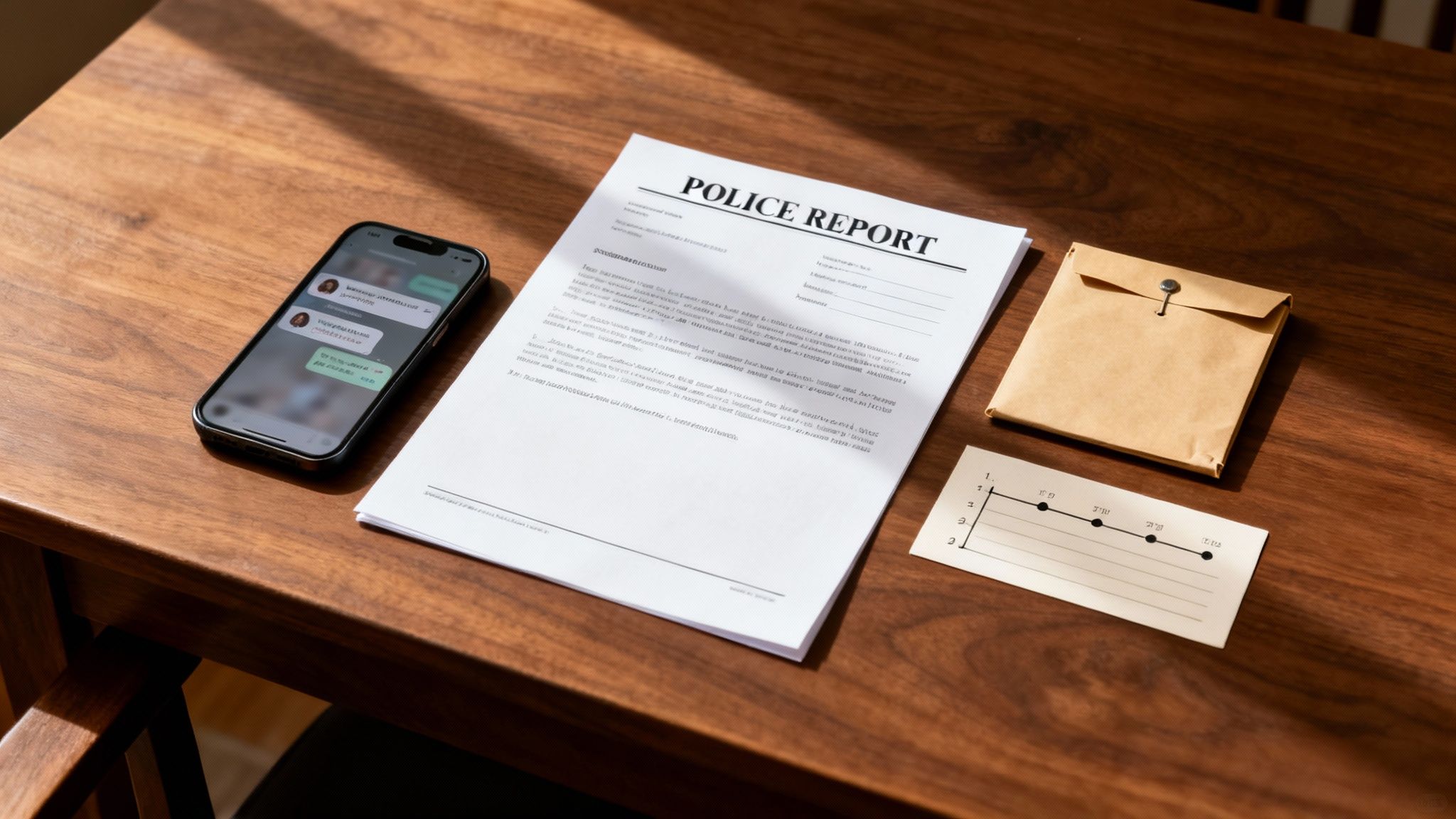
The final hearing is where the judge makes a crucial decision: will your temporary protection become a long-term shield for your family? We know that walking into a courtroom can feel incredibly intimidating, but solid preparation is your best tool. This is your chance to tell your story, and with the right evidence and a clear strategy, you can make a powerful case for your family’s safety.
Your goal is simple but critical: you need to prove to the judge that family violence has occurred and is likely to happen again if the court doesn't step in. This takes more than just your word—it requires clear, organized proof that paints a vivid picture of your reality.
Gathering Your Evidence
Evidence is the backbone of your entire case. It’s what turns your personal experiences into tangible facts that a judge can see, read, and consider. The stronger and more organized your evidence, the more compelling your story becomes.
Start thinking about every interaction and incident that has made you feel unsafe. You need to begin collecting anything and everything that supports your application for a protective order.
Here’s a practical list of what to focus on:
- Communications: Gather every threatening or harassing text message, voicemail, email, and social media message. Don't just save them on your phone; take clear screenshots and print them out.
- Photographs: Photos of injuries, damaged property, or even the abuser showing up uninvited are incredibly powerful visual aids for a judge.
- Police Reports: If you've ever had to call the police, get a copy of the report. The case number, date, and the officer’s summary provide official, third-party documentation of an incident.
- Medical Records: Did you see a doctor for any injuries? These records directly corroborate your testimony about physical violence and its impact.
- Witness Information: Think about who has seen or heard the abuse. This could be anyone—a friend, a family member, a neighbor, or even a coworker. Their testimony can be invaluable.
This collection of proof helps the court grasp the severity and, just as importantly, the pattern of the behavior you've been forced to endure.
Organizing Your Proof for the Judge
Just having a folder full of random screenshots and papers isn't going to cut it. You have to present your evidence in a way that’s easy for the judge to follow and digest. A disorganized case can unfortunately weaken your credibility and confuse the very person you're trying to convince.
One of the most effective strategies we've seen is creating a chronological timeline of events.
A timeline connects the dots for the judge, showing a clear pattern of escalation rather than a series of isolated incidents. It gives context to your fear and demonstrates why court intervention is necessary.
Let’s look at a real-world example. Imagine a mother seeking protection from her ex-partner. Her timeline might look something like this:
- May 10: Received 15 harassing text messages in one evening (Exhibit A: Printed Screenshots).
- May 15: He showed up at her workplace unannounced. A coworker saw the entire interaction (Exhibit B: Witness statement from Jane Doe).
- May 20: He left a voicemail threatening to "make her sorry" (Exhibit C: Audio recording on a flash drive).
- May 22: He began pounding on her front door late at night, prompting a call to the police (Exhibit D: Police Report #12345).
By organizing her proof this way, she’s not just saying, "He's been bothering me." She's presenting an undeniable pattern of stalking and threats that is far more impactful.
What to Expect During the Hearing
The final hearing is a formal court proceeding, not a casual conversation. As the petitioner, you will present your case first. This usually involves testifying under oath—you'll tell the judge, in your own words, what has happened and why you need protection. As you speak, you'll refer to the evidence you've gathered to back up your testimony.
After you've had your turn, the respondent (the person you filed against) gets their chance to tell their side of the story and present any evidence they might have. They also have the right to challenge your claims and cross-examine you or your witnesses. We won't sugarcoat it; this part can be emotionally draining and difficult. It’s a major reason why having an experienced attorney by your side can make all the difference.
An attorney can help you stay focused on the facts, object to improper or harassing questions, and ensure your case is presented in a way that meets all the legal standards for filing a protective order in Texas.
The judge will listen carefully to both sides before making a final decision. If they find that family violence has occurred and is likely to occur in the future, they will sign a Final Protective Order. This is the legally binding document that provides long-term protection for you and your family. With careful preparation, you can walk into that courtroom feeling not of fear, but of readiness.
Life After the Order Is Granted
Securing a final protective order is a monumental victory. It’s the moment the legal system validates your fears and provides a powerful, enforceable shield for you and your family. That piece of paper represents safety, but it's natural to wonder, "What happens now?"
Life after the order is granted is all about understanding its power and knowing exactly what to do to enforce it.
Understanding the Duration of Your Protection
A final protective order in Texas isn't just a temporary fix; it's designed to provide lasting security. For years, these orders were only valid for one year, but a crucial change in the law recognized that victims often need a much longer period of stability and safety to truly get back on their feet.
Typically, a standard final protective order in Texas will remain in effect for two years. This two-year period is intended to give you and your family a significant amount of breathing room to rebuild your lives in a safe environment, free from the constant threat of harassment or violence.
There are also specific situations where this timeline can be extended. For example, if the abuser is incarcerated or in jail when the order is about to expire, the court has the authority to extend it. This is a critical safeguard to ensure they cannot resume their harmful behavior the moment they are released.
This important legal protection was put in place when the Texas Legislature amended the Family Code, recognizing that the transition period after an abuser's release is an incredibly vulnerable time for victims. You can learn more about this vital legislative update that extended protective orders and its impact on family safety.
What to Do If the Order Is Violated
This is the most critical part of living with a protective order: it is not just a piece of paper. It's a direct command from a judge, and violating it is a criminal offense.
If the other person breaks any of the rules laid out in the order—whether by calling you, sending a text, showing up at your home, or even trying to communicate through a third party—your response should be immediate and decisive.
Do not engage with them. Do not respond to their attempts at communication. Your one and only action should be to call 911 immediately.
When you call the police, tell them you have a protective order and that it has been violated. Law enforcement has the authority to arrest the violator on the spot for defying the court's order. This is where the order's true power lies—it turns a family law matter into a criminal one, with serious and immediate consequences for the abuser.
Ensuring Your Children Are Protected
Often, a protective order will include specific provisions directly related to your children. These can dictate who has the right to make decisions about their schooling and healthcare, a legal concept known as conservatorship in Texas. The order may also flat-out prohibit the abuser from coming to the children's school or daycare.
To make sure everyone is on the same page, provide a copy of your protective order to:
- Your child's school administration
- Their daycare provider
- Your employer's security or HR department
- Your local police department
Distributing copies ensures that the people responsible for your and your children's safety during the day are aware of the legal restrictions in place. This creates a much wider network of protection.
Filing a protective order in Texas is a brave and necessary step. The final order is your tool for maintaining long-term peace and security, and knowing how to use it is the key to truly reclaiming your life.
Common Questions About Texas Protective Orders
When you're thinking about filing for a protective order, your mind is probably racing with urgent questions. The entire process can feel overwhelming, especially when you’re already dealing with an incredible amount of stress. Let's walk through some of the most common concerns we hear from families in your exact situation and get you some clear, straightforward answers.
How Much Does It Cost to Get a Protective Order?
This is a critical question for so many people, and thankfully, the answer often brings immediate relief. In Texas, there are absolutely no court costs or filing fees for someone seeking a protective order based on family violence. Our state’s laws are specifically designed to make sure that money is never a barrier to getting the protection you need.
Now, while you aren't required to have a lawyer, bringing an experienced attorney on board can be a game-changer. A good lawyer makes sure your application is filed correctly from the start, helps you pull together the right kind of evidence, and knows how to powerfully present your case to the judge. Our firm offers free consultations so you can understand all your legal options without any financial pressure.
Will Filing an Order Just Make the Abuser Angrier?
This is a completely valid and understandable fear. It’s impossible to predict exactly how another person will react, but it’s important to see the protective order for what it is: a tool for safety, not a tool for escalation.
An order creates a firm legal boundary that comes with immediate, criminal consequences for any violation. This gives the police the authority to make an arrest right on the spot if the order is broken, which is often a powerful deterrent. A crucial part of this process is talking with an attorney or a domestic violence advocate to create a comprehensive safety plan. This helps you manage this period safely and with more confidence.
A protective order shifts the power dynamic. It replaces uncertainty and fear with the clear, enforceable authority of the court, giving you and law enforcement a direct course of action.
Can a Protective Order Address Custody of Our Children?
Yes, a final protective order can and very often does include temporary orders concerning your children. A judge has the authority to grant you the sole right to decide where the children live (exclusive possession) and can prohibit the other parent from seeing them or require that any visits be supervised.
These provisions are put in place to protect both you and your children from any further harm. While the protective order hearing isn’t a full-blown custody trial, it absolutely can establish immediate safeguards. These issues can then be sorted out more permanently in a separate family court case, like a divorce or a Suit Affecting the Parent-Child Relationship.
What if We Have Another Court Case Like a Divorce?
A protective order stands on its own. It remains in full effect during any other legal proceedings you might have going on, including a divorce or a custody case. The judge handling your other family law matter will be made aware of the protective order.
Its conditions—like no-contact rules and stay-away distances—must be followed strictly, even if you’re both at the courthouse for other hearings. Your attorney can coordinate with court staff to ensure your safety during these times, arranging for things like:
- Separate waiting areas to avoid any contact before a hearing.
- Staggered arrival and departure times so you don't have to cross paths.
- A court security officer to escort you safely to your vehicle.
Navigating the intersection of family law and protective orders requires some careful coordination, but your safety will always be the top priority.
The legal system can feel like a maze, especially when you are trying to protect your children from harm. You don't have to find your way through it alone. At The Law Office of Bryan Fagan PLLC, we are committed to providing the compassionate guidance and strong legal representation you need to protect your family from violence and navigate any related CPS matters. If you are considering filing a protective order in Texas, contact us today for a free, confidential consultation to discuss your case. Let us help you take the first step toward a safer future. You can reach us at The Law Office of Bryan Fagan PLLC.