Skip to content
A final trial notice can stop you cold. One sheet of paper. One date. One courtroom. And suddenly it feels like your whole future with your child has been reduced to a deadline.
If you're searching for final trial cps texas, you're probably not looking for theory. You're looking for answers that make this process feel less confusing and less frightening. You want to know what the judge will decide, what CPS will argue, what you need to do now, and whether there is still time to protect your family.
That fear is normal. So is the anger, the shame, and the exhaustion. Many parents walk into this stage feeling like every mistake they've ever made is about to be lined up against them. But the final trial is also the point where the court must make a permanent decision based on evidence, your progress, and your child's long-term safety.
A parent in this situation often tells me the same thing: “I did what they asked, but I still don't know if it's enough.” That uncertainty is one of the hardest parts of a CPS case. The good news is that uncertainty can be reduced with preparation, organization, and a clear understanding of how Texas courts handle these cases.
The Most Important Day in Your CPS Case An Introduction
When that envelope arrives, most parents don't open it calmly. They stare at it first. They know it matters before they read a word.

Inside is the date that can determine whether your child returns home, remains with a relative, stays in foster care, or becomes the subject of a termination case. That's why this hearing feels different from every other court date you've already endured.
Take a common example. A mother has spent months attending counseling, taking drug tests, finding stable housing, and trying to repair trust with CPS after a removal. She has visitation records, class certificates, and messages from her employer confirming she's working steadily. Then the final trial notice arrives. Her first thought isn't legal. It's personal. “What if none of this is enough?”
That reaction makes sense because the stakes are enormous. Texas child welfare data show that nearly half of children who exit DFPS custody become victims in another maltreatment investigation within 5 years, which underscores why courts focus so heavily on a stable and lasting outcome for the child (TexProtects State of the State).
The final trial isn't just about your past. It's about whether the court believes your child's future will be safe with you.
Parents often think this hearing is designed only to highlight failure. In practice, it's the clearest opportunity to present change. If you've worked services, stayed sober, kept a job, repaired your home, followed court orders, or rebuilt healthy routines, that work must be shown in a concrete, believable way.
You don't need to be perfect. You do need to be prepared.
Decoding the Final Trial in a Texas CPS Case
The final trial is the court's decision point. Earlier hearings are temporary. This one is not.
A good way to think about it is this. The early hearings decide where things stand for now. The final trial decides where your child will live and who will hold legal rights going forward.
What this trial is and what it isn't
This is a civil trial, not a criminal prosecution. The judge isn't deciding whether to send you to jail. The judge is deciding what final legal arrangement serves your child's best interest.
That distinction matters because many parents walk in expecting something that looks like a criminal courtroom drama. CPS cases are serious, but the questions are different:
- Safety at home
- Progress on the service plan
- Stability
- Parenting ability
- Whether lasting reunification is realistic
If termination is on the table, the court will also examine whether CPS proved a legal ground for termination and whether termination is in the child's best interest. That issue is separate from custody placement and deserves careful attention. If you want a deeper discussion of that topic, our page on Parental Rights Termination in Texas can help you understand what is at stake.
Who will be involved
Several people usually play a role at final trial:
- The judge decides the outcome unless a jury has been requested on issues a jury may hear.
- The CPS attorney presents CPS's evidence.
- Your attorney challenges CPS's evidence and presents your side.
- The caseworker often becomes a key witness.
- The attorney ad litem for the child speaks for the child's legal interests.
- Other witnesses may include relatives, counselors, service providers, teachers, doctors, or law enforcement.
What the court is trying to decide
The court wants permanence. Judges don't want children to remain in legal limbo.
That means the judge is not only looking at whether things have improved. The judge is looking at whether those improvements are likely to hold. A few weeks of progress right before trial usually won't carry the same weight as steady, documented progress over time.
Practical rule: The judge will care less about promises and more about patterns.
Why legal language confuses parents
Parents often hear terms like “conservatorship,” “best interest,” “termination,” and “trial on the merits” without anyone translating them into everyday language. Here's the plain version:
| Term | Plain meaning |
|---|---|
| Trial on the merits | The final trial where the judge makes the lasting decision |
| Conservatorship | Legal rights and duties over the child |
| Best interest | What the judge believes will most protect the child long term |
| Termination | Ending the legal parent-child relationship |
The final trial is where the court stops asking, “What should happen for now?” and starts answering, “What should happen permanently?”
The Critical 12-Month Countdown and Dismissal Deadlines
A parent can be doing better, passing drug tests, attending visits, and finally getting stable housing, then learn the legal clock is almost out. That is why this part of a CPS case feels so unforgiving. Progress matters, but progress also has to happen in time.
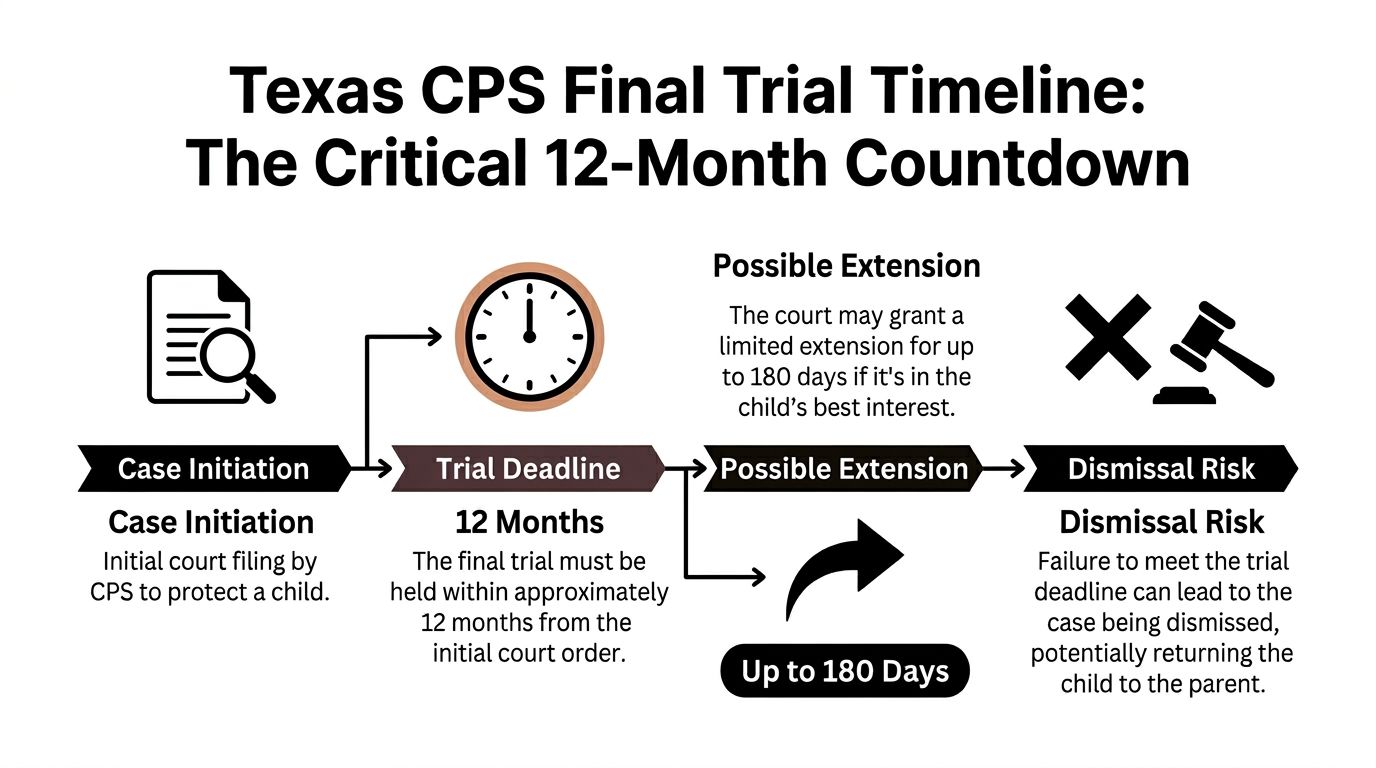
Under Texas law, the court generally must reach a final order by the first Monday after the first anniversary of the adversary hearing's conclusion, giving parents roughly 12 months to complete services and show the court real, lasting change. That deadline is often called the dismissal date. Many parents hear "12 months" and assume they have plenty of time. In practice, they have much less, because referrals take time, evaluations get scheduled weeks out, classes fill up, and missed appointments can set a parent back fast.
The simplest way to understand the deadline is this: it works like an expiration date on the court's power to keep the case open. If the required order is not entered on time, the case can be dismissed. For a parent, that means the calendar is not just paperwork. It should shape what you do this week, this month, and long before trial is set.
Why parents get caught off guard
Delay is common. Safety plans can change. Service providers can be slow. A parent may spend the first few months confused, grieving, or trying to keep a job and make visits. If criminal charges are also pending, many parents freeze because they are afraid that anything they say in one case will hurt them in the other.
That hesitation is understandable. It is also dangerous.
A CPS judge will usually focus less on why things started late and more on whether enough has been done by the deadline. If you are waiting for "the right time" to begin counseling, fix housing problems, gather records, or ask your lawyer hard questions, the court's clock keeps running anyway.
What this deadline should change about your strategy
The 12-month period should push your preparation into smaller, concrete steps.
- Start services early, even if you disagree with parts of the plan and are working with your attorney on objections.
- Keep proof as you go, including certificates, drug test results, counseling attendance, pay stubs, lease documents, and messages showing your effort to schedule services.
- Raise problems immediately if referrals are missing, visits are being blocked, or a provider is not responding.
- Prepare for trial months in advance, not after a setting is announced.
- Coordinate your CPS and criminal defense strategy if you have been arrested or investigated, because silence that may help in one case can create problems in the other if not handled carefully.
If you want a broader view of how hearings and deadlines fit together, this guide on the Texas CPS case timeline can help you place the final trial date in context.
The one extension rule
Texas courts can grant one extension of up to 180 days, but only if the judge finds extraordinary circumstances. That means the outside limit is usually about 18 months, and families should not assume they will get that extra time (Texas Law Help on CPS final hearing, dismissal, extension, or monitored return).
An extension is not a comfort blanket. It is more like emergency extra time, and judges often want a clear reason why the case cannot be finished on schedule. If the delay happened because a parent waited too long to engage, the request becomes much harder to win.
The "drop-dead date" and why it matters
Lawyers often call the dismissal deadline the drop-dead date because missing it can change the entire case. If the final order is not entered by the legal deadline, the suit may have to be dismissed.
There is one part that confuses many parents. If the trial on the merits begins before the deadline, the court may still be able to finish after that date and sign the final order later. That detail matters a great deal, especially when a family hears, "Your trial started in time," and assumes the deadline issue disappeared completely. Whether it did depends on the procedural posture of the case and whether the issue was preserved correctly.
A good calendar is legal strategy in a CPS case, not office housekeeping.
This is also why parents should ask direct questions early: What is my dismissal date? Has any extension been granted? Has trial begun in a way that satisfies the statute? What still needs to be finished before then?
A discussion from the Texas District and County Attorneys Association explains the automatic dismissal rule and the effect of timely starting trial before the deadline (Texas District and County Attorneys Association journal article). For parents, the practical lesson is simple. Do not measure progress by effort alone. Measure it against the court's calendar.
Navigating the Courtroom on Trial Day
Trial day feels formal because it is formal. But it isn't random. There is a sequence, and knowing that sequence can steady you.

Most final trials begin with the judge calling the case. Everyone identifies themselves, and the court confirms who is present. If there are preliminary matters, the judge may handle them first.
How the hearing usually unfolds
The structure is often familiar from one case to the next:
- Opening statements. The lawyers may briefly tell the judge what they believe the evidence will show.
- CPS presents first. The Department usually calls the caseworker and other witnesses.
- Cross-examination. Your attorney gets to question those witnesses.
- Your side presents evidence. You may testify, and your lawyer may call witnesses who know your progress and parenting.
- Closing arguments. Each side tells the judge what ruling should be entered.
That order matters because parents often panic when CPS goes first and it sounds one-sided. It won't stay one-sided if your attorney is prepared and your evidence is organized.
The people you may hear from
The caseworker is often the centerpiece witness, but not the only one. CPS may also call a therapist, a doctor, a police officer, a school employee, or a placement representative. Your lawyer may call family members, employers, sponsors, counselors, or service providers.
Some parents are surprised that paperwork can matter as much as live testimony. Records of classes, test results, lease documents, photographs, visitation records, and treatment discharge summaries can all become important pieces of the story.
If you're unsure whether your case will be decided by a judge or involve a jury on some issues, this resource on jury trial vs bench trial can help clarify the difference.
A short overview can also make the courtroom feel less foreign:
What you should do in the room
Your behavior matters. Judges notice whether a parent appears focused, respectful, and engaged.
Use this checklist:
- Arrive early: Give yourself time to find parking, clear security, and speak with your lawyer.
- Dress neatly: Court isn't the place for casual clothing, slogans, or anything distracting.
- Stay calm during testimony: Even if you hear something unfair, don't interrupt.
- Listen before answering: If you testify, answer the question asked. Don't guess.
- Bring your documents: Your lawyer may not need every paper, but you should have them available.
The courtroom rewards preparation and self-control more than emotion.
Building Your Case How to Prepare for Your Final Trial
A few weeks before final trial, many parents feel the same fear. “I have been working hard, but how do I prove it before the drop-dead date gets here?” That question matters because final trial is not only about whether you love your child. It is about whether you can show, clearly and calmly, that the safety concerns that brought CPS into your life have been addressed.
The preparation starts long before you walk into the courtroom. The court's deadline puts real pressure on parents. Each month that passes is a chance either to build proof or to leave gaps that CPS will point out later. Parents who do best at trial usually treat the case like a timeline they must document, not a story they will try to explain from memory at the end.
One mother I represented kept a binder with tabs for counseling, drug testing, work records, housing papers, and visits with her child. That binder worked like a map. If CPS claimed she missed treatment, we had the attendance sheet. If someone questioned stability, we had the lease, utility bill, and work schedule. By trial, the judge did not have to guess whether she had changed. The record showed it.
Build one clear story
Your evidence should answer four simple questions:
- What was the concern?
- What did you do about it?
- What changed?
- Why is your child safe with you now?
That is the story the court needs to hear.
Parents sometimes bring stacks of papers without a clear theme. A better approach is to organize your proof so each document supports the next one. If the concern was drug use, your records should show assessment, treatment, testing, and follow-through. If the concern was unstable housing, your records should show where you live, how long you have lived there, and how the home is set up for the child. If the concern involved a criminal accusation, even a lower-level charge can affect how the court views judgment and safety, so it helps to understand how Texas misdemeanors can still affect a family law case.
Gather proof that answers the judge's real concerns
Judges usually want specifics, not promises. “I am doing better” is a starting point. Documents make it believable.
Useful records often include:
- Service plan proof: certificates, sign-in sheets, discharge summaries, counseling attendance logs
- Drug or alcohol testing records: especially if they show a pattern over time
- Housing records: lease, utility bills, photos of the child's sleeping space, letters from a landlord or homeowner
- Employment records: pay stubs, schedules, or a letter from a supervisor
- Parenting records: visit logs, school contact, medical follow-up, or receipts for supplies for the child's return
- Personal timeline notes: dates of setbacks, treatment starts, clean periods, job changes, and moves
A timeline matters more than many parents realize. Final trial often turns on whether the judge sees progress as recent and fragile, or steady and believable. A dated record helps your lawyer show the difference.
Choose witnesses who add facts, not just support
A witness should do more than say you are a good parent. The strongest witnesses fill in details that documents cannot.
A counselor can explain attendance and progress. An employer can confirm punctuality and steady work. A sponsor can describe consistency. A relative or family friend can be helpful if that person has seen you often enough to speak from direct knowledge, not guesswork.
Ask yourself:
| Question | Why it matters |
|---|---|
| How often has this person seen me? | Regular contact makes testimony more believable |
| Can this person give examples? | Specific facts carry more weight than praise |
| Does this person know the problem that started the case? | A witness who understands the concern can explain the change |
| Will this person stay careful under cross-examination? | A nervous or defensive witness can weaken a good point |
Meet with your lawyer early enough to fix weak spots
Do not wait until the last few weeks. Trial preparation is part evidence review, part problem-solving.
Bring a folder or binder with:
- Court papers and service plans
- Proof of completed tasks
- Names and contact information for witnesses
- A simple timeline of major events
- Questions you still have
- Any documents tied to an arrest, bond condition, probation term, or pending criminal allegation
That last category is often overlooked. A parent may complete services but still face a major problem if the CPS strategy and criminal strategy are working against each other. The Law Office of Bryan Fagan PLLC handles matters where criminal allegations and CPS issues overlap, so clients in that situation often benefit from coordinated document review rather than treating each case as separate.
If your file is large, organization helps. Some lawyers and clients use digital tools to sort records by date, issue, and witness. Broader workflow discussions, including reviews of AI tools for lawyers, can show how legal teams manage document-heavy cases. The lesson for a parent is simple. Keep every record dated, easy to find, and grouped by topic.
Progress matters more than perfection
Setbacks happen. A missed class, a scheduling problem, or a rough month does not always decide the case. What hurts parents most is failing to document the setback, failing to correct it, or hoping the judge will overlook it.
Explain the problem to your lawyer early. Bring the makeup certificate. Bring the new test result. Bring the updated counseling record. Judges are used to hearing that life is messy. They are less patient with disorganization, silence, or half-finished explanations.
Bring your lawyer facts, dates, names, and records. General assurances are not enough at final trial.
A parent who arrives with organized proof gives the court something solid to rely on. That is how preparation changes the human side of the case. It turns fear into a plan, and a plan into evidence.
When Criminal Charges Overlap with Your CPS Case
A CPS case and a criminal case may start from the same incident, but they don't stay in separate lanes for long. What happens in one can affect the other.
A parent might be dealing with a DWI arrest, a possession charge, or an assault allegation while also trying to satisfy a family service plan. That's not unusual. What is dangerous is handling them as if they have nothing to do with each other.
The overlap matters because criminal convictions can be used as evidence in conservatorship and termination proceedings. That connection is often missed in general CPS discussions, even though it can shape how the family court views safety, judgment, and future risk (discussion of concluding a Texas CPS case).
Why coordination matters
A plea decision in criminal court may create facts that CPS later emphasizes. At the same time, statements made in a CPS setting can create problems if a criminal case is still pending.
That doesn't mean parents should refuse all participation in services or ignore the CPS case. It means your legal strategy should account for both courts at the same time.
Examples of issues that need coordination include:
- Admissions in treatment or classes
- Protective order allegations
- Drug testing results
- Bond or probation conditions
- Pending family violence accusations
Common situations where parents get trapped
Sometimes a parent tries to “explain everything” in family court without realizing there is still criminal exposure. In other cases, the parent stays silent everywhere and loses credibility with CPS because no one has helped them present the facts safely.
If your underlying criminal matter involves a lower-level charge, understanding how Texas classifies those offenses can help you ask better questions and avoid assumptions. This overview of misdemeanors in Texas is a practical starting point.
When both courts are active, every statement should be made with both cases in mind.
The goal is not to survive each hearing. The goal is to avoid improving one case while damaging the other.
Possible Outcomes Reunification Termination or Conservatorship
At the end of the trial, the judge signs a final order. That order decides the legal future of your family. Parents often hear these outcomes discussed as if one is a win and the others are all the same. They aren't.
CPS final trial outcomes at a glance
| Outcome | Parental Rights Status | Child's Custody | Long-Term Implication |
|---|---|---|---|
| Reunification | Rights remain intact | Child returns to parent | CPS case closes or moves toward closure with the child back home |
| Permanent managing conservatorship | Rights remain, but are limited | Child remains with DFPS or another conservator, often a relative | Parent may have reduced decision-making power and limited possession or access |
| Termination of parental rights | Rights are ended | Child is placed for permanency without the parent as a legal parent | Child may become eligible for adoption and the legal relationship is severed |
Reunification
This is the outcome most parents are working toward. The judge decides the child can return home because the concerns that led to removal have been addressed enough for a safe return.
Reunification does not mean the court forgot the past. It means the court believes your present circumstances and likely future are strong enough to support your child safely.
Permanent managing conservatorship
This outcome can surprise parents because their rights are not terminated, yet they still do not get custody back. The court may place the child permanently with DFPS or another adult, often a relative, while leaving you as a legal parent with limited rights.
That can include restricted decision-making, controlled visitation, or other long-term limitations. It is not the same as reunification, and it is not a minor setback.
Termination of parental rights
This is the most severe result. It permanently ends the legal parent-child relationship.
In practice, that means you no longer have the legal rights and duties of a parent. Because the consequences are so grave, termination requires a higher level of proof than many other family court decisions. If CPS is requesting termination in your case, your lawyer should be preparing for that issue with exceptional care.
A parent's confusion often comes from hearing multiple recommendations before trial. CPS may want one result. A child's ad litem may suggest another. A relative may seek placement. Only the judge's signed final order controls.
After the Verdict Your Options for Appeal
A bad result at final trial can leave a parent feeling frozen. That reaction is understandable, but the appeal deadline moves whether you're ready or not.
In Texas CPS cases, the notice of appeal must be filed within 20 days after the final order is signed, and filing post-judgment motions does not extend that deadline (Texas courts guidance for appeals in parental termination and child protection cases).
What to do immediately
If the final order is not what you expected, act fast. The first call should be to your attorney.
Use this short post-trial checklist:
- Get the signed order: Ask for a copy right away.
- Confirm the signature date: The deadline runs from the date the order is signed.
- Discuss appeal grounds promptly: Don't assume your lawyer can evaluate everything at the last minute.
- Preserve your contact information: Appellate timelines are short, and missed communication can cause real harm.
Why the appeal process feels different
CPS appeals move on an accelerated track. That means the courts try to resolve them quickly. The urgency reflects the law's focus on permanency for children.
Appeals are not re-trials. The appellate court reviews whether legal errors occurred and whether the evidence and procedure support the judgment. Some issues become stronger on appeal than others, so fast, candid advice matters.
Don't rely on delay
Parents sometimes think they can file a motion after trial and buy themselves more time. In ordinary civil cases that may happen in some situations. In CPS appeals, the normal extension rule doesn't apply to the notice of appeal deadline.
If you think you might appeal, treat the 20-day window as fixed from the moment the judge signs the order.
That doesn't mean every case should be appealed. It means every adverse final order should be reviewed immediately by counsel who understands accelerated CPS procedure.
If you're facing a final trial, a pending criminal charge, or a CPS order that doesn't feel right, speaking with counsel quickly can make a real difference. The attorneys at Law Office of Bryan Fagan PLLC help Texas families understand deadlines, prepare for trial, and evaluate urgent next steps after a final order. If you need clarity about what happens next in your case, reach out for a free consultation.