Skip to content
Facing an investigation from Child Protective Services (CPS) is a parent's worst nightmare. The fear, confusion, and sense of helplessness can be overwhelming. But when a criminal charge as serious as a first-degree felony is involved, that nightmare escalates into a full-blown crisis that threatens to tear your family apart forever.
A first-degree felony conviction in Texas carries devastating penalties, including the possibility of life in prison and fines reaching up to $10,000. These charges are reserved for crimes involving extreme violence or catastrophic harm to others. For a parent, such an accusation isn't just about the legal penalties; it's about the terrifying possibility of losing your children permanently.
That Phone Call Every Texas Parent Dreads

It’s the phone call that makes the world stop turning. It might be a CPS investigator on the line, or worse, a detective, telling you that you or your spouse are being investigated for a serious crime involving your child. The initial shock quickly gives way to a cold, creeping fear when you hear the charge: a first-degree felony.
In that instant, you are thrust into a bewildering legal maze where the stakes are terrifyingly high. Your family's entire future—your freedom, your reputation, and your right to raise your children—hangs in the balance.
For parents across Texas, from Houston to Dallas, this moment is a nightmare filled with frantic questions and a deep sense of helplessness. What does this really mean? What happens now? And how can you possibly protect your family from a system that feels so massive and intimidating?
A Relatable Scenario: The Fear Becomes Real
Picture this: A CPS caseworker shows up at your door with a police officer. They're investigating an allegation of serious injury to a child. Your toddler fell off the playscape and broke an arm, but a mandated reporter saw the cast and called the hotline, suggesting it was intentional.
The legal jargon they throw at you—"serious bodily injury," "intentional or knowing," "first-degree felony"—sounds like something from a TV show, abstract and frightening. All you know is that a terrible accident is being twisted into an accusation that could send you to prison for life and result in the termination of your parental rights under Chapter 161 of the Texas Family Code.
This guide is for you. It’s for every parent, spouse, and family member trying to navigate the frightening reality of first-degree felonies in Texas, especially when CPS is involved. We’re going to break down what these charges mean in plain, understandable language. Our goal is to replace your fear with knowledge, because understanding what lies ahead is the first, most critical step in mounting a powerful defense for both your freedom and your family.
When you're up against the immense power of the State of Texas, it's easy to feel completely alone. But remember this: an accusation is not a conviction, and you do not have to face this by yourself. Every single person has constitutional rights that must be defended.
We'll walk you through everything you need to know, from the specific crimes that qualify as first-degree felonies to the harsh penalties they carry and, most importantly, the actionable advice you must take to protect your family. Knowledge is your family's first line of defense, and it starts right here.
What Makes a Crime a First-Degree Felony in Texas?
When your family is thrown into the legal system and facing a charge as heavy as a first-degree felony, the language alone can be overwhelming. You hear words like "aggravated" and "enhancement" from prosecutors and investigators, leaving you scared and confused. Let’s cut through the legal speak and get straight to what actions the state of Texas considers serious enough to earn this label.
A first-degree felony isn't just one specific crime. Think of it as a category reserved for the most severe offenses in the Texas Penal Code. These crimes almost always share a few common threads: they involve extreme violence, the use of a deadly weapon, horrific harm to a vulnerable person like a child or an elderly individual, or massive drug trafficking operations.
The central idea is that these offenses cause a level of physical, emotional, or societal damage that is fundamentally greater than other crimes. That’s exactly why the penalties are so incredibly harsh and why a conviction can be used by CPS to terminate your parental rights.
Common Examples of First-Degree Felonies
While the list is long, some of the most common first-degree felony charges we see families grappling with include:
- Murder: Although capital murder is in a class of its own, many other forms of intentional killing fall squarely into the first-degree felony category.
- Aggravated Sexual Assault: This charge often applies when a sexual assault involves a deadly weapon, causes serious bodily injury, or the victim is a child.
- Aggravated Robbery: A standard robbery charge becomes "aggravated" the moment it involves causing someone serious bodily injury or using or even just showing a deadly weapon.
- Aggravated Kidnapping: This is more than just taking someone against their will. It involves abducting a person to hold them for ransom, use them as a shield, or inflict bodily harm.
- Trafficking of Persons: Forcing or tricking someone, especially a child, into labor or commercial sex acts is a first-degree felony.
These examples really drive home the seriousness of first degree felonies in Texas. The state reserves this classification for acts that inflict deep and often irreversible harm.
A critical first step in any defense is breaking down the specific elements of the alleged crime. The prosecution has the immense burden of proving every single component of that charge "beyond a reasonable doubt." A powerful defense often starts by finding the cracks in their evidence and showing it simply doesn't meet that high standard.
To give you a clearer picture, here is a quick-reference table of common first-degree felonies and where to find them in the Texas Penal Code.
Common First Degree Felonies and Their Penal Code Statutes
| Offense | Texas Penal Code Section | Key Elements |
|---|---|---|
| Murder | § 19.02 | Intentionally or knowingly causing the death of an individual. |
| Aggravated Robbery | § 29.03 | Committing robbery while using a deadly weapon or causing serious bodily injury. |
| Aggravated Sexual Assault | § 22.021 | Sexual assault involving factors like serious bodily injury, a deadly weapon, or a child victim. |
| Aggravated Kidnapping | § 20.04 | Abducting someone with intent to hold for ransom, inflict injury, or terrorize. |
| Trafficking of Persons | § 20A.02 | Transporting, enticing, or coercing a person into forced labor or sexual conduct. |
This table is just a starting point, as many other offenses can be charged at this level, especially when certain aggravating factors are present.
How a Lesser Crime Can Become a First-Degree Felony
Sometimes, an offense that would normally be a second or even third-degree felony can be "enhanced" and bumped up to a first-degree charge. This is a vital concept to grasp. An enhancement acts like a legal multiplier, dramatically increasing the seriousness of the charge—and its potential punishment—based on the specific circumstances of the crime.
Several factors can trigger an enhancement, turning an already bad situation into a potentially life-ruining one.
Key Factors That Can Enhance a Felony Charge
- Prior Felony Convictions: A history of certain prior felony convictions can automatically elevate a new felony charge to a higher degree.
- Use of a Deadly Weapon: Committing almost any felony while using or even just displaying a deadly weapon is a fast track to an enhancement.
- Targeting Vulnerable Victims: Crimes committed against children, the elderly, or individuals with disabilities often carry much stiffer penalties.
- Hate Crime Motivations: If the crime was proven to be motivated by a bias against someone’s race, religion, sexual orientation, or another protected status, the charge can be enhanced.
- Large-Scale Drug Offenses: Possessing or distributing very large quantities of controlled substances is a classic example. For instance, possessing between four and 400 grams of a Penalty Group 2 drug, like THC concentrates, is a first-degree felony. It’s also important to distinguish between different types of charges, like the specific thresholds for Texas felony theft amounts compared to drug possession.
In Texas, these charges aren't taken lightly. First-degree felonies carry a massive potential prison sentence ranging from 5 to 99 years or life. The sheer weight of these crimes is reflected in prison data; for example, homicide convictions alone accounted for 17,707 individuals in Texas state prisons. You can read more about these statistics in the Texas Department of Criminal Justice's report. This number alone highlights why a powerful, strategic legal defense is not just an option—it’s an absolute necessity.
The Severe Penalties and Lifelong Consequences
When a first-degree felony charge enters the picture, especially during a CPS investigation, it's not just a legal problem—it's a full-blown family crisis. The numbers alone are staggering: a conviction carries a statutory punishment of 5 to 99 years or life in prison and fines up to $10,000. But the real impact goes far beyond what you can count in years or dollars.
Suddenly, the word "life" takes on a terrifying new meaning. Your family’s future is no longer your own; it's dictated by court dates, prison regulations, and parole hearings. It's a heavy burden, and the feeling of despair can be overwhelming as you realize every family moment is now at the mercy of the justice system.
Statutory Punishment Range
The Texas Penal Code lays out the harsh reality of a first-degree felony conviction in black and white.
- Prison time: 5 to 99 years, or even a life sentence.
- Maximum fine: A steep $10,000.
- Parole eligibility: Only after a significant portion of the sentence has been served.
Think about it this way: someone handed a 10-year sentence might not even be considered for parole until they've served five of those years. That's five years of your family's life hanging in the balance, dependent on a complex and often unpredictable parole system.
Sentencing and Parole Considerations
A judge doesn't just pull a number out of a hat. When deciding on a sentence, they're looking at the whole picture—the nature of the crime, any prior criminal history, and the specific details of the case. Later on, the parole board will conduct its own deep dive.
They'll scrutinize things like:
- The severity of the offense, particularly if violence was involved.
- The defendant’s past behavior and criminal record.
- How the person behaved in prison and if they participated in rehabilitation programs.
- A solid release plan, including proof of stable housing and a job.
Knowing what they look for is a huge advantage. It allows your family to start gathering the right documents, character references, and other evidence that could make a real difference when it's time for a parole review. We saw this firsthand in a Travis County case where a mother, who had completed parenting classes and secured housing while incarcerated, was granted parole early. Preparation matters.
Collateral Consequences That Last
The punishment doesn't stop when someone walks out of prison. A first-degree felony conviction leaves a permanent mark that creates lifelong hurdles for the entire family.
These "collateral consequences" are far-reaching and can include:
- Losing the right to vote.
- A permanent ban on owning a firearm.
- Major obstacles to finding a decent job or renting a home.
- Being disqualified from holding certain professional licenses.
"A felony conviction can feel like a lifetime of punishment, long after you leave prison," says a former prosecutor.
These consequences aren't just technicalities; they are real-world barriers that make it incredibly difficult for families to find their footing and rebuild a stable life.
| Consequence | Impact on Families |
|---|---|
| Voting Rights | Silences your voice in your community and civic life. |
| Gun Ownership | Restricts your ability for self-defense and recreational activities. |
| Employment | Makes it tough to secure a job, as many employers hesitate to hire someone with a felony record. |
| Housing | Leads to application denials from landlords who run background checks. |
Why Immediate Defense Matters
When CPS is involved, the stakes get even higher. A first-degree felony on your record is more than just a criminal issue; it can be used as definitive proof of "moral unfitness" in family court, potentially derailing your custody rights for good.
Practical Advice for Parents
If you find yourself in this situation, here are three things you must do immediately:
- Demand an experienced criminal defense attorney. Don't wait. Do not speak to CPS or law enforcement without legal counsel.
- Gather character letters. Ask teachers, coaches, employers, and clergy to vouch for you as a parent and a person.
- Document your progress. If substance use or mental health is part of the allegation, show proof of treatment and progress. This can be crucial in both your criminal case and your CPS case.
These proactive steps are essential to protecting your parental rights while the CPS case unfolds.
For a deeper dive into what comes after a conviction, our guide on Felony Probation Rules in Texas is a must-read.
Beyond the legal battle, the emotional toll on individuals and their families is immense. Taking the time for understanding the distinction between guilt and shame can be an important part of the healing process.
Taking Action Today
Facing a first-degree felony charge is one of the most frightening experiences a family can go through, but you don’t have to do it alone. Contact the Law Office of Bryan Fagan, PLLC for a free, confidential consultation. We provide compassionate, strategic guidance specifically for Texas parents navigating the terrifying intersection of criminal charges and CPS involvement. We're here to fight for your rights, protect your family, and work tirelessly for the best possible outcome.
Your First Steps After a Loved One Is Arrested
That phone call is a gut punch. The words "I've been arrested" send a jolt of panic and confusion through you. Your mind is racing, every minute feels like an hour, and you have no idea what to do first. This is the moment to take a deep breath, push the panic aside, and focus. The first few actions you take can set the entire tone for the case ahead, protecting your loved one’s rights and building the foundation for their defense.
So, what happens now? Once in custody, they’ll be taken to a local jail for booking. This is the administrative part—getting their photo and fingerprints taken. After that comes one of the most critical early moments: the magistration, or initial appearance. This isn't a trial. It's a brief hearing where a magistrate judge will read the charges, explain their rights (including the all-important right to an attorney), and set the bail amount.
The Power of Silence and a Lawyer
From the moment flashing lights appear, there is one rule that towers above all others: exercise the right to remain silent. Police officers and detectives are trained professionals whose job is to gather evidence. Anything your loved one says—even if they think it's helping—can and will be twisted and used against them.
The only thing they need to say is, "I want to speak with my lawyer."
It’s a natural human instinct to want to explain your side of the story, to "clear things up." Resist it. Giving a statement to investigators without a lawyer present is one of the most catastrophic mistakes someone can make. An experienced criminal defense attorney will take over all communication, ensuring your loved one's rights are protected.
The Texas criminal justice system is a machine. In a single recent year, there were 225,497 new felony cases filed. With 254,929 people on felony community supervision, the system is built for volume. Early legal intervention is the only way to keep your loved one from becoming just another number processed by that machine. You can see the staggering numbers for yourself in the Texas Judiciary's annual report.
Getting Through Bail and the Grand Jury
Once the judge sets bail, the next hurdle is securing their release. For a first-degree felony, bail can be astronomical, easily reaching tens or even hundreds of thousands of dollars. This is where having an attorney from the very start pays dividends. A good lawyer can immediately argue for a more reasonable bond by presenting the judge with evidence of community ties—things like a steady job, a family, and a local home—to show that your loved one isn't a flight risk.
After bail, the case moves quietly but quickly toward the grand jury. This part of the process is often misunderstood, so here’s how it works:
- The Prosecutor Presents: The District Attorney's office lays out its evidence against your loved one to a panel of citizens.
- It's a One-Sided Story: These proceedings are secret. Your loved one isn't there. Their attorney isn't there. No one is there to cross-examine witnesses or challenge the evidence.
- The Indictment: If the grand jury feels there’s enough probable cause, they issue a "true bill," which is a formal indictment. This officially charges your loved one with the crime.
This flowchart shows just how quickly the consequences of a felony conviction can stack up, from prison and fines to the permanent loss of civil rights.
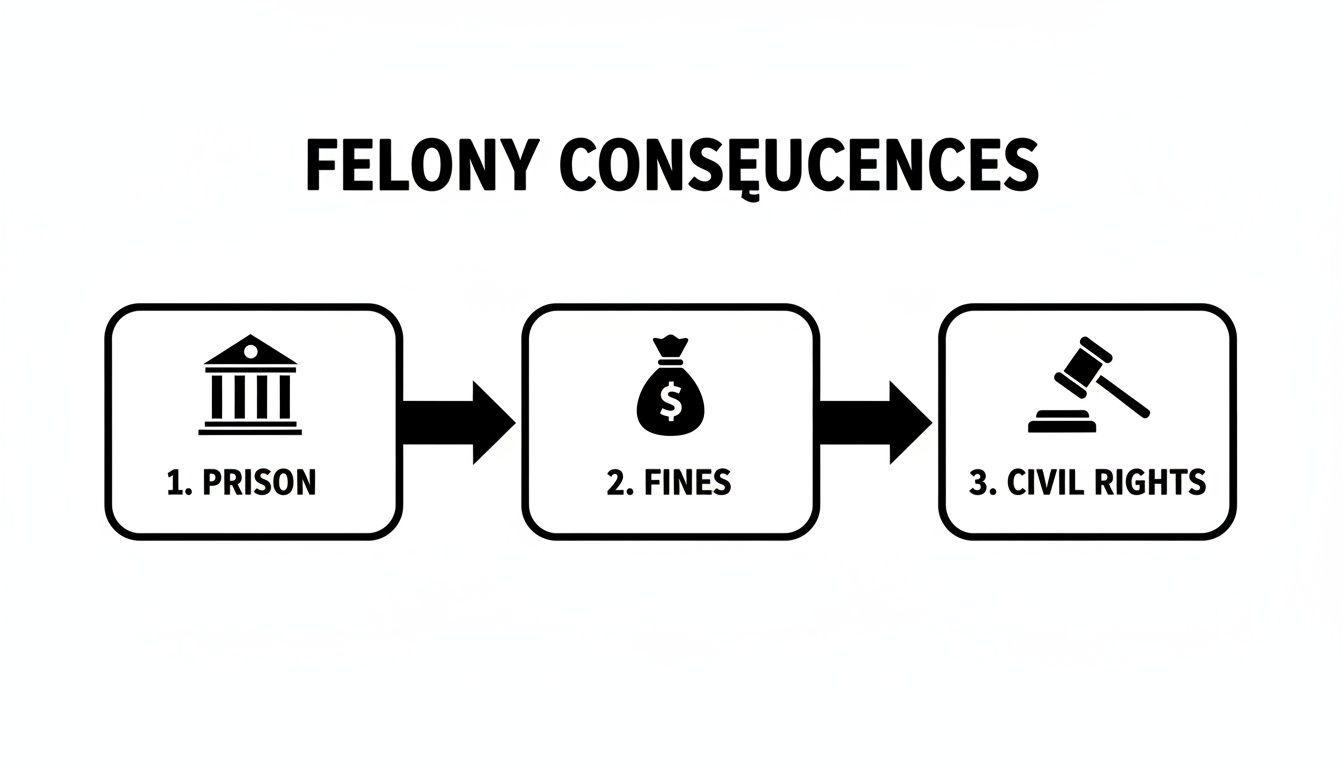
As you can see, a conviction isn't just about jail time. It creates a domino effect that impacts a person's freedom, their finances, and their most fundamental rights as a citizen.
For families, these first few days are a frantic scramble against the clock. Imagine getting the call that bail is set at $100,000. You’d have to find a bail bondsman, who will likely ask for a 10% non-refundable fee—that's $10,000 cash you won't get back—plus collateral, like the deed to your house. While you're pulling all that together, a proactive lawyer is already filing motions and demanding evidence from the prosecutor.
Having those two tracks running at the same time is essential. The steps you take in the first 48 hours can make all the difference in the long fight ahead. You can learn more about what happens when you get arrested in our guide to get a fuller picture of this critical period.
How a Strong Defense Can Change Everything

An arrest is just the start of a long, grueling journey—it's not the end of the story. When a family hears the words “first-degree felony,” it’s easy to feel like the fight is already over. But that’s just not true.
In the Texas justice system, an accusation is exactly that: an accusation. The state carries the immense burden of proving every single element of its case beyond a reasonable doubt. A strong defense is all about holding them to that incredibly high standard.
The moments right after an arrest aren't for despair. They're for strategic action. A skilled defense attorney doesn’t just sit back and react to what the prosecution does; they go on the offensive. It starts with meticulously dissecting the state’s case, hunting for weaknesses, constitutional violations, and procedural mistakes that can be turned to your advantage.
Challenging the Prosecution's Case
Building a powerful defense against first-degree felonies in Texas means scrutinizing every shred of evidence and every move law enforcement made. It's a detailed, painstaking process of asking the tough questions and demanding answers. Was the arrest even lawful? Was the evidence collected by the book? Were your loved one's constitutional rights respected at every single turn?
Common defense strategies include:
- Motions to Suppress Evidence: If the police conducted an illegal search or seizure, a good lawyer can file a motion to have that evidence thrown out completely. If that evidence is the linchpin of the state's case, suppressing it can sometimes lead to a full dismissal.
- Questioning Witness Credibility: Let's be honest, eyewitness testimony can be notoriously unreliable. A sharp defense lawyer will dig into a witness's background, look for potential biases, or find inconsistencies in their story to challenge their credibility on the stand.
- Asserting Affirmative Defenses: Sometimes, the facts of what happened aren't really in dispute, but the reason for the action is what matters. Defenses like self-defense, mistaken identity, or a rock-solid alibi can completely reframe the narrative and pave a clear path to an acquittal.
The hard reality is that police and prosecutors make mistakes. A strong defense is your family’s most powerful tool for making sure those mistakes don't lead to a wrongful conviction and a lifetime of devastating consequences.
The Role of Forensic Evidence and Expert Witnesses
In many high-stakes felony cases, the battle is won or lost on forensic evidence. We're talking about everything from DNA and fingerprints to digital data pulled from a phone or computer. A prosecutor will present their expert analysis, but that is never the final word.
A thorough defense often means hiring our own independent experts to re-examine the state's findings. When building a strong defense against felony charges, understanding forensic evidence is paramount; for those in Central Texas, dedicated services like Hill Country Forensics assist legal teams and law enforcement. These independent analyses can uncover critical errors in the state’s testing or offer alternative interpretations that create the reasonable doubt needed to win a case.
A skilled defense attorney doesn’t just take the state's evidence at face value. They challenge it, test it, and force the prosecution to prove its validity. This is how you level the playing field.
Plea Bargaining as a Strategic Option
While the ultimate goal is always a dismissal or a "not guilty" verdict at trial, sometimes the evidence against you is formidable. In those situations, plea bargaining becomes an essential strategic tool. This involves negotiating with the prosecutor to potentially reduce the charge from a first-degree felony to a lesser offense with a much more manageable penalty.
This isn't about giving up. It's a calculated decision to control the outcome and avoid the terrifying risk of a life sentence. A successful plea negotiation can mean the difference between decades behind bars and a chance to one day rebuild your life and, hopefully, reunify with your children.
Texas felony conviction trends paint a stark picture. Recent data shows that 62% of state prisoners were convicted of violent crimes. With 36% of parolees coming from violent first-degree convictions, having expert legal counsel is crucial to building a defense that avoids these outcomes. You can learn more about Texas's criminal justice data snapshot to see the full scope. This data really underscores why exploring every single defensive avenue is absolutely essential.
When the state of Texas levels a first-degree felony charge against someone you love, the clock starts ticking. Loudly. This isn't a situation where you can afford to wait and see what happens. The stakes are as high as they get: a potential life sentence, a permanent criminal record that slams doors shut forever, and a family torn apart at the seams.
Every minute that goes by is another minute the prosecution spends building their case. They're already talking to witnesses, collecting evidence, and shaping a story designed to lead to one place: a conviction. The only way to push back, to counter their momentum, is to get a skilled legal team in the fight right away.
The Fight for Your Family Begins on Day One
From the second an arrest is made, your loved one's constitutional rights are under fire. An experienced Texas criminal defense lawyer knows the battle doesn't start at the indictment; it starts now. They get to work immediately, digging into the facts of the case from your side of the story—not just the one the police are telling.
This means tackling crucial, time-sensitive tasks that can define the outcome:
- Locking Down Evidence: We're talking about finding and preserving evidence that can help your case before it vanishes. Think surveillance footage that gets erased or a key witness who moves away.
- Challenging the State's Story: Right from the jump, a good lawyer starts looking for the holes—the weak spots, inconsistencies, and constitutional violations in the prosecution's case.
- Protecting Your Loved One's Rights: This is huge. A lawyer ensures your family member isn't bullied or tricked into making statements and that every single legal protection they're entitled to is asserted, loudly and clearly.
Taking this kind of proactive stance can completely alter the trajectory of a case. Sometimes, it leads to getting charges reduced. Other times, it can get the case thrown out entirely before it even sees the inside of a courtroom.
This is not a journey you should ever take alone. The legal system, especially when you're up against a first-degree felony in Texas, is a complex and unforgiving machine. Having a dedicated advocate in your corner isn't just about legal strategy; it's about having the peace of mind that someone is fighting for you with everything they've got.
Think about it this way: your son gets arrested, and the police want to "just ask him a few questions." Without a lawyer, he might try to explain himself, thinking he's helping. But in reality, he could be handing the prosecution the very words they need to convict him. With an attorney, that interview simply doesn't happen. His lawyer takes control, shields him from self-incrimination, and begins the strategic process of dismantling the state's arguments.
This is exactly why you need to act now. Your family's future, their freedom, and your ability to stay together are all on the line, and it all hinges on the choices you make in these first critical hours.
The Law Office of Bryan Fagan, PLLC, is ready to stand with you. We know the fear and confusion you're feeling right now. Contact us for a free, confidential consultation. Let us be your shield, protect your rights, and fight for the future your family deserves.
Common Questions We Hear from Families Facing First-Degree Felony Charges
When a loved one is facing a charge as serious as a first-degree felony in Texas, the flood of questions and worries can be overwhelming. The legal jargon is dense, the stakes are impossibly high, and the path forward feels anything but certain. We've compiled answers to some of the most urgent questions we hear from families just like yours, trying to make sense of an incredibly difficult situation.
Can a First-Degree Felony Ever Be Cleared From a Record?
This is often the first question on everyone's mind, born from a hope for a future beyond this crisis. Unfortunately, a conviction for a first-degree felony in Texas is a permanent stain on a person's criminal record. The process known as expunction, which completely erases the records of an arrest as if it never happened, is only an option if the case is dismissed or if you are found "not guilty" at trial.
You may have also heard of an order of nondisclosure, which seals the record from public view. While law enforcement can still access it, potential employers, landlords, and the general public won't see it. This is usually reserved for much lesser offenses and often requires completing a deferred adjudication program. For a first-degree felony, this path is almost never available, which hammers home the importance of fighting the charge aggressively from day one.
What's the Real Difference Between Probation and Parole?
It’s incredibly easy to mix these two up, but they happen at completely different points in the justice system. Getting them straight is key to understanding what your loved one might be up against.
- Probation is a sentence you serve instead of going to prison. Think of it as a judge giving someone a chance to stay in the community under a very tight leash, with a probation officer monitoring their every move. It's also called "community supervision."
- Parole, on the other hand, is an early, supervised release from prison. After an inmate has served a required part of their sentence, a parole board decides if they can finish the remainder of their sentence out in the community, again under strict supervision.
Both probation and parole come with a long list of demanding rules—regular check-ins, drug tests, holding down a job, and more. A single slip-up can have devastating consequences, leading to probation being revoked and a prison sentence imposed, or for someone on parole, a trip right back behind bars.
Is It Even Possible to Get Bail for a First-Degree Felony?
Yes, getting bail is possible for most first-degree felony charges, but it is never a guarantee. The whole point of bail is to make sure the accused person shows up for their court dates. Given how serious these offenses are and the life-altering prison sentences they carry, judges are extremely cautious.
When deciding on bail for a first-degree felony, a judge is going to carefully weigh several key factors: the specific details of the alleged crime, the person's past criminal history, their ties to the community (like a job and family), and whether they are considered a flight risk or a danger to others.
This is why bail amounts for first-degree felonies in Texas can be astronomical, often reaching into the hundreds of thousands of dollars. A skilled attorney can make a huge difference here. At a bail hearing, they can present a compelling argument for a reasonable bond, providing evidence that your loved one isn't a flight risk and can be trusted to see the case through. Securing a manageable bond is often the first critical battle won in a very long war.
Facing a first-degree felony is a terrifying experience, especially when your children's future is on the line. You don't have to navigate it alone. The attorneys at the Law Office of Bryan Fagan PLLC have the experience and compassion to guide your family through this crisis. We are committed to protecting your rights and fighting for the best possible outcome in both your criminal and CPS cases. For a free, confidential consultation to discuss your case, contact us today at https://texascpslawyer.net.