Skip to content
The flashing lights in your rearview mirror can trigger an instant wave of fear and panic. For a parent, a first DWI charge in Texas isn’t just about legal trouble; it’s about what this means for your children, your job, and your family’s future. The confusion and dread can feel suffocating. What if I go to jail? Who will take care of my kids? Is this one mistake going to ruin everything we’ve built?
This moment of crisis doesn't have to define your life. While the charge is serious—typically a Class B Misdemeanor for a first offense—an arrest is not a conviction. Understanding the process, knowing your rights, and building a strategic defense are the first steps toward navigating this challenge and protecting the life you’ve worked so hard to create.
Your Life Changed in a Moment—What Happens Now?
A DWI arrest is disorienting. It immediately splits your life into two separate, simultaneous legal battles: a criminal case that threatens your freedom and a civil process that threatens your ability to drive. It’s an overwhelming situation, but you are not the first parent to face it. It's a path that can be managed with the right guidance and a clear understanding of what lies ahead.
Remembering that the state carries the full burden of proof is crucial. The details of your stop and arrest are filled with opportunities to challenge the prosecution's case.

A Charge Is Not a Conviction: A Real-Life Scenario
Consider Maria, a single mother working two jobs to support her family. After a long shift, she had a single glass of wine with dinner and was pulled over for a broken taillight. Overwhelmed by exhaustion and anxiety during the stop, she performed poorly on the field sobriety tests. The breathalyzer registered just over the legal limit. Her first thought was of her son—a conviction would mean losing her job and, potentially, her ability to care for him.
Her attorney, however, dug deeper. By reviewing the officer's dashcam footage, he discovered that the officer had given confusing and incorrect instructions for the sobriety tests. Furthermore, the breathalyzer's maintenance logs were out of date, calling its accuracy into question. Armed with these facts, her lawyer negotiated with the prosecutor, highlighting the weaknesses in the case. The DWI charge was ultimately dismissed. Maria’s story is a powerful reminder that an initial arrest is far from the final word. You can learn more about the initial steps by reading our guide on what happens when you get arrested in Texas.
The Reality of First DWI Cases
Many people believe a DWI charge automatically leads to a conviction, but the data tells a different story. In 2022, the Texas Department of Public Safety recorded 83,361 DWI arrests statewide. Of those, 3,793 cases resulted in the defendant being released without any charges filed, and an additional 10,021 cases were dismissed entirely.
While these statistics cover all DWI arrests, courts often show more leniency to first-time offenders, meaning your chances for a favorable outcome could be even better.
For any parent just arrested, seeing the potential consequences in one place can help clarify what's at stake. Here’s a quick overview of what a first-time DWI charge typically involves.
First-Time Texas DWI At a Glance
| Aspect | Typical Classification | Potential Penalties |
|---|---|---|
| Criminal Charge | Class B Misdemeanor | Up to 180 days in county jail. Fines up to $2,000. |
| Driver's License | Administrative License Revocation (ALR) | Suspension from 90 days to 1 year. |
| Probation | Common outcome instead of jail | Up to 2 years of community supervision with strict conditions. |
| Financial Costs | Beyond fines and court fees | Attorney fees, ignition interlock device, SR-22 insurance, DWI education classes. |
This table is just a snapshot, and every case is unique. The final outcome depends heavily on the specific facts of your arrest and the quality of your legal defense.
Understanding the Criminal Penalties You're Facing
After the initial shock of an arrest wears off, the legal jargon can create a new wave of anxiety. Terms like "Class B Misdemeanor" or "community supervision" feel abstract, but they have real-world consequences for your family and your ability to provide. Breaking down these penalties is the first step toward building a defense that protects what matters most.
For a first DWI in Texas, the charge is usually a Class B Misdemeanor. This legal classification sets the boundaries for potential punishments and tells the court system how seriously to treat the offense.
The Standard Class B Misdemeanor DWI
This is the baseline charge for a first-time DWI. It applies when your Blood Alcohol Concentration (BAC) is 0.08 or higher but below 0.15, and no other aggravating factors are present (like having a child passenger).
While the potential penalties look intimidating, a skilled attorney can often negotiate a more favorable outcome. For a Class B conviction, the law allows for:
- Jail Time: A sentence ranging from 72 hours to 180 days in county jail.
- Fines: A fine of up to $2,000.
- License Suspension: Your driver's license can be suspended for up to one year.
It is rare for a first-time offender without aggravating circumstances to serve significant jail time. Judges often prefer rehabilitative solutions, especially when the individual is a parent and the primary caregiver for their family.
When Penalties Escalate: The Class A Misdemeanor
The stakes increase dramatically if your BAC is measured at 0.15 or higher. This single factor elevates the charge to a Class A Misdemeanor, effectively doubling the potential penalties. The law views a higher BAC as a greater risk to public safety, and the consequences reflect that severity.
For a Class A Misdemeanor DWI, you could be looking at:
- Jail Time: Up to one full year in county jail.
- Fines: A much steeper fine, up to $4,000.
- License Suspension: A longer potential suspension period of up to two years.
This jump in severity is why challenging the accuracy of breath or blood tests is a critical component of many DWI defense strategies.
The most frightening thought for any parent is being separated from their children by jail. But for a first DWI in Texas, judges frequently choose probation, also known as "community supervision," instead of incarceration. This allows you to stay home with your family, keep your job, and prove you're committed to responsible behavior.
What Probation Really Means for Your Family
Probation is the most frequent outcome for a first DWI, but it requires strict adherence to court-ordered conditions. It is a structured period, typically one to two years, where you must follow a set of rules to avoid jail.
Think of it as a contract with the court. Fulfilling your obligations means you remain with your family. Violating the terms can lead the judge to revoke your probation and impose the original jail sentence.
Actionable steps for successfully navigating probation include:
- Calendar Everything: Immediately schedule all meetings with your probation officer, DWI education classes, and community service deadlines.
- Communicate Proactively: If you have a scheduling conflict with work or a family emergency, contact your probation officer before you miss an appointment.
- Stay Organized: Keep a dedicated folder with all your court documents, class completion certificates, and contact information for your probation officer.
These requirements demand discipline, but they provide a path to stay home and continue providing for your loved ones. It’s also important to understand the financial side. As of 2019, old civil surcharges were replaced with increased fines. Now, you’re looking at a $3,000 fine for a first offense and $6,000 if your BAC was 0.15 or higher. These costs are a major factor, and you can get a clearer picture of what to expect by reviewing our guide on DWI fines in Texas.
Navigating The Two Fronts Of A DWI Case
One of the most jarring realities for anyone facing a first DWI in Texas is the sudden discovery that you aren't just fighting one legal battle—you're fighting two at the same time. The criminal case determines guilt and penalties like fines or probation. Simultaneously, the Texas Department of Public Safety (TxDPS) initiates a separate civil case to suspend your driver's license.
It feels like trying to put out two fires at once. Managing both effectively is essential to protecting your freedom and your ability to maintain your family's daily life.
The Critical 15-Day Deadline
From the moment of your arrest, a non-negotiable clock starts ticking. You have exactly 15 days to request an Administrative License Revocation (ALR) hearing to challenge the automatic suspension of your driver's license.
If you miss this 15-day window, your license will be suspended automatically. There are no extensions. This suspension typically begins 40 days after your arrest, leaving you unable to legally drive to work, take your children to school, or run essential errands.
The stakes are always high in any DWI-related case. For perspective, a Bexar County jury awarded $82 million in a DWI wrongful death crash, a stark reminder of the devastating potential consequences and why every legal front must be addressed with absolute seriousness.
The flowchart below shows how quickly the penalties can stack up, depending on the details of your DWI charge.
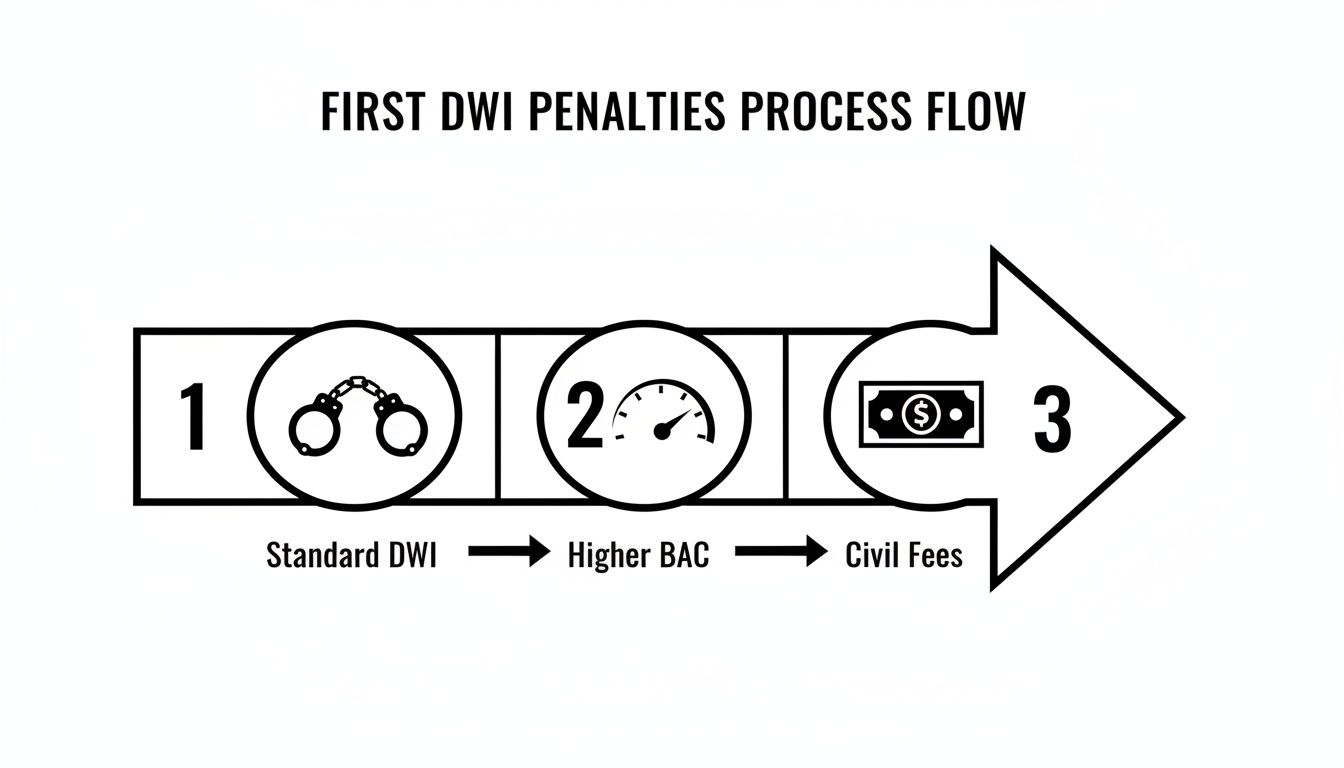
As you can see, a standard DWI is just the starting point. Higher BAC levels and additional civil fees can dramatically increase the consequences.
Why The ALR Hearing Is A Golden Opportunity
Many people view the ALR hearing as just another bureaucratic hassle. However, a strategic defense attorney sees it as a critical advantage. This hearing is often the first opportunity to question the arresting officer under oath—a dress rehearsal for the criminal trial.
During the ALR hearing, your attorney can get a head start on building your defense by:
- Challenging the Traffic Stop: Forcing the officer to justify their reason for pulling you over.
- Examining Procedures: Scrutinizing every step of the arrest, from the administration of field sobriety tests to the reading of your rights.
- Gathering Key Evidence: Obtaining police reports and dashcam footage that will be vital for your criminal defense.
- Locking in Testimony: Getting the officer's account on the record, which can be used to expose inconsistencies later.
Winning the ALR hearing means you keep your license—a huge relief for any parent. But even if you don't win, the intelligence gathered is invaluable for strengthening your criminal defense. For a deeper dive into your rights during a stop, check out our article that answers the question: Can you refuse a breathalyzer test in Texas?.
It's crucial to understand that these two legal proceedings—the criminal case and the ALR hearing—are completely separate. Here’s a quick breakdown to help clarify the distinction.
Criminal Case vs ALR Hearing Key Differences
| Feature | Criminal DWI Case | Administrative License Revocation (ALR) Hearing |
|---|---|---|
| Purpose | To determine criminal guilt and impose penalties like jail, fines, or probation. | To determine if your driver's license should be suspended. |
| Who is Involved | Prosecutor vs. Defendant and their Attorney | TxDPS Attorney vs. Your Attorney |
| Burden of Proof | "Beyond a reasonable doubt" (very high standard) | "Preponderance of the evidence" (much lower standard) |
| Key Question | Did you operate a motor vehicle while intoxicated? | Did the officer have reasonable suspicion to stop you? Was there probable cause for the arrest? |
| Location | County or District Criminal Court | Administrative Law Court |
| Outcome | Conviction or acquittal, fines, probation, possible jail time. | License suspension or no suspension. |
Facing two separate legal battles can feel overwhelming, but understanding the differences is the first step toward building a solid, comprehensive defense strategy for both fronts.
Keeping Your Life Moving With An Occupational Driver’s License
If your license is suspended, your life doesn't have to come to a standstill. You have the right to petition the court for an Occupational Driver’s License (ODL), sometimes called an essential need license.
An ODL is a special, restricted license that allows you to drive for specific, necessary purposes. It’s the legal tool that ensures you can continue to meet your family’s needs and maintain your employment while your case proceeds.
An ODL lets you drive for essential, pre-approved activities, including:
- Traveling to and from your job.
- Driving your kids to and from their school or daycare.
- Attending religious services.
- Performing essential household duties, like grocery shopping or going to the bank.
Obtaining an ODL is a formal legal process that requires filing a petition, proving your essential need to drive, and providing proof of SR-22 insurance. It is an extra step, but a vital one for maintaining stability for you and your family during a difficult time.
How to Build a Strong DWI Defense Strategy
Facing a DWI charge, it’s easy to feel defeated and assume a conviction is inevitable. But you must remember a critical truth: an arrest is not a conviction. The state carries the entire burden of proving its case beyond a reasonable doubt, and every piece of their evidence can and should be challenged.
A powerful defense is built by meticulously deconstructing the entire incident, from the moment the police lights flashed in your mirror. Many people facing a first DWI in Texas mistakenly believe that a "failed" test is the end of the story. The reality is that procedural errors, faulty equipment, or an officer's subjective judgment can become the foundation of a successful defense.
Challenging the Initial Traffic Stop
The entire DWI case rests on one question: did the officer have a legal right to pull you over? This is your Fourth Amendment right against unreasonable seizure. An officer needs "reasonable suspicion"—specific, articulable facts that you violated a law—not just a hunch.
Reasons for a stop that can be challenged include:
- Vague Driving Patterns: An officer’s claim of "weaving" within your lane may not be sufficient without corroborating dashcam video.
- Minor Traffic Violations: Did you truly fail to signal for the required 100 feet? An attorney can scrutinize the traffic code and the officer's claims.
- Pretextual Stops: Was a minor infraction just an excuse for a DWI investigation?
If your lawyer proves the stop was illegal, all evidence gathered afterward can be suppressed, often leading to a full dismissal of the case.
The Unreliability of Field Sobriety Tests
Standardized Field Sobriety Tests (SFSTs)—the roadside balance and coordination exercises—are notoriously subjective and prone to error. Many factors besides alcohol can cause a person to perform poorly:
- Medical Conditions: Issues with balance, prior injuries, or inner ear problems can make these tests impossible for a sober person to pass.
- Nerves and Anxiety: The stress of a police encounter on the side of a busy road is immense and can easily affect coordination.
- Improper Instructions: Officers must give instructions verbatim. Any deviation can invalidate the test results.
- Environmental Factors: Uneven ground, poor lighting, or inappropriate footwear can dramatically impact performance.
A tired parent after a long workday might stumble during a test not because they're intoxicated, but because they are exhausted, nervous, and trying to balance on the sloped shoulder of a highway at night.
An experienced lawyer knows how to cross-examine an officer on the precise administration of these tests, creating reasonable doubt about their validity.
Scrutinizing Breath and Blood Test Results
The "scientific" evidence from a breathalyzer or blood test often feels irrefutable, but these tests are highly vulnerable to error.
Common problems with breath tests include:
- Improper Calibration: The Intoxilyzer 9000 machine used in Texas requires regular maintenance. If records show it was not properly calibrated, the results are unreliable.
- Human Error: The officer must follow a strict 15-minute observation period to ensure mouth alcohol from a burp or reflux doesn't contaminate the sample.
- Medical Conditions: Acid reflux (GERD) or even certain low-carb diets can produce compounds that create a falsely high reading.
Blood tests are also fallible. Your attorney will demand to see the "chain of custody" for the sample. Any mistake in this chain—from improper storage to a lab mix-up—can render the results inadmissible in court. From a bad stop to a bad machine, every step of the DWI process is an opportunity to build your defense.
Hopeful Outcomes: Charting a Path Forward
When you're facing a first DWI in Texas, it’s easy to feel like the future has already been written for you. The fear is real—a conviction, jail time, and a permanent mark on your record. But it’s critical to understand that an arrest is just the start of a long process. There's a whole spectrum of possible outcomes, and many of them are far more hopeful than you might imagine.
With the right legal guide, you can navigate this maze and work to minimize the long-term impact on your life and family. The goal is always to find the best possible resolution, and that starts with knowing what's on the table.
The Best-Case Scenario: A Full Dismissal
The ultimate win in any DWI case is getting the charges dismissed entirely. This means the prosecutor drops the case, and legally, it’s as if the arrest never happened. It might sound like a long shot, but dismissals happen more often than you'd think, especially when a sharp attorney can find cracks in the state's evidence.
A case can be dismissed for a number of reasons:
- An Illegal Stop: If your lawyer can prove the officer had no valid legal reason to pull you over in the first place, any evidence they gathered afterward—like the breath test—gets thrown out.
- Faulty Test Results: A skilled attorney can show that a breathalyzer wasn't calibrated correctly or that a blood sample was contaminated or mishandled. This can make the results inadmissible in court.
- Suppression of Evidence: If your constitutional rights were violated at any point during the stop or arrest, crucial evidence can be suppressed. Without that evidence, the prosecution's case often falls apart.
Reducing the Charge Through a Plea Bargain
Sometimes the evidence against you is strong, but not airtight. In these situations, your attorney can often negotiate a plea bargain with the prosecutor to get the DWI charge reduced to something less severe and not alcohol-related. A common outcome here is pleading to a charge like Obstruction of a Highway.
This is a huge victory. It keeps a DWI conviction off your record, which is massive for protecting your driver's license, keeping your insurance rates from skyrocketing, and safeguarding any professional licenses you might have. It gives you a way forward that acknowledges a mistake without the lifelong baggage of a DWI.
Deferred Adjudication: Keeping a Conviction Off Your Record
For many first-time offenders, deferred adjudication is a fantastic option. It’s not a dismissal, but it’s the next best thing for protecting your future. Here's how it works: you plead "guilty" or "no contest," but the judge defers finding you guilty. Instead, they place you on community supervision (which is a lot like probation).
You’ll have to stick to specific conditions for a set period, like:
- Taking a DWI education class.
- Doing some community service.
- Possibly having an ignition interlock device on your car.
The real power of deferred adjudication is this: once you successfully complete the supervision period without any issues, the case is formally dismissed. You will never have a final conviction on your public record.
This outcome is an absolute lifeline for parents and professionals who can't afford a conviction threatening their careers and reputation. Historically, many successful DWI defenses have hinged on technicalities, like an improper stop or flawed testing procedures. An experienced attorney uses these exact angles to argue for favorable outcomes like deferred adjudication or even a complete dismissal. You can learn more about these legal precedents from resources at utexas.edu.
Standard Probation: A Path to Avoid Jail Time
If deferred adjudication isn't on the table, standard probation is another common way to avoid jail for a first DWI in Texas. With probation, a conviction is entered on your record, but you serve your sentence in the community instead of behind bars. You’ll have to follow court-ordered rules, like checking in with a probation officer and staying out of trouble.
While this does result in a conviction, it allows you to stay with your family and keep your job—which, for most parents, is the most important thing in the world.
Clearing Your Record with Expunction and Nondisclosure
Once the stress and uncertainty of your court case are behind you, the journey isn’t quite over. The final, and arguably most important, step is to protect your future from the shadow this event can cast. For anyone navigating a first DWI in Texas, understanding how to clean up your criminal record is the key to truly moving on and safeguarding your family's future.
Luckily, Texas law offers two powerful tools to help you do just that: expunction and nondisclosure. While they might sound similar, they work in very different ways, and your eligibility hinges entirely on how your case was resolved.

Expunction: The Power to Erase Your Arrest
An expunction is the most complete form of record-clearing you can get. Think of it as a legal time machine that goes back and completely wipes the slate clean.
When a judge grants an expunction, every government agency—from the arresting police department to the court clerk—is ordered to destroy all physical and digital records of your arrest. It’s a powerful remedy.
Legally, it’s as though the arrest never even happened. You can deny it ever occurred on job applications, apartment leases, and loan documents without any fear of legal penalties.
But this powerful tool isn't available to everyone; the eligibility requirements are extremely narrow. You can typically only get an expunction if your case ended in one of these specific outcomes:
- Your case was dismissed by the prosecutor.
- A judge or jury found you not guilty (acquitted).
- You were arrested but were never formally charged with a crime.
For many parents, getting an expunction is the ultimate goal. It offers total peace of mind and removes any and all barriers to future opportunities.
Nondisclosure: Sealing Your Record from Public View
If your case didn't end in a dismissal or an acquittal, don't lose hope—you may still have an excellent option. An order of nondisclosure acts like a privacy shield for your criminal record. It doesn't destroy the records of your arrest and case, but it does seal them from public view.
This means that potential employers, landlords, and the general public won't see the offense on a standard background check.
The most common way to get a nondisclosure for a first DWI in Texas is by successfully completing deferred adjudication. Once you finish your supervision period and the judge dismisses the case, you can petition the court to seal the record.
While law enforcement and certain state licensing agencies can still access the sealed information if needed, a nondisclosure effectively removes the charge from the public eye. This is an absolute game-changer when you're trying to land a new job, get a professional license, or even just volunteer at your child's school. It lets you put the mistake behind you without it constantly holding you back.
Both expunction and nondisclosure require filing a formal petition with the court. It's a detailed legal process where the guidance of an experienced attorney is invaluable.
Frequently Asked Questions About a First Texas DWI
A DWI charge throws a lot of questions and uncertainty into your life. It's completely normal to feel overwhelmed. Below, I’ve answered some of the most pressing concerns I hear from families dealing with a first DWI in Texas.
Will I Have to Install an Ignition Interlock Device?
It’s definitely more common than it used to be, but it’s not an automatic requirement for a first offense.
An ignition interlock device (IID) often becomes mandatory if your blood alcohol concentration (BAC) was 0.15 or higher. It's also typically required if you need an Occupational Driver's License to get to work while your main license is suspended.
In other situations, it's really up to the judge's discretion. They might order an IID as a condition of your probation. This is one of those areas where a skilled attorney can really make a difference by negotiating the terms to minimize the disruption to your daily life.
Can I Lose My Job Because of a First DWI Arrest?
This is a big one, and the answer really depends on your employer's policies and your line of work.
Some professions are at much higher risk. If your job involves driving, holding a Commercial Driver's License (CDL), or requires a state-issued professional license (like for nursing or teaching), a DWI arrest can put your career in immediate jeopardy.
The absolute best way to protect your job is to fight for an outcome that keeps the DWI off your permanent record. An experienced DWI defense lawyer can work towards a result that allows for an expunction or a nondisclosure, effectively sealing it from public view.
How Much Does a First DWI in Texas Really Cost?
The final bill goes far beyond the fines you pay to the court. When you look at the big picture, you should prepare for a number of expenses:
- Attorney fees
- Court costs and administrative fees
- Monthly probation supervision fees
- Mandatory DWI education classes
- Significantly higher car insurance premiums for years to come
- License reinstatement fees
- IID installation and monthly monitoring fees, if required
When you're facing a mountain of potential costs, practical concerns are front and center. It's no surprise that many people ask, “Do lawyers accept payment plans?”. Think of it this way: investing in a strong legal defense from the start can often reduce the total financial damage by securing a much better outcome in court.
A DWI charge can feel like a devastating blow, shaking your family’s sense of stability and security. You are not just a case number; you are a parent fighting for your future. You don’t have to go through this alone. The dedicated attorneys at the Law Office of Bryan Fagan are here to listen with compassion, provide clear legal guidance, and build the strongest possible defense to protect everything you hold dear. We understand what's at stake for you and your children.
Contact us today for a free, confidential consultation to discuss your case. Let us help you navigate this difficult time and fight for the best possible outcome for your family. Visit us at https://texascpslawyer.net.