Skip to content
When you are facing an investigation from Child Protective Services (CPS), it can feel like your entire world is crumbling. The fear and confusion are overwhelming, and the thought that evidence might be used to tear your family apart is terrifying. It’s easy to feel helpless, but it’s critical to remember that you have constitutional rights—and one of the most powerful shields to protect those rights is a motion to suppress evidence.
This isn't some legal loophole or a technicality. It’s a formal, written request we file with the court, asking a judge to throw out certain evidence that CPS or law enforcement wants to use against you. It's a fundamental protection designed to make sure the government plays by the rules when gathering information that could impact your children and your future.
Your Constitutional Shield in a Texas CPS Case

Being involved with CPS is a deeply unsettling experience. Your future as a parent, your relationship with your children, your family’s stability—it all feels like it's on the line. But even when you feel powerless, you have a constitutional shield.
Think of a motion to suppress as a formal objection to the judge. We're essentially saying, "Your Honor, the government obtained this piece of evidence illegally, and you cannot allow them to use it in court against this family." This protection exists to hold caseworkers and police accountable and ensure every Texan gets a fair shake in the justice system, especially when the stakes are as high as your parental rights.
A Real-Life Example of a Suppression Motion in a CPS Case
Let’s make this real. Imagine a CPS caseworker shows up at your door unannounced, responding to an anonymous tip. They are aggressive, implying that if you don't let them in to search your home right now, things will be worse for you. Feeling intimidated and fearing you’ll lose your children, you let them in. They find something they claim is evidence of neglect, like a messy kitchen or prescription medication on a counter.
This is a classic scenario where a motion to suppress can be a game-changer.
Your attorney would argue that your "consent" to the search was not truly voluntary but was the result of coercion, making it a violation of your Fourth Amendment rights against unreasonable searches. Under the Texas Family Code, particularly Chapter 262 which governs procedures in suits by a governmental entity, evidence must be obtained lawfully. If the judge agrees the search was illegal, any evidence found gets "suppressed"—meaning CPS is legally forbidden from using it against you in court. Understanding what happens when you get arrested or when you're under investigation is the first step in building this kind of strong defense for your family.
This motion is a cornerstone of American justice. It ensures that the government cannot profit from its own misconduct, reinforcing the principle that the ends do not justify the means when it comes to your family's future.
By challenging evidence that was obtained illegally, you're not just defending your family. You are upholding the integrity of our entire legal system.
Understanding a Motion to Suppress Evidence

So, what is a motion to suppress evidence, really? In plain English, it’s a formal legal request we file with the court, arguing that CPS or law enforcement broke the rules when they gathered evidence against you. We’re asking the judge to throw that evidence out.
Think of it like a football game. The offense scores a touchdown, but the referee sees a flag on the play for holding. That touchdown comes right off the scoreboard. A motion to suppress asks the judge to act as that referee—to call a penalty on illegally obtained evidence and make sure the court never even sees it.
This is one of the most powerful tools in a family law attorney's arsenal. It's grounded in the Fourth Amendment’s promise to protect you from unreasonable searches and seizures. When successful, this pretrial motion can completely change the trajectory of a CPS case. You can find more details on how these motions impact case outcomes from studies by the Office of Justice Programs on search warrants and motions to suppress.
What Kind of Evidence Can Be Suppressed?
We're not just talking about physical objects here. A motion to suppress can target almost anything CPS wants to use against you, as long as it was obtained illegally. This often includes:
- Physical Evidence: This is the obvious one—photos of your home, prescription bottles, or other items found during an illegal search of your house or car.
- Statements or Confessions: If you were in custody and police questioned you without reading your Miranda rights, or if a CPS caseworker coerced statements from you, those admissions can often be suppressed.
- Witness Identifications: A police lineup or photo array that was set up in a way that was unfairly suggestive could be challenged and thrown out, though this is less common in family law.
By blocking CPS from using this tainted evidence, we can seriously cripple their case. Sometimes, a successful motion leaves them with so little evidence that they have no choice but to change their recommendations or dismiss the case entirely, allowing your family to begin the healing process.
A motion to suppress isn't about finding a "technicality" to get away with something. It’s about holding the government accountable to the Constitution. It’s a crucial check on power that ensures the justice system remains fair for every Texas family.
While we're focused on suppressing evidence, it helps to understand how different legal motions work together. For instance, a motion to dismiss is another powerful tool for attacking the state’s case early on. Both are designed to challenge the very foundation of the state's argument before a trial on your parental rights even begins.
Common Grounds for Suppressing Evidence in Texas
When we ask a judge to throw out evidence in a CPS case, it’s not about finding some obscure loophole. It’s about holding the government accountable to the fundamental rights guaranteed by both the U.S. and Texas Constitutions. We have to give the court a powerful, legally sound reason why the evidence was obtained illegally.
At the heart of most suppression motions is the Fourth Amendment, your shield against unreasonable searches and seizures. This is the bedrock of your privacy rights, and it’s where we often find the strongest arguments to protect your family.
Unreasonable Search and Seizure Violations
So what makes a search "unreasonable"? It happens when a government agent, like a police officer or CPS caseworker, intrudes on your reasonable expectation of privacy without a valid reason. It’s a broad concept, and a judge will always look at the “totality of the circumstances” to decide if an agent’s actions crossed the line.
Here are a few common scenarios where the Fourth Amendment comes into play:
- Warrantless Searches of Your Home: Your home is your castle, and it gets the highest level of legal protection. A caseworker or officer simply cannot walk in and start searching without a valid court order, your clear and voluntary consent, or a true emergency (like hearing a child screaming for help from inside).
- Improper Vehicle Searches: Police can’t just toss your car on a whim during a traffic stop. To search beyond what’s in plain view, they need probable cause—a solid, fact-based belief that you’ve committed a crime. A mere hunch that you might have something in the trunk or glove box isn't enough.
- Lack of Probable Cause for a Warrant or Removal: Even when the government does have a court order, we can still attack it. If the affidavit they used to get the order (like one required under Texas Family Code Chapter 262 for removing a child) was based on false information or just didn't add up to probable cause, any evidence they found can be thrown out.
Think of probable cause as more than just a gut feeling; it has to be built on concrete facts. If the foundation for the search is weak or nonexistent, the entire search is illegal. Any evidence discovered becomes "fruit of the poisonous tree" and is inadmissible in court.
To make this clearer, let's break down the most common constitutional violations we see.
Common Reasons to File a Motion to Suppress
This table highlights the core constitutional issues that often lead to evidence getting tossed out, with a real-world example for each.
| Constitutional Violation | What It Means | Common Example |
|---|---|---|
| Fourth Amendment | Protection from unreasonable searches and seizures by the government. | A CPS caseworker threatens to take your kids unless you let them search your home, so you reluctantly agree. |
| Fifth Amendment | Your right to remain silent and not incriminate yourself. | Police arrest you in connection with a CPS case, put you in an interrogation room, and start questioning you without ever reading you your Miranda rights. |
| Sixth Amendment | Your right to an attorney during critical stages of a criminal case. | You've been formally charged in a related criminal matter and have a lawyer, but detectives question you again at the jail without your attorney present. |
Other Key Grounds for Suppression
While Fourth Amendment challenges are the most frequent, they aren't the only tool in our toolbox. Other critical constitutional safeguards can also be powerful grounds for getting evidence excluded.
A major one is the Fifth Amendment, which protects your right against self-incrimination. This is where the famous Miranda rights originate. If you are in police custody and they start asking you questions designed to get an incriminating response, they must first inform you of your right to remain silent and your right to an attorney.
If they fail to give you that warning, any confession or damaging statement you make can be suppressed. This is a vital protection, especially when you’re in a high-stress, intimidating environment like an interrogation room, worried sick about your children.
Finally, we can challenge the evidence on procedural grounds by attacking the chain of custody. The prosecution has the burden of proving that the evidence they want to use at trial is the very same evidence collected from the scene—and that it hasn't been contaminated, mishandled, or tampered with.
If there are unexplained gaps or sloppy procedures in how evidence like a drug test sample was stored and handled, we can argue that it’s no longer reliable. While this isn’t a constitutional violation, it’s a critical rule that ensures the integrity of the evidence. Understanding how these procedural rules apply, for instance, is crucial when police ask you to refuse a breathalyzer test, as the handling of that evidence is everything.
Navigating the Motion to Suppress Process
Knowing your rights is one thing, but actually challenging the state's evidence is a whole other ball game. This isn't about some dramatic courtroom outburst you see on TV; it's a careful, strategic legal process that happens long before a trial ever begins, all aimed at protecting your constitutional rights and your family. It all kicks off when your attorney drafts and files a formal, written motion to suppress.
This document is far more than a simple form. Think of it as a detailed legal argument, built brick by brick. It lays out the specific facts of what happened in your case, points to relevant laws like the Texas Family Code and past court decisions, and makes a powerful case for why a certain piece of evidence shouldn't be allowed in court. There's no room for error here—both federal and state rules have strict requirements for what needs to be included. For a deeper dive into these procedural rules, you can explore the legal standards for suppression motions here.
Once that motion is filed, it sets the stage for a crucial showdown: the suppression hearing.
The Suppression Hearing: A Mini-Trial on the Evidence
Imagine a mini-trial focused on just one thing: the evidence the state wants to use against your family. There’s no jury. The judge is the sole audience, and their decision here can completely change the direction of your case. In this hearing, your attorney and the state's attorney will each get their chance to argue their side.
Often, the main event is the testimony from the police officers or CPS caseworkers who collected the evidence. This is where a skilled family law attorney really shines. They will cross-examine the state’s witnesses, digging into every single detail of the investigation, the search, or the interrogation.
- Did they really have a valid reason to enter your home in the first place?
- Did you actually give them clear and voluntary consent before they searched?
- Did they follow every single rule in the Texas Family Code when they questioned you or your children?
The entire goal is to bring any mistakes, procedural shortcuts, or outright constitutional violations to light for the judge to see.
This simple chart shows the path from filing the motion to the judge's final decision.
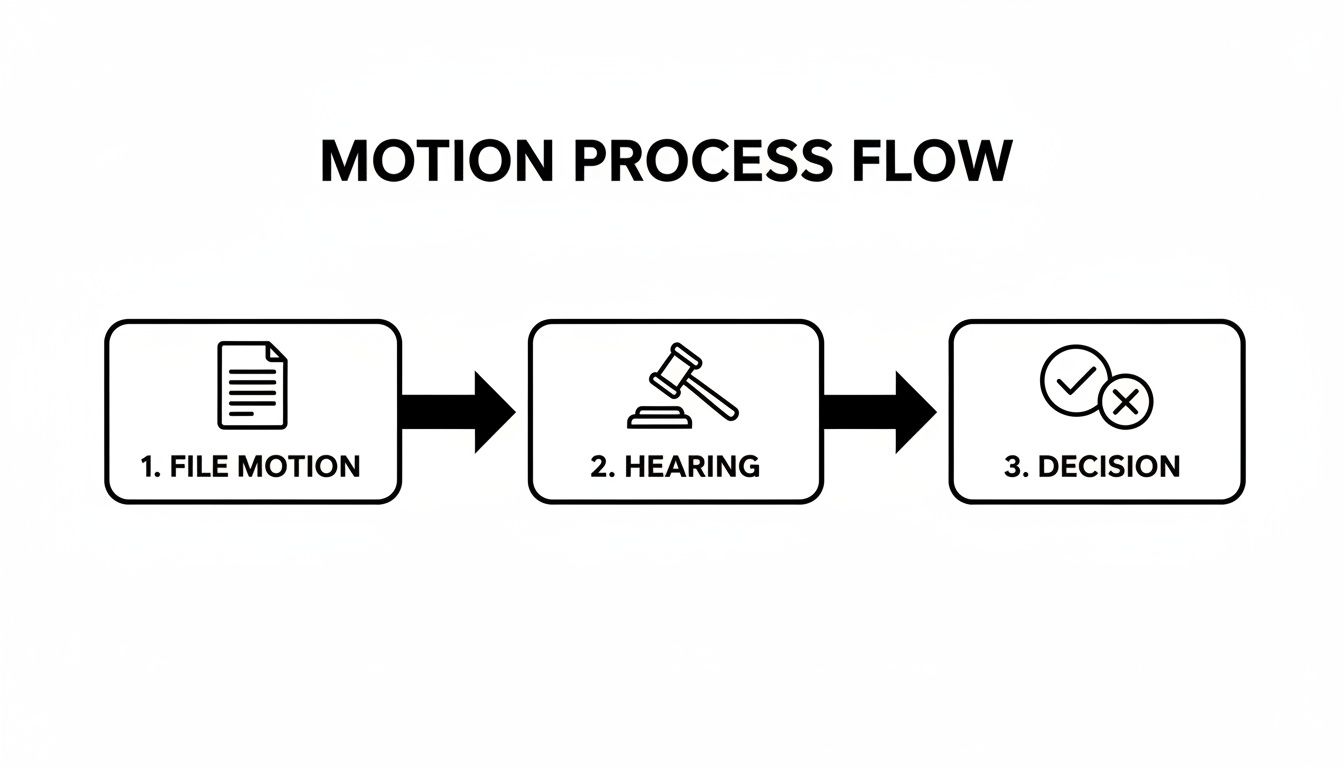
From the carefully written motion to the pointed questions asked at the hearing, every step is designed to lead to a ruling that could make or break the entire case and help you get closer to reunification with your children.
The Judge's Decision and What It Means for Your Case
After listening to all the arguments and testimony, the judge makes a call. They decide if the evidence was gathered by the book or if your family's rights were trampled on in the process.
If the judge grants the motion, that piece of evidence is out. It’s suppressed, and the state can't mention it or use it against you. But if the judge denies the motion, the evidence stays in, and the state can present it to the court at trial. Either way, this one ruling has a massive impact on how both sides will approach a settlement or prepare for trial.
What Happens When a Suppression Motion Actually Works?
Winning a motion to suppress evidence can completely turn a CPS case on its head. When a judge grants our motion, it means the state is legally blocked from using that specific piece of evidence against you at trial. This one ruling can fundamentally shift the power dynamic in the courtroom.
Think of the state’s case like a house of cards. A key piece of evidence—maybe a coerced statement or items found during an illegal search of your home—acts as one of the foundational cards holding the whole thing up. If we successfully pull that card out, the entire structure can get wobbly or even collapse entirely.
This often backs the state into a corner, creating powerful new possibilities for keeping your family together.
How a Successful Motion Reshapes Your Case
When a critical piece of evidence gets thrown out, the state’s attorney has to go back to the drawing board and rethink their whole game plan. Their next move usually leads to one of these outcomes:
- Case Dismissal: If the suppressed evidence was the linchpin of their case, they might not have enough left to even proceed. This can lead to the charges being dropped altogether and the case against your family closed.
- A Much Better Service Plan or Settlement: With a weakened case, the state is suddenly far more willing to negotiate. A service plan with less burdensome requirements or an agreement that leads to faster reunification becomes a real possibility.
- A Weaker Case at Trial: If the state decides to push forward to a trial to terminate your parental rights (governed by Texas Family Code Chapter 161), they're now fighting with one hand tied behind their back. They're left trying to sell a much weaker, less convincing story to the judge.
For example, in a case involving allegations of drug use, if the drug test results are suppressed because of an illegal search or improper chain of custody, the state has literally nothing left to prove that specific allegation. This is the ultimate goal—it doesn't just weaken the case; it dismantles it.
It might feel like a legal technicality, but the exclusionary rule is what gives your constitutional rights teeth. Data shows that successful motions don't let dangerous people off the hook; instead, they are vital for holding government agents accountable and protecting families from overreach.
Studies show that motions to suppress are granted in a small fraction of cases—typically less than 2% of defendants file them successfully—but their impact on protecting individual liberties is huge. You can learn more about how these motions impact case outcomes and hold the system to its constitutional promises. The point isn't to exploit a loophole; it's to demand a fair fight for your family.
Why an Experienced Attorney Is Crucial for Your Motion
Successfully challenging the state's evidence isn't something you can do yourself; it's a complex, high-stakes legal battle. A motion to suppress evidence is far more than a simple form you fill out—it's a sophisticated legal argument built on decades of constitutional law, Texas court precedents, and the intricate procedures of the Texas Family Code.
An experienced family law attorney who handles CPS cases knows exactly what to look for when they review your file. They will meticulously tear through caseworker notes, police reports, and any other documentation to pinpoint potential violations of your rights. Think of them as a detective for your defense—their entire job is to find the weak spots in the state's case and fight to protect your family.
Building a Winning Argument
When it comes time for the suppression hearing, your attorney’s skill is everything. They have to effectively cross-examine caseworkers and police officers, challenging their version of events and exposing any inconsistencies or contradictions in their stories. From there, they will craft a compelling, persuasive argument tailored to the unique facts of your case, presenting it to the judge with the clarity and authority that only comes from experience.
Choosing to hire a skilled attorney isn't just another bill to pay—it's a direct investment in protecting your rights, your freedom, and your family's future. The outcome of a suppression motion can change the entire trajectory of your case and be the key to reunification.
Facing a CPS investigation is a lonely and terrifying experience, but you don't have to walk through this stressful process by yourself. Having the right lawyer on your side ensures you understand all your options and have a powerful voice fighting for the best possible outcome for you and your children. To get ready for this critical step, you should know the right questions to ask a criminal defense lawyer, as many of these apply to finding the right CPS defense attorney as well.
We are here to help. Contact The Law Office of Bryan Fagan today for a free, confidential consultation to discuss your case and learn how we can defend your rights.
Frequently Asked Questions About Motions to Suppress
Walking through the family court system can feel like navigating a maze in the dark. It’s completely normal to have a million questions running through your mind when your family is at stake. Getting a handle on your rights and the legal tools we can use is the first step toward getting some of that control back. Here are some of the most common questions we hear from parents about motions to suppress evidence, answered in plain English.
What Are My Chances of Winning This Motion?
This is usually the first thing parents ask, and the honest-to-God answer is: it all comes down to the specific facts of your case. There's no magic 8-ball here. A win depends on whether your lawyer can point to a clear constitutional violation that happened when CPS or the police gathered their evidence.
A good attorney is going to dig into every last detail—the caseworker’s notes, police reports, any recordings—looking for any misstep or illegal action. Your chances go way up when we can build a strong, fact-based argument that the state simply went too far and violated your family's rights.
Can CPS Still Win if the Motion Is Successful?
Yes, it’s possible. Winning a motion to suppress just means one specific piece of evidence gets tossed out. The state can absolutely move forward if they have other, legally-obtained evidence that’s still strong enough to prove their case. The standard in most CPS hearings is a "preponderance of the evidence," and for termination, it is "clear and convincing evidence" (Texas Family Code, Chapter 161).
But here's the thing: suppressing a key piece of evidence often guts their case. Think about a neglect case—if we get photos from an illegal home search thrown out, the state is left scrambling to prove their allegations. It makes their job a whole lot harder.
What Happens if the Judge Denies the Motion?
If the judge rules against us and denies the motion, then the state gets to use that evidence against you. It's a setback, for sure, but it is not the end of the line. Your attorney can still attack that evidence in front of the judge at trial, questioning its credibility, its relevance, and how much weight it should really be given.
Plus, if a judge makes the wrong call on a motion to suppress, that incorrect ruling can become a powerful argument for an appeal if the final outcome of the case is not in your favor.
Do I Have to Testify at My Suppression Hearing?
Almost always, no. At a suppression hearing, the shoe is on the other foot—the legal burden is on the state to prove that they got their evidence by the book.
Our strategy is usually to focus on cross-examining the state's witnesses, especially the CPS caseworker and any police officers who were involved. This keeps the spotlight on their actions and procedures, all without you having to take the stand and face questions from the state’s attorney. Your job is to focus on your service plan and work toward reunification; our job is to fight for you in court.
When your family’s future is on the line, you need more than just answers—you need an advocate who will fight for you. The attorneys at The Law Office of Bryan Fagan have the experience to scrutinize every piece of evidence and protect your constitutional rights. If you are facing CPS involvement in Texas, don't wait. We understand the fear and uncertainty you're feeling, and we are here to provide the compassionate, authoritative guidance you need.
Contact The Law Office of Bryan Fagan for a free consultation.