Skip to content
In Texas, a DWI conviction will stick to your insurance rates for at least 3 years, but the financial pain can easily drag on for 7 years or even longer. How long you'll be paying for it really comes down to your insurance company's internal rules and the specific details of your case.
The Immediate Impact of a Texas DWI on Your Insurance
The moment you see those flashing lights, your mind starts racing. For a parent in Texas, the fear isn't just about the immediate legal trouble; it's the thought of the crushing financial fallout that could follow your family for years. The fear, confusion, and sense of dread can be overwhelming, especially when you think about how this one moment could impact your ability to provide for your children.
You might be thinking about a single, out-of-character mistake—maybe one glass of wine too many at a friend's dinner party. Now you're facing a tidal wave of stress and uncertainty. The biggest question—how long is this going to hurt my family?—is both urgent and completely overwhelming.

Understanding the Financial Consequences
After a DWI conviction, insurance companies will immediately reclassify you as a "high-risk" driver. It's not personal; it's a cold, hard business decision based on statistics and risk assessment. To really get a handle on the fallout, it's helpful to understand the bigger picture of What Is Impaired Driving and the laws that surround it.
The financial sting is both immediate and severe. Recent data shows that a single DUI conviction can nearly double your full coverage rates. Think about that. You could go from paying an average of $2,697 a year to a staggering $5,287—that's a 96% jump. Even for minimum coverage, you're looking at hikes to around $1,645 annually.
In big Texas markets like Houston and Dallas, insurers are especially tough on DWI offenders, leading to these kinds of punishing surcharges. You can dig deeper into these rate changes in this article from Car and Driver.
A DWI conviction signals to insurers that you are statistically more likely to be involved in a future accident, leading to higher potential payouts. This risk assessment is the primary driver behind the steep and long-lasting premium increases that affect Texas families.
The Timeline You Can Expect
The financial penalties don't just disappear overnight. While every situation is unique, it's helpful to see a general overview of what a Texas driver can expect after a DWI conviction hits their auto insurance.
Quick Look: DWI Insurance Impact in Texas
This table breaks down the road ahead. Remember, these are just typical ranges; the actual impact will depend on your driving history, the specifics of your case, and your insurance carrier's policies.
| Impact Area | Typical Duration | Average Premium Increase (Full Coverage) |
|---|---|---|
| SR-22 Requirement | 2 years minimum | Additional filing fees |
| Increased Premiums | 3 to 7 years | 80% to 200% or more |
| High-Risk Classification | 5+ years | Limited coverage options |
Understanding this process is the first step toward getting back in control. It also shines a light on how important it is to handle related legal hurdles, like learning how to reinstate a suspended license in Texas, which is a critical part of moving forward.
Why Insurers See You as a High-Risk Driver After a DWI
To really get why your insurance rates skyrocket—and stay there—after a DWI, you have to step into the insurance company’s shoes. It’s not personal. It's a business decision based purely on risk and cold, hard data. A DWI conviction completely changes how they see you, moving you from a standard driver to a “high-risk” client.
Insurance carriers are essentially in the business of predicting the future. They comb through massive amounts of data to figure out how likely it is that any given driver will get into an accident and file a claim. When you apply for a new policy or your old one comes up for renewal, they pull your driving history to see where you fit.
Your Driving Record Tells a Story
Insurers get their information from a couple of key places:
- Your Motor Vehicle Record (MVR): This is your official rap sheet kept by the Texas Department of Public Safety. It’s a running list of traffic tickets, accidents, license suspensions, and—most critically—any DWI convictions.
- A CLUE Report: This is the Comprehensive Loss Underwriting Exchange report, and it details your history of past auto insurance claims. A DWI itself isn’t a claim, but any accident tied to it would show up here.
A DWI on your record is one of the biggest red flags an underwriter can possibly see. It tells them that, statistically, you are far more likely to cause an accident in the future. That means there’s a much bigger chance they’ll have to pay out a very expensive claim on your behalf. To get a better handle on why they take this so seriously, it helps to have a basic understanding of insurance underwriting, which is the process they use to price that risk.
From an insurer's point of view, a driver with a DWI is no longer an unknown. You’re now a statistically proven risk. They see a much higher likelihood of a future accident, and they have to charge higher premiums to offset that financial liability.
Think about a single father in Austin who, after a terrible week, makes a mistake that leads to a DWI. Before this, he had a spotless driving record for 15 years. But overnight, his insurance company no longer sees a reliable, safe customer. They see a data point that throws him into a high-risk pool, triggering an immediate and steep premium hike to protect their bottom line.
What Is an SR-22 in Texas?
After a DWI conviction in Texas, the state will almost certainly require you to file something called an SR-22. This is a huge point of confusion for a lot of families, so let’s clear it up.
An SR-22 is not an insurance policy. It's simply a certificate of financial responsibility. It’s a form that your insurance company files with the state for you, basically vouching that you're carrying at least the minimum liability coverage Texas requires. You can think of it as a leash the state puts on your insurance to make sure you stay covered.
The SR-22 form itself is cheap—the filing fee is usually just $15 to $25. The real cost comes from what it represents. Needing an SR-22 automatically puts you in the high-risk insurance category. Many standard, big-name insurance companies won't even file them, forcing you to find a new provider specializing in high-risk policies—which, of course, come at a much higher price.
For most people in Texas, the SR-22 requirement lasts for two years from the date of the conviction. It’s a constant, and costly, reminder of the DWI's impact on your driving privileges and your wallet.
The Timeline for How Long a DWI Impacts Your Premiums
This is the question that keeps so many Texas parents and families up at night after a DWI arrest. While the legal process is stressful enough, the looming financial consequences can feel like a dark cloud that just won’t go away. You need to know how long this will affect your family's budget.
A DWI conviction doesn't just vanish from your insurance file overnight. It can haunt your rates for a predictable, and often lengthy, period. Nationally, you can expect the financial pain to last anywhere from 3 to 10 years. Here in Texas, most drivers see the impact for around 3 to 7 years.
When Does the Clock Start Ticking?
Here’s a critical detail that trips a lot of people up: the clock on those higher premiums almost always starts ticking on the date of conviction, not the date of your arrest. That's a crucial distinction.
The time between getting arrested and having a final court date can sometimes stretch for months. During that limbo period, your insurance rates might not change at all. But once that conviction is official, your insurance company will see it the next time they pull your Motor Vehicle Record (MVR). That’s when the high-risk label gets slapped on, the surcharges begin, and the clock starts on Texas's two-year SR-22 requirement.
This is basically how insurers see it: a DWI on your record is a major red flag.
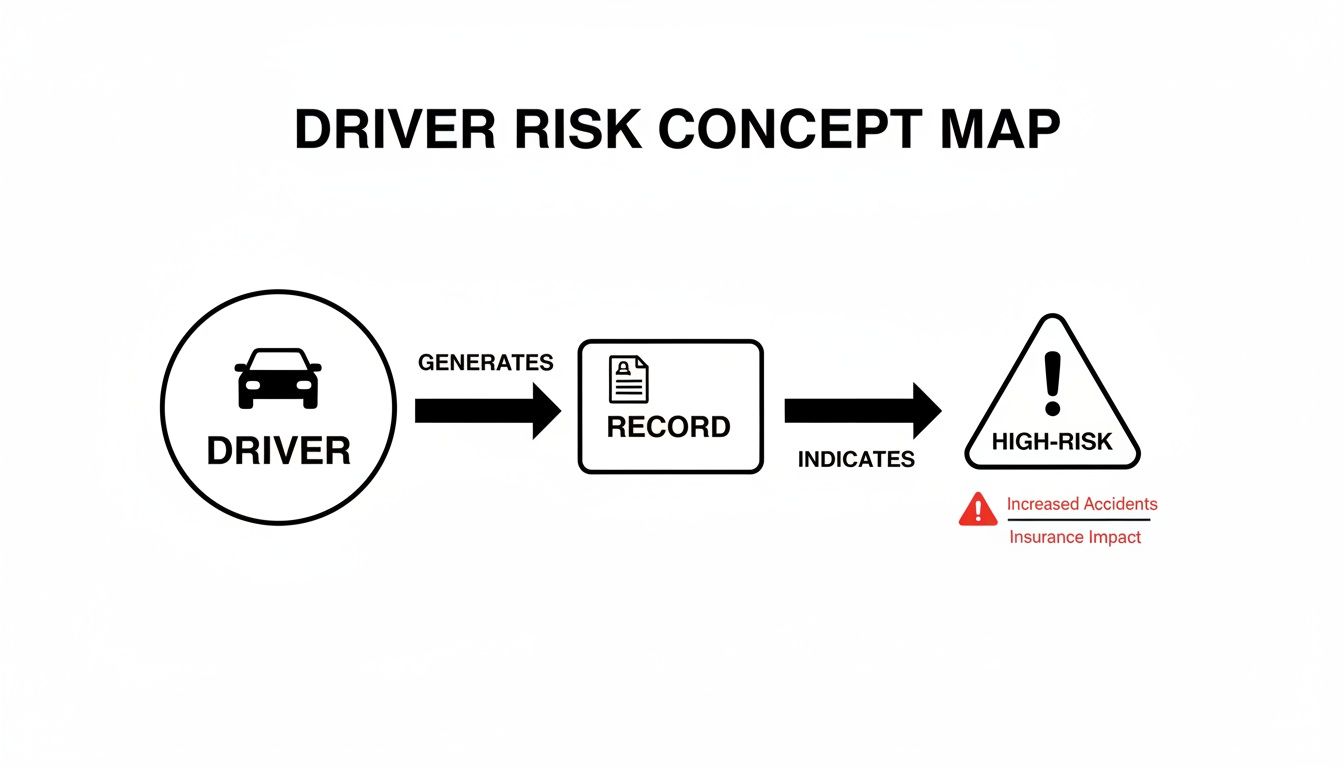
To them, that conviction signals you're statistically more likely to cause an accident in the future, and they make you pay for that increased risk.
A Real-World Example of the Ripple Effect
Let’s put this in perspective. Imagine a mother in a Houston suburb who gets a DWI after a single mistake. Her conviction date is six months after her arrest. For the next few years, her family’s car insurance bill—once a manageable $200 a month—skyrockets to over $500.
Here’s how it could break down:
- Year 1-2: She's paying an extra $3,600 per year while also maintaining her SR-22 filing with the state.
- Year 3: The SR-22 requirement ends, which is a relief. But her insurer still sees the DWI as recent, so her rates only drop a little. She’s still paying an extra $3,000 this year.
- Year 4-5: Her rates finally start to come down more significantly, but she's still paying more than she was before the incident.
Over five years, that one conviction has cost her family well over $10,000 in extra insurance payments alone. This financial ripple effect can completely derail a family's budget, eating into savings for college, family vacations, or just everyday bills. It really highlights how vital a proactive legal defense is from the very beginning.
The timeline for insurance surcharges is often longer than the official state penalties. While Texas requires an SR-22 for two years, most insurance companies will continue to penalize your rates for a minimum of three to five years, and sometimes longer, until the violation is old enough to no longer be considered in their risk calculation.
This extended financial penalty is why understanding the long-term consequences is so important. The impact on your driving record is a separate but related issue. To learn more about that, you can check out our guide on how long a DWI stays on your record in Texas. Protecting your record is the first and best step toward protecting your family’s financial future.
How Much Your Insurance Will Actually Increase
Let’s talk numbers, because that’s what really hits your family’s budget. While it’s scary to think about, facing the potential costs head-on is the only way to plan and react effectively. The premium increase after a DWI in Texas isn't just a minor bump; it's a major financial hurdle that can stick around for years.
The hard truth is that a single DWI conviction can make your auto insurance rates skyrocket by an average of 80% to 96%. For many Texas families, that means paying hundreds, or even thousands, of extra dollars every single year. This isn't just a penalty—it’s your insurer’s way of balancing the new, higher risk they now see in your policy.

Why Shopping Around Is Not Optional
Here’s something you absolutely need to know: not all insurance companies treat a DWI the same way. Some are far more punishing than others. While your current provider might double or even triple your rates, another company that specializes in high-risk policies might offer something more manageable, though still increased.
This is exactly why shopping for a new policy is non-negotiable. Sticking with your current insurer out of convenience could cost you thousands over the next three to five years. You have to get multiple quotes to see which carrier will penalize you the least.
The differences can be shocking. National data shows that while one company might raise rates by 56%, another could hit you with a staggering 125% or even 150% increase for the exact same offense. In Texas, a full-coverage policy can jump by an average of $1,657 a year after a DWI. You can dig deeper into these rate differences in this comprehensive insurance analysis from Bankrate. This disparity proves that comparing your options is the single most powerful step you can take to control the financial damage.
Comparing Premium Increases by Insurance Carrier After a DWI
To give you a clearer picture, this table shows how different major insurance companies might adjust full coverage annual premiums after a single DWI conviction. These are estimates, of course, but they reveal just how dramatically the risk calculations can vary from one insurer to the next.
| Insurance Carrier | Average Annual Premium (Before DWI) | Average Annual Premium (After DWI) | Percentage Increase |
|---|---|---|---|
| Carrier A (e.g., Progressive) | $2,100 | $3,675 | 75% |
| Carrier B (e.g., Geico) | $1,850 | $3,940 | 113% |
| Carrier C (e.g., Nationwide) | $2,200 | $4,950 | 125% |
| Carrier D (e.g., Allstate) | $2,700 | $4,212 | 56% |
Note: These figures are illustrative examples based on national averages and can vary significantly based on your specific circumstances in Texas.
The bottom line is that your insurance company holds immense power over your finances after a DWI. Loyalty to your current provider won't be rewarded; in fact, it will likely cost you dearly. Proactively seeking quotes is the only way to find the most affordable path forward for your family.
Factors That Can Make It Even Worse
The average rate hike is already steep, but certain factors can send your premiums even higher. Insurers look at the whole picture, and any aggravating circumstances will amplify the financial penalty.
These factors include:
- Prior Violations: If you already have speeding tickets or at-fault accidents on your record, a DWI will be seen as part of a pattern of risky behavior, leading to a much higher surcharge.
- Causing an Accident: A DWI that resulted in property damage or injury is an insurer's worst-case scenario. The rate increase will be far more severe than for a simple DWI stop.
- High Blood Alcohol Content (BAC): A BAC well over the legal limit (like 0.15 or higher) can trigger enhanced criminal penalties and, in turn, more extreme insurance hikes.
- Refusing a Breathalyzer: While this can be a strategic legal decision, a refusal often leads to an automatic license suspension, which is a major red flag for any insurer.
Facing these numbers can feel overwhelming, but remember that information is power. By understanding exactly how much your insurance could go up and why, you can start making informed decisions to protect your family's budget.
Steps You Can Take to Lower Your Insurance Costs
It's completely normal to feel powerless after a DWI charge. The legal system, the potential penalties, and the financial stress can feel like a tidal wave threatening to pull you and your family under. But it’s so important to understand that you have more control over the outcome—and the long-term insurance impact—than you might realize.
We're shifting gears now, moving from explaining the problem to giving you a concrete, actionable roadmap. The situation is serious, yes, but there are clear, practical steps you can take to soften the financial blow and start moving forward.
Start with the Strongest Defense Possible
The single most important move you can make to protect your future is to hire a skilled DWI defense attorney right away. Why? Because the outcome of your criminal case is the engine that drives all the insurance consequences.
A charge reduction or an outright dismissal is the only way to potentially sidestep the insurance fallout altogether. If there's no conviction on your record, your insurer has no reason to re-label you a high-risk driver.
A seasoned lawyer will pick apart every detail of your case, from whether the traffic stop was legal in the first place to the calibration records of the breathalyzer. They can fight to get the charge reduced to something like reckless driving, which often carries a much less severe insurance penalty. This initial legal fight is your best shot—and really, your only shot—to stop the insurance nightmare before it even starts.
Proactively Shop for High-Risk Insurance
Now, if a conviction is simply unavoidable, don't just sit back and wait for your current insurance company to send you an astronomical bill. The moment you know a conviction is coming, you have to start shopping around. Many standard carriers will either drop you or hike your rates to a level that's just not sustainable.
The good news is that a whole segment of the insurance market actually specializes in high-risk policies. These companies are already set up to file the necessary SR-22 form for you, and their rates for drivers in your situation are often much more competitive. Get ready to put in some time here; you'll want to get quotes from at least five to seven different providers to find the most affordable option.
Complete State-Approved Courses
While it's not a magic fix, completing a state-approved defensive driving course or a DWI education program can sometimes help soften the blow. Some insurance providers, especially those in the high-risk market, might offer a small discount to drivers who can prove they’ve taken proactive steps to address their behavior.
Look, it won't erase the rate hike completely, but even a 5% or 10% discount adds up to real savings over the three to five years you'll be paying those higher premiums. It never hurts to ask a potential insurer if they'll give you credit for completing these courses.
Explore Long-Term Legal Solutions
Even after a conviction, the fight for your future isn't over. Texas law offers a path to seal certain criminal records through an order of nondisclosure. This is a legal game-changer.
Here’s a quick breakdown of how it can help you:
- Eligibility: After you've successfully completed your sentence (including any probation) and a specific waiting period has passed, you might be eligible to petition the court.
- The Process: Your attorney files a formal petition, making the case that sealing your record is in the best interest of justice.
- The Result: If the judge agrees, your DWI record is sealed from public view. This means most private companies, including insurance carriers running background checks, can no longer see it.
Securing an order of nondisclosure can effectively hit the reset button on your insurance rates. When your policy is up for renewal, that conviction may no longer pop up on the reports insurers run, potentially dropping you back into a standard-risk category much sooner than you thought possible. It's a powerful legal tool that offers a clear, hopeful way to finally put the financial consequences of a past mistake behind you for good.
How a DWI Defense Attorney Protects Your Future
The single biggest factor determining the financial wreckage a DWI can cause your family is the final legal outcome of your case. Facing this alone is overwhelming, but a dedicated defense attorney is your best shield—protecting your record, your wallet, and your future.
From the moment you call The Law Office of Bryan Fagan, we start digging into every detail. We challenge everything from the legality of the initial traffic stop to the calibration records of the breathalyzer. Was there even probable cause to pull you over? Were your rights read and respected? These aren't just legal checkboxes; they're the foundation of a powerful defense.

Fighting on Every Front for Your Family
Our strategy goes beyond just the criminal charges. We guide you through the separate, and often confusing, Administrative License Revocation (ALR) hearing. This is the civil proceeding where we fight to protect your driver's license—an absolute necessity for any Texas parent juggling work, school runs, and family life.
In the courtroom, we are relentless negotiators. We work with prosecutors to find better resolutions, like getting a charge reduction to a lesser offense like reckless driving. An outcome like that often comes with a much smaller insurance penalty than a full-blown DWI conviction. In some situations, we can even secure a complete dismissal of the charges.
The surest way to stop a DWI from crushing your insurance rates is to prevent a conviction from ever hitting your record in the first place. An aggressive, proactive defense isn’t just about staying out of jail—it’s about protecting your family's financial stability for years to come.
Looking Toward a Clearer Future
Even if a conviction happens, our job isn't over. We help families pursue post-conviction options to clean up their records. One of the best tools Texas law provides is an order of nondisclosure, which can seal the DWI record from public view.
This can be a total game-changer for your insurance. If an insurer runs your driving record and can no longer see the conviction, you're more likely to be moved out of that high-risk category. This could mean your premiums drop back to normal much sooner than you'd expect. To see what this involves, you can learn more about how to fight a DWI in Texas and explore every legal path available.
Ultimately, protecting your record is the same as protecting your finances. We're here to help Texas families get through these crises with compassion and strength, and that always starts with a powerful defense built for your specific situation.
Answers to Your Pressing Questions About DWI and Insurance in Texas
When you're staring down a DWI charge, the uncertainty can feel crushing. It's not just the court case that keeps you up at night; it's the real-world fallout for your family's finances and daily life. We field these urgent questions every single day from families across Texas, and our goal is to give you clear, straightforward answers to cut through the stress.
What’s the Difference Between a DWI Arrest and a Conviction?
This is a critical distinction, so let's be crystal clear: an arrest is not a conviction.
Your insurance company almost always waits for a conviction to hit your Motor Vehicle Record (MVR) before they take action. This means that in the weeks or months between your arrest and your final day in court, your rates will likely stay exactly as they are.
However, there's a wrinkle. If your license gets suspended through the separate Administrative License Revocation (ALR) process before your criminal case is even resolved, your insurer might get wind of it sooner. But the conviction is the real trigger—that's what gets you reclassified as "high-risk" and sends your premiums soaring.
How Do I Actually Get an SR-22 in Texas?
Getting an SR-22 is simpler than it sounds, but it does signal a major shift in your status with insurers. You don't "buy" an SR-22 certificate directly. Instead, you have to get your auto insurance provider to file it with the Texas Department of Public Safety for you.
Here’s how it usually works:
- Step 1: Find an insurance company that's willing to file an SR-22. Your current "standard" carrier might not, so you may have to shop around for a provider that specializes in high-risk policies.
- Step 2: Pay the filing fee. This is usually a small, one-time charge of about $15-$25.
- Step 3: Your insurer submits the form. This officially certifies to the state that you have the minimum liability coverage required by law. You'll need to keep this coverage continuously for two years.
Can My Insurance Company Really Just Cancel My Policy?
Yes, they absolutely can. For many standard insurance carriers, a DWI conviction is considered a major breach of their policy terms or simply an unacceptable level of risk.
They might choose not to renew your policy when it's up, or in some situations, they can cancel it outright after giving you proper notice. If that happens, you'll be forced to find a new insurer—often in the high-risk market—to get the coverage you need to drive legally.
If I Get My DWI Record Sealed, Do I Still Have to Tell My Insurer?
This is where things can get much better. If you successfully get an order of nondisclosure to seal your DWI record, Texas law forbids government agencies from releasing that information to the public.
What does that mean for you? When a new insurance company runs a standard background check on your MVR, the conviction shouldn't even show up. You are generally not required to volunteer information that has been legally sealed from public view. This is one of the most powerful long-term benefits of pursuing a nondisclosure, as it can be your ticket back to normal insurance rates much, much faster.
Navigating the insurance mess after a DWI is complicated and incredibly stressful, but it's not something you should face on your own. The final outcome of your court case is the single most important factor in protecting your financial future. At The Law Office of Bryan Fagan, PLLC, we understand what’s at stake for your family. We are here to provide the warm, educational, and legally accurate guidance you need during this difficult time. Our entire focus is on defending your rights and fighting for the best possible result for your family. Contact us today for a free, compassionate consultation to discuss your case.