Skip to content
An old arrest record can feel like a dead weight, dragging you down and keeping you from better jobs, decent housing, and even just simple peace of mind. For a parent, that weight is even heavier, shadowed by the constant fear that a past mistake could one day be used against you in a CPS case or custody dispute. You’re more than ready to put it behind you, but the million-dollar question is always the same: how long does an expungement actually take in Texas?
While every case has its own unique twists and turns, you can generally expect the entire expungement process to take somewhere between four to twelve months from the day you start to the day your record is finally cleared.
Your Path to a Fresh Start in Texas
For many Texas parents, a past criminal record is a source of constant, personal stress. You worry about how it could impact your family’s future. The fear that a simple mistake or a long-dismissed case could be weaponized against you in a CPS investigation or a nasty custody battle is a heavy burden to carry. That fear is real, and it’s something we hear from families every day.
That’s why getting your name cleared through expungement is so much more than a legal procedure—it’s about taking back control of your own story and making sure your past doesn’t get to define your future. It's about protecting your children and your rights as a parent.
This guide is here to pull back the curtain on the expungement timeline. We’ll walk you through every single stage, from figuring out if you’re even eligible to getting that final court order in your hands. Once you understand the road ahead, you can feel more in control and optimistic about what’s to come.
What to Expect in the Expungement Process
The journey to a clean slate follows a very specific legal sequence. Getting the steps wrong can lead to frustrating delays or, even worse, an outright denial of your case. Think of it like building a house: you can’t start putting up the walls before you’ve poured a solid foundation. In the same way, Texas law, particularly the Texas Code of Criminal Procedure, requires you to wait out certain statutory periods before you can even think about filing your petition.
Once you’ve met the eligibility requirements, the process generally unfolds like this:
- Initial Legal Review: An attorney digs into your case to confirm you qualify for an expungement under Texas law.
- Filing the Petition: Your official request is carefully drafted and filed with the correct court.
- Agency Notification: Every single government agency that has a copy of your record is formally notified of your petition.
- Court Hearing: A judge reviews the details of your case and, if everything is in order, signs the final order.
- Record Destruction: That signed order is then sent out to all the agencies, legally instructing them to destroy every trace of the record.
A Quick Look at the Timeline
To give you a clearer picture of what to expect, we've put together a table that breaks down the estimated time for each major stage. This will help you see how the different pieces of the puzzle fit together.
At-a-Glance Texas Expungement Timeline
| Expungement Stage | Estimated Timeframe | Key Activity |
|---|---|---|
| Initial Review & Eligibility | 1–2 Weeks | Your attorney verifies you qualify under Texas law. |
| Petition Filing & Court Processing | 4–6 Weeks | Your petition is drafted, filed, and served to state agencies. |
| Agency Review & Court Hearing | 2–5 Months | Agencies respond and the court schedules a final hearing. |
| Order Execution & Record Destruction | 1–4 Months | The signed order is sent to agencies to destroy the records. |
Keep in mind, these are just estimates. The timeline for your specific case could be shorter or longer depending on the county, the complexity of your record, and how quickly the state agencies respond.
The Expungement Timeline: A Step-by-Step Breakdown
When you're ready to leave an old arrest record in the past, the legal system can feel like a confusing maze. The biggest stressor for most people is just not knowing what comes next or how long it’s all going to take. For parents, that anxiety is even worse—there's always the fear that a past mistake could unfairly impact their family, especially in situations involving CPS or child custody, where Chapters 262 and 263 of the Texas Family Code give investigators wide latitude.
My goal here is to give you a clear, predictable roadmap of the Texas expungement process. We'll walk through each stage together, step-by-step, so you can see the path forward and feel more in control of your journey.
Step 1: Initial Case Evaluation and Eligibility Check
First things first: we have to confirm you are legally eligible for an expungement. This is the foundation of the entire case, and you can't build a house on shaky ground. An experienced attorney will dig into the details of your arrest, looking at the charge, how the case ended (dismissal, acquittal, etc.), and whether you've met the mandatory waiting periods.
This deep dive is critical. Filing a petition too early or for a case that doesn't qualify means an automatic denial from the court. That's a waste of both time and money. This initial review typically takes about one to two weeks while we pull court records and triple-check every detail to make sure your case is built to succeed.
Step 2: Drafting and Filing the Petition for Expunction
Once we've confirmed you're good to go, it's time to prepare the official legal paperwork: the Petition for Expunction. This isn't just a simple form; it's a detailed document that formally asks the court to order the complete destruction of your records. It has to be drafted perfectly.
The petition must include:
- Your personal identifying information.
- Specific details about the arrest—the date, the offense, and which agency arrested you.
- A comprehensive list of every government and private entity that might have a record of your arrest.
- The legal reasons for your request, pointing to the exact sections of the Texas Code of Criminal Procedure that apply to your case.
Getting the paperwork right is a huge part of the process. If you want a general overview on how to file court documents, this resource offers some helpful context. After drafting, the petition is filed with the district court in the county where you were arrested. This entire stage usually takes around two to four weeks.
Step 3: Agency Review and Setting the Hearing
After your petition is filed with the court, it’s legally "served" on all the government agencies we listed. Think of the District Attorney's office, the Texas Department of Public Safety (DPS), and the police department that arrested you, just to name a few. These agencies get about 30 days to review the petition and file an answer.
Most of the time, if the petition is solid and you're clearly eligible, the agencies won't put up a fight. But they do have the right to object if they believe you don't qualify. Once that response window closes, the court will schedule a final hearing. Just getting that hearing on the court's calendar can take anywhere from two to four months, depending on how busy that particular county is.
For many, this waiting period is the hardest part. It’s important to remember that this is a normal part of the process. The court system has its own pace, and a longer wait for a hearing date doesn't necessarily mean there's a problem with your case. Your actionable advice is to stay in communication with your attorney, who can provide updates and manage expectations during this quiet phase.
This timeline gives you a bird's-eye view of the key stages.
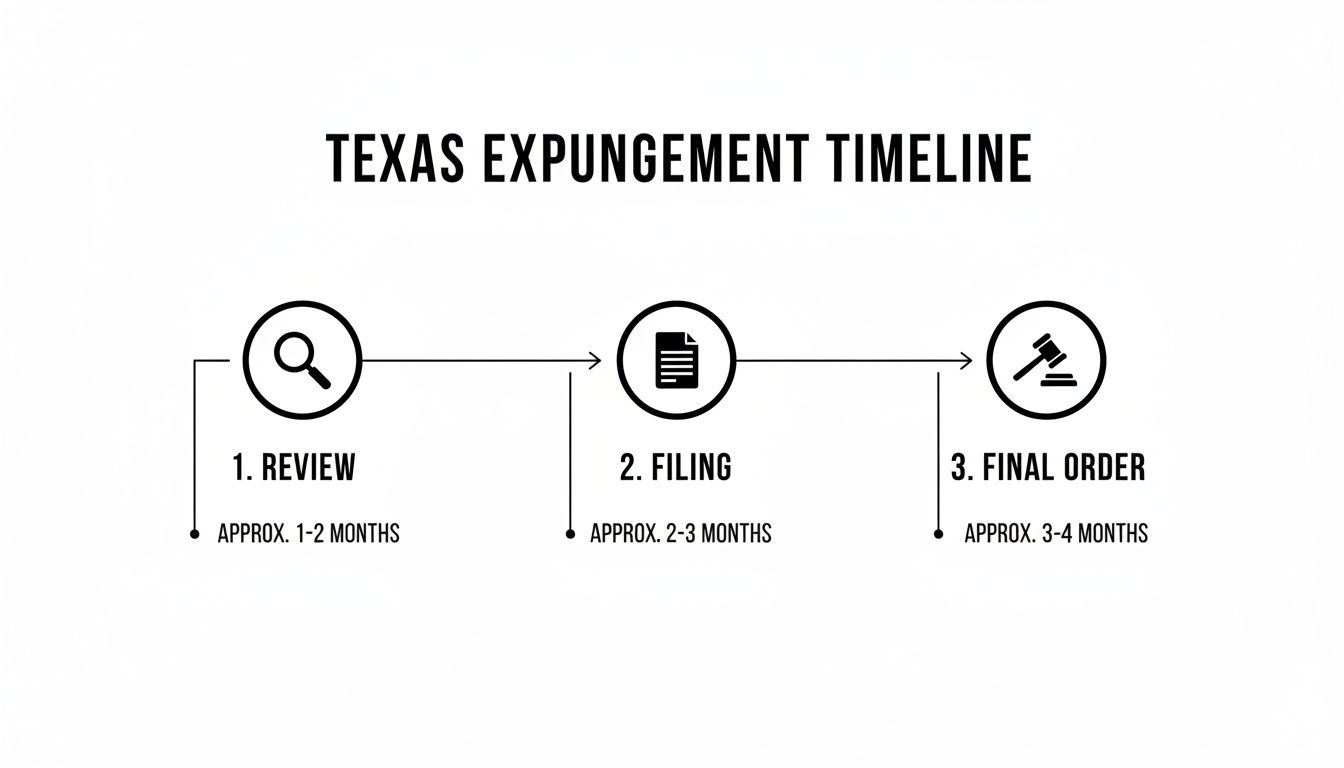
As you can see, the process moves methodically from the initial review and filing all the way to the final court order, with each step having its own general timeframe.
Step 4: The Final Order and Record Destruction
The final hearing is often just a formality, especially if no agencies objected. In many cases, we can work out an "agreed order" with the prosecutor beforehand, and you may not even need to show up in court. The judge simply reviews the petition, confirms you're eligible, and signs the Final Order of Expunction.
That signed order is the legal key that unlocks your fresh start. But we're not quite done yet. The court clerk has to send a certified copy of that order to every single agency we listed in your original petition. Once they get it, those agencies are legally required to find and destroy their copies of your arrest record. This last phase of compliance can take another one to two months.
All told, the entire process usually takes anywhere from 4 to 12 months from the day you start to the day it's finished. It starts with a 1-2 week evaluation, followed by 2-3 weeks of document prep. Filing with the court takes about a month, scheduling the hearing can take 2-4 months, and it takes another 1-2 months for the agencies to follow the judge's order and scrub their databases. Getting familiar with the specifics, like how to expunge a misdemeanor in Texas, can give you even more clarity on what to expect.
Understanding Texas Waiting Periods Before You File
Before you can even think about filing a single piece of paper with the court, Texas law makes you wait. For a lot of people, this is the most frustrating and confusing part of the whole expungement journey.
Think of it as a mandatory cooling-off period. The state wants to be absolutely sure a criminal case is well and truly over before it lets anyone destroy the records.
Filing your petition too early is one of the quickest ways to get it denied. It's a gut punch that wastes your time, money, and hope. This is why getting a handle on these waiting periods isn't just a technicality—it’s the absolute first step toward a successful expungement.
The clock starts ticking from the date you were arrested or the date your case was dismissed. The specific amount of time you have to wait is tied directly to the seriousness of the original charge.
Waiting Periods Based on Case Outcome
The law is crystal clear about these timelines, and they are not negotiable. Here’s a quick rundown of the most common situations you’ll encounter, all laid out in the Texas Code of Criminal Procedure.
Class C Misdemeanors: If you were arrested for a Class C offense (think minor traffic tickets or public intoxication) and the case was dismissed, you have to wait 180 days from the arrest date before you can file.
Class A & B Misdemeanors: For more serious misdemeanors that got dismissed, the waiting period bumps up to one year from the date of the dismissal. This gives the prosecutor’s office plenty of time to decide if they want to refile the case for any reason.
Felonies: If you were arrested for a felony that was later dismissed, you’re looking at a three-year wait from the dismissal date. It's a much longer period, which reflects just how serious the original charge was.
These waiting periods are in place to protect the state's ability to prosecute a case if new evidence suddenly appears. Once this waiting period—which also acts as the statute of limitations—is over, the state generally can't bring those charges against you again. Only then does the door to expungement truly open up.
A Real-Life Scenario: Maria's Costly Mistake
Let’s talk about Maria. She’s a single mom who was arrested for a Class A misdemeanor theft charge two years ago after a simple misunderstanding at a grocery store. The store quickly realized its mistake, and the charges were dismissed. Eager to clear her name before starting a new job search, and terrified the arrest could somehow affect her custody agreement, she found a form online and filed for expungement just six months after the dismissal.
A few weeks later, a notice came in the mail: petition denied. Why? She hadn't waited the mandatory one year required for a dismissed Class A misdemeanor. Not only did she lose her filing fee, but she had to start the entire process over again a year later, feeling defeated and completely let down by the system. Maria's story is a perfect example of why getting the timing right from the start is so critical. An actionable step for anyone in Maria's situation is to consult an attorney to calculate the exact eligibility date before taking any action.
The waiting period isn't a suggestion; it's a legal requirement. Accurately calculating your eligibility date is the single most important action you can take to ensure your petition isn't dead on arrival.
Understanding these timelines is essential, especially when you're dealing with more serious charges. For anyone concerned about a felony record, our guide on whether felonies can be expunged in Texas gets into the specific rules and exceptions for those cases.
Ultimately, patience is your best friend here. While it feels like just another delay, satisfying the mandatory waiting period is what turns your request from a hopeful wish into a legally sound petition that a judge can and will approve. It’s the foundation you need to build your fresh start.
What Speeds Up or Slows Down Your Expungement
You’ve done everything right. You followed the rules, patiently waited out the mandatory period, and you're finally ready to file. So why did your friend's expungement case wrap up in four months while yours seems to be dragging on forever?
The truth is, several critical factors can either put a tailwind behind your petition or act as a frustrating roadblock. It’s not just about the court’s schedule; it's about the specific details of your case and how it's handled. Understanding these variables is the key to setting realistic expectations for how long does expungement take in Texas.
Accelerating Your Timeline: The Power of Agreement
The single most effective way to shorten the timeline is to get an agreed order. It’s that simple.
This happens when your attorney proactively reaches out to the District Attorney's office, presents a well-documented petition for a clearly eligible case, and gets them to agree to the expungement without a fight. When the prosecutor signs off, it signals to the judge that the state has no objections.
This simple step can often eliminate the need for a formal court hearing altogether—which is usually the longest waiting period in the whole process. Instead of waiting months for a spot on a crowded court docket, an agreed order can sometimes be signed by a judge in just a few weeks.
Common Roadblocks That Cause Delays
On the flip side, several issues can pump the brakes on your case, stretching the wait time out considerably. Knowing these potential hurdles is the first step to navigating around them.
Prosecutor Objections: If the DA’s office objects to your petition, your case is no longer straightforward. It becomes a "contested" matter that requires a formal hearing where your attorney has to present legal arguments to the judge. An objection automatically adds weeks, and more often months, to your timeline.
Clerical and Filing Errors: The legal system runs on precision. A simple mistake on the petition—a wrong date, an incorrect case number, or forgetting to list a state agency—can get the whole thing rejected. This forces you to correct the error and start the filing process all over again, creating completely avoidable delays.
High Court Caseloads: This one is largely out of your control. Major counties like Harris or Dallas handle an enormous volume of cases. Their dockets are often packed, meaning even an uncontested hearing might take longer to schedule than in a smaller, rural county.
An expungement in Texas is rarely a quick fix. Simple cases might take a few months, but more complex ones can easily stretch from six to twelve months. For instance, in Harris County, about 70% of filings averaged 7.2 months, with a quarter of those being delayed by agency challenges, such as a DPS review adding an extra 60 days. You can find more details about these timelines and what they mean for your case.
How Your Legal Team Impacts the Pace
The efficiency of the law firm you choose can also make a real difference. An attorney who is disorganized, slow to respond, or unfamiliar with the local court's procedures can inadvertently add delays by missing deadlines or failing to follow up. Your case can end up just sitting there, languishing.
Conversely, a proactive and organized legal team keeps your case moving forward. It goes beyond just filing paperwork; the internal efficiency of your firm matters. Their use of tools like legal workflow automation software can significantly impact how quickly your petition is prepared, filed, and managed. This commitment to efficiency ensures no time is wasted, keeping the focus on clearing your record as quickly as the system allows.
How Your County's Caseload Impacts Your Wait Time

Here in Texas, the answer to "how long will my expungement take?" often comes down to your zip code. The county where the arrest happened is one of the single biggest variables in the timeline, creating a huge difference between what you can expect in urban versus rural areas.
Think of the court system like a highway. A courthouse in a small, rural county is like a quiet country road with almost no traffic—things move through quickly and smoothly. On the other hand, a major metropolitan courthouse in Harris, Dallas, or Travis County is more like a ten-lane freeway jammed solid at rush hour. Everything just crawls along.
The Urban vs. Rural Divide
In big city centers, the courts are simply swamped. They are juggling thousands of cases every single day, covering everything from minor tickets to serious felonies. This incredible caseload creates a massive backlog that slows down every single step of the expungement process.
This means you’re going to be waiting longer for just about everything:
- Initial Processing: It’ll take the clerk’s office longer just to get your petition filed and in the system.
- Agency Responses: Overworked District Attorney's offices might use every last day they're allowed to review your case.
- Securing a Hearing: Getting a date on a judge's crowded calendar can be the biggest delay of all, sometimes adding months to your wait time.
This can be incredibly frustrating, especially for parents who feel a pressing need to clear their record and protect their family. A past mistake, even one that was dismissed, can hang over your head in custody battles or if CPS ever gets involved. The desire to erase that vulnerability is powerful, and these county-level delays can feel like an unfair roadblock.
Timelines Across Texas Counties
While every case has its own unique path, the data shows a clear pattern across the state. In Texas, the average expungement lands somewhere between four to nine months for most petitions. Busier courts, like those in Houston, often stretch closer to 12 months, while smaller counties can sometimes get it all done in as little as four.
As a real-world example, recent stats from Collin County showed it processed 1,200 expunctions with a median time of 5.5 months. You can dig deeper into these procedural recommendations for communities across Texas.
It’s important to remember that a long wait in a busy county doesn't mean something is wrong with your case. It is simply a reflection of the court's limited resources and high demand. Your actionable advice here is to have a lawyer who knows the local court system and can set realistic expectations from the start.
A Relatable Scenario
Let’s look at two guys, John and David. Both had similar Class B misdemeanor cases dismissed and filed for expungement on the exact same day. The only difference? John's case was in a small West Texas county, and David's was in Dallas County.
John's lawyer worked out an agreed order with the local prosecutor in just a few weeks. The judge signed off on it shortly after, and the whole thing was wrapped up in under five months.
David's attorney, however, had to wait nearly two months just for the swamped clerk's office to process the petition. Then, scheduling a hearing on the court's packed docket added another three months. Even though his case was straightforward, David's journey took closer to nine months simply because of the sheer volume of cases his courthouse was managing. Understanding these local dynamics is key to setting realistic expectations for your own path to a clear record.
Ready to Take the First Step Toward a Clear Record?
The road to clearing your name can feel overwhelming, but it’s a journey you don’t have to walk alone. For parents who have already faced the stress of a CPS investigation or a tough custody fight, an old arrest record can feel like a shadow that just won't go away. A successful expungement isn’t just a legal win; it’s the final step in shutting a painful chapter of your life for good and protecting your family's future.
This process is about more than just paperwork—it’s about reclaiming your freedom and getting a genuine fresh start. An expungement order opens doors that might have felt permanently locked: better jobs, stable housing for your family, and the simple peace of mind that comes from knowing the past is truly in the past. While the timeline involves waiting periods and court schedules, you don’t have to navigate that uncertainty on your own.
Understanding how long does expungement take in Texas is the first step, but taking action is what turns that knowledge into a real-world outcome for your family. A clean slate ensures a past mistake can't be used against you, protecting your future and your parental rights.
If you’re ready to put a past arrest behind you for good, we’re here to offer the compassionate, knowledgeable guidance you need. We understand what’s at stake for Texas parents and will treat your case with the urgency and care it deserves.
We invite you to contact The Law Office of Bryan Fagan for a free, confidential consultation. Let’s talk about your specific situation, map out a personalized timeline, and show you how to take that first concrete step toward reclaiming your future and securing your family’s peace of mind.
Frequently Asked Questions About Texas Expungement
Going through the expungement process kicks up a lot of questions, especially when you’re just ready to put a mistake behind you. For parents in Texas, the stakes always feel higher—a clean slate is everything when it comes to protecting your family’s future. Here are some of the most common questions we hear about the timeline and what you can realistically expect.
Can I Do Anything to Speed Up My Expungement?
While you can’t make a judge’s calendar move any faster, you absolutely have control over preventing needless delays. The single best thing you can do to keep your case on track is to work with an experienced attorney.
They know exactly what paperwork to file and how to file it correctly the first time. They’ll also proactively chase down all the necessary records and can often negotiate an "agreed order" with the prosecutor. This simple step can sometimes let you skip a formal court hearing altogether, potentially shaving months off the process. Your actionable advice is to be proactive in gathering all relevant documents for your lawyer to ensure they have everything they need from day one.
What Happens if the District Attorney Objects?
Don't panic. An objection from the District Attorney's office is not the end of the road. It just means a contested hearing will be put on the court’s calendar.
At this hearing, your attorney will need to present solid legal arguments to the judge, proving that you are entitled to the expungement under Texas law. Yes, this can add several weeks or even a few months to your timeline, but a well-prepared case built on a strong legal foundation can still win the day.
An objection is a hurdle, not a stop sign. It just highlights how critical it is to have a strong legal strategy from day one to counter any challenges the state might throw your way.
How Will I Know My Record Is Officially Cleared?
Once the judge signs the final expunction order, the court clerk gets to work sending it to every state and private agency that has a record of your arrest. From that point on, those agencies are legally required to destroy their files on the matter.
You probably won't get a confirmation letter from every single agency. That’s normal. Your attorney can follow up to make sure everyone complied. A good way to check for yourself is to run a personal background check a few months after the order is finalized to see that the arrest record is gone for good. Of course, understanding the full financial picture is also key; learn more about the cost of expungement in Texas in our detailed guide.
Facing this process can feel overwhelming and isolating, but you don't have to walk this path alone. Having clear answers and a legal partner who knows the ropes can turn a confusing legal journey into a clear path toward your fresh start.
The legal team at The Law Office of Bryan Fagan, PLLC understands what is at stake for you and your family. If you are ready to leave the past behind, contact us today for a free, confidential consultation to discuss your case and start the process of clearing your record for good. https://texascpslawyer.net