Skip to content
When a judge hands down a guilty verdict, the world can feel like it's collapsing. For a Texas parent, that single word—guilty—is a gut punch. It’s a moment of pure shock and fear, and it's easy to feel like every door has just been slammed shut, especially when Child Protective Services (CPS) is involved. The future you planned for your family suddenly vanishes, replaced by confusion and a deep sense of powerlessness.
But it's crucial to know this: a conviction is not always the final word. The Texas justice system has built-in pathways to challenge an unfair outcome. Your fight isn't over, but what you do in the moments and days immediately following that verdict is absolutely critical.
The first step is simply filing a Notice of Appeal. This is a non-negotiable, time-sensitive document that must be submitted within 30 days of sentencing. It’s the action that officially preserves your right to have a higher court scrutinize the trial for legal mistakes. An appeal isn't a do-over or a new trial; it's a careful review of the existing court record to find errors that may have resulted in a wrongful conviction.
Your First Moves After a Wrongful Conviction
Before you can fight, you have to know what tools are available. The legal world has specific procedures for different types of problems, and using the right one is everything.
Distinguishing a Direct Appeal from a Writ
Your first and most common option is a direct appeal. Think of it as asking a higher court to act as a referee, reviewing the trial judge’s calls for mistakes. A direct appeal is strictly limited to legal or procedural errors that are already documented in the official trial record—things like transcripts, motions, and evidence. You can’t bring in new evidence here.
On the other hand, a post-conviction writ, like a writ of habeas corpus, is a completely different animal. It's a more complex tool used to bring up issues that couldn't have been raised during the trial or on direct appeal. This is where you might argue that constitutional rights were violated or that you've discovered new evidence that proves innocence.
A direct appeal argues that the game was played unfairly based on the existing rules and what happened on the field. A post-conviction writ argues that something fundamentally wrong happened off the field that tainted the entire game's outcome.
A Relatable Scenario
Let’s put this into perspective. Imagine a father is convicted of injury to a child, and CPS has already removed his kids and started a case to terminate his parental rights under Chapter 262 of the Texas Family Code. A key piece of evidence against him was a doctor's testimony that his trial lawyer argued was speculative and should have been excluded. The lawyer objected, but the judge overruled him and let the jury hear it anyway. That objection is now part of the official record.
The family is devastated by the guilty verdict, feeling completely defeated as they face not only prison time but also the permanent loss of their children. But their attorney acts fast and immediately files a Notice of Appeal. That one simple, time-sensitive document is the most important step they can take. It locks in their ability to later argue that the judge’s bad call made the trial unfair, giving them a real chance to overturn the conviction that threatens to tear their family apart.
As you start the process of finding an attorney for your appeal, it helps to understand how different lawyers approach their clients and cases. Getting a sense of understanding criminal defense attorney marketing strategies can give you some useful context. More importantly, you need to know what to ask. To help you find the right advocate for your family, we've put together a guide on the most important questions to ask a criminal defense lawyer.
Navigating Critical Deadlines and Grounds for Appeal
In the world of Texas criminal appeals, the clock is not your friend. It starts ticking the second the judge hands down a sentence, and the deadlines that pop up are absolute. Miss one, and the door to your appeal can slam shut for good, no matter how strong your case might be.
This is no time to wait and see. The first and most unforgiving deadline is for filing the Notice of Appeal. You typically have just 30 days from the sentencing date to get this document filed with the trial court. Think of this notice as the key that starts the engine for the entire appellate process—without it, your appeal is over before it even begins.
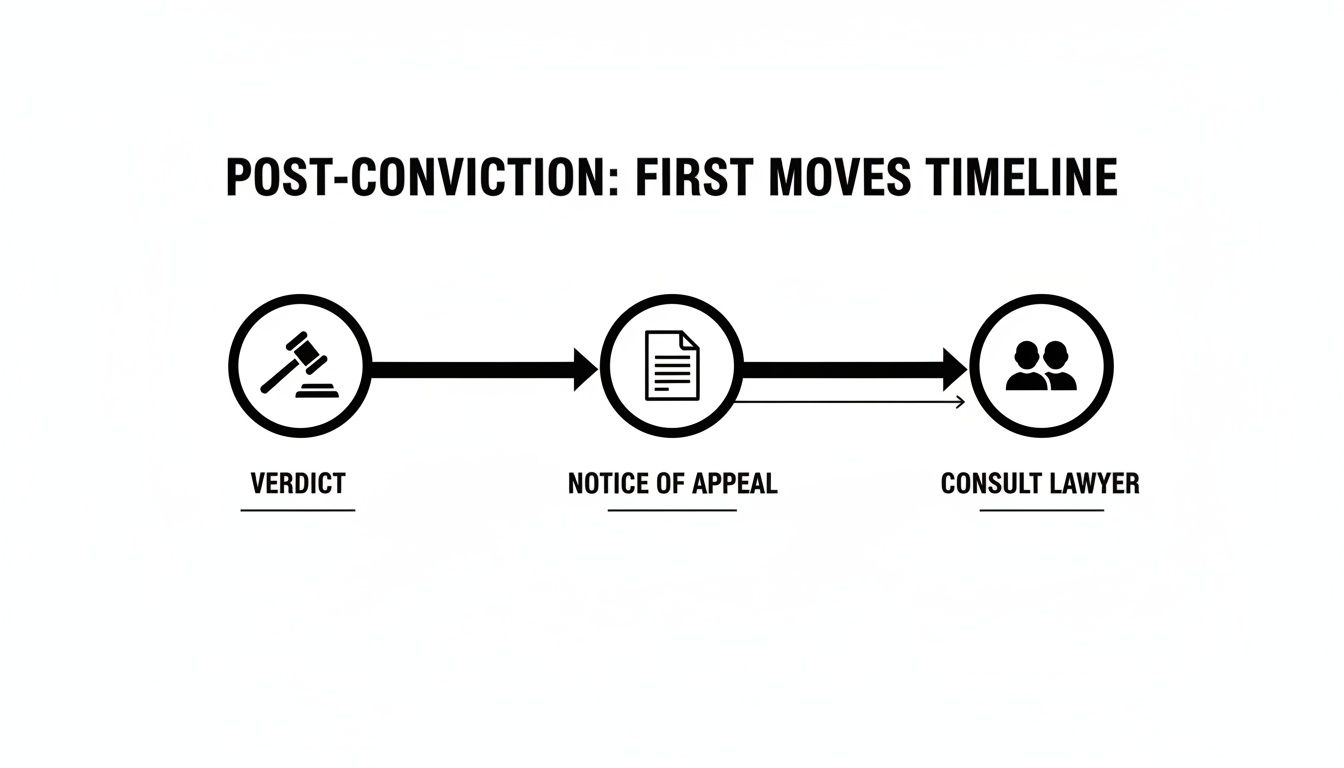
There is one common strategy to stretch this window. Filing a Motion for a New Trial within 30 days of the sentence can push the deadline for your Notice of Appeal out to 90 days. But this isn't automatic; it's a tactical move that demands immediate input from an experienced appellate lawyer.
To help you keep these critical dates straight, here is a quick reference table of the most important deadlines you'll face at the start of your appeal.
Texas Criminal Appeal Deadlines At-a-Glance
| Action Item | Standard Deadline | Notes & Potential Extensions |
|---|---|---|
| Motion for New Trial | Within 30 days of sentencing | Filing this is optional but often strategic. It's a prerequisite for extending the Notice of Appeal deadline. |
| Notice of Appeal | Within 30 days of sentencing | This is the most crucial deadline. If you don't file a Motion for New Trial, this is your hard stop. |
| Notice of Appeal (Extended) | Within 90 days of sentencing | This longer deadline only applies if you timely filed a Motion for New Trial. |
| Request for Court Reporter's Record | At or before filing the Notice of Appeal | You need the official transcript of the trial. This request must be made in writing to the official court reporter. |
Remember, these deadlines are enforced rigidly by the courts. Missing one is rarely excusable, so treating them with the utmost seriousness is the only way to protect your rights.
Common Grounds for a Texas Criminal Appeal
Once you've secured your spot in the appellate court by meeting the deadlines, the real work begins. An appeal isn't a do-over of the trial. You don't get to re-argue the facts or claim you're innocent in the same way. Instead, the entire focus shifts to identifying serious legal mistakes that happened during the trial and convincing a panel of judges that these errors tainted the final verdict.
These legal mistakes, known as grounds for appeal, must already be part of the trial record. That means your trial lawyer had to spot the error and object to it right then and there. If they didn't, the issue is often waived. Here are some of the most common grounds we build appeals on in Texas:
- Improperly Admitted or Excluded Evidence: The rules of evidence are a minefield. If the judge let the jury hear something they shouldn't have—like evidence from an illegal search—or blocked you from presenting crucial evidence, that could be a powerful point for appeal.
- Incorrect Jury Instructions: The instructions the judge reads to the jury are their legal roadmap. If that map is wrong, misleading, or confusing, it can easily lead them to the wrong destination—an unjust verdict. This is a classic, and often successful, basis for an appeal.
- Prosecutorial Misconduct: This covers a lot of ground. It could be a prosecutor making inflammatory remarks in their closing argument, hiding evidence that would have helped you (Brady violation), or knowingly letting a witness lie on the stand.
- Ineffective Assistance of Counsel: The Constitution guarantees you a lawyer, but it also guarantees that lawyer will be effective. If your trial attorney's performance was so bad that it essentially deprived you of a fair fight—maybe they failed to investigate, didn't object to obvious errors, or slept through testimony (yes, it happens)—this can be grounds for a new trial.
Remember, an appeal isn’t a second chance to tell your story. It’s a second chance to ensure the law was followed correctly the first time. The focus shifts from the facts of what happened to the legality of how the trial was conducted.
A Real-World Scenario
Let me paint a picture for you. We worked with a family in Houston whose son was convicted of aggravated assault. During the trial, the prosecutor kept bringing up a past misdemeanor—something the judge had already ruled was inadmissible. The defense lawyer objected every single time, but the bell had been rung, and the jury couldn't un-hear it.
After the guilty verdict, the family was in shock, feeling powerless. They knew something about the trial felt deeply unfair, but they didn't have the legal vocabulary for it.
By getting in touch with an appellate attorney right away, they learned that the prosecutor's repeated violations amounted to prosecutorial misconduct. Because they acted fast, they filed their Notice of Appeal well within the 30-day window, preserving their right to fight the conviction on that critical trial error. That quick decision was the only thing that kept the door to justice from closing.
Building Your Case with the Appellate Record and Brief
Let's get one thing straight: a criminal appeal isn't a do-over. You don't get a second trial to tell your story. Instead, an appeal is a microscopic review of what already happened in the trial court. That’s why the appellate record is the absolute foundation of your entire case. Nothing else matters more.
The appellate record is the official, bound history of everything that happened in the trial court. Think of it as the case's complete biography. Your appellate attorney is handcuffed to this record; they can only argue errors that can be found within its pages. If it’s not in the record, then for all legal purposes, it never happened.

What Makes Up the Appellate Record?
Digging into what’s inside this official file makes it clear why appeals are all about legal procedure, not new evidence. The record is really just two main parts.
- The Clerk's Record: This is the paper trail. It contains every official document filed in the case—the indictment, motions from both sides, the judge's rulings, and the final judgment of conviction.
- The Reporter's Record: This is the word-for-word transcript of everything said out loud in court, meticulously typed up by the court reporter. It has all the witness testimony, lawyer arguments, and—critically—every objection made during the trial.
Picture a trial lawyer leaping to their feet to object to an improper question from the prosecutor. That split-second objection and the judge's ruling are captured forever in the reporter's record. Down the road, that single moment in the transcript could become the winning argument on appeal. But if that objection was never made and put on the record, the error is almost certainly lost for good.
Crafting the Persuasive Appellate Brief
Once that appellate record is compiled, the real work begins. Your attorney’s job is to take that cold, dense transcript and transform it into a powerful, persuasive story for the appellate judges. That story is called the appellate brief.
This isn't just a boring summary. A good brief is a meticulously crafted legal argument that weaves together two crucial elements:
- The Facts: A compelling narrative of what went down at trial, told entirely from what’s documented in the official record.
- The Law: A deep dive into legal precedent—past court decisions and statutes—that proves a "reversible error" occurred.
The goal isn't just to point out a mistake. It’s to show the appellate court why that mistake was so significant that it denied your loved one a fair trial. Honing your legal writing is key here, much like it is when drafting effective legal memos.
The appellate brief is where the technical, black-and-white trial record comes to life. It’s your attorney’s one shot to frame the narrative and convince a panel of judges that justice demands a different outcome.
The Reality of Winning an Appeal
It's vital for families to go into this process with eyes wide open. The path to overturning a conviction is a tough one. State court statistics from across the U.S. show that trial decisions are upheld in 52% of cases. Reversal rates are often lower for criminal convictions, hovering around 17%, even though they are the most frequently appealed.
These numbers aren't meant to discourage, but to underscore why a perfect appellate record and a brilliantly written brief are absolutely essential.
This journey often intersects with other parts of the justice system. For instance, if an appeal could lead to a modified sentence like community supervision, you need to understand what that entails. Learning about how does probation work in Texas provides crucial context for what life might look like during or after the appeal process.
Ultimately, building an appellate case is about painstaking analysis and powerful storytelling. Your attorney has to comb through hundreds—sometimes thousands—of pages to find the critical errors that can win an appeal. It's that detail-oriented work that turns a dry trial transcript into a compelling argument for justice.
Understanding Oral Argument and the Court's Decision
After all the briefs are filed, the next major milestone in many appeals is oral argument. But let's get one thing straight right away: this is nothing like the dramatic courtroom scenes you see in movies. There are no surprise witnesses, no last-minute evidence, and definitely no jury to persuade.
Instead, oral argument is a highly structured, intellectual exchange between your appellate attorney and a panel of judges. The judges have already read every word of the briefs from both sides. They’ve reviewed the record from the trial court. They walk into that courtroom already having formed opinions and questions about the case.
Think of it less as a speech and more as the toughest, most intense Q&A session imaginable. This is the judges' one chance to poke holes in the arguments, clarify confusing points, and directly challenge the lawyers on the weakest parts of their case.
What Really Happens During Oral Argument
A top-tier appellate lawyer knows they aren't there to give a prepared speech. Their job is to engage in a rapid-fire dialogue with judges who know the case inside and out. It requires thinking on your feet and having an encyclopedic command of the case record.
The judges will cut right to the chase with pointed questions like:
- "Counsel, let's assume for a moment the trial court did make that mistake. With all the other evidence against your client, wasn't it 'harmless error'?"
- "Can you point us to the exact page in the record where the trial lawyer properly objected to this issue? If they didn't, how is it preserved for us to review?"
- "How do you reconcile your argument with the precedent we set in Smith v. Texas just two years ago? It seems to directly contradict your position."
This is where a true appellate specialist earns their keep. Their ability to field these tough questions with confidence and persuasive legal reasoning can genuinely influence the final outcome.
The Court's Decision and What It Means for You
Once oral argument concludes, the waiting game begins. The judges deliberate behind closed doors, a process that can take anywhere from a few weeks to several months. Eventually, the court will issue a formal written opinion explaining its decision and the legal logic that got them there.
The appellate court’s final ruling isn't just a simple "win" or "loss." The specific language of the decision dictates exactly what happens next for you and your family, shaping the entire path forward.
Your case will end in one of three primary outcomes. Let's break down what each one means in the real world.
Affirmed: This is the outcome you don't want. It means the appellate court found no "reversible error" in the trial, and the conviction and sentence are upheld. While it’s a tough pill to swallow, it doesn't always have to be the final word. Your attorney can analyze the opinion for potential grounds to file a Petition for Discretionary Review (PDR), asking the highest criminal court in Texas to take up the case.
Reversed and Remanded: This is a major victory. The court agrees that a serious legal error occurred that tainted the verdict. The conviction is wiped out, and the case is sent back (remanded) to the original trial court for a new trial. At that point, the prosecutor has to decide: do they have enough evidence to try the case all over again, should they offer a more favorable plea deal, or is it time to dismiss the charges altogether? For a parent fighting a CPS termination case under Chapter 161 of the Texas Family Code, this can be a lifeline, potentially stopping the termination while the criminal case is re-litigated.
Reversed and Rendered: This is the rarest and most powerful win—a grand slam. The appellate court not only finds a critical error but goes a step further. They conclude that, based on the legally sufficient evidence, no rational jury could have ever found guilt. They don't just send it back; they render a judgment of acquittal themselves. This means the case is over, the person is legally innocent, and they are set free.
Avenues Beyond a Direct Appeal
So, what happens when a direct appeal isn't enough? For too many families, this is a terrifying question. Maybe the appeal didn't work out, or maybe years after a conviction, you've stumbled upon powerful new evidence of innocence—the kind of evidence the original jury never got a chance to see.
In these desperate moments, it can feel like the fight for justice is over. But it's not.
This is where a different, more powerful legal tool comes into play: a post-conviction writ. The most common of these is the writ of habeas corpus, a profound legal action designed to challenge an unlawful imprisonment. Unlike a direct appeal, which is stuck with the existing trial record, a writ opens a completely new door.

Writs Versus Appeals: What's the Difference?
Think of a direct appeal as reviewing the game film, checking for bad calls the referee made during the game. A writ of habeas corpus, on the other hand, argues that something fundamentally wrong happened outside the view of the original cameras—something that makes the final score completely unjust.
These writs are specifically designed to address issues that simply couldn't have been raised before. They are the only way to get claims in front of a court that go beyond the trial transcript.
- Constitutional Violations: This is a huge one. It includes claims like ineffective assistance of counsel, where your trial lawyer's performance was so terrible it violated your Sixth Amendment rights.
- Newly Discovered Evidence: If credible new evidence pops up that proves actual innocence—like a key witness recanting their testimony or a previously unknown alibi surfacing—a writ is the only vehicle to present it.
- Prosecutorial Misconduct: This could involve the state hiding evidence that would have helped the defense (a Brady violation).
This process offers a vital path forward, especially in wrongful conviction cases. For many families, it's the last, best hope for justice.
The Power of New Evidence: A Real-World Scenario
Imagine a man is convicted of a violent crime in Texas and has already lost his direct appeals. For years, his family refuses to give up hope. They finally connect with an organization that re-examines cold cases. After a ton of work, they uncover DNA evidence from the crime scene that was never tested because the technology didn't exist back then.
The results are conclusive: the DNA doesn't match their loved one. It matches someone else entirely.
Because this evidence is brand new and was impossible to present at the original trial, a direct appeal would have been completely useless. Their only option is to file a writ of habeas corpus based on this newly discovered evidence of actual innocence. This is exactly how countless wrongful convictions have been overturned, giving people back the lives that were stolen from them.
A writ of habeas corpus isn't about re-arguing old points. It's about bringing new, powerful truths to light that challenge the very foundation of a conviction. It is a demand for the court to address a fundamental injustice.
Navigating the Complex Writ Process
Filing a writ is a far more complicated undertaking than a direct appeal. It involves a new, independent investigation to gather evidence that lives outside the original record. This means tracking down old witnesses, hiring expert investigators, and drafting incredibly detailed affidavits.
The procedural rules in both Texas state courts and federal courts are notoriously strict and unforgiving.
For example, federal habeas petitions generally have a one-year statute of limitations that starts ticking after the direct appeal process is finished. Missing that deadline can permanently bar someone from ever getting relief in federal court.
The incredible power of this process is highlighted by the work of organizations dedicated to uncovering wrongful convictions. The Innocence Project has documented over 375 DNA exonerations, with exonerees having spent an average of 14 years behind bars for crimes they did not commit. You can learn more about their groundbreaking research and data on wrongful convictions.
Because the stakes are so high and the process is so complex, navigating a writ is not something a family should ever attempt alone. It demands an attorney with specialized post-conviction expertise who knows how to build a case from the ground up and present it persuasively. For many, a successful writ is the final step toward not just freedom, but also clearing a name. For those seeking a completely clean slate, it's helpful to understand the related process of how to get a record expunged in Texas.
Common Questions About the Texas Appeals Process
When a conviction hits, it feels like the world stops. Suddenly, your family is thrown into a confusing maze of legal terms and procedures, and the questions can feel endless and overwhelming. We get it. Let's walk through some of the most pressing questions we hear from families trying to find their footing in the appellate world.
How Much Does It Cost to Appeal a Criminal Conviction in Texas?
This is usually the first question on everyone's mind, and the honest answer is: it depends. There’s no flat rate for an appeal because the cost is almost entirely driven by the complexity and, most importantly, the length of the original trial. A simple one-day trial creates a much smaller, less expensive record to review than a month-long capital case.
The main expenses you'll see are:
- The Attorney's Fee: Most experienced appellate lawyers charge a flat fee for a direct appeal. This is a good thing—it gives your family certainty and lets you plan without worrying about surprise hourly bills.
- Preparing the Record: This can be a huge and unavoidable cost. You have to pay the court reporter for a word-for-word transcript of the trial and pay the clerk to assemble all the documents filed in the case. For a long trial, this alone can run into thousands of dollars.
- Filing Fees: These are relatively minor administrative costs for filing the appeal itself.
It's vital to have a frank conversation about all potential costs with any attorney you consider hiring. If you simply can't afford a private lawyer, you may qualify for a court-appointed attorney for your first direct appeal, but that right usually doesn't extend to later appeals or post-conviction writs.
Can My Loved One Get an Appeal Bond to Come Home?
Yes, it's possible for someone to be released on an appeal bond and come home while the appeal is pending, but it is far from guaranteed. Getting a bond is a game-changer—it allows your loved one to return to their life, go back to work, and be with family during the long, stressful months (or years) of the appeals process. For parents in a CPS case, this can be the difference between being able to attend hearings under Chapter 263 of the Texas Family Code and trying to fight for your children from behind bars.
The decision rests with the trial judge, who has to approve a motion for the bond. The judge will weigh several factors:
- The seriousness of the offense.
- The length of the sentence handed down.
- The person's ties to the community—do they have a family, a job, a home?
- Whether the appeal raises a substantial legal question that has a real chance of leading to a reversal.
Getting an appeal bond is tough, especially for serious felonies or cases with long sentences. A skilled appellate lawyer knows how to analyze the case and frame the strongest argument for why your loved one is not a flight risk and should be released.
What Are the Real Chances of Winning a Criminal Appeal?
Let’s be honest: the statistics can be pretty grim. Nationally, the success rate for reversing a criminal conviction on direct appeal is often less than 20%. That’s because appellate courts give a huge amount of deference to the trial judge and jury. Their job isn’t to second-guess the jury’s verdict on the facts; it’s only to hunt for serious legal errors.
But here's what you need to remember: your case has nothing to do with national statistics. Your chance of winning depends entirely on what happened in your trial.
A single, clear legal mistake—like the court admitting illegally seized evidence or giving the jury a completely wrong instruction on the law—can be enough to win. It’s not about the odds; it's about the quality of the legal issues in your record. A well-argued appeal that shows exactly how a specific error changed the outcome is what gives you the best shot at a new trial.
Can We Use New Evidence in a Direct Appeal?
This is one of the biggest misconceptions about the appeals process. A direct appeal is strictly limited to what happened during the original trial. The appellate court is like a referee reviewing the game tape—they can only look at what's already on the record.
That means you absolutely cannot introduce new evidence, call a new witness, or bring up facts that weren't presented at trial. If you’ve discovered something huge that proves innocence—maybe a key witness lied and has now recanted, or new DNA evidence has surfaced—a direct appeal is not the right tool. For that, you would need to file a post-conviction writ of habeas corpus, which is a separate, specialized proceeding designed to address new facts outside the original trial record.
The road through a criminal appeal is long and filled with uncertainty, but you don’t have to walk it alone. When your family's future is at stake, especially with the looming threat of a CPS case, having a knowledgeable and compassionate guide in your corner can make all the difference. At The Law Office of Bryan Fagan, PLLC, our focus is on fighting for Texas families and making sure every legal path is explored. If your loved one was wrongfully convicted, we’re here to help you understand the next steps and fight for the second chance they—and your family—deserve.
Contact us today for a free, confidential consultation to discuss your case. Let our experience be your guide.
Schedule Your Free Consultation with The Law Office of Bryan Fagan, PLLC