Skip to content
Navigating the Texas legal system can be a lonely and confusing journey, especially when an old misdemeanor stands in the way of your family’s future. The fear that a past mistake could jeopardize your job, your home, or even your ability to volunteer at your child's school is a heavy weight to carry. For Texas parents trying to build a stable life, a criminal record can feel like an anchor, holding you back no matter how hard you pull forward.
If you’re caught in this struggle, please know you are not alone, and there is a path to a true fresh start. A legal process called expunction can permanently erase an arrest from your record, giving you and your family the clean slate you deserve. This guide will walk you through how to expunge a misdemeanor in Texas, providing the clear, practical guidance you need to take back control of your future.
Giving Your Family a Fresh Start After a Misdemeanor

A past misdemeanor can cast a long and frustrating shadow over your family's life. It has a way of popping up at the worst possible moments, creating hurdles that feel both unfair and impossible to overcome.
Imagine this scenario: A mother, years ago, was involved in a heated argument with a former partner. The police were called, and though charges were later dropped, an arrest for misdemeanor assault remains on her record. Now, she's trying to get involved in her son’s life after a difficult CPS case. She wants to chaperone field trips and volunteer in his classroom, but the mandatory background check flags the old arrest. Suddenly, she is barred from participating, leaving her feeling ashamed and powerless, all because of a case that was dismissed.
This is the kind of heartbreaking reality many Texas parents face. A single mistake, even one that never led to a conviction, can create constant roadblocks.
What an Expunction Really Means for Your Family
Unlike sealing a record, which just hides it from public view, an expunction results in the complete and permanent destruction of all records related to your arrest. It’s as if the event never happened in the eyes of the law. This legal remedy is grounded in the principles of the Texas Family Code, which prioritizes giving families every opportunity to create a stable environment for their children.
This powerful tool provides real-world benefits that directly impact your family's well-being:
- Better Job Opportunities: You can legally deny the arrest ever happened on job applications, opening doors to better career paths and financial stability.
- Housing Security: Landlords and property managers will no longer see the arrest during background screenings, giving you more housing options.
- Full Participation in Your Child's Life: You can pass background checks to volunteer at school, coach a team, or be involved in any capacity without fear.
- Peace of Mind in CPS Cases: An expunged record cannot be used against you in future family court or CPS matters, providing a layer of protection and security.
The process to expunge a misdemeanor in Texas can feel complicated, but it is an achievable goal that can restore your good name and remove significant barriers holding you back.
At The Law Office of Bryan Fagan, we believe everyone deserves a second chance. An expunction isn't just a legal procedure; it’s a pathway to restoring your reputation and securing the future your family deserves.
Navigating the Texas legal system can feel intimidating, but you don't have to do it alone. We've created this straightforward roadmap to help you understand the journey ahead. For a deeper look into the steps involved, you can learn more about the expungement process in Texas in our detailed guide.
Understanding Your Legal Options: Expunction vs. Nondisclosure
When you're trying to put a past mistake behind you, the legal jargon alone can feel like a roadblock. In Texas, two terms pop up constantly when talking about clearing a criminal record: expunction and nondisclosure. They both offer a fresh start, but they are fundamentally different paths with very different results. Figuring out which one applies to your situation is the first—and most critical—step forward.
Here’s a simple way to think about it: an expunction is like shredding a document and then wiping the hard drive. The record is physically destroyed. For all legal intents and purposes, the arrest never happened.
A nondisclosure, on the other hand, is like putting that same document in a locked safe. The public can't get to it, but law enforcement and certain government agencies still hold a key.
Expunction vs. Nondisclosure: Key Differences
To really grasp which option might work for you, it helps to see them side-by-side. This table breaks down the core features of each process.
| Feature | Expunction (Record Destruction) | Order of Nondisclosure (Record Sealing) |
|---|---|---|
| Primary Goal | Completely destroy all records of an arrest. | Seal records from public view, but not from law enforcement or certain agencies. |
| Eligibility | Typically for arrests that did not result in a conviction (e.g., dismissal, acquittal, case never filed). | Generally for cases resolved through deferred adjudication community supervision. |
| Outcome | You can legally deny the arrest ever occurred (with very few exceptions). | The record is hidden from public background checks, but still accessible to government/licensing bodies. |
| What Happens to Records? | All records held by government agencies are physically destroyed. | Records are sealed and made confidential; they are not destroyed. |
| Ideal Candidate | Someone whose case was dismissed, who was found not guilty, or was arrested but never formally charged. | Someone who successfully completed deferred adjudication for a misdemeanor or certain felonies. |
Ultimately, your eligibility hinges entirely on how your criminal case was resolved. An expunction is for cases that ended without any finding or plea of guilt, while nondisclosure is the remedy for those who successfully finished deferred adjudication.
What is a True Expunction?
An expunction, sometimes called an expungement, is the gold standard for clearing your name. When a judge signs an order of expunction, they are issuing a direct command to every government agency—from the arresting police department to the district clerk—to find and destroy every single record related to your arrest.
This powerful legal tool is usually available only when a case didn't result in a final conviction. You might be eligible for an expunction if:
- The prosecutor dismissed your case outright.
- You went to trial and were found "not guilty" (acquitted).
- You were arrested, but charges were never formally filed, and the statute of limitations has run out.
- You successfully completed a pretrial diversion program.
Once the expunction is granted, Texas law allows you to legally deny the arrest ever happened on job applications, housing forms, and in most other circumstances. This is the path that gives you and your family the most complete fresh start possible.
When Nondisclosure Is the Right Path
While an expunction is the ideal outcome, it simply isn't an option for everyone. Many cases are resolved through a process called deferred adjudication. This is where you enter a plea of "guilty" or "no contest," but the judge holds off on finding you guilty while you complete a term of community supervision (probation).
If you complete your deferred adjudication successfully, the judge dismisses the case. But here's the catch: because of that initial plea, the case does not qualify for an expunction. This is exactly where an order of nondisclosure comes into play.
An order of nondisclosure seals your criminal record from public view. While it doesn't destroy the record, it prevents potential employers, landlords, and the general public from accessing it through a standard background check.
This is a huge benefit. Imagine you're up for a promotion at work or want to volunteer at your kid's school. With a nondisclosure order, that old misdemeanor won't pop up and create an immediate barrier.
It is important to remember, however, that law enforcement, state licensing boards, and certain government entities can still see the sealed record. For a more detailed look at how this process works, you can find a comprehensive overview in our guide on the order of nondisclosure in Texas.
Knowing this distinction from the start is essential as you begin the process of clearing your record and building a better future.
Determining Your Eligibility for a Misdemeanor Expunction
Figuring out if you qualify for an expunction can feel like trying to solve a complex puzzle. The rules are specific and strict, and not every case is eligible. Think of it as a narrow gate—only certain circumstances allow you to pass through and have your record permanently destroyed. The key is understanding how your case ended, as this outcome is the single most important factor.
To put it simply, expunction is reserved for arrests that did not result in a final conviction or finding of guilt. You might be a strong candidate if your situation falls into one of these main categories.
Primary Paths to Eligibility
The Texas Code of Criminal Procedure lays out a clear path for those who were arrested but never actually found guilty. Your case may qualify for expunction if you were:
- Acquitted at Trial: If you went before a judge or jury and were found "not guilty," you have a right to an expunction. This is one of the most direct routes to clearing your name.
- Pardoned: While less common, receiving a pardon from the Governor of Texas or the President of the United States for the offense also makes you eligible.
- Arrested but Never Charged: If you were arrested but the prosecutor’s office decided not to file formal charges (a "no-bill" by a grand jury or a rejection of charges), you can often seek an expunction after the statute of limitations for the offense has passed.
- Charges Were Dismissed: This is the most common scenario. If the prosecutor dismissed the charges against you for any reason, such as lack of evidence or completion of a pretrial diversion program, your case is a prime candidate for expunction.
This visual decision tree helps clarify the two primary routes for clearing a record in Texas—expunction for dismissals and nondisclosure for deferred adjudication.
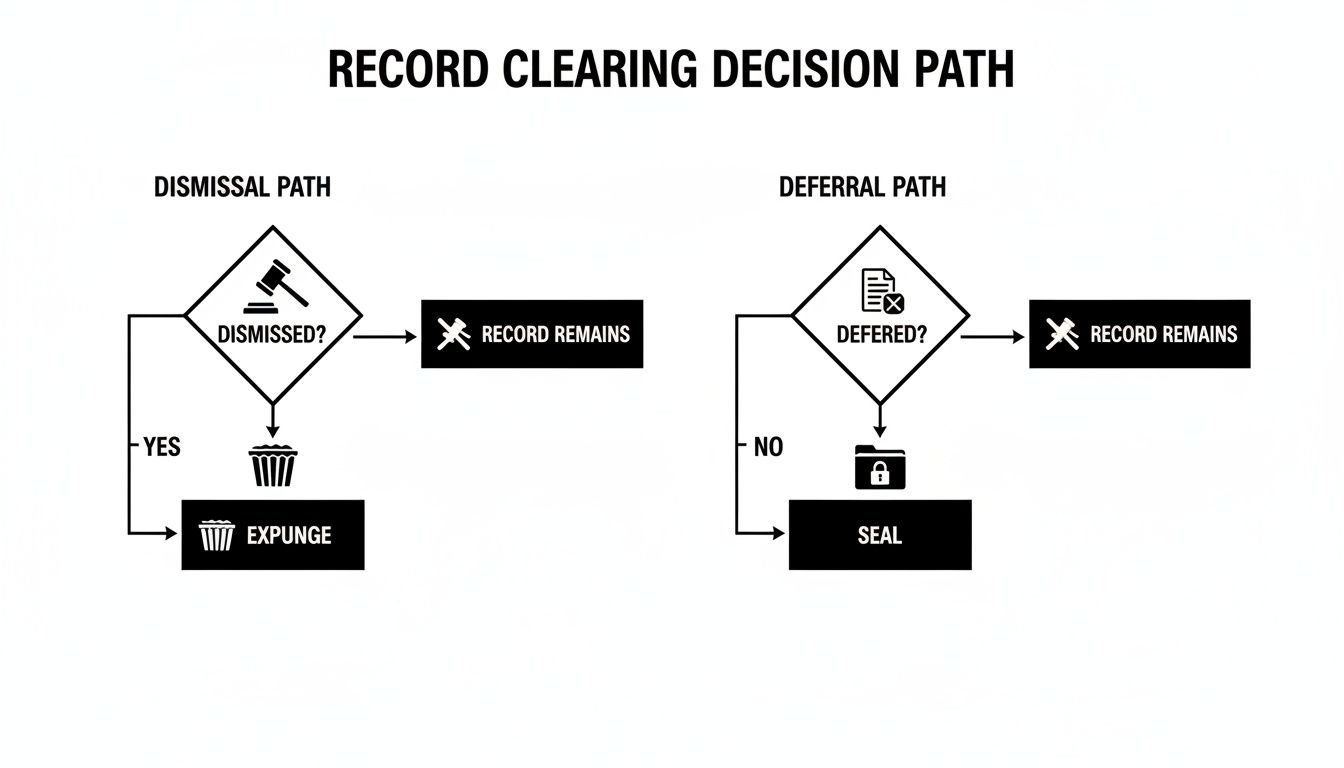
The flowchart makes it clear: the outcome of your case—whether it was dismissed or you completed deferred adjudication—determines whether you can destroy the record (expunge) or just hide it from public view (seal).
Understanding Mandatory Waiting Periods
Even if your case was dismissed, you often can't file for an expunction the very next day. Texas law imposes a mandatory waiting period that begins on the date of your arrest, not the date of dismissal. This period gives the state time to ensure no further action will be taken on the case.
The length of this waiting period depends on the severity of the misdemeanor:
- Class C Misdemeanors: You must wait 180 days from the date of arrest.
- Class A & B Misdemeanors: You must wait one full year from the date of arrest.
Imagine getting arrested for a Class C misdemeanor in Texas, like a minor theft or public intoxication—something that happens to thousands every year. Under Texas law, specifically Article 55.01(b)(1) of the Code of Criminal Procedure, you can have that record fully expunged just 180 days after the arrest date, provided there was no conviction or it was dismissed or quashed. This is a game-changer because expungement doesn't just hide the record; it destroys it, making it inaccessible to employers, landlords, or anyone running a background check.
For Class A or B misdemeanors, the waiting period extends to one full year from the arrest date, as outlined in Art. 55.01(a)(2)(A)(ii)—think disorderly conduct or simple assault charges that get dropped. You can explore more data on Texas court proceedings to understand the sheer volume of cases handled annually.
Critical Disqualifiers You Must Know
Just as important as knowing what qualifies you is understanding what will block your path to an expunction. These are hard-and-fast rules that can immediately disqualify your petition.
The most significant barrier to expunction is a final conviction. If you pleaded 'guilty' or 'no contest' and were found guilty by a judge—even if you only paid a fine or served a short time in jail—you are almost certainly ineligible for an expunction for that offense.
Here are the most common disqualifiers we see trip people up:
- Final Conviction: As mentioned, any finding of guilt closes the door to expunction.
- Deferred Adjudication (for most cases): If you successfully completed deferred adjudication for a Class A or B misdemeanor, your case was dismissed, but you are not eligible for an expunction. Your remedy is an Order of Nondisclosure. The only exception is for Class C misdemeanors, which can be expunged after deferred adjudication.
- Probation: If you were sentenced to regular probation (community supervision), this means you were convicted of the offense, making you ineligible.
Accurately assessing your eligibility is the foundation of a successful expunction petition. Misunderstanding these rules is a common reason petitions get denied, forcing you to start the process all over again.
How to Navigate the Texas Expunction Process

Once you've determined you are likely eligible for an expunction, the next phase involves navigating the formal legal process. This journey requires careful attention to detail, from gathering the right documents to meeting strict court deadlines. Each step is a crucial part of building a strong case to present to the judge.
As a parent, your primary goal is to create stability and security. An actionable piece of advice is to approach this process methodically. Start a dedicated folder for all your documents, create a timeline with key dates, and don't hesitate to ask for help. This proactive approach can reduce stress and ensure you don’t miss a critical detail.
Gathering Your Essential Documents
Before you even think about drafting a legal document, your first job is to become an investigator of your own past. You need to gather all the official records tied to your arrest and the court case that followed. This homework is the foundation of your entire effort, and getting it right prevents frustrating delays or outright rejections later on.
The most critical pieces of the puzzle you’ll need are:
- Arrest Records: These documents spell out the date, time, and location of your arrest, along with the specific offense you were charged with. You can usually get these directly from the arresting agency, like your local police department or county sheriff’s office.
- Court Dispositions: This is the official court paper that shows exactly how your case was resolved. It will state whether the charges were dismissed, you were found not guilty, or something else happened. The district or county clerk's office where the case was handled is your source for this.
- Case Number and Offense Details: Every detail matters. The original cause number, the exact charge, and the date of the offense all need to be precise. Any slip-up here could give the state a reason to challenge your petition.
Think of it like building a house—you need a rock-solid foundation of facts before you can put up the walls of your legal argument. Investing the time to gather these documents thoroughly is the single best way to ensure the process goes as smoothly as possible.
Drafting the Petition for Expunction
The Petition for Expunction is the formal legal document you file to get the ball rolling. This isn’t a simple one-page form; it's a detailed legal pleading that has to contain very specific information laid out in the Texas Code of Criminal Procedure. It’s your official request to the judge, asking for the relief you’re seeking.
Your petition must accurately list:
- Your personal identifying information.
- All the details of the arrest you want wiped clean.
- A clear statement confirming why you are legally eligible for the expunction.
- A complete list of every single government agency that might have records of your arrest.
That last point is incredibly important and, frankly, it's where a lot of people trip up. You have to name every entity, from the arresting police department and county sheriff to the District Attorney's office and the Texas Department of Public Safety (DPS). If you miss even one, their records won't be destroyed, which defeats the whole purpose of the expunction.
A well-drafted petition is your first and best chance to present a clean, legally sound request to the court. Precision and thoroughness here can head off objections from the state and lead to a much faster, more successful outcome.
The complexity of getting this document exactly right is a major reason why many Texans choose to work with an attorney. For a deeper dive into these specific requirements, our team has put together a detailed guide on how to get a record expunged in Texas.
Filing and Serving the Petition
Once your Petition for Expunction is drafted and double-checked for accuracy, it needs to be filed with the district court in the county where the arrest happened. This officially kicks off the legal proceedings. The court clerk will stamp your petition and give it a new case number.
But filing it is just the beginning. You are now legally required to formally notify—or "serve"—every single agency you listed in your petition. This gives them a chance to respond or object. This includes serving the District Attorney's office, as they will represent the state in the matter.
Proper service is a formal legal step and isn't as simple as mailing a letter. To be valid, it often has to be done by a certified process server or constable. Trying to cut corners here will bring the entire process to a dead stop.
While Texas provides a path to wipe the slate clean, the numbers show just how rare a true expunction is. This relief is reserved for those who meet strict conditions, but it offers a complete erasure that sealing a record just can't match. As of 2023, it's estimated that over 9 million Texans have a criminal record, with Harris County alone having around 640,000 cases eligible for some type of relief. An expunged record vanishes entirely, empowering you to confidently pass background checks for jobs in major markets from Houston to Dallas.
The Court Hearing and Final Order
After the petition is filed and everyone has been served, the court will usually set a hearing date at least 30 days out. This window gives the state and other agencies time to review your request and decide if they want to fight it.
If no one objects, the hearing can be a very brief and simple affair where the judge just reviews your petition and signs the Order of Expunction. However, if the District Attorney files an objection, you’ll need to be ready to present your case at the hearing, providing evidence and legal arguments to prove you’re eligible.
Once the judge signs the Order, you're almost at the finish line. The clerk then sends a certified copy of that Order to all the agencies you listed, officially directing them to destroy their records of your arrest. It’s always a good idea to follow up with these agencies after a few months just to confirm they’ve complied. That's how you ensure your fresh start is truly complete.
Common Mistakes That Can Derail Your Expunction (And Why a Lawyer is Your Best Bet)
The path to an expunction is paved with good intentions, but it's also filled with legal landmines that can easily blow up your efforts. A simple mistake on a form or a missed deadline can lead a judge to deny your petition. That means you're forced to start over, costing you more time, money, and emotional energy.
Trying to handle this process on your own might seem like a good way to save a few bucks, but the stakes are incredibly high. These are some of the most common pitfalls we see when people try to navigate the Texas expunction process without an attorney.
Miscalculating the Waiting Period
This is one of the most frequent and heartbreaking errors we see: filing the petition too early. The statutory waiting period—180 days for a Class C misdemeanor and one year for Class A or B—starts on the date of your arrest, not the date the case was dismissed.
Imagine this scenario: a young father was arrested for a Class A misdemeanor, and his case was finally dismissed on March 1st. Thrilled to put it all behind him, he waits a few months and files his expunction petition on September 15th, thinking he’s in the clear.
But his original arrest was on October 1st of the previous year. He filed just two weeks too early. The prosecutor’s office immediately filed an objection, and the judge had no choice but to deny his petition. He had to pay all the filing fees all over again and start from scratch.
Forgetting to Notify All the Right Agencies
A petition for expunction isn't just a request to the court; it's a legal order that must be sent to every single government agency holding a record of your arrest. If you miss even one, the whole process is incomplete.
Most people remember to list the obvious ones:
- The arresting police department or sheriff's office
- The county or district attorney’s office
- The county and district clerk
- The Texas Department of Public Safety (DPS)
But what about the local jail where you were booked? The crime lab that processed evidence? Or a municipal court if the case started there? Failing to properly identify and serve notice to every single agency is a critical error that can leave fragments of your record floating around, defeating the entire purpose of the expunction.
The legal process for an expunction is designed to be exact. A petition that is 99% correct can still be 100% denied. This is where an experienced attorney provides immense value, ensuring every single detail is nailed down from the start.
Handling Objections from the State
Even a perfectly filed petition can run into an objection from the prosecutor's office. They might argue that you don't meet the strict eligibility rules or claim that granting the expunction is not "in the interest of justice."
When that happens, you'll have to go to a contested hearing and argue your case in front of a judge. This isn't a casual conversation; it's a formal legal proceeding where you have to present evidence and make arguments based on Texas law. Facing off against a seasoned prosecutor alone is an incredibly tough battle and seriously lowers your chances of winning.
An attorney can see these objections coming, counter them with legal precedent, and advocate fiercely for you. As you move through the process, you may also run into legal documents that require a precise understanding. Learning how to accurately translate legal documents can be critical for ensuring all paperwork is correctly interpreted, especially if any international records are involved.
The compassionate guidance of a skilled attorney transforms this process from a high-stakes gamble into a strategic legal action. At The Law Office of Bryan Fagan, we protect you from these common mistakes and manage every complex detail, so you can focus on moving forward.
Common Questions About Texas Expungement
The journey to clear your record is often filled with practical questions about time, money, and what happens next. Knowing these details can help you feel more prepared and less anxious as you move forward. We’ve gathered some of the most common questions we hear from families just like yours to give you clear, straightforward answers.
How Much Does It Cost to Expunge a Misdemeanor in Texas?
The total cost for an expunction can vary quite a bit, depending on the county and the unique details of your case. Generally, you can expect to pay court filing fees, which are usually somewhere between $250 and $400.
On top of that, you’ll have service fees for officially notifying each government agency that holds a copy of your records. The largest part of the investment will be attorney fees. While it might seem like a lot, skilled legal help is crucial for preventing costly errors that could get your petition denied, forcing you to pay all those fees a second time.
Can I Legally Deny My Arrest After an Expunction?
Yes, you absolutely can. This is the single most powerful benefit of getting a successful expunction. Once a judge signs that final Order of Expunction, Texas law allows you to legally deny the arrest and even the existence of the records in most situations.
That includes when you're filling out applications for jobs, housing, or loans. The entire point of destroying the record is to put you back in the position you were in before the arrest ever happened, giving you a true fresh start.
What Happens If the Prosecutor Objects to My Petition?
If the District Attorney’s office files an objection, it doesn’t automatically mean your case is over. It just means a hearing will be scheduled where both sides can present their arguments to the judge.
The prosecutor will likely argue that you don't meet the very strict eligibility requirements laid out in the law. This is a make-or-break moment in the process and a key reason why having an experienced attorney is so important. Your lawyer can build a strong counter-argument, present the right evidence to support your eligibility, and advocate directly to the judge on your behalf.
An objection from the state essentially turns the process into a contested legal battle. Having a skilled legal advocate in your corner can be the difference between getting your petition granted or denied.
How Long Does the Expunction Process Take in Texas?
The timeline can differ from one county to another based on how busy the court's docket is, but the process generally takes somewhere between three to six months. This clock starts from the date you file the petition and runs until the final order is signed.
After your petition is filed, there’s a mandatory 30-day waiting period before a hearing can even be set. This gives all the notified agencies a chance to respond. An attorney can help you avoid unnecessary procedural delays and keep the process moving as efficiently as possible, making sure you get your clean slate without any extra setbacks.
A past mistake shouldn't define your family's future. Clearing your record is a powerful step toward securing better opportunities and peace of mind, especially when you are working to create a safe and stable home for your children. At The Law Office of Bryan Fagan, PLLC, we provide the compassionate, experienced guidance you need to navigate the Texas expunction process with confidence. Don't let a past arrest hold you back any longer. Contact us today for a free, no-obligation consultation to discuss your case and learn how we can help you achieve a true fresh start. Visit us at https://texascpslawyer.net to get started.