Skip to content
The moment a process server hands you a stack of legal papers is jarring. Seeing your name on a document titled "Temporary Ex Parte Protective Order" can feel like you've been judged before you've even had a chance to speak. Your heart pounds as you read words that might kick you out of your own home, keep you from your kids, and brand you as a threat. That initial shock, the fear, and the confusion are completely normal reactions when your family is on the line.
To win a fight against a protective order in Texas, you have to do two things at once: understand the order's specific terms and strictly comply with them, while immediately starting to gather evidence that tells your side of the story. Your entire defense will come down to presenting this evidence—witnesses, documents, texts, you name it—at a formal court hearing to prove that family violence, as defined under the Texas Family Code, did not happen.
What to Do When You Are Served with a Protective Order

It’s important to understand how this can happen. A Temporary Ex Parte Order is often issued based entirely on the petitioner's side of the story. A judge can grant it without you ever setting foot in the courtroom if they believe there's a "clear and present danger" of family violence. This is a temporary safety measure designed to prevent immediate harm, not a final verdict on your character or your rights as a parent.
Your First Steps After Being Served
Picture this: Mark is in the middle of a messy divorce. One evening after work, he’s served with papers at his front door. The order, filed by his estranged wife, accuses him of threatening behavior and bans him from going back to the family home or even contacting his two young kids. His mind is racing. He’s confused, hurt, and angry because he knows the claims are blown way out of proportion to get an upper hand in their custody battle.
If you find yourself in Mark's shoes, what you do next is absolutely critical. Panicking or reacting out of anger will only make a bad situation worse and can jeopardize your future with your children. Here’s what you need to do immediately:
- Read the Order. Every Word. Don't just skim it. You need to know exactly what you are prohibited from doing. Does it forbid all contact, or are there exceptions? What specific locations are you barred from? Understanding these details is your first line of defense.
- Comply Completely. This is non-negotiable. Violating any part of the order—even with a seemingly innocent text like "I love you" to your child—is a criminal offense under Texas law. A violation can lead to your arrest and obliterates your credibility with the judge who will decide your case.
- Document Everything. Start a log immediately. Write down the date and time you were served and everything that happened leading up to it from your perspective. Preserve every text message, email, and social media post that could provide context or directly challenge the allegations.
The most important thing to remember is that a Temporary Ex Parte Order is a one-sided story. The upcoming hearing is your opportunity to present your side and the evidence that supports it.
Preparing for Your Hearing
The order will have a date for a formal hearing, usually within 20 days. That’s your window to build a defense. This is not the time to go it alone. The consequences of a final protective order are severe—it can impact your parental rights, your job, and your right to own a firearm for years.
Getting legal help right away is crucial. You need to find a specialized Austin protective order lawyer or an attorney in your area who lives and breathes these kinds of cases. As you get ready, keep the case off social media and do not discuss it with the petitioner. Your energy should be focused on calmly and methodically building your defense. To get a better handle on the different types of orders, you can learn more about an emergency protective order in Texas and see how it works. This is your first step toward fighting back with facts and a clear legal game plan.
Understanding What You Are Up Against
To effectively fight a protective order in Texas, you first need to get a handle on the legal battlefield you’ve just been dropped into. The term "protective order" isn't a one-size-fits-all label. It actually covers several different types of orders, and each one comes with its own set of rules, deadlines, and serious consequences for you and your family.
Knowing which specific order you’re facing is the critical first step in building a solid defense. Not all of them are created equal. You might have been served with a Temporary Ex Parte Order, be staring down a hearing for a Final Protective Order, or be subject to a Magistrate's Order of Emergency Protection (MOEP). The biggest difference usually comes down to who issued the order and whether you've had a chance to tell your side of the story yet. Getting this straight is non-negotiable because it dictates your immediate next steps.
The Different Kinds of Protective Orders
Let's break down the common types of orders you might encounter. Each one carries serious legal weight and comes with stiff penalties if violated.
- Temporary Ex Parte Protective Order: This is the one most people get hit with first. It's temporary, usually lasting 20 days, and is issued "ex parte"—which is a legal way of saying a judge granted it based only on the other person's side of the story. You weren’t there to defend yourself. Its purpose is to put an immediate stop to contact until a full hearing can be held where you can present your case.
- Final Protective Order: This is the big one. It's issued after a full court hearing where both sides get to present evidence, call witnesses, and argue their case. If a judge grants a final order, it can last for up to two years—and in some severe cases, even for a lifetime.
- Magistrate's Order of Emergency Protection (MOEP): This one is different because it’s tied to a criminal case, not a civil one. A magistrate issues a MOEP right after an arrest for an offense involving family violence, stalking, or sexual assault. These typically last between 31 and 91 days.
The legal system can feel like a maze, but figuring out which document you're holding clarifies exactly what you need to do to protect your rights. Our firm has a more detailed guide if you want to dig deeper into what a protective order is in Texas and the nuances of each type.
The Legal Standard of Family Violence
To get a Final Protective Order, the petitioner can't just walk in and say they feel threatened. They have a specific legal hurdle they have to clear. Under the Texas Family Code, they must prove to the judge that "family violence" has occurred and is likely to happen again in the future.
This isn't some vague concept; it has a precise legal definition. "Family violence" is an act against a family member intended to cause physical harm, injury, assault, or sexual assault, or a threat that puts that person in fear of any of those things.
It’s crucial to understand this: the case isn't just a "he said, she said" argument. The person asking for the order has the burden of proof. They are the ones who must present credible evidence—not just accusations—that makes it more likely than not that family violence actually happened.
Your entire defense will be built around showing the judge that the petitioner has failed to meet this burden. This means poking holes in their evidence, presenting your own counter-evidence, and demonstrating that their claims simply don't rise to the legal definition of family violence.
Comparing Texas Protective Orders
| Order Type | How It Is Issued | Typical Duration | What It Restricts |
|---|---|---|---|
| Temporary Ex Parte Order | By a judge based on one side's story, without a hearing for you. | Usually 20 days, until the final hearing. | Contact, proximity to home/work, and possessing firearms. |
| Final Protective Order | By a judge after a full court hearing where both sides present evidence. | Up to 2 years, or potentially for life in severe cases. | Everything in a temporary order, and can also impact child custody. |
| Emergency Order (MOEP) | By a magistrate after an arrest for a family violence-related crime. | 31 to 91 days, depending on the offense. | Similar to a temporary order, but tied directly to a criminal case. |
Understanding these distinctions will help you grasp the seriousness of your situation and start preparing for the legal fight ahead.
Building Your Defense: Gathering Crucial Evidence
An accusation is just that—an accusation. It's not a fact, and it's certainly not the end of the story. When you're fighting a protective order in Texas, the judge needs more than just your word against the petitioner's. They need proof. This is where you shift from an emotional reaction to a strategic one, focusing on gathering concrete, credible evidence that tells your side of the story.
The petitioner has the legal burden to prove family violence occurred. Your job is to dismantle their narrative with facts. Success often comes down to how clearly, logically, and factually you can present your defense.
Turning Words into Evidence
Every text, email, and social media post can be a puzzle piece in your defense. You need to start thinking like a detective, reviewing every interaction you've had with the petitioner. What can you find that provides context, highlights inconsistencies, or flat-out disproves an allegation?
Here are the most compelling types of evidence you should start collecting right away:
- Text Messages and Emails: This is often where the truth comes out. Don't just cherry-pick the messages that make you look good; save the entire conversation. A complete thread can reveal the actual tone of your relationship, show the petitioner wasn't afraid of you, or even expose an ulterior motive, like trying to get leverage in a custody battle.
- Social Media History: Check your own posts, but don't forget to look at the petitioner's public profiles. A picture of them out having a great time with friends the day after an alleged violent incident can speak volumes and completely undermine their claim of being in fear for their life.
- Photos and Videos: Do you have pictures or videos that show the scene of an alleged incident in a different light? Maybe you have a Ring camera recording of a perfectly calm conversation on a day the petitioner claimed you were screaming threats. This kind of evidence is incredibly powerful.
- Financial Records: Money often tells a story the petitioner might not want the judge to hear. Bank statements showing you paying their bills or jointly managing finances can directly contradict a narrative of coercive control or financial abuse.
Get organized. Create a digital folder and sort everything you find by date. A clear, chronological timeline makes your case easy for the judge to follow and understand.
The Power of Credible Witnesses
While your documents are critical, nothing beats the impact of a credible human voice backing you up. A good witness can offer that neutral, third-party perspective that validates your side of the story. But you can't just put anyone on the stand. You need people who can speak to specific events or your character in a believable, unbiased way.
Think about people who have direct, firsthand knowledge:
- A neighbor who can testify they never heard any fighting or screaming from your home.
- A mutual friend who saw you both interacting calmly on a day an alleged violent argument took place.
- A family member who heard the petitioner admit they were filing the order to get a leg up in the divorce.
It's absolutely essential to talk to your potential witnesses before the hearing. You need to know exactly what they saw and what they're prepared to say. The last thing you want is a witness who gets confused, changes their story, or says something that accidentally hurts your case. A bad witness is often worse than no witness at all.
Your defense is a puzzle. Each text message, photo, and witness statement is a piece that helps the judge see the full picture—one that shows the allegations against you simply don't meet the legal standard for a protective order.
Understanding Local Court Differences
As you build your defense, remember this critical point: how these cases are handled can change dramatically from one Texas county to the next. The Collaborative Commission on Domestic Violence's Annual Report, for instance, noted 1,568 protective order petitions were filed in Bexar County civil courts in just one year. Other studies have shown huge differences in how judges and prosecutors in different jurisdictions apply the law.
This lack of uniformity means a strategy that works wonders in a Houston courtroom might fall flat in Austin. This is why having a locally experienced attorney is so important; they understand the nuances and tendencies of the local judges and courts. You can discover more about these statistical findings and their impact on Texas protective order cases to see just how much location matters.
Ultimately, gathering evidence is about taking abstract accusations and grounding them in reality. It's a methodical process, but with a well-organized and factual defense, you give the judge a compelling reason to see the truth and rule in your favor.
Navigating the Protective Order Hearing
Walking into a courtroom for a protective order hearing is enough to make anyone's stomach turn. The formal atmosphere, the high stakes, and the fact that a judge is about to make a decision that will impact your life is intensely stressful. But remember, knowledge is power. When you understand exactly what’s about to happen, you can trade that fear for a sense of control.
This hearing is your first real chance to tell your side of the story. The Temporary Ex Parte Order was granted based on a one-sided account—this is where the judge finally hears from you. Your testimony, your evidence, and even how you carry yourself will directly influence the outcome. Forget what you’ve seen on TV. This is a structured, formal process designed to get to the truth.
What to Expect Inside the Courtroom
From the moment you arrive at the courthouse, your conduct matters. Dress professionally, like you’re going to an important job interview. Get there early, turn your phone completely off (not just on silent), and be respectful to everyone—the bailiff, the clerk, and yes, even the other side. The judge sees everything, and your demeanor shows you’re taking this seriously.
A protective order hearing follows a fairly predictable script:
- Opening Statements: The petitioner's attorney goes first. They'll give the judge a short roadmap of what they plan to prove—that family violence has occurred and is likely to occur again. Then, your attorney will give their opening, explaining why the petitioner hasn't met their legal burden and what your evidence will show.
- Petitioner's Case-in-Chief: The person asking for the order presents their evidence. This means they will testify and call any witnesses they have. The most critical part for your defense is that your lawyer gets to cross-examine every single person who testifies against you.
- Your Defense: Once the petitioner rests, it’s your turn. You will take the stand to testify. Your attorney will then call your own witnesses and introduce your evidence, such as text messages, emails, photos, or videos.
- Closing Arguments: Finally, both attorneys get one last chance to speak to the judge. They'll summarize the evidence and argue why the law supports their client's position.
The Art of Answering Questions Under Pressure
One of the most nerve-wracking parts of any hearing is cross-examination. This is when the petitioner’s lawyer gets to ask you questions directly. Their job is to find inconsistencies in your story, provoke an emotional reaction, or make you look untrustworthy.
Your composure here is your single greatest asset. It is absolutely essential to stay calm, even when the questions feel accusatory or are designed to make you angry.
The key is to listen carefully to the question, pause to think, and answer only what was asked. Don't volunteer extra information. Don't guess. And never, ever argue with the attorney. Your most powerful answers will be simple, truthful, and direct.
Let's walk through a common scenario. The petitioner’s attorney asks, “So you admit you were yelling at her on the night of the 15th, correct?” If you fire back with, “Well, she was yelling at me first!” you look defensive and reactive. A much better, calmer response is a simple, “No, that is not correct,” or “I raised my voice, but I was not yelling.” Let your attorney bring out the full context later.
This process flow shows how your evidence—from documents to witnesses—builds a comprehensive timeline for your defense.
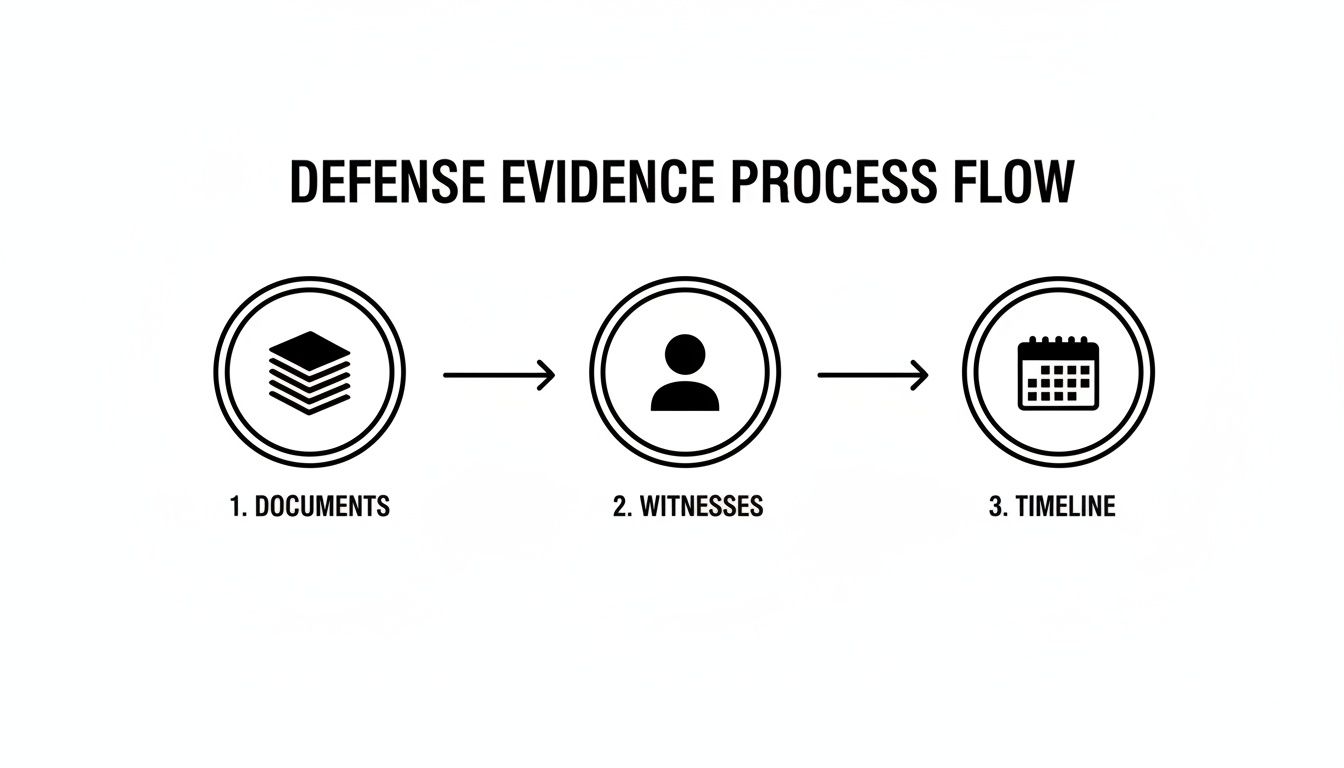
This visual is a great reminder that a solid defense isn't built on one single thing. It’s built piece by piece, with each element supporting the others to give the judge a clear, factual narrative. The hearing is a methodical process, not a shouting match. By understanding the procedure and preparing your evidence, you give yourself the best possible chance to fight the protective order and clear your name.
How a Protective Order Can Wreck Your Custody Case and Divorce

A protective order is never just a piece of paper telling two people to stay away from each other. For Texas families, it’s a legal earthquake. The shockwaves can tear through every part of your life, especially if you’re already dealing with a divorce or a child custody fight. The stakes in that protective order hearing aren't just about whether you can text your ex. They’re about your fundamental rights as a parent and your entire future with your kids.
A final protective order can have a catastrophic impact on a family law case. It often creates a steep, uphill battle that can haunt you for years.
The "Family Violence" Presumption Changes Everything
Here’s the part that trips up so many parents. Under the Texas Family Code, if a judge finds that family violence has occurred, it triggers a powerful legal presumption. The court must presume it is not in your child's best interest for you to have unsupervised visits or be named the primary caregiver (the parent who decides where the child lives).
That’s a massive hurdle to clear. It flips the script entirely. Instead of starting on a level playing field, you’re now on the defensive, forced to prove to the court why you should be allowed to see your own children without supervision.
Think about this scenario: a father is in a heated custody dispute. The mother, looking for an edge, files for a protective order with exaggerated claims. If the judge grants that order, the father’s fight for his kids just became exponentially harder. He could be facing:
- Supervised Visitation Only: This means seeing your kids only with a third party watching, often in a sterile facility and on your own dime.
- Loss of Decision-Making Rights: The judge can strip your right to be a "joint managing conservator," meaning you lose your voice in your child’s education, healthcare, and religious upbringing.
- Geographic Restrictions: The order can even dictate where you can live, potentially forcing you miles away from your children.
The finding of “family violence” in a protective order hearing can become the single most influential factor in a subsequent custody determination. It effectively stacks the deck against you before the custody battle even begins.
When Your Cases Get Combined, the Stakes Skyrocket
The connection between these legal fights has become even more direct. Recent changes to Texas law have completely changed how protective orders are handled when kids are involved.
New legislation now requires that any protective order involving family violence must be consolidated into a pending divorce or child custody case. This means the protective order hearing and your custody case will likely happen in the same court, in front of the same judge.
This consolidation changes everything. These are no longer separate issues; they are one and the same. You absolutely cannot afford to treat the protective order as a secondary problem. The evidence, testimony, and ruling from that hearing will bleed directly into every decision made in your divorce or custody case. Understanding how to navigate these combined proceedings, including the crucial role of divorce temporary orders, is more critical than ever.
Answering Your Urgent Questions
When you’re suddenly served with a protective order, your mind starts racing. The questions come fast and furious, and the uncertainty can feel crushing. You need clear, direct answers, and you need them now. Let's tackle the most pressing concerns we hear from Texas families day in and day out, so you know exactly what you're up against.
What Happens If I Violate a Protective Order in Texas?
Let me be blunt: violating a protective order in Texas—even if you think it's just a small, harmless mistake—is a serious criminal offense. This isn't a slap on the wrist. A first-time violation is usually a Class A Misdemeanor, which could land you in jail for up to a year and hit you with a fine of up to $4,000.
If you've had a prior violation, the stakes jump dramatically. A second offense can be charged as a third-degree felony, putting you at risk of spending 2 to 10 years in prison. Sending a single text, making a phone call, or even asking a mutual friend to pass along a message are all considered violations. You have to follow every single condition of the order to the letter. The only way to challenge an unfair order is in court, not by ignoring it.
Can a Protective Order Be Removed or Changed?
Yes, it’s possible to get a final protective order modified or even terminated, but it is a tough, formal legal process. You can't just call the judge and ask for it to be dropped. To have any chance, you must file a "Motion to Modify or Dissolve" and prove that there has been a "material and substantial change" in circumstances since the day the order was issued.
For instance, if the person who requested the order (the petitioner) has a genuine change of heart and is willing to testify that they want it gone, a judge might consider it. But courts are extremely cautious about lifting orders designed to stop family violence. Your desire for it to be over isn't enough; you need compelling legal arguments and solid evidence showing the order is no longer needed to protect the petitioner.
A judge’s number one concern is always safety. To undo a protective order, you have to give the court a strong, evidence-backed reason to believe the original threat of family violence is completely gone.
Will This Show Up on a Background Check?
Absolutely. A final protective order is a public court record. That means it will almost certainly pop up on the comprehensive background checks used for jobs, professional licenses, and even apartment applications. While it’s a civil order, not a criminal conviction, the stigma it carries can throw up major roadblocks in your personal and professional life.
On top of that, being subject to a final protective order means you lose your right to own or possess a firearm under federal law. This is just one more reason why fighting the order from the very beginning is so critical to protecting your future. If the judge ultimately denies or dismisses the order, you may have options to get the record sealed from public view, but that's a separate legal battle you have to take on after the case concludes.
Do I Really Need a Lawyer to Fight This?
While you technically have the right to represent yourself, it's a huge gamble. Protective order hearings aren't casual chats with a judge—they are complex legal proceedings with strict rules of evidence and courtroom procedure. The petitioner will almost certainly have a lawyer arguing for them, which immediately puts you at a massive disadvantage.
An experienced family law attorney who knows how to fight a protective order in Texas understands the strategy. They know how to cross-examine witnesses to expose inconsistencies, how to properly submit your evidence so the judge will actually look at it, and how to build a persuasive legal argument rooted in the Texas Family Code. Given the severe and lasting consequences of a final protective order—on your parental rights, your reputation, and your freedom—hiring a professional gives you the best possible chance of a fair outcome.
We know that facing a protective order is overwhelming, leaving you feeling scared for your future and your relationship with your children. The legal system is a maze, and trying to fight this battle on your own can put your family’s future in jeopardy. You don’t have to go through this alone. At The Law Office of Bryan Fagan, PLLC, our experienced and compassionate attorneys are here to defend your rights and make sure your side of the story is heard with clarity and strength. Contact us today for a free consultation to discuss your case and learn how we can provide the reassuring guidance you need.