Skip to content
The knock on your door from a Child Protective Services (CPS) agent is a moment that can stop your heart and fill you with a unique blend of fear and confusion. Your mind races with worst-case scenarios, and panic feels like the only possible reaction. We understand. But that initial feeling of terror doesn't have to define your story. Fighting CPS in Texas begins in that first critical interaction, with the hope that comes from knowing your rights and having a plan. It's about being polite but firm, understanding what to say—and what not to say—and never, ever signing anything or agreeing to an interview without first speaking with a lawyer.
What to Do When CPS Shows Up at Your Door
When a CPS caseworker appears unannounced, it's easy to feel like your world is crumbling. In that moment of sheer terror and confusion, what you know becomes your greatest defense. That knock doesn't mean you've lost. It means a process has started, and how you handle this first meeting can set the tone for the entire investigation. The key is to be cooperative without surrendering your constitutional rights.
Your first job is to stay as calm as possible. We know your heart is pounding, but a polite, composed demeanor is your best friend here. If you panic, get angry, or become defensive, the caseworker can easily twist that normal human reaction into a sign of guilt or instability in their report—which a judge will later read.

A Real-Life Scenario
Imagine this: a mom we'll call Sarah is home with her two young children when a CPS caseworker arrives, claiming they received an anonymous tip about neglect. Instead of panicking and throwing the door open, letting a stranger into her home, Sarah steps out onto the porch and closes the door behind her.
She calmly says, "Thank you for introducing yourself. Can I please see your ID and get your business card? I also need you to tell me exactly what the allegations are."
Just by doing this, Sarah took a measure of control. The conversation happened on her terms, outside her home. She obtained the caseworker's information and the basic allegations. She did it all respectfully without being aggressive.
Sarah then politely told the caseworker, "Thank you. I take this very seriously, but I won't be answering any questions or letting you in my home until I have spoken with my attorney." That simple, firm statement protected her family and showed she was treating the situation with the gravity it deserved. It's a perfect example of how to handle a CPS home visit in Texas.
Your Immediate and Actionable Advice
Just because a CPS investigator is at your door doesn't mean your constitutional rights have disappeared. You have no obligation to let them inside without a court order. They need a warrant signed by a judge or what the law calls “exigent circumstances”—a real, provable reason to believe your child is in immediate, life-threatening danger.
Your home is your castle, protected by the Fourth Amendment. Never let anyone pressure you into giving up that right. Politely refusing entry until you speak with an attorney isn't an admission of guilt; it's a smart, protective measure.
What you say is just as critical. Every word can be noted and used in a report that a judge will read. You should never agree to a formal interview on the spot. Instead, clearly state that you plan to hire an attorney who will coordinate with the caseworker.
Here's a quick checklist to help you remember what to do—and what to avoid—in those first few overwhelming minutes.
Your Immediate CPS Contact Checklist
| What You Should Do | What You Should Avoid |
|---|---|
| Stay Calm and Polite: Your demeanor matters. | Panicking or Getting Angry: This can be used against you. |
| Step Outside: Keep the caseworker out of your home. | Letting Them Inside: You don't have to without a warrant. |
| Ask for ID and Contact Info: Know who you're dealing with. | Answering Questions: State you will speak through an attorney. |
| Ask for the Specific Allegations: You have a right to know. | Signing Any Documents: This includes "Safety Plans." |
| State Your Intent to Hire a Lawyer: This is your right. | Volunteering Extra Information: Don't chat or try to explain. |
| Take Your Own Notes: Document everything you can remember. | Agreeing to an Interview: Schedule it through your lawyer later. |
Think of this table as your emergency guide. The goal is to be a closed book until your attorney can help you open it safely and strategically.
Caseworkers will often try to get you to sign documents, sometimes called a "Parental Child Safety Placement" or a "Safety Plan." Do not sign anything. These are often presented as "voluntary" agreements that can strip you of your rights, sometimes by asking you to move out of your own home or agree to supervised visits. Signing can be interpreted as admitting a problem exists and can be held against you in court. Always insist that your attorney reviews any and all paperwork first.
Understanding Your Parental Rights in a Texas CPS Case
When a CPS investigator shows up, it’s natural to feel cornered and powerless. The pressure to just go along with everything they ask is intense, fueled by a deep-seated fear that if you say "no," you'll look guilty.
Let's be clear: that's a myth. Knowing your rights isn't about creating conflict; it's about protecting your family and ensuring the process remains fair. Your rights under the U.S. Constitution and the Texas Family Code don't vanish the second an investigator introduces themselves.
Your Right to an Attorney
This is your single most important right. You should never try to handle a CPS case on your own. As soon as you are contacted, your first and most critical move should be to find a family law attorney with real experience fighting these specific kinds of cases.
You can politely but firmly tell the caseworker, "I intend to cooperate fully, but I will be doing so with my attorney. Please direct all future communication to them." This one sentence is a game-changer. It:
- Immediately puts a legal expert between you and the state.
- Stops you from accidentally saying something that can be twisted or used against you.
- Shows that you are taking this with the seriousness it deserves and are prepared to defend your family.
Your Right to Refuse Entry Without a Warrant
Your home is your private space, protected by the Fourth Amendment. A CPS caseworker cannot simply walk into your home without your permission or a court order signed by a judge. The only exception is "exigent circumstances," which means a true, life-or-death emergency.
If a caseworker asks to "just take a quick look around," you have every right to decline. You can say, "I'm not comfortable with that right now. My lawyer will be in touch to coordinate a visit." This is not obstruction; it's you exercising a basic constitutional right to protect your family's privacy.
A classic CPS tactic is to imply you're hiding something if you don't let them in. They might say, "If you have nothing to hide, what's the problem?" Do not fall for it. The burden of proof is on them, not on you to prove your innocence by giving up your rights.
Your Right to Remain Silent
Just like in a police investigation, you have the right to remain silent. You are not legally required to answer an investigator's questions on the spot. Many of their questions are designed to get you to admit something—anything—they can use to build their case.
A caseworker might start asking about past mental health struggles or a time you had a few drinks. Instead of getting defensive or trying to explain your life story, simply state that you will discuss it with your lawyer first. This prevents your own words from being taken out of context in a report that a judge will read. In these high-stakes situations, it's also vital to understand all aspects of your parental rights, including how they relate to custody issues like how a dad can get full custody in Texas.
How These Rights Play Out in the Real World
Let me share a real situation. CPS showed up at a client's home—we'll call her Maria—after a report and demanded she take a drug test right then and there. Panicked, she almost agreed. But then she remembered the guidance we'd provided.
She politely declined the on-the-spot test and called our office immediately. We contacted the caseworker and made it clear that Maria would not submit to any testing without a court order. Because CPS lacked the evidence to obtain that order, the demand was dropped. By calmly asserting one right, Maria completely changed the dynamic of the investigation.
It's also worth noting that the system itself is shifting. The number of child maltreatment reports assigned for investigation in Texas is projected to drop from 273,415 in Fiscal Year 2021 to 227,199 by Fiscal Year 2025. This 17% reduction is due to new laws that prioritize which cases actually need a full-blown CPS investigation. Having an attorney involved from the beginning can make all the difference. You can learn more about these child maltreatment report findings directly from the state's data.
Navigating the Texas Family Court Process
When CPS files a lawsuit, everything changes. You're no longer just dealing with an investigator; you've been pulled into the formal Texas family court system. It's a world with its own language, strict deadlines, and rigid rules. It’s completely normal to feel overwhelmed, but this is a process we can walk you through, step by step.
If CPS is taking you to court, it’s because they believe your child is in danger and are asking a judge to either remove your child or force you to comply with court-ordered services. This lawsuit is officially called a “Suit Affecting the Parent-Child Relationship,” or SAPCR.
The Emergency Removal and 14-Day Hearing
If CPS has already removed your child, Texas law is crystal clear: a judge must see the case almost immediately. This first, critical court date is called the “14-Day Hearing” or "Show Cause Hearing," and under Texas Family Code Chapter 262, it must happen within 14 days of the removal.
The judge has one question to answer at this hearing: Was there an immediate danger to the child's physical health or safety that made removal necessary?
That's it. The burden is entirely on CPS to prove that urgent danger existed. This is your first real opportunity, alongside your attorney, to challenge their narrative and fight to bring your child home. A judge can return your child to you, place them with a trusted relative, or order them to stay in foster care. Showing up to this hearing with an experienced lawyer is absolutely essential.
The Key Players in Your Case
Once you're in the courtroom, you’ll see many new faces. It's vital to understand who they are and what role they play.
- The Judge: This is the person who makes all the final decisions.
- The CPS Attorney: This lawyer works for the Department (DFPS) and is trying to prove the case against you.
- Your Attorney: This is your advocate, your defender, and the person who is 100% on your side, guiding you through every step.
- Attorney ad Litem: The court appoints this lawyer to represent what they believe are the child's "best interests." They do not work for you or for CPS.
- Guardian ad Litem: Sometimes, the court also appoints a guardian (who may or may not be a lawyer) to advocate for the child's best interests.
This timeline gives you a high-level view of the major stages in a Texas CPS case, from the shock of removal to the final trial.
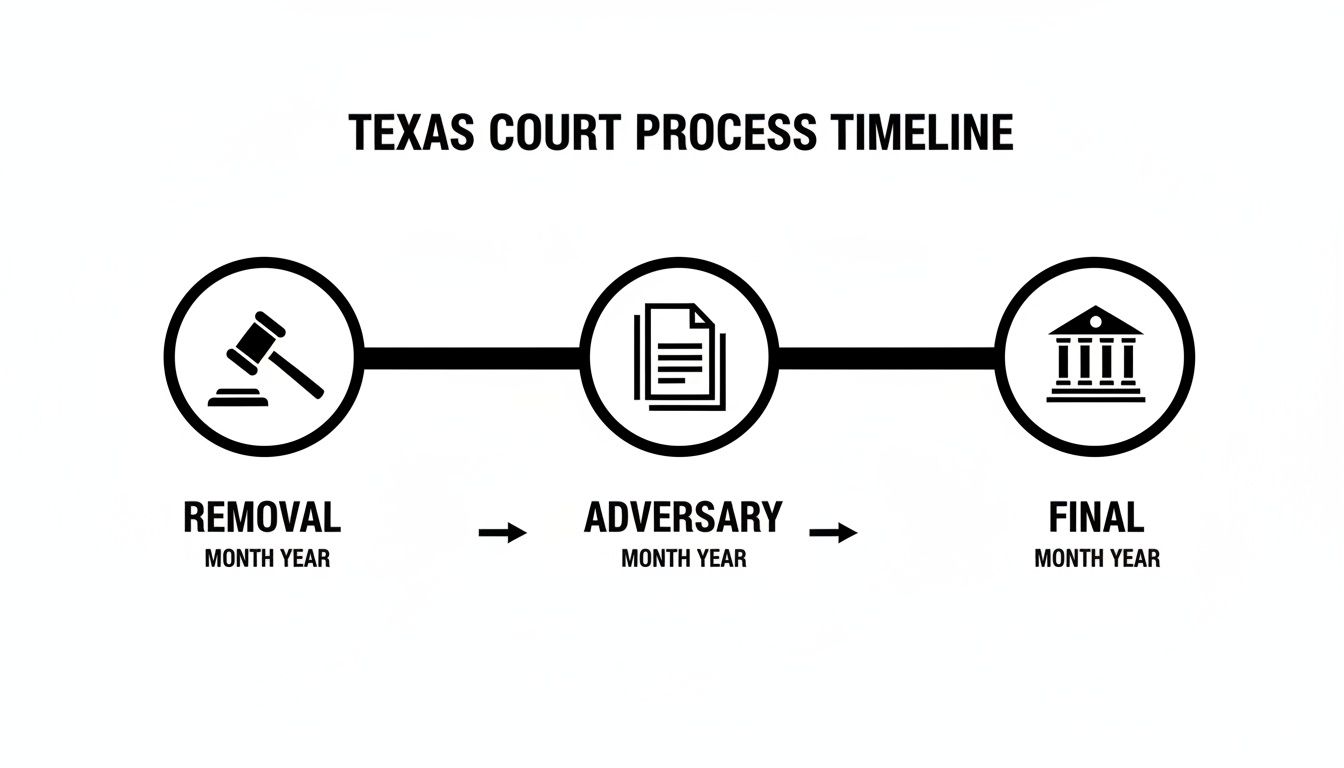
Each of these hearings is a critical moment where evidence is presented and life-altering decisions about your family are made.
Adversary, Status, and Permanency Hearings
After the initial rush of the 14-day hearing, the case settles into a more structured timeline. You can find a deeper dive into these proceedings in our essential guide on Texas CPS court hearings and timelines for parents.
Next up is the Adversary Hearing, which must take place within 60 days of the removal. This is a much more detailed hearing where your attorney can cross-examine the CPS caseworker and present your evidence to prove that your child is not in danger and can safely come home.
From there, the court sets regular Status Hearings and Permanency Hearings. These are your opportunities to show the judge that you are diligently working your service plan and making real progress toward reunification.
It's crucial to understand that the entire legal landscape is shifting. Texas has made a huge effort to keep families together. Since 2018, child removals by CPS have plummeted by an incredible 55%, a direct result of legislative reforms. You can discover more insights about this child welfare revolution in Texas and see for yourself how the state is prioritizing family preservation. This trend could be a game-changer in your case.
This change highlights why a strong legal defense is so important. Now more than ever, courts are open to solutions that keep children safely with their parents. Your job, with our help, is to prove that your home is that safe place. Fighting CPS in court is all about preparation, solid evidence, and a mastery of the law.
How to Build a Powerful Defense Against CPS Allegations
When CPS brings an allegation, it's not just their word against yours—it's their story against yours. A successful fight against Child Protective Services is built on a foundation of solid proof, not just hope. Your job, with your attorney's guidance, is to build a stronger, more believable story backed by undeniable evidence.
This is your playbook for taking control of the narrative.

From the moment an investigation begins, you need to become a meticulous record-keeper. We've seen countless cases turn on the smallest details. Every interaction with CPS, no matter how brief, needs to be documented. This proactive approach is critical if you want to learn how to fight CPS in Texas and win.
Gathering Your Evidence and Documentation
The evidence you collect has one single purpose: to prove that you are a fit, loving, and capable parent and that the allegations against you are false. Your attorney will guide you, but you are the one on the ground who can gather the raw materials needed to build your defense.
Start right now. Get a dedicated folder or binder for everything related to your case. This level of organization is invaluable to your legal team and shows the court you are taking this matter with the seriousness it deserves.
The evidence you gather should paint a complete picture of your life and your child's well-being. Think in terms of these categories:
- Your Child’s Well-Being: Collect school attendance records, recent report cards, medical and dental records, and letters from teachers or coaches. This paperwork demonstrates that your child is cared for, healthy, and thriving under your roof.
- Your Character and Stability: Gather character reference letters from credible people who know you and your family well—employers, your landlord, trusted neighbors, or leaders from your church. These letters should speak directly to your parenting skills and responsible nature.
- Your Home Environment: When your house is clean and safe, take pictures and videos. We can't stress this enough. Show that you have plenty of food in the pantry and refrigerator, that your child has their own clean bed, and that the home is free of obvious hazards.
Documenting Every CPS Interaction
One of the most powerful tools in your defense is your own detailed log of every conversation, email, and meeting with CPS. After any phone call or visit with your caseworker, you must immediately write down everything you can remember.
Every note you take is a potential piece of evidence. A caseworker’s promise, a casual threat, or a glaring inconsistency, if documented, can be used by your attorney to challenge their credibility in court. Do not rely on your memory—write it down.
Your log should include these basic facts for every single entry:
- The date and time of the interaction.
- The name of the specific caseworker you spoke with.
- A summary of what was discussed, including any requests they made of you.
- What you said in response to them.
- Any deadlines or follow-up actions that were mentioned.
This journal becomes a real-time record of your case that can be used to expose contradictions in the caseworker's official reports and prove your consistent cooperation.
Coordinating with a Criminal Defense Lawyer
Sometimes, the very allegations that trigger a CPS case—like assault or drug use—can also lead to a parallel criminal investigation. This is an incredibly dangerous situation for any parent.
What you say in your family court case can absolutely be used against you in your criminal case, and the reverse is also true.
It is crucial that your family law attorney and a criminal defense attorney work together as a single, unified team. They must coordinate a strategy to ensure you don't inadvertently admit to something in one court that jeopardizes your freedom or your parental rights in the other. A simple statement to a CPS worker could lead to a criminal conviction. Likewise, a plea deal in a criminal case could be used by CPS as grounds to terminate your parental rights under Texas Family Code Chapter 161. This is a two-front battle that requires a seamless legal defense.
Your Path to Reunification and Closing the Case

When your child has been removed from your home, your entire world grinds to a halt. Every moment feels like an eternity, and your only focus is getting them back. The road to bringing your child home runs directly through what's called the Family Plan of Service.
This isn't just a list of suggestions; it's a court-ordered checklist of everything you must do to prove the issues that brought CPS into your life have been resolved. It can feel overwhelming and deeply unfair, but your job, with your attorney's guidance, is to systematically check every single box.
Executing Your Family Plan of Service
Every service plan is customized, but most will include a mix of services designed to address the Department's concerns. It’s best to view these not as punishments, but as opportunities to build new skills and show the court your dedication to safe parenting.
Commonly required services include:
- Parenting Classes: To learn new strategies for discipline and healthy communication.
- Individual Counseling: A space to work on personal challenges, like anger management or past trauma.
- Drug or Alcohol Assessments and Treatment: If substance use was a factor in the investigation.
- Maintaining Stable Housing and Employment: To demonstrate you can provide a secure, predictable environment for your child.
To tackle core family dynamics and improve how everyone communicates, engaging in family counseling can be a powerful move. This kind of therapy shows the court you are proactively working to strengthen your family from the inside out.
The Power of Documentation
Finishing the services is only half the job. You have to prove you did it. Simply telling a judge you completed counseling isn’t enough—you need to hand them the proof.
Get a binder and dedicate it to your CPS case. Inside, you'll keep every certificate of completion, every attendance record from therapy, and written proof of every negative drug test. This binder is your arsenal of evidence.
We've seen it play out time and time again. One father, let's call him David, was ordered to take a 12-week parenting course. He not only attended every class but also got a signed letter from the instructor detailing his active participation and the skills he learned. When the CPS caseworker later tried to claim he wasn't engaged, his lawyer presented that letter to the judge. It immediately discredited the caseworker's vague report and proved David's commitment. That's how you fight cps in texas—with undeniable facts.
Making Supervised Visitations Count
Supervised visits can be heartbreaking, but they are also your best opportunity to show the judge the powerful bond you share with your child. Think of every visit as an audition. Be on time. Bring an age-appropriate game or book. Give your child every ounce of your attention.
Do not use this precious time to discuss the case or ask your child intrusive questions. Instead, just be their parent. Play with them, laugh with them, and connect. The person supervising your visit is reporting everything back to the court, and you want that report filled with observations of a loving, attentive parent.
Legal Steps to Close the Case
As you check off items on your service plan, your attorney will be working on the legal strategy to formally close the case. If CPS simply lacks evidence, your lawyer might file a Motion to Dismiss. More often, the path involves successfully completing your service plan, which shows the court that any perceived risk to your child is gone.
The ultimate goal is to avoid a final trial where the state tries to terminate your parental rights under Texas Family Code Chapter 161. By diligently working your plan and documenting every bit of progress, you build an overwhelming case for reunification. You are showing the judge, through your actions, that the safest place for your child is back home with you. This journey can feel long, but our guide on how to get your child back from CPS offers more detailed insights into this process.
Common Questions We Hear When You're Fighting CPS in Texas
When CPS knocks on your door, your mind is flooded with questions, fear, and a thousand worst-case scenarios. This is a completely normal reaction. We've been in the trenches with parents just like you, and we want to offer clear, straightforward answers to the questions that are likely keeping you up at night.
Can CPS Make Me Take a Drug Test?
Technically, no. A caseworker cannot physically force you to provide a sample for a drug test unless they have a specific court order signed by a judge.
However, this is a tricky situation. If you refuse their "request," they will document that refusal and argue to a judge that it's evidence you have something to hide, which can make it easier for them to get that court order. The moment a drug test is brought up, your first call should be to your attorney. We can discuss the situation and determine the best strategy to protect your rights and your family.
Can CPS Talk to My Child Without Me There?
Yes, and this is one of the most frightening powers CPS has. Texas law gives caseworkers the authority to interview your child at school, daycare, or another location without your permission—and often without even telling you until after the fact.
Finding out a stranger has interrogated your child is gut-wrenching. If this happens, you must contact your lawyer immediately. We need to find out what was said and begin working to protect your child and your parental rights from any misinterpretations or false statements.
How Long Does a CPS Case Last in Texas?
There's no single, simple answer to this, as the timeline can vary wildly depending on the unique facts of your case.
Here’s what you can generally expect:
- If your child is removed from your home: The law moves fast. Texas Family Code Chapter 263 puts everyone on a strict clock, with the goal of reaching a final decision within about 12 months. A judge can grant a six-month extension, but the pressure is on from day one.
- If your child stays in the home: The timeline is much more fluid. The case could wrap up in a few months if you are compliant with your service plan, or it could drag on for much longer if CPS continues to have concerns.
Your best path to a faster resolution is meticulous compliance, thorough documentation, and a strong lawyer pushing the case forward.
What Is a CPS Safety Plan? Should I Sign It?
A CPS "Safety Plan" may be presented as a simple, voluntary agreement to keep everyone safe. It is anything but. In our experience, these plans are legal traps often filled with extreme demands, like forcing a parent to move out of the house or requiring that all contact with your child be supervised.
Under no circumstances should you sign a safety plan or any other CPS document without your attorney reviewing it first. By signing, you may be unintentionally admitting there's a problem, and CPS will use that signed plan against you as evidence in court. The right move is to politely decline and tell the caseworker that your attorney will be in touch to review any proposed agreements.
Facing a CPS investigation is one of the toughest battles a parent can endure, but you do not have to fight it alone. The compassionate and experienced attorneys at the Law Office of Bryan Fagan, PLLC are ready to stand by your side, protect your rights, and fight for your family every step of the way. Your family's future is too important to leave to chance. Contact us today for a free, confidential consultation to discuss your case and learn how we can help you navigate this difficult time. https://texascpslawyer.net