Skip to content
You can find out if you have a warrant by checking your local county sheriff’s or clerk of court’s website, as many offer public online search portals. For a confidential and safer approach, the best method is to have a family law or criminal defense attorney conduct the search for you. This prevents any direct contact with law enforcement and protects your inquiries under attorney-client privilege.
That Sinking Feeling You Might Have a Warrant
It starts with a nagging worry. Maybe it was a missed court date for a traffic ticket ages ago, or a past dispute that never felt quite finished. That quiet uncertainty can quickly grow into a persistent, stressful fear, especially when your family’s future is on the line.
For Texas parents, particularly those involved with Child Protective Services (CPS), the question "Do I have a warrant?" isn't just a legal issue; it's a deeply personal crisis. It threatens your stability, your job, and most importantly, your connection with your children. You imagine the worst-case scenario: being pulled over for a minor traffic violation and finding yourself arrested right in front of your family, giving CPS even more ammunition to use against you.
This is a deeply unsettling and common fear, but you don't have to live with the anxiety of not knowing. Waiting around for an embarrassing and stressful arrest is not your only option. Instead, you can take control of the situation by proactively finding out where you stand.
Taking Proactive Steps to Protect Your Family
Ignoring a potential warrant is the single most damaging thing you can do, especially during a CPS case. The legal system doesn't just forget, and a warrant stays active until it’s addressed.
The consequences of an unexpected arrest can ripple through your life. It can affect your employment and, most critically, undermine your efforts in any ongoing family law matter, like a CPS investigation or a child custody case.
Under the Texas Family Code, a court's primary focus is the best interest of the child. The discovery of an active warrant, no matter how minor the original offense, can be used by CPS or an opposing party to paint you as irresponsible or unstable. Protecting your parental rights starts with addressing any outstanding legal issues head-on.
This guide provides a clear path forward. By understanding the types of warrants you might face—from an arrest warrant for a new charge to a bench warrant for a missed court appearance—you can find out your status safely and build a smart plan. You can learn more about how different types of warrants work in Houston and what they might mean for you.
Knowing is the first step toward resolving the issue and safeguarding your family's future. Our goal is to empower you with the knowledge needed to turn that fear and uncertainty into a manageable plan of action.
How to Safely Find Out If You Have a Warrant in Texas
That feeling in the pit of your stomach—the nagging worry about a possible warrant—is a heavy weight to carry. But figuring out your status requires a careful, calm approach. Just jumping into action without a plan can sometimes dig a deeper hole. Here's a practical breakdown of the safest ways to find out if you have a warrant in Texas so you can get some clarity and move forward.
The path from uncertainty to a clear plan involves a few key decisions. This visual guide can help you map out your next steps.
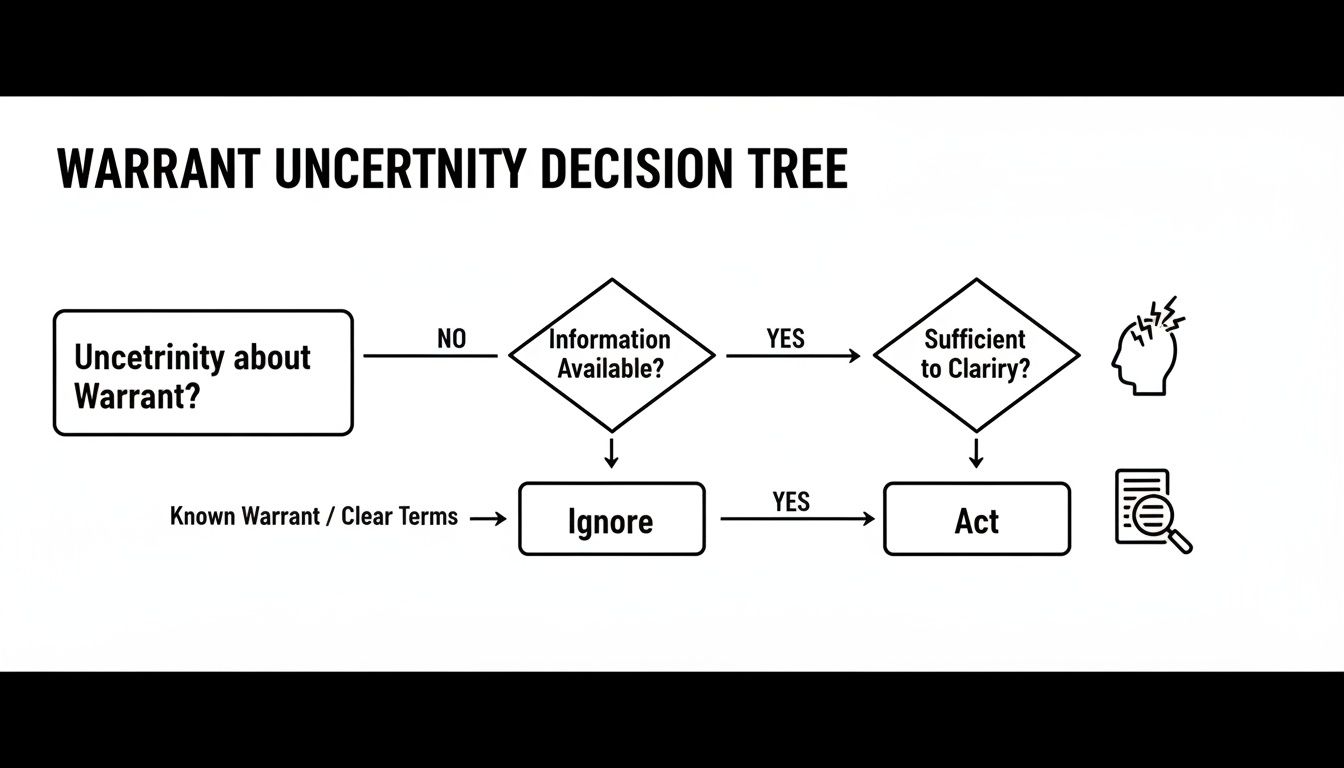
As you can see, ignoring the problem just prolongs the stress. Taking proactive, smart steps is what empowers you to find a resolution and get your life back on track.
Navigating your search for an outstanding warrant involves weighing the benefits and drawbacks of each method. This table breaks down the three primary approaches to help you decide which path is right for your situation.
Comparing Warrant Search Methods in Texas
| Search Method | Pros | Cons / Risks | Best For |
|---|---|---|---|
| Official County Websites | Anonymous, free, accessible 24/7 | Can be hard to navigate; info may be incomplete or confusing | Preliminary, low-risk checks when you have specific case details |
| Calling the County Clerk | Can provide direct, immediate answers | High risk of self-incrimination; an innocent question can be misinterpreted | Not recommended without legal guidance |
| Private Background Checks | Convenient and fast | Information may be outdated or inaccurate; privacy concerns with your data | Quick, informal searches, but results should be verified through official channels |
| Attorney-Led Search | 100% confidential (attorney-client privilege); accurate and discreet; provides immediate legal advice | Requires hiring an attorney | Anyone who needs definitive answers and a strategic plan to address a potential warrant, especially parents in a CPS case. |
Ultimately, while online tools offer a starting point, the safest and most effective method involves professional legal assistance to protect your rights and provide a clear path forward.
Digging Through Official Online County Records
Most of the larger counties in Texas—think Harris, Dallas, Tarrant, and Travis—have online portals where you can search public records. These are usually found on the websites for the county clerk or the local sheriff's office.
The catch is that these systems can be clunky and hard to use. You often need exact information, and even then, the results might be confusing or incomplete. A lot of people worry that searching their own name will somehow flag them to law enforcement, but these public searches are generally anonymous.
Picking Up the Phone and Calling the County Clerk
Another route is to call the county clerk's office directly. While this can sometimes get you a faster answer, it's also loaded with risk. You have to be incredibly careful about what you say.
If you call, never admit to any wrongdoing or give details about what might have led to the warrant. Just state that you're inquiring about a case status for a certain person. Have their full name and date of birth ready. Knowing the basics of how to do legal research can be helpful when you're trying to track down official legal matters on your own.
Crucial Takeaway: Directly talking to court staff or law enforcement without a lawyer is a bad idea. An innocent question can easily be twisted, making your situation much worse. Always frame your questions impersonally and say as little as possible.
The sheer volume of active warrants is a stark reminder of why you can't just ignore this. In a recent year, the U.S. Marshals Service and its partners made 73,323 arrests, clearing tens of thousands of state and local warrants. This shows that warrants don't just fade away; there's constant pressure to enforce them.
What About Those Private Background Check Websites?
You’ve seen the ads—websites promising instant background checks for a few bucks. While they can sometimes turn up a warrant, they come with some serious downsides.
- Accuracy Issues: The data they use might be old or missing key details. They scrape information from public databases, but there's no guarantee those databases are current.
- Privacy Risks: You're handing over your personal information to a third-party company. Who knows how they store, use, or protect it?
- No Context: A private service won't give you any legal advice. It will just spit out a result and leave you to figure out what it means and what to do next.
These services are tempting because they seem easy, but they're often less reliable than official sources and offer zero legal protection. If you want to dive deeper into how these checks actually work, you can learn more about how criminal background checks work.
The Safest Bet: A Confidential Search by an Attorney
Hands down, the most secure and effective way to find out if you have a warrant is to have an attorney do it for you. This approach gives you critical advantages that you can't get anywhere else, especially when dealing with CPS.
First, anything you say to an attorney is protected by attorney-client privilege. That means your conversation is completely confidential and can't be used against you. You can be totally honest about your situation without fear.
Second, a good lawyer knows exactly where to look and how to make sense of what they find. They can navigate the court system quietly and efficiently.
Finally, and most importantly, if a warrant does exist, your attorney is ready to start working on a solution immediately. They can advise you on the best course of action—whether that’s arranging a voluntary surrender or preparing to fight the charge. They turn a moment of discovery into a concrete plan for resolution.
Interpreting Your Search Results: Arrest vs. Bench Warrants
Finding information online or through an attorney is a huge step forward, but the results can feel like reading a foreign language. Seeing your name connected to legal terms like "warrant" is jarring, to say the least. But understanding what those terms mean is the key to taking your power back.
Not all warrants are created equal, and knowing the difference is critical for planning your next move.

The two most common types you'll run into are arrest warrants and bench warrants. While both give law enforcement the authority to take you into custody, they come from very different places and often signal different levels of legal trouble.
Understanding the Arrest Warrant
An arrest warrant is what most people picture when they hear the term. A judge typically issues one at the very beginning of a criminal case after law enforcement presents evidence showing there is probable cause to believe a specific person committed a crime.
Think of it this way: a detective investigates a theft, gathering witness statements and security footage that all point to one suspect. The detective takes this evidence to a judge, who then signs an arrest warrant. This gives the police the green light to find and arrest that individual for the alleged crime.
If your search turns up an arrest warrant, it means you're being formally accused of a new criminal offense. It's a serious matter that kicks off the entire criminal justice process.
The Common Bench Warrant
A bench warrant, on the other hand, is issued directly by a judge (from "the bench") when someone disobeys a court order. It isn't about a new crime; it’s about failing to follow through on a previous legal obligation.
Here’s a scenario that’s all too common for Texas families: A father is working two jobs to make ends meet and forgets about a court date for an old speeding ticket. Life gets in the way, he doesn't show up, and the judge, seeing his failure to appear, issues a bench warrant for his arrest. Simple as that. Now, during a CPS investigation, this forgotten ticket can be framed as a willful disregard for the law, damaging his credibility.
Other common reasons for a bench warrant include:
- Failing to pay a court-ordered fine or restitution.
- Missing a required counseling session or drug test as part of probation.
- Violating the terms of a child support order.
Bench warrants are incredibly common and can pop up over something as minor as a forgotten traffic ticket. While they might seem less severe than an arrest warrant for a new crime, they carry the exact same power—police can and will arrest you. There are also other types of warrants to be aware of; you can learn more about capias warrants and what they mean here.
Key Details to Look For in Your Results
When you or your attorney find a warrant, the fine print matters immensely. You need to zero in on these specific details, as they will shape the entire strategy for getting this resolved:
- Issuing County: This tells you which jurisdiction you have to deal with. A warrant from Harris County requires a completely different approach than one from Dallas County.
- The Underlying Charge: What is the warrant actually for? Is it a misdemeanor failure to appear or a felony assault charge? The severity here dictates the urgency and complexity of the whole situation.
- Bond Amount: Sometimes the warrant will specify a bond amount. This is the amount of money that must be paid to secure your release from jail after an arrest. Knowing this number ahead of time is absolutely crucial for financial planning.
Deciphering these details provides a clear roadmap. It tells you not just that there's a problem, but what the problem is, where it is, and what it might take to start fixing it. This information is the foundation for the plan your attorney will build with you.
What to Do Next If You Have a Warrant
That sinking feeling in your stomach when you confirm there’s a warrant out for your arrest is something you don't forget. Your mind immediately jumps to the worst-case scenarios—getting pulled over for a minor traffic violation and ending up in handcuffs, or worse, having police show up at your job or your child's school.
But right now, the absolute worst thing you can do is ignore it. Hiding won't make it disappear. Instead, a calm, proactive approach can turn this terrifying moment into a manageable legal problem.
First things first: stay calm and don't make any sudden moves. Whatever you do, don't pick up the phone and call the police or the court to "just explain things." Your top priority is getting professional legal help to protect your rights, your freedom, and your family.

Hire an Experienced Family Law and Criminal Defense Attorney Immediately
Before you do anything else, your first call should be to an attorney who understands both criminal and family law. This is not a DIY situation. An experienced Texas attorney can start working on your behalf right away, often before you ever have to see the inside of a courtroom or jail cell.
Here's what a good attorney will do immediately:
- Verify the Warrant: They’ll get all the critical details—which county issued it, the exact charge, and the bond amount.
- Assess the Situation: You'll be able to tell them your side of the story, and everything you say is protected by attorney-client privilege.
- Formulate a Defense Strategy: Based on the facts, they will map out the best way to handle the warrant and the charge behind it, always keeping your CPS case in mind.
Hiring a lawyer is about more than just advice. It’s about having a professional advocate who can start negotiating with the prosecutor to get the warrant lifted, or "quashed." They can begin challenging the evidence and paving the way for a better outcome, putting you back in control.
The moments after discovering a warrant are critical. An attorney can intervene early, potentially preventing an arrest altogether and working to resolve the issue with minimal disruption to your life and family.
Don’t underestimate the urgency. Law enforcement agencies are actively clearing warrants every single day. For instance, in 2025, the U.S. Marshals Service (USMS) arrested a staggering 74,222 fugitives nationwide, clearing nearly 89,000 warrants. With major hubs in Houston, Dallas, Austin, and San Antonio, Texas law enforcement works closely with federal task forces, making an eventual arrest almost inevitable. You can read more about these enforcement statistics and trends.
Arrange a Voluntary Surrender or Walk-Through
One of the most valuable moves your attorney can make is arranging a voluntary surrender, often called a "walk-through." This simple process prevents the trauma and public humiliation of an unexpected arrest. Instead of waiting for the police to knock on your door, you and your lawyer go to the courthouse or jail on your own terms.
Here’s a real-world example: A mom named Maria missed a court date for an old shoplifting charge because her child was sick. A bench warrant was issued. Instead of living in constant fear during her CPS case, she hired a lawyer who immediately got on the phone with the court.
Her attorney scheduled a time for her to come in, had a bail bondsman on standby, and had already spoken with the prosecutor. Maria walked in, was booked, and was released in just a couple of hours. She was never publicly handcuffed, her kids never had to see her arrested, and her CPS caseworker saw that she handled the issue responsibly. This controlled process turned a potential crisis into a resolved matter.
Understand the Role of a Bail Bondsman
If the warrant has a bond amount attached, your attorney will likely connect you with a bail bondsman before you surrender. A bondsman provides a "surety bond," which is essentially a promise to the court that you'll show up for all your future court dates.
You’ll typically pay the bondsman a non-refundable fee—usually around 10% of the total bond amount. By having the bond pre-arranged, the whole release process moves much faster. Your attorney coordinates with the bondsman so that as soon as you’re booked, the bond is posted, and you can be released almost immediately. That synergy between your legal team and the bondsman is key to making this as painless as possible.
How a Warrant Can Derail Your Child Custody or CPS Case
For a Texas parent, finding out you have an outstanding warrant is a nightmare. But the fallout doesn't just stop at the criminal courthouse steps—it can spill directly into your family life, threatening the most important thing you have: your relationship with your children.
An active warrant, no matter how small the original offense, can be weaponized against you in family court.
Imagine you're already in a stressful CPS investigation. The caseworker runs a routine background check and—bam. They find an old bench warrant for something like unpaid traffic tickets or a missed court date you forgot about years ago.
Suddenly, the conversation isn't about your parenting or the steps you're taking to protect your children. It's about this legal mistake. CPS will use it to paint a picture of you as irresponsible, unstable, and someone who flouts the law. That narrative can be absolutely devastating, potentially swaying a judge’s opinion on everything from your visitation rights to the final outcome of your case.
The Damage in CPS Investigations and Court Orders
In a CPS case, an active warrant is more than a red flag; it's often viewed as a direct threat to a child's safety. The court's entire focus is on the child's best interest, as laid out in the Texas Family Code. An unresolved warrant can easily portray you as someone who creates an unstable, or even dangerous, environment.
- Under Chapter 262 of the Texas Family Code, which governs procedures in suits by a governmental entity, a parent's criminal history or outstanding legal issues are heavily scrutinized when determining if a child should be removed from the home.
- In Chapter 263, which deals with the final order for a child under CPS care, a warrant can be a major barrier to reunification, delaying or even preventing your child from coming home.
- If CPS seeks to terminate your parental rights under Chapter 161, an outstanding warrant will be presented as evidence of your inability to provide a safe and stable environment for your child.
A warrant gives CPS and the other side an easy way to attack your character and fitness as a parent. Taking care of it isn't just about clearing your name in criminal court; it’s about defending your fundamental rights as a parent.
Here’s a quick look at the concrete damage a warrant can do:
- Credibility: It completely undermines your credibility with the judge. If you can't be trusted to handle a court matter, will they trust your testimony about your children?
- Custody Evaluations: Any court-appointed evaluator or psychologist will find the warrant and include it in their report, and it will almost always reflect poorly on you.
- Negotiation Power: It tanks your leverage in settlement talks and in meetings with CPS. They know they have a powerful piece of evidence to use against you.
How an Experienced Attorney Can Mitigate the Damage
This is exactly why you need an attorney who is skilled in both criminal defense and Texas family law, particularly CPS defense. Someone who understands how these two worlds collide can take immediate, strategic action to control the narrative.
A good lawyer can work to get the warrant lifted quickly and quietly, often without you ever having to see the inside of a jail cell.
Once the warrant is resolved, your attorney can frame the situation correctly in family court. They can explain it was a minor, resolved administrative oversight, preventing the other side from blowing it up into a character assassination. Protecting your parental rights means proactively shutting down any issue that could be used against you—and an old warrant is a prime target.
Common Questions About Warrants in Texas
When you're staring down the barrel of a potential warrant, the questions can hit you like a flood. The not-knowing is often the worst part, especially when you're worried about how it will affect your kids. Let's clear the air and tackle some of the most common questions we hear from Texas families, so you can get the straightforward answers you need.
Do Warrants Expire in Texas?
This is probably the biggest—and most dangerous—misconception out there. The short answer is no, warrants in Texas generally do not expire.
While the criminal charge itself might have a statute of limitations (a deadline for the state to prosecute), the warrant is a different beast. Once it's issued, it stays active in law enforcement databases indefinitely, waiting to be cleared by a court. That means a routine traffic stop for a broken taillight could land you in handcuffs for a warrant that's five, ten, or even twenty years old. Trying to "wait it out" isn't a strategy; it's just delaying the inevitable.
Can I Be Arrested at the Airport or DMV?
Yes, absolutely. It happens more often than you'd think. Government agencies, from the local DMV to the TSA at the airport, are all plugged into the same state and federal law enforcement networks.
When you go to renew your driver's license or your ID gets scanned at a security checkpoint, the system will instantly flag any active warrants. An everyday errand or a long-planned family vacation can turn into a legal nightmare in the blink of an eye. You can be detained and arrested right there on the spot. For a parent in a CPS case, an arrest like this would be catastrophic.
What Does It Cost to Hire a Lawyer for a Warrant?
The cost to hire an attorney to handle a warrant isn't one-size-fits-all. The final fee really depends on the specifics of your situation, including things like:
- The underlying charge: A warrant for a simple misdemeanor is going to be less complex (and less expensive) to resolve than one for a serious felony.
- The county it's in: Every court has its own way of doing things, which can change the amount of legal legwork needed.
- The complexity of your case: A straightforward warrant for missing a court date is a lot simpler than a case that's going to require a full-blown defense strategy.
While hiring a lawyer comes with an upfront cost, the price of not hiring one is almost always higher. The potential fallout—jail time, losing your job, and doing irreversible damage to a child custody or CPS case—is far more costly than any legal fee.
We know that money is a huge concern for families. That’s why we always offer a free, confidential consultation to go over your specific situation. It gives us a chance to give you a clear, honest picture of the costs involved in fighting to protect your freedom and your family.
Discovering you have a warrant is a serious wake-up call, but it's one you don't have to answer alone. The fear and uncertainty can feel overwhelming, but taking the first step toward resolving it can restore your peace of mind and protect your family. At the Law Office of Bryan Fagan PLLC, our experienced attorneys are here to provide the compassionate guidance and strategic defense you need. We understand what's at stake for you and your children. Contact us today for a free, confidential consultation to discuss your case and build a plan to protect your future.