Skip to content
The phone call from Child Protective Services (CPS) can turn your world upside down. Suddenly, your life, your parenting, and your past are under a microscope. Among the many fears that race through a parent's mind, one of the most immediate is the criminal background check. For Texas families caught in the confusing and often terrifying CPS system, the thought of an old mistake—no matter how long ago—resurfacing to jeopardize their children’s future is a heavy burden.
This isn’t just about a job application; it’s about your ability to keep your family together. A past arrest, even one that was dismissed, can feel like a shadow that threatens to undermine everything you've built. At The Law Office of Bryan Fagan, we understand this fear. Our goal is to replace that anxiety with clear, actionable information about how criminal background checks work within the Texas CPS system, giving you the knowledge to protect your parental rights.
How Background Checks Are Used in a CPS Investigation
When CPS opens an investigation under the Texas Family Code, a criminal background check is one of the first and most critical steps they take. This isn't just a formality; it's a mandated part of their process to assess the safety of a child's environment. The results of these checks can influence every decision CPS makes, from whether to remove a child from the home to what services they require of the parents.
The fear this process creates is palpable. We often work with parents who are terrified that a minor drug charge from their college days or a long-forgotten arrest for a bar fight could be used to paint them as an unfit parent today. Understanding what CPS is looking for and what the law says can help you navigate this stressful process.
To give you a clearer picture, here’s a quick breakdown of how the process usually unfolds within a CPS case.
| Stage | What Happens | Key Takeaway for Texas Parents |
|---|---|---|
| 1. Initial Investigation | CPS investigators run checks on all adults living in the home. This is non-negotiable under Texas Family Code § 261.302. | You will be asked to consent, but they can often obtain the information regardless as part of their child safety mandate. |
| 2. Identity Verification | The screening company verifies your name, date of birth, and Social Security Number to avoid mix-ups. | Ensure all your personal information provided to CPS is accurate to avoid errors. |
| 3. Database Search | CPS uses official databases, including the Texas Department of Public Safety (DPS) and often the FBI fingerprint database. | These are comprehensive checks that will show arrests, deferred adjudications, and convictions from Texas and other states. |
| 4. Report Compilation | All "hits" are gathered into a report, which the CPS caseworker reviews to identify any "red flags" related to child safety. | This is where old, irrelevant charges can be misinterpreted. Context is everything. |
| 5. Safety Plan/Service Plan | Based on the report (and other factors), CPS may require specific services, like counseling or parenting classes, as part of a safety plan. | An old charge may be used to justify services, even if it has no bearing on your current parenting ability. |
| 6. Court Proceedings | If the case goes to court, your criminal history becomes evidence for the judge to consider in hearings, including the 14-Day Adversary Hearing. | This is your chance, with an attorney, to explain your history and show it doesn't impact your child's safety. |
Knowing these steps helps you anticipate what’s coming and prepare to address it with the help of an experienced attorney.
At The Law Office of Bryan Fagan, we believe that your past does not have to define your future as a parent. If you're facing a CPS investigation and are worried about a criminal background check, contact us for a free consultation. Let's build a strategy to protect your family.
The Different Levels of Criminal Background Checks
When you hear the term “background check,” it’s easy to picture a single, all-knowing report that pulls up every mistake you’ve ever made. The reality is a lot more complicated.
Think of it less like a single document and more like peeling an onion—there are several layers, and the depth of the search depends entirely on who is looking and why. Not all checks are created equal. For a Texas parent involved with CPS, understanding that the agency uses the most thorough checks available is crucial.
Some checks are just a quick, surface-level skim, kind of like a quick internet search. Others are incredibly detailed, digging deep into official records like a formal archive request. CPS uses the latter. This process usually involves multiple players, from you to the agency requesting the check and the various databases providing the information.
This flowchart shows how a request typically flows from a company, through a screening service, to different data sources.
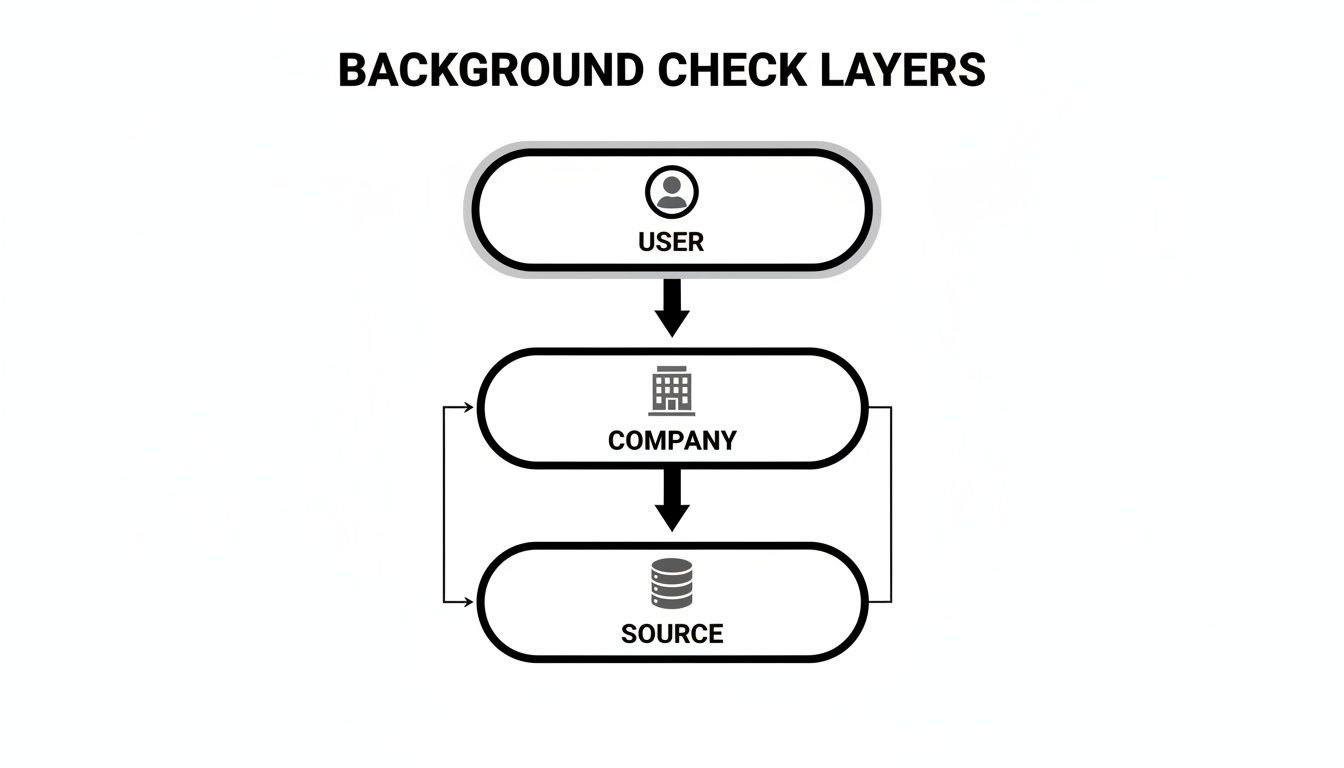
What an employer or landlord ultimately sees is often a compiled report from multiple sources, not just one single file. That’s why information can sometimes be inconsistent or incomplete, depending on which type of check they run.
Common Types of Checks in Texas
In Texas, you're most likely to run into a few specific kinds of background checks, each pulling from different sets of records.
- Commercial/Private Database Checks: These are the go-to for most pre-employment screenings. Private companies build massive databases by scraping public records from thousands of counties. They’re fast and cheap, but they have a major downside: they can contain outdated or flat-out wrong information, like an arrest that was later dismissed but never updated in their system.
- Texas Department of Public Safety (DPS) Check: This is an official, state-level check that searches the Texas Computerized Criminal History (CCH) System. It’s much more reliable for anything that happened in Texas, but it won’t show offenses from other states. CPS will always run this check.
- Local County Court Checks: Sometimes, an employer will skip the databases and request a direct search of court records in a specific county, like Harris County or Dallas County. This is a very targeted search to see exact filings, charges, and case outcomes within that one jurisdiction.
The Deepest Dive: The FBI Check
The most comprehensive background check you can face is the fingerprint-based FBI check. This isn't just a name search; it's tied directly to your unique fingerprints. CPS is required to conduct this type of check on parents, caregivers, and other adults in the home.
This search scours the national Integrated Automated Fingerprint Identification System (IAFIS), a massive database containing criminal history information submitted by law enforcement agencies from every corner of the country.
Because it’s tied to your fingerprints, this check is the gold standard for accuracy and is nearly impossible to dispute. It’s almost always required for jobs involving vulnerable populations—think working with children, the elderly, or in law enforcement and government positions.
For example, a parent hoping to adopt or even just reunify with their child after a CPS removal will be subject to a fingerprint-based FBI check. It's mandated by law to ensure the long-term safety of children.
Understanding this helps you see why CPS screening is so rigorous. If you are worried about how a past mistake might impact your ability to keep your family together, knowing the depth of these checks is the first step toward addressing the issue head-on with a solid legal strategy.
What Information Actually Appears on Your Record
For any Texas parent waiting on the results of a background check, the single biggest question is always the same: "What are they actually going to see?"
It’s a fear that comes from the unknown, from picturing a single, damning report that lays bare every past mistake. The reality, though, is that what shows up depends entirely on the type of check being run and the specific databases it pulls from. Within a CPS case, you should assume they will see everything that has not been legally expunged.
Think of it like learning a new language. A criminal record isn't just about convictions; it’s a story told through arrests, charges, and case outcomes. To a CPS caseworker or a judge, each of those pieces means something different.

Arrests Versus Convictions
This is, without a doubt, the most critical and confusing distinction for Texas families. Here’s the bottom line: an arrest is not a conviction.
You can be arrested based on mere suspicion. A conviction, on the other hand, only happens if you are found guilty in court, plead guilty, or accept a plea of "no contest."
The problem is that many commercial background checks blur this line. An arrest record can stick around long after the case was dismissed or you were found not guilty, painting a completely misleading picture of who you are.
A painful scenario we see all too often involves a parent who was arrested for DWI years ago. The charges were later dropped, but the arrest record itself still pops up on a background check. An employer just sees "DWI Arrest" and might immediately toss their application without ever knowing the case went nowhere. In a CPS case, that same arrest record requires an explanation to show it's not relevant to your parenting today.
This is precisely why you need to know what’s on your own record. It gives you a chance to prepare an explanation and, more importantly, to explore your legal options for cleaning it up for good.
What Shows Up on a Texas Background Check
When an employer or CPS runs a check, they are scanning for specific red flags. Here’s a quick breakdown of what they can typically find:
- Felony Convictions: These are the most serious crimes and will almost certainly show up on any kind of background check. Certain felonies can be grounds for termination of parental rights under Texas Family Code § 161.001.
- Misdemeanor Convictions: Lesser offenses, like petty theft or a first-time DWI, will also appear, especially on more official state-level checks.
- Pending Criminal Cases: If you’ve been charged with a crime but the case is still making its way through the courts, this will be visible on most comprehensive checks.
- Arrest Records: As we discussed, arrests that never led to a conviction can still appear, particularly on the cheaper, private database searches.
- Deferred Adjudication: In Texas, if you successfully complete deferred adjudication, you aren't formally convicted. However, the record of the charge and the deferred status can still be seen by the public unless you get it sealed. CPS will see this.
The technology powering these checks has become incredibly sophisticated. Modern systems can pull and cross-reference data with stunning speed and are only getting better. In fact, one of the top national criminal record databases returned 18 percent more reportable criminal records in 2023 than older systems. As this analysis of modern criminal background checks shows, the net for catching old records is wider than ever.
The Problem with Public Records
At its core, the issue is that arrests and court filings are generally public information. Commercial data miners scrape this data from county websites and other public sources to build their massive databases.
Once they have your information, they often have little incentive to update it when a case is dismissed or resolved in your favor.
This leaves you in a tough spot, where an old, irrelevant, and misleading piece of data can cost you a job or a place to live. In a CPS case, it can cost you time with your children. The good news is that Texas law offers a powerful way to fix this. For many people who successfully complete deferred adjudication or have their cases dismissed, sealing the record through an order of nondisclosure in Texas can hide it from most private employers and landlords.
At The Law Office of Bryan Fagan, we know how a lingering record can hold your family back. A mistake from your past shouldn't get to decide your future. If you’re worried about what might be on your background check, give us a call. We offer a free, compassionate consultation to go over your situation and see what options you have for clearing your record and moving forward with confidence.
Your Rights During a Texas Background Check
Knowing your rights is your strongest shield when you're facing a background check in Texas. It’s easy to feel powerless, like your entire history is being put under a microscope without your say-so. But you are not without protection. Both federal and state laws create a critical safety net, making sure the process is fair, transparent, and respectful.
These laws aren't just bureaucratic red tape; they exist because a background check is a formal investigation that can deeply impact your family's ability to get a job or a home. In a CPS case, it's about protecting your fundamental right to parent. Understanding these rules is the first step toward advocating for yourself.
The Power of Your Consent
First things first: a potential employer or landlord cannot legally run a background check on you without your explicit, written permission. This is a cornerstone of the federal Fair Credit Reporting Act (FCRA), a law that governs how companies called consumer reporting agencies (CRAs) collect and use your personal information.
That consent form isn't just another piece of paper to sign. It’s a legal document that should clearly state that a background report is being requested. Before you put pen to paper, you have every right to know who is running the check and what kind of information they're looking for.
Real-life Scenario: Imagine a single mother applies for an office job and is handed a stack of new-hire paperwork. Buried inside is a vague authorization form. She has every right to pause and ask, "What exactly does this cover?" This small act is a powerful exercise of her rights. In a CPS case, while you may feel you have no choice but to consent, understanding the process is still key.
Understanding the Adverse Action Process
If a company looks at your background check and is thinking about not hiring you because of something they found, they can't just ghost you. The FCRA requires them to follow a strict two-step process known as adverse action.
This process is designed to give you a fighting chance. It ensures you see the report and can correct any mistakes before a final decision is made.
Here’s how it works:
- Pre-Adverse Action Notice: Before making their final call, the employer must give you a copy of the background check they used. They also have to provide a document called "A Summary of Your Rights Under the Fair Credit Reporting Act."
- Time to Respond: This gives you a reasonable amount of time—usually about five business days—to look over the report for errors. You can then contact the employer or the screening company to dispute anything that's inaccurate.
- Final Adverse Action Notice: Only after giving you that opportunity can the employer make their final decision and send you a formal notice. This final notice has to include the name and contact information of the company that provided the report.
This procedure is your most important tool for fighting back against flawed reports that contain misleading or outdated information.
Texas Laws and Local "Ban the Box" Rules
On top of the federal FCRA, Texas has its own specific protections. For instance, in cities like Austin and San Antonio, local "Ban the Box" ordinances change when an employer can ask about your criminal history. These local laws prohibit employers from asking about your record on the initial job application.
The goal here is simple: to make sure you’re judged on your qualifications first, not on a past mistake. The question about your history can only be asked after a conditional job offer has been made, giving you a fair shot to prove you're the right person for the job. While these laws don't apply to CPS, they reflect a broader principle of fairness that a good attorney can argue for in court.
The FCRA creates clear obligations and restrictions for employers using background checks in their hiring process. Think of it as a set of rules they have to play by to ensure fairness.
The table below breaks down the must-dos and the can't-dos for employers under this critical federal law.
Your Rights Under the Fair Credit Reporting Act (FCRA)
| Employer Obligation (What They MUST Do) | Employer Restriction (What They CANNOT Do) |
|---|---|
| Get your written consent before running a check. | Run a background check on you in secret. |
| Provide you a copy of the report if they might take adverse action. | Make a final decision against you without showing you the report first. |
| Give you time to review and dispute the information. | Use information from a report that violates state or federal laws. |
| Follow the full two-step adverse action process. | Refuse to provide the contact information for the CRA they used. |
Ultimately, these rules are in place to protect you. If you believe an employer has violated your rights—by not getting your consent or failing to follow the adverse action process—you have legal recourse. Holding them accountable not only protects you but also helps ensure a fairer system for everyone in Texas.
It's a gut-wrenching feeling, waiting for a background check to come back and hoping some old mistake doesn't wreck your family's future. But you don't have to just sit back and worry. You can take control of your story by getting out ahead of it. The single most powerful first step is finding out exactly what's on your record before any employer or landlord ever sees it.
This move completely flips the script, putting the power back in your hands. It gives you the chance to spot errors, figure out what needs to be addressed, and start looking into legal ways to clean things up. You stop being a passive applicant and become an informed advocate for yourself and your family.

How to Get a Copy of Your Texas Criminal Record
The only way to know for sure what an official background check will dig up is to run one on yourself. The Texas Department of Public Safety (DPS) offers a secure, direct path to review your own Computerized Criminal History (CCH).
Here’s the basic rundown:
- Schedule a Fingerprint Appointment: You'll need to use the official DPS Fingerprint Service to get your prints taken electronically. This is crucial for making sure the record is matched accurately to you and only you.
- Send in Your Request: You'll submit a formal request to the DPS Crime Records Service, which will be paired with your fingerprints.
- Get Your Report: DPS will send you a copy of your CCH. This report details every arrest, charge, and final outcome that law enforcement agencies across Texas have reported.
Go over this report with a fine-tooth comb. You’re looking for any mistakes—big or small. Maybe a dismissed case is still showing up as "pending," or maybe there are records that don't even belong to you. Catching these errors now gives you a fighting chance to get them fixed.
Two Powerful Tools for Clearing Your Name
If you discover arrests or charges on your record that didn't end in a conviction, Texas law gives you two main legal options to clean it up: expunction and an order of nondisclosure. They might sound similar, but they do very different things.
- Expunction: The Complete Erasure. Think of an expunction (or expungement) as the ultimate fresh start. It leads to the physical destruction of all records tied to an arrest. Legally, it's as if the whole thing never even happened. You can lawfully deny the arrest ever occurred on a job application or anywhere else.
- Nondisclosure: Sealing the Record. An order of nondisclosure is different. It doesn't destroy the record; it seals it from the public. While the record still exists and can be seen by law enforcement and certain government agencies (including CPS), it’s hidden from most private employers, landlords, and anyone else running a public background check.
Imagine a parent who was arrested for shoplifting as a teenager, but the charges were ultimately dropped. An expunction would be like running that entire case file through a shredder. A nondisclosure, on the other hand, is like putting the file in a locked cabinet where only a few people with a special key can ever open it.
Which Option Is Right for You?
Whether you qualify for an expunction or a nondisclosure boils down to the nitty-gritty details of your case—specifically, the type of offense and how it was resolved.
You might be eligible for an Expunction if:
- You were arrested but never formally charged with a crime.
- Your case was dismissed by the prosecutor.
- A judge or jury found you "not guilty."
- You successfully finished a pretrial diversion program.
You might be eligible for an Order of Nondisclosure if:
- You successfully completed a deferred adjudication community supervision program for certain misdemeanors or felonies.
Background checks are a massive part of the hiring process these days. In fact, a staggering 93 percent of organizations perform some kind of screening, with criminal record searches being the go-to for North American businesses. With so much riding on the results, making sure your record is as clean as the law allows isn't just a good idea—it's essential. Exploring your eligibility for sealing your criminal records is one of the most important steps you can take.
Taking on this process can feel like a heavy lift, but you don’t have to do it alone. At The Law Office of Bryan Fagan, we know the weight a criminal record carries for Texas families. If you’re ready to take control of your future by cleaning up your past, contact us for a free, confidential consultation. We’re here to help you understand your options and fight for the fresh start you deserve.
When You Should Contact a Defense Attorney
Trying to fix a mistake on a background check or get your record cleared can feel like trying to navigate a maze in the dark. The legal jargon is dense, the deadlines are unforgiving, and the stakes for your family’s future are sky-high. Knowing when to stop going it alone and call in a professional is a critical moment.
The second you discover an error on your background report, or when you realize you might qualify to have your record cleared, that's your cue. It’s time to reach out to an experienced defense attorney who knows the system inside and out. They can slice through the red tape, file the right petitions, and stand up for you in court to fight for the fresh start you deserve.
How an Attorney Provides a Clear Path Forward
A good attorney does far more than just fill out paperwork. They become your personal advocate, your strategic guide, and your translator for a system that often feels designed to work against you.
Think about it this way: a father gets passed over for a promotion because a dismissed assault charge from ten years ago keeps popping up. Without help, he might just accept it as his fate, believing that old mistake will haunt him forever. An attorney, however, can immediately see if he's eligible for an expunction, track down the necessary court documents, and file the petition to have that record totally wiped.
Here’s how an attorney provides that crucial support:
- Disputing Inaccurate Information: They will formally challenge errors on your report with the background check companies, citing your rights under the Fair Credit Reporting Act (FCRA).
- Determining Your Eligibility: They’ll analyze your entire criminal history to figure out the best legal tool for your specific situation—whether that’s an expunction or an order of nondisclosure.
- Navigating the Court Process: They handle all the court filings, hearings, and tough conversations with the prosecutor’s office to get your record sealed or destroyed.
- Advising on Applications: They can give you expert advice on how to answer those tricky application questions about your past honestly, but in a way that doesn’t automatically get you disqualified.
A past mistake does not have to define your family's future. Getting legal guidance is the most powerful step you can take to ensure that it doesn't.
If you’re getting ready to talk to a lawyer, it pays to be prepared. Knowing the right questions to ask a criminal defense lawyer will help you find the best possible advocate for your family.
At The Law Office of Bryan Fagan, we understand the weight of these situations and the deep desire for a second chance. We are here to help you find a clear, effective path forward. Contact us today for a free, confidential consultation to explore your legal options and start reclaiming your future.
Frequently Asked Questions About Texas Background Checks
When you're trying to build a stable life for your family, the last thing you want is a past mistake showing up and slamming the door on an opportunity. If you're like most Texas parents we talk to, you've got questions about how background checks really work. Let's get you some clear, straightforward answers.
How Long Does a Conviction Stay on My Record in Texas?
This is a big one. In Texas, a conviction is permanent—it stays on your public record forever unless you take specific legal action to get it off. Unlike a traffic ticket that might eventually "fall off" your driving record after a few years, criminal convictions don't just disappear with time.
The only way to truly clear a conviction or arrest from your public record is through the courts. Your two main options are an expunction, which completely destroys the record of an arrest, or an order of nondisclosure, which seals the record from public view. Without one of these, that record isn't going anywhere.
Can an Employer Ask About a Dismissed Arrest?
Yes, an employer can ask about a past arrest, but what they can do with that information is limited. Thanks to "Ban the Box" laws in cities like Austin and San Antonio, employers are blocked from asking about your criminal history on the initial job application. This forces them to consider your qualifications first.
Even more importantly, the Fair Credit Reporting Act (FCRA) makes it tricky for employers. It's often illegal for them to decide against hiring you based only on an arrest that didn't lead to a conviction. Doing so can be seen as a discriminatory practice.
What Is the Difference Between Expunction and Nondisclosure?
This is a critical distinction that trips a lot of people up. Think of it this way:
-
An expunction is like hitting the delete button on the entire record. The files are physically destroyed, and you can legally deny the arrest ever even happened. It’s the ultimate fresh start, usually available for arrests that were dismissed, never resulted in charges, or ended in an acquittal.
-
A nondisclosure is more like putting the record into a locked vault. The record still exists for law enforcement and certain government licensing agencies, but it's sealed off from the general public—including most employers and landlords. For almost all practical purposes, like applying for a job or renting an apartment, it's as if the record doesn't exist.
Do Landlords Run Background Checks on Tenants?
Absolutely. It’s standard practice for most professionally managed properties in Texas. Landlords and property managers use these checks as a key part of their screening process to evaluate potential risks.
If you're curious about what this looks like from their side of the table, this resource explains in detail how property managers screen potential tenants and what kind of information they're looking for.
A past mistake shouldn't be a life sentence that holds your family back from a better future. If you're worried about what a background check might turn up, or if you know an old record is keeping you from moving forward, you have options.
The experienced attorneys at The Law Office of Bryan Fagan, PLLC are here to provide the compassionate and strategic guidance you need. Contact us today at https://texascpslawyer.net for a free, confidential consultation to discuss clearing your record and securing the future your family deserves.