Skip to content
That notice in the mail feels like a gut punch. Your driver's license is suspended. Suddenly, the simple act of driving to work, grabbing groceries, or picking up your kids from school feels like an impossible task. If you're a parent already dealing with the stress and fear of a CPS investigation, this can feel like the final straw, a moment of pure panic. How are you supposed to keep your job, get your kids where they need to go, and hold your family together? It’s an overwhelming moment, but a suspension doesn't have to be the end of the road.
In Texas, you have an option: an occupational license, sometimes called a hardship or essential need license.
This isn't just about paperwork; it's a practical guide to getting your life back on track during one of its most challenging chapters. We understand the fear you're feeling. This guide will walk you through the legal steps, one by one, with compassion and clarity.
The Real-World Impact of Licensing Rules in Texas
Getting and keeping a license in Texas can be a real challenge. In fact, our state ranks among the highest for heavy occupational licensing burdens. These complex rules have led to more than 140,000 lost jobs and a staggering $431.5 million hit to our state's annual economic output. For families already navigating the legal system, these hurdles can feel insurmountable.
This infographic breaks down how over-licensing creates a tough cycle, leading to job loss and putting a real strain on Texas families.
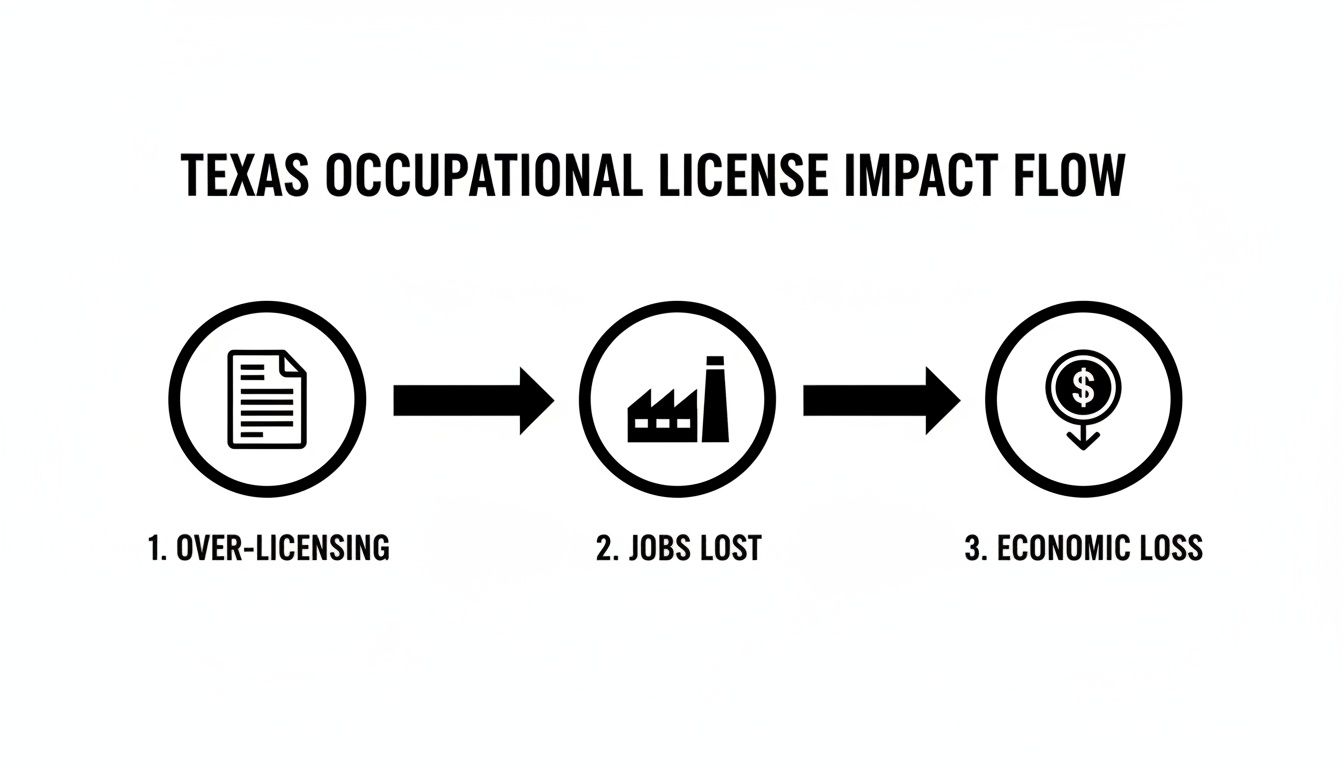
As you can see, these aren’t just abstract numbers. Burdensome requirements turn a simple mistake into a potential catastrophe for hardworking people.
Why an Occupational License Is a Lifeline
Think of an occupational license as a bridge—it connects the reality of a license suspension with your ability to keep your life stable. Without it, you’re stuck between a rock and a hard place: either risk more legal trouble by driving with an invalid license or risk losing your job. The consequences of driving illegally can be severe, digging you into an even deeper hole, especially when you're trying to show stability for your family.
An occupational license allows you to continue fulfilling your most critical responsibilities—for your job, your education, and your family—while navigating the legal system. It is a tool for maintaining stability during an unstable time.
Getting this license requires careful attention to detail, from filing the right petition with the court to clearly explaining your situation to a judge. Understanding the process is the first step toward regaining control. It shows the court you're taking this seriously and trying to do the right thing for your children and your future.
The attorneys at The Law Office of Bryan Fagan understand what’s at stake. We know this is more than just a legal procedure; it’s about your ability to provide for the people who depend on you. If you're facing a license suspension, you don’t have to figure this out alone. Contact us today for a free consultation to talk about your options and start moving forward.
Before you start pulling together paperwork or paying filing fees, the very first move is to make sure you actually qualify for a Texas occupational license. Think of this as the critical first step—getting it wrong means wasting time and money on a petition that’s doomed from the start. The court isn't just handing these out; they need to see a real, provable need, not just a matter of convenience.

Proving Your Essential Need to Drive
In Texas, the whole process hinges on proving you have an "essential need" to drive. This isn't just a casual term; it's a legal standard. It means you have to show that without a license, you genuinely can't perform the tasks necessary to run your household, keep your job, or stay in school.
Consider Maria, a single mother involved in a CPS case. Her license was suspended, but her reunification plan required her to attend parenting classes twice a week across town, take her son to therapy appointments, and maintain her job as a home health aide. Public transport was unreliable and didn't reach her patients' homes or the required service locations. This is a textbook example of an essential need, directly tied to her ability to comply with court orders and care for her child.
So what counts in the eyes of the court?
- Getting to and from work. This is the big one. If you can't get to your job, you can't provide for your family.
- Driving as part of your job. Like Maria, maybe you're in sales or a trade that requires you to be mobile all day.
- Attending school or vocational classes. The court recognizes the importance of education and self-improvement.
- Handling essential household duties. This is a broad but important category. It covers things like taking kids to school or daycare, getting to doctor’s appointments, and buying groceries. For parents in CPS cases, this includes attending court-ordered services, therapy, and visitations.
Be prepared to be specific. A judge needs to see the real-world impact. Vague statements won't cut it.
Understanding Waiting Periods and Disqualifications
Now, here’s where a lot of people get tripped up. Not everyone can apply for an occupational license the day after their suspension starts. Texas law imposes mandatory waiting periods for certain offenses, and these are non-negotiable.
For instance, if your license was suspended for a first-time DWI after refusing a breathalyzer, you could be facing a 180-day hard suspension—a period where you can't drive at all, no exceptions. On the other hand, a suspension for something like unpaid surcharges might have no waiting period. The details of your specific suspension are everything.
Don't just assume you can file right away. The reason for your suspension directly dictates when you’re eligible to even ask the court for help.
On top of that, some situations will disqualify you completely. You generally won't get an occupational license if:
- Your suspension involves a commercial driver's license (CDL).
- The suspension is due to a physical or mental disability that makes driving unsafe.
- A judge believes that letting you drive, even in a limited capacity, poses a threat to public safety.
Knowing these rules from the get-go is key. If your suspension is tied to a criminal case, the sentence itself will lay out what you can and can't do. For example, the terms of probation can heavily influence your eligibility; you can learn more about how probation works in Texas to see how different conditions might apply.
Once you’ve confirmed you meet the essential need requirement and have cleared any mandatory waiting period, you can move forward with confidence. Taking this first step seriously shows the court you respect the process, which is exactly the right foot to start on.
Alright, you've confirmed you're eligible for an occupational license. Now it's time to roll up your sleeves and get to work. This is the hands-on part—gathering all the required paperwork and formally asking the court to let you drive again. It can feel like a mountain of documents, but if you tackle it one piece at a time, it's completely manageable.
I’ve seen clients get overwhelmed at this stage, but the ones who succeed are methodical. Think of it like building a case for yourself. The more organized and thorough you are, the more seriously the court will take your request. This isn't just about filling out forms; it's about showing the judge you're responsible and truly need this license.
First Things First: Find the Right Courthouse
Before you can file anything, you have to know where to go. In Texas, you'll file your Petition for an Occupational Driver’s License in either the county where you live or the county where your license was originally suspended.
But which court? It could be a Justice, County, or District Court, and this is a critical detail. The right court depends on the original offense that led to your suspension.
For instance, a suspension stemming from a Class C misdemeanor will likely land you in a Justice of the Peace (JP) court. For more serious situations, like a DWI, you'll probably need to file in the County Court or District Court where that criminal case is being handled. Filing in the wrong court is a surprisingly common mistake, and it's a frustrating one—it can get your case thrown out, forcing you to start the entire process over from scratch.
Getting Your Paperwork in Order
Getting your documents right the first time is non-negotiable. The court won't even look at your request without the complete, correct paperwork. Being meticulous here not only prevents delays but also signals to the court that you respect the process.
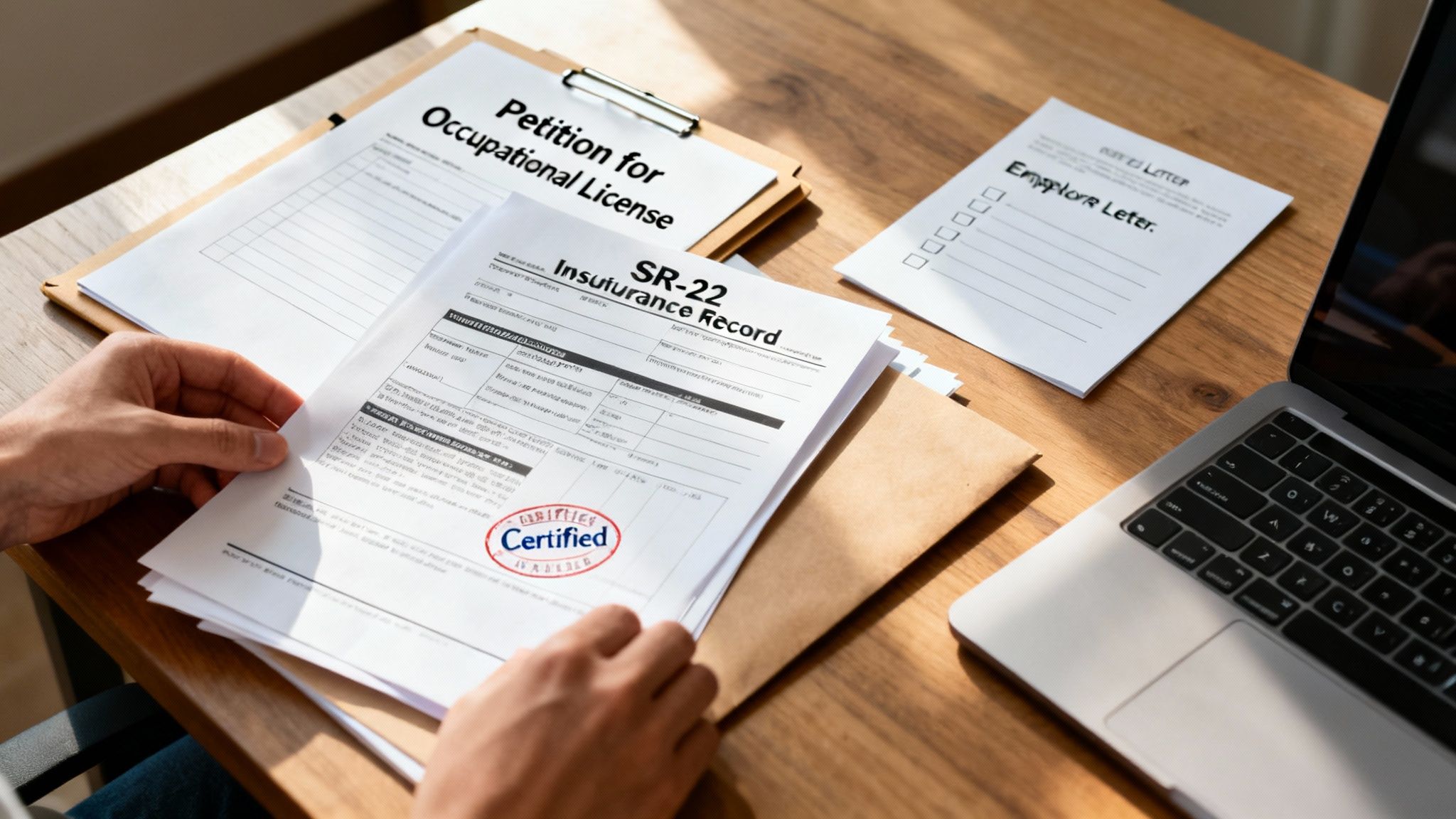
Below is a checklist of the core documents you'll need to pull together before you can file your petition. Use this to make sure you have everything ready to go.
Required Documents Checklist for Your Occupational License Petition
Use this checklist to ensure you have all the necessary documents prepared before filing your petition with the court.
| Document | What It Is | Where to Get It | Pro Tip |
|---|---|---|---|
| A Verified Petition | The formal legal document stating your case. It must be sworn to under oath. | You or your attorney will draft this. | This is your chance to tell your story. Be specific about your "essential need" and the exact hours and counties you need to drive in. |
| SR-22 Insurance Certificate | A certificate from your auto insurance company proving you have state-required liability coverage. | Contact your auto insurance provider and request an SR-22 filing. | This isn't standard insurance. It's a specific form for high-risk drivers, so be sure to ask for an "SR-22" by name. |
| Certified Driving Record | Your official driving history from the state. | Request your "Type AR" (Abstract Record) from the Texas Department of Public Safety (DPS). | The judge will be looking at your entire history, so it's good for you to know exactly what's on there before you go to court. |
| Letter from Your Employer | A letter on company letterhead confirming your job, schedule, and need to drive for work. | Ask your direct supervisor or HR department for this letter. | This is incredibly persuasive if your job is the main reason you need the license. It provides crucial third-party validation. |
The petition isn't just another form—it's your story. It’s where you connect the dots for the judge, explaining precisely why driving is an absolute necessity for you and your family, not just a convenience.
While most court business is handled in person or online these days, you might be surprised to find some official bodies still require submissions by fax. If you run into this, knowing how to fax documents online can be a handy, unexpected skill.
The process for an occupational license is just one example of Texas's complex regulatory environment. Agencies like the Texas Department of Licensing and Regulation (TDLR) manage licensing for dozens of professions, often involving applications, background checks (which can include a $38.25 fingerprinting fee), and exams. These hurdles can be tough, especially for people trying to get back on their feet. While there have been some reforms, as detailed by the Archbridge Institute's research on licensing challenges, many barriers still exist.
Filing the Petition and Paying the Fees
Once your document package is complete, you're ready to file it with the clerk of the correct court. This action officially kicks off your case. Be prepared to pay a filing fee, which usually runs between $250 and $350, though it can vary by county and court.
After you file, the clerk will give you a case number and set a hearing date. That hearing is your day in court—your chance to make your case directly to the judge. The whole experience can be intimidating if you've never done it before. To get a feel for general courtroom procedures, you might find it helpful to read our guide on what happens at an arraignment hearing. Being prepared is your best tool for success.
Navigating Your Court Hearing with Confidence
Filing the petition is a huge step, but the real test comes in the courtroom. This is your chance to stand before a judge and personally explain why you need to drive. It's totally normal to feel a bit on edge, but with the right preparation, you can walk in there feeling ready and composed.
This isn’t about putting on a show or arguing like a lawyer on TV. It's simply about having a clear, honest conversation. The judge just wants to understand your situation and make sure that giving you an occupational license is both essential for you and safe for everyone else on the road.
Making Your Case for an "Essential Need"
The entire hearing boils down to one critical concept: "essential need." Your job is to show the judge, clearly and convincingly, that driving is a true necessity for you—not just a convenience. This is where you connect the dots, explaining how your ability to drive is directly tied to your job, your education, or your family's basic well-being.
Take John, for example. He was a construction worker who hated public speaking and was terrified of talking to a judge. He was worried he’d just freeze up. So, before his hearing, he sat down and wrote out the three biggest reasons he had to drive: the list of different job sites he had to get to each week, his son’s specialized therapy appointments across town, and his elderly mom’s weekly grocery run.
By thinking through his points beforehand and just speaking from the heart, he calmly laid out his situation. He didn't make excuses or get overly emotional; he just gave the judge the facts of his life. That simple honesty and preparation worked. The judge granted his petition.
What to Expect Inside the Courtroom
Courtrooms can be intimidating places, but knowing who’s going to be there and what they do can take a lot of the anxiety away. For most occupational license hearings, the room will be pretty empty. It’s usually just:
- You (the petitioner)
- Your attorney (if you hired one)
- The judge
- A court clerk or bailiff
In some situations, a prosecutor for the state might show up to either agree with your petition or object to it. This is more common if your license was suspended for a serious offense like a DWI.
The judge will have your petition in front of them and will likely ask you some direct questions. They’re just trying to confirm the information you provided and get a clearer picture of your circumstances.
The judge needs to understand the practical, real-world consequences if you can’t drive. Be ready to talk about your work schedule, your family's needs, and why public transportation or rideshares just aren't a realistic solution for you.
Presenting Yourself Professionally
First impressions matter, especially in court. How you present yourself shows the judge you're taking this whole process seriously. You don’t need to go out and buy a three-piece suit, but your clothes and your attitude send a message.
Here are a few simple tips to make sure it's a good one:
- Dress the Part: Think business-casual. No graphic tees, shorts, hats, or flip-flops. Treat it like you're going to an important job interview.
- Show Up Early: Nothing says "I don't care" like being late. Arriving at least 15-20 minutes early shows respect for the judge and gives you a moment to get your head straight.
- Know the Etiquette: You’ll be asked to stand when the judge enters the room. Always address the judge as "Your Honor." Speak clearly, be respectful, and never, ever interrupt them.
- Be Honest and Direct: Stick to the facts. Answer every question truthfully, without exaggerating. If you don't know the answer, it’s much better to say so than to guess. Your credibility is everything.
Getting through your court hearing successfully is all about being prepared, respectful, and honest. If you focus on explaining your essential need and present yourself like you take it seriously, you’ll have the best possible shot at walking out of that courtroom with a signed order—your ticket to getting back on the road and back to your life.
Knowing When to Hire a Criminal Defense Attorney
While some people manage to get through the occupational license process on their own, plenty of situations have hidden tripwires that can derail a petition fast. Knowing when you can handle it yourself versus when to bring in a professional is a critical decision. Hiring an attorney isn't admitting defeat; it's a strategic move to protect your family's stability when the stakes are this high.

If your license was suspended for something straightforward, like unpaid surcharges, and you have a clean driving record, a DIY approach might be perfectly fine. But the moment complications pop up, the balance shifts dramatically. An experienced attorney can be the difference between getting a quick approval and facing a frustrating denial that leaves you stranded.
Red Flags That Signal You Need an Attorney
Certain factors crank up the difficulty level of getting an occupational license approved. If any of the following sound like your situation, it's a strong sign you need professional legal help. An attorney knows the specific arguments and evidence needed to overcome these exact hurdles.
Consider these scenarios serious red flags:
- Your suspension is tied to a DWI or another serious criminal conviction. These cases get far more scrutiny from judges and prosecutors.
- You have multiple prior suspensions on your record. A pattern of suspensions can make a judge very hesitant to grant another chance without a compelling legal argument.
- The State prosecutor is planning to oppose your petition. If you find out the State will be arguing against you in court, going in alone is incredibly risky.
- Your case involves a breathalyzer refusal or a felony charge. These situations often come with mandatory "hard suspension" periods and complex legal requirements you must navigate perfectly.
Think about a father facing a second DWI charge while also trying to comply with a CPS safety plan to keep his children. He needs to drive for his contracting job to support his family and get to his required services, but the prosecutor is actively fighting his petition for an occupational license, arguing he's a public safety risk. Without an attorney to present a strong, evidence-based case for his essential need and the steps he's taking toward rehabilitation, his chances are slim to none.
The Strategic Advantage of Legal Counsel
An experienced criminal defense attorney does a lot more than just fill out paperwork. They bring a deep understanding of local court procedures, including the specific preferences and unwritten rules of the judges in your county. That kind of insider knowledge is priceless.
A good lawyer can anticipate the prosecutor's objections before they're even made and prepare solid counterarguments. They know how to craft a petition that tells a persuasive story, backed by the right documentation—like letters from an employer, proof of enrollment in required programs, and a detailed driving log—to put the judge at ease.
A good attorney doesn't just represent you; they build a comprehensive legal strategy designed to overcome the specific obstacles in your case. They advocate for you when you may not know how to advocate for yourself.
On top of that, they can negotiate directly with the prosecutor's office. Sometimes, an agreement can be reached before the hearing even begins, smoothing the path to approval. This level of advocacy is something you simply can't replicate on your own. When trying to figure out if you should hire someone, and who, it helps to consider the general principles on how to choose a qualified attorney to make sure you get the right legal support.
Don't Risk Your Family's Future
The ability to drive is often directly tied to your ability to provide. Losing it can create a ripple effect, impacting your job, your housing, and your kids' well-being. When you're facing a complex suspension, trying to save a little money by not hiring an attorney can be a devastatingly costly mistake in the long run.
The compassionate attorneys at The Law Office of Bryan Fagan understand what’s on the line. We know this isn't just about a license; it’s about keeping your life from falling apart. If you're facing a complicated license suspension and feel in over your head, don't leave the outcome to chance. Contact us for a free, confidential consultation to talk about your case.
Answering Your Top Questions About Texas Occupational Licenses
When you're trying to get an occupational license, a lot of specific questions pop up. It makes sense—the details really matter, and getting clear answers can take a lot of the stress out of the process. I've put together some of the most common questions my clients ask to give you the straightforward information you're looking for.
How Long Does It Take to Get an Occupational License in Texas?
Honestly, the timeline can vary quite a bit. A lot depends on which county you're in and just how backed up the court's schedule is. Once you file your petition, you can typically expect to wait anywhere from a few days to a few weeks to get a hearing date on the calendar.
The good news? If the judge grants your request, you can legally drive with that signed court order the moment you walk out of the courthouse. You're not quite done, though. You still have to send that order over to the Texas Department of Public Safety (DPS) and pay up on all the required reinstatement fees.
All in all, most people find the entire process takes between 2 to 6 weeks from start to finish.
What Are the Restrictions on an Occupational License?
It's absolutely critical to understand that this isn't a regular driver's license. A judge will place very specific restrictions on your driving, limiting you to only what is absolutely essential for your life to function.
Think of it this way—you're being given a very limited, conditional privilege. The restrictions typically include:
- Purpose: Your driving is strictly limited to work, school, and essential household duties. This means things like doctor's appointments, picking up prescriptions, or going to the grocery store. For parents involved with CPS, this also includes driving to court-ordered services, therapy sessions, and supervised visitations.
- Time: You'll likely be limited to driving a maximum of four hours per day. However, this can be extended up to 12 hours if you can show the judge a genuine, documented need for it.
- Location: The court order will spell out the exact counties where you are allowed to drive. No road trips outside that zone.
- Logbook: You will have to keep a detailed logbook of every single trip you take. You’ll need to note your starting point, your destination, and the specific reason for the drive.
Violating any of these rules is a huge deal. It can lead to new criminal charges and a much, much longer license suspension.
An occupational license is a privilege granted by the court, and following its rules perfectly is non-negotiable. Think of it as a strict agreement you've made with the judge—one you must honor to keep your driving privileges.
Can I Get an Occupational License for a Commercial Vehicle?
The short answer is no. Texas law is crystal clear on this point: an occupational license cannot be issued for the purpose of operating a commercial motor vehicle (CMV).
Even if your suspension is tied to your Commercial Driver's License (CDL), the occupational license will only permit you to operate a regular, non-commercial passenger car or truck for your essential needs.
How Much Does an Occupational License Cost in Total?
The total cost is really a mix of several different fees. You'll need to budget for court filing fees, which usually run somewhere between $250 to $350.
On top of that, you will also need to pay for an SR-22 insurance certificate, your official driving record from DPS, and any license reinstatement fees you owe the state. The biggest variable, of course, is often the attorney fees, which will depend on the complexity and specifics of your case.
When your ability to provide for your family is on the line, navigating the legal system can feel isolating and terrifying. You don't have to face it alone. The attorneys at the Law Office of Bryan Fagan PLLC have helped countless Texas parents regain their ability to drive legally, comply with court orders, and keep their lives on track. If you are facing a license suspension and are overwhelmed by what it means for your family and your CPS case, contact us today for a free, no-obligation consultation. We are here to listen and to help.