Skip to content
The moment you learn you are under investigation for intoxication manslaughter in Texas is a moment of pure, paralyzing fear. It’s a charge that means a tragic accident has occurred, a life has been lost, and now your own life and future hang in the balance. The confusion, grief, and terror can feel overwhelming, especially when you think about your family and what this accusation could mean for them. But an accusation is not a conviction. The first, most critical step is to understand the legal road ahead and know that you do not have to face this alone.
Navigating the Moments After a Fatal Accident and Arrest

The aftermath of a fatal crash is a blur of shock, fear, and profound confusion. When an arrest for intoxication manslaughter follows, that fear can feel paralyzing. One moment you're at the scene of a tragedy, the next you're being pulled into a complex legal system where your entire future hangs in the balance. This guide is here to walk you through what to expect, helping replace panic with the clarity and actionable advice you need to protect yourself and your family.
Understanding the Charge Itself
Under Texas Penal Code § 49.08, the state defines intoxication manslaughter in a very specific way. To convict you, prosecutors have to prove every one of these elements beyond a reasonable doubt:
- You were operating a vehicle: This means you were driving or had actual physical control of a car, boat, or another type of motor vehicle.
- You were intoxicated: The state must show you either lost the normal use of your mental or physical faculties due to alcohol or drugs, or your Blood Alcohol Concentration (BAC) was 0.08 or higher.
- You caused a death: The prosecution must prove a direct causal link—that your intoxication was the reason the accident happened and someone died.
As a second-degree felony, a conviction carries a potential prison sentence of 2 to 20 years and a fine of up to $10,000. It's a charge that changes lives forever, making immediate, experienced legal guidance absolutely essential. If you want to learn more about the initial steps after any DWI-related arrest, you can find a breakdown in our detailed guide about what happens after a DWI arrest.
A Relatable but Terrifying Scenario
Imagine this: you're driving your family home after a celebratory dinner. You had a couple of glasses of wine over several hours and feel perfectly fine, but out of nowhere, another car speeds through a stop sign and slams into you. The other driver is tragically killed.
When the police arrive, they smell the wine on your breath. A breathalyzer test shows your BAC is just over the legal limit.
Even though the other driver was clearly at fault, you are arrested and charged with intoxication manslaughter. In that terrifying moment, your world turns upside down. You are no longer just a person involved in a tragic accident; you are now a defendant facing decades in prison, separated from your family. This scenario highlights a crucial point: an arrest is just the beginning. The legal process that follows will involve several critical steps, including the detailed phase of discovery in litigation, where both sides are required to exchange all of their evidence.
Your story deserves to be heard, and the facts must be scrutinized. A skilled attorney will challenge every piece of the prosecution's case, from the legality of the initial stop to the actual cause of the accident itself.
How Prosecutors Build Their Case Against You

When the State of Texas charges you with intoxication manslaughter, they shoulder the entire burden of proof. To secure a conviction, the prosecutor has to build a case that proves every single element of the crime beyond a reasonable doubt. This is no small feat; it requires them to meticulously connect your actions to a tragic outcome.
Think of the prosecution's case like a three-legged stool. If a skilled defense attorney can knock out just one of those legs, the whole case falls apart. Understanding these core components is the very first step toward building a defense that protects your future and your family.
The Three Pillars of the Prosecution’s Case
For a jury to convict someone of intoxication manslaughter in Texas, the prosecutor must prove three things:
- Operation: That you were actually operating a motor vehicle, aircraft, or watercraft in a public place. This is usually the easiest part for the state to prove.
- Intoxication: That you were legally intoxicated while you were operating it. This is a critical point and often where the legal battle begins.
- Causation: That your intoxication directly caused the death. This is often the most difficult element for the state to prove and where many strong defenses are built.
Let's break down what each of these means in a real-world scenario.
Proving Intoxication Beyond a Number
A lot of people think intoxication is just about hitting a certain number on a breathalyzer. While a BAC of 0.08 or higher does create a legal presumption of intoxication, Texas law defines it more broadly. A prosecutor can still argue you were intoxicated—even with a lower BAC—if they can show you lost the "normal use of mental or physical faculties."
This is why police reports are filled with detailed observations about things like slurred speech, unsteadiness on your feet, or how you performed on field sobriety tests. In an intoxication manslaughter case, the prosecution leans heavily on scientific evidence from blood or breath tests. Experts in the field can help in understanding a toxicology report after an autopsy, which often becomes a cornerstone of the state's argument.
An arrest for intoxication manslaughter is not the end of the road. It is the beginning of a legal fight where every piece of evidence must be challenged, from the officer's initial observations to the complex science behind blood tests.
It's also crucial to remember your rights when it comes to chemical testing. While refusing a test comes with its own set of consequences, it’s a significant decision. You can learn more about this in our article exploring whether you can refuse a breathalyzer test.
The Crucial Element of Causation
The most fiercely contested battleground in an intoxication manslaughter case is almost always causation. The prosecutor can't just show that you were intoxicated and that a fatal accident happened. They have to prove, beyond a reasonable doubt, that your intoxication was the direct cause of the crash that led to the death.
Imagine this: A driver is heading home after having a few drinks and has a BAC of 0.09. Suddenly, another car blows through a red light at high speed and slams into them, killing the other driver.
In this situation, the prosecution can prove operation and intoxication. But a skilled defense attorney would argue that the cause of this tragedy wasn't the driver's intoxication—it was the other driver's incredibly reckless act of running a red light. The accident would have happened no matter what. By bringing in accident reconstruction experts and other evidence, a defense team can create that all-important reasonable doubt about causation, which is the key to fighting the charge.
The Staggering Penalties and Lifelong Consequences

Make no mistake: a conviction for intoxication manslaughter in Texas brings penalties that don't just change your life—they can shatter it. The consequences go far beyond a courtroom sentence, reshaping your future in ways that are hard to imagine until you're facing them head-on.
It's absolutely critical to have a clear-eyed view of what’s truly at stake. We're not just talking about prison time; we're talking about a permanent mark on your record that impacts your family, your career, and your freedom for the rest of your life. This is one of the most serious charges you can face, and it demands an aggressive, strategic legal defense from day one.
The Standard Punishment in Texas
Under Texas law, intoxication manslaughter is classified as a second-degree felony. That designation comes with a heavy price. If convicted, you're looking at a prison sentence ranging from 2 to 20 years in a Texas state prison. On top of that, the court can impose a fine of up to $10,000.
But the punishment doesn't stop there. A conviction also carries a mandatory community service requirement of between 240 and 800 hours. These aren't just abstract numbers; they represent years lost, opportunities vanished, and a future dictated by the criminal justice system. A felony of this magnitude is a life-altering event, and you can learn more about what a DWI felony in Texas truly means for your future here.
When Penalties Get Even Harsher
Some situations can dramatically raise the stakes, elevating the charge to a first-degree felony. This happens if the person who died was a first responder on official duty.
This includes public servants like:
- Police officers
- Firefighters
- Emergency medical services (EMS) personnel
If the charge is enhanced to a first-degree felony, the punishment skyrockets. The potential prison sentence becomes 5 to 99 years, or even life. This enhancement reflects the state's commitment to protecting public servants and shows just how quickly the potential consequences can escalate.
A felony conviction is more than just a sentence; it's a permanent brand that follows you long after any prison time is served. It slams doors to employment, housing, and even basic civil rights, creating a lifetime of obstacles.
The Lifelong Collateral Consequences
The real punishment of an intoxication manslaughter conviction often begins after a person's sentence is served. A permanent felony record unleashes a cascade of devastating collateral consequences that can haunt you for a lifetime. These are the hidden penalties that can make rebuilding your life and supporting your family feel nearly impossible.
Some of the most common long-term consequences include:
- Loss of Professional Licenses: Careers in fields like nursing, teaching, law, and real estate are often impossible with a felony on your record. State licensing boards can deny or revoke your credentials.
- Loss of Civil Rights: In Texas, a convicted felon loses the right to vote while incarcerated and on parole. You also permanently lose your right to own or possess a firearm.
- Employment and Housing Barriers: The vast majority of employers and landlords conduct background checks. A felony conviction can make it incredibly difficult to find a stable job or a safe place to live.
Taken together, these consequences create a punishing future where supporting yourself and your family becomes a daily struggle. Understanding this full spectrum of penalties is the first step in realizing why fighting this charge with an experienced legal team isn't just an option—it's a necessity.
An intoxication manslaughter charge in Texas feels like the world is ending. The sheer weight of the accusation, compounded by the tragic loss of life, can make it seem like a conviction is a foregone conclusion. But I need you to understand something critical: an accusation is not a guilty verdict. A strategic, aggressive defense can and will challenge every single piece of the state's case, protecting your rights and your future at every single turn.
The defense begins the second you hire an experienced attorney. The first thing we do is put every detail of your case under a microscope, starting with the moment the blue and red lights flashed in your rearview mirror.
Was the traffic stop even legal? An officer can't just pull you over on a hunch. They need a concrete, articulable reason—a traffic violation, erratic driving—to justify the stop. If they can't provide one, any evidence they gathered after that moment could be thrown out by the court. It's often the first domino to fall.
Putting the State's Evidence on Trial
After dissecting the initial stop, a strong defense team pivots to the scientific and procedural evidence the prosecution is banking on. This is where many of these cases are won or lost. The state’s evidence is far from perfect and is frequently vulnerable to attack.
We zero in on common weak points, including:
- Field Sobriety Tests: Were these tests administered by the book, following standardized national procedures? Did the officer account for things like uneven pavement, bad lighting, or even the weather? These details matter.
- Breath and Blood Tests: Was the breathalyzer machine recently and properly calibrated? Was the blood drawn by a qualified professional in a sterile setting? A single mistake can compromise the results.
- Chain of Custody: Can the prosecution prove, without a doubt, where that blood or breath sample was every second from collection to analysis? Any gap or sloppy handling can destroy the integrity of the evidence.
A single procedural error is sometimes all it takes to get a crucial piece of evidence ruled inadmissible. Without a valid BAC reading, the state's case gets a whole lot weaker.
Dismantling the Causation Argument
Perhaps the most powerful defense strategy in an intoxication manslaughter in Texas case is to directly attack the element of causation. You have to remember, the prosecutor can't just prove you were intoxicated and that a fatal accident happened. They must prove that your intoxication was the direct cause of the death. The link has to be unbreakable.
The heart of a powerful defense is creating reasonable doubt. If we can show that the accident would have happened even if the driver was completely sober, the state cannot prove causation—and their entire case can unravel.
This is where expert witnesses become absolutely essential. A skilled defense lawyer will bring in accident reconstruction experts who can analyze the crash scene, vehicle damage, and other physical evidence to piece together the real story of what happened.
Picture this: a driver is just over the legal limit but is driving safely through a green light. Suddenly, another driver—speeding and texting—blows through their red light and causes a fatal collision.
In a situation like that, an accident reconstructionist can use data from the vehicles' "black boxes," traffic camera footage, and the laws of physics to prove the other driver's reckless actions were the sole cause of the tragedy. They can demonstrate that even a stone-cold sober driver would have been powerless to avoid the crash. By proving an independent cause, the defense severs the critical link between the intoxication and the tragic outcome. Factors like treacherous road conditions, a sudden vehicle malfunction, or the other driver's negligence are all powerful tools for dismantling the prosecution's argument on causation.
Why Are These Cases Prosecuted So Aggressively in Texas?
To truly grasp why an intoxication manslaughter charge is pursued with such force, you have to understand the environment your case is walking into. Texas prosecutors aren't just looking at an isolated legal file; they're responding to a full-blown public safety crisis that ends lives with shocking regularity. The heartbreaking statistics behind these tragedies create immense public and political pressure to land convictions and hand down severe penalties.
This aggressive stance is born from a grim reality: Texas has tragically become a national hotspot for drunk and drugged driving fatalities. The numbers paint a dark picture of why district attorneys' offices across the state treat these cases with maximum seriousness. This isn't just about legal theory; it's about a community-wide cry for accountability in the face of so much loss.
The Human Cost Behind the Statistics
These numbers are far more than just data points. Each one represents a family ripped apart by a completely preventable event. Over a recent ten-year period, Texas saw an astounding 14,389 fatalities where alcohol or drugs were a factor. That's one person dying every eight hours. According to state data, more than 37 percent of all traffic deaths in Texas involve an impaired driver. These statistics have fueled a powerful public demand for action, and you can discover more about these tragic trends directly from the Texas government.
Understanding this context is vital. When a prosecutor picks up an intoxication manslaughter case, they don't just see the specific facts in front of them. They see a devastating pattern of loss that has touched communities from Houston to Dallas and everywhere in between. This perspective almost always leads to a prosecutorial strategy that leaves little to no room for leniency or plea bargains.
To show just how widespread this problem is, here's a look at how several major Texas cities rank nationally for drunk driving fatalities.
Texas Cities with High Rates of Drunk Driving Fatalities
This table highlights the pervasive nature of this issue across major Texas cities based on national data.
| Texas City | National Rank | Percentage of Fatal Crashes Involving Alcohol |
|---|---|---|
| El Paso | 4 | 42.6% |
| San Antonio | 6 | 40.7% |
| Austin | 13 | 36.1% |
| Dallas | 25 | 31.8% |
| Houston | 30 | 30.6% |
| Fort Worth | 33 | 29.8% |
As you can see, this isn't a localized issue. The pressure on prosecutors is statewide, driven by tragedies occurring in their own backyards.
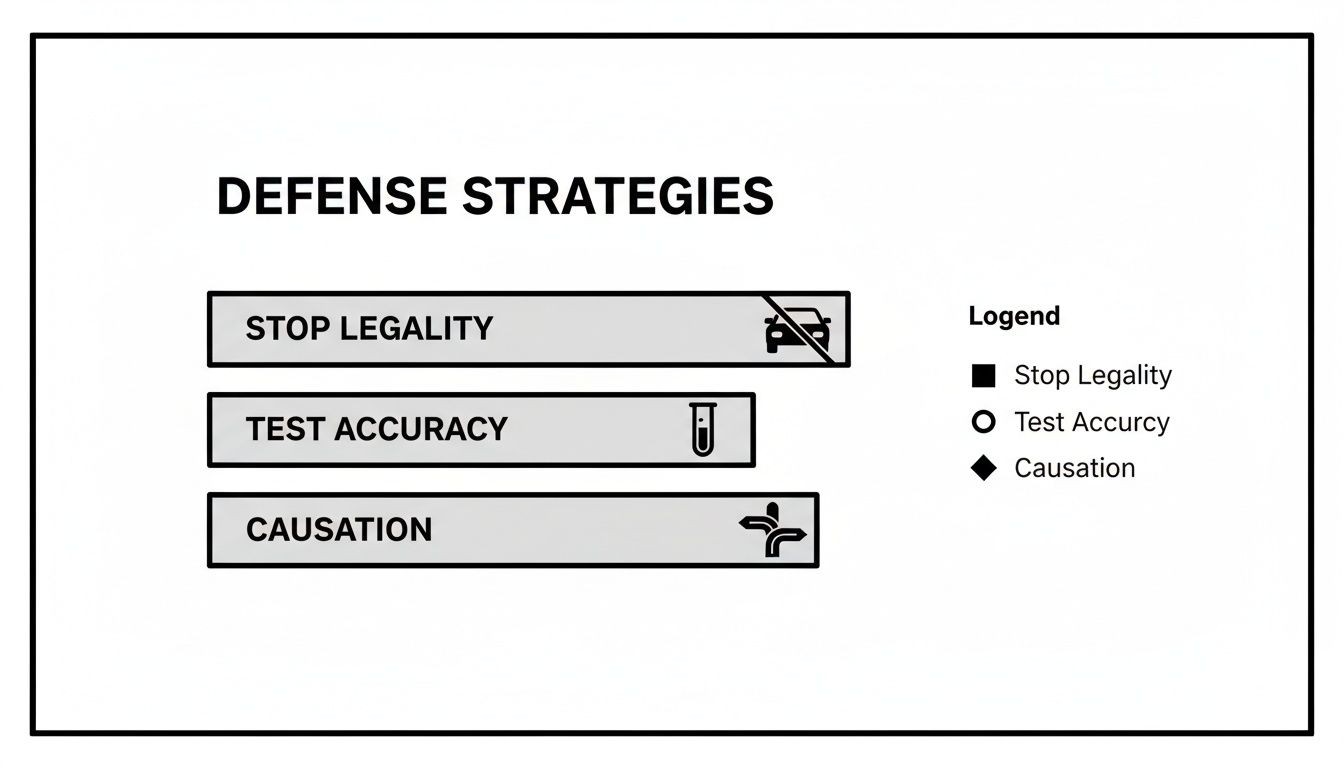
This graphic outlines the key areas your defense attorney will need to investigate to challenge the state's case. By scrutinizing the legality of the traffic stop, the accuracy of any chemical tests, and the actual cause of the accident, a skilled defense can effectively dismantle the prosecution's narrative.
The Pressure to Secure Convictions
The high-profile nature of these cases puts prosecutors directly under a microscope. Powerful advocacy groups like Mothers Against Drunk Driving (MADD) are a constant voice in Texas, relentlessly pushing for tougher laws and more aggressive prosecution. This creates an atmosphere where prosecutors are heavily incentivized to chase the maximum penalties available.
In the court of public opinion, an intoxication manslaughter charge is often treated as a conviction before a trial even begins. This external pressure means your legal defense must be proactive, strategic, and ready to fight back from day one.
This intense public scrutiny means prosecutors often feel they have no choice but to adopt a hardline stance. They aren't just trying to win a case; they're trying to prove to the public that they are taking a firm stand against a deadly and devastating problem.
This isn't meant to scare you. It’s meant to drive home a critical truth: when you’re facing a charge of intoxication manslaughter in Texas, a powerful, experienced legal defense is not an option—it is an absolute necessity to protect your future.
Why You Need an Experienced Attorney on Your Side
Facing an intoxication manslaughter charge feels like the world is collapsing. It's a terrifying, life-altering moment, and you’re immediately thrown into a legal battle where the stakes couldn't be higher. The prosecution will be relentless. In times like these, it’s vital to remember that you have a constitutional right to a defense. Choosing to exercise that right is the single most important decision you can make for your future.
An accusation like this is isolating, but you don't have to go through it alone. Here at the Law Office of Bryan Fagan, we do more than just represent you—we partner with you. We’ll be right there beside you at every stage, from the gut-wrenching bond hearing all the way through a potential trial.
Navigating a System Designed for Conviction
Let's be blunt: the pressure on prosecutors in Texas to secure convictions for impaired driving is immense. This is especially true in cities that have become ground zero for this issue. Tragically, Austin ranks first in the entire nation for fatal crashes involving alcohol, which was a factor in a staggering 83.19 percent of deadly accidents there.
Even more sobering, six of the top ten U.S. cities for drunk driving fatalities are right here in Texas. You can read the full research on these alarming Texas statistics to get a clearer picture of the environment we're up against.
This intense public and political pressure means the state will pursue your case with everything it has. An experienced attorney not only understands this reality but knows exactly how to build a defense that can stand up to the prosecution's aggressive tactics.
Your future is on the line. Choosing the right attorney isn't just about finding someone with legal knowledge; it's about finding a dedicated advocate who will fight for you, your family, and your freedom with compassion and an unwavering commitment.
Your First Step Toward a Strong Defense
We believe in hope, and we believe in empowering our clients. The path forward starts with one simple action: asking for help. A confidential, no-obligation consultation is your first chance to understand your rights, see what your options are, and begin building the powerful defense you deserve.
The weight of an intoxication manslaughter in Texas charge is too heavy to carry by yourself. Let us help you shoulder that burden. We are here to listen, to guide you with honest advice, and to fight for you with everything we've got. Your future is worth fighting for.
If you are facing an intoxication manslaughter charge, the time to act is now. Contact the Law Office of Bryan Fagan today for a free, confidential consultation. Let us stand with you, protect your rights, and begin the fight for your future.
When you or someone you love is facing a charge as devastating as intoxication manslaughter in Texas, your mind is probably racing with urgent, terrifying questions. The uncertainty of it all can be completely overwhelming. Let's walk through some of the most common concerns we hear from clients and get you some clear, straightforward answers.
What's the Real Difference Between Manslaughter and Intoxication Manslaughter?
While both are incredibly serious felony charges, the key difference boils down to what the prosecutor has to prove to a jury. For a standard manslaughter charge, the state has the heavy burden of proving you acted recklessly—meaning you were aware of a substantial and unjustifiable risk but consciously chose to ignore it.
But for intoxication manslaughter, the rules change. The prosecutor doesn't need to prove you were reckless at all. All they have to show is that you were legally intoxicated while operating a vehicle and that your intoxication was the direct cause of the fatal accident. This lowers the bar for the prosecution, which is why it's the go-to charge for any DWI-related fatality.
Can I Still Be Charged If My BAC Was Under 0.08?
Yes, absolutely. This is a common and dangerous misconception. In Texas, the legal definition of "intoxicated" has two parts: either having a BAC of 0.08 or higher, OR having lost the normal use of your mental or physical faculties because of alcohol, drugs, or a combination of both.
This means a prosecutor can—and often will—move forward with an intoxication manslaughter charge even if your BAC was, say, a 0.06. To do this, they’ll build their case on other pieces of evidence. Think police reports detailing your driving, your performance on field sobriety tests, dashcam video, or witness statements all arguing that you were impaired and that this impairment led to the accident.
What If the Other Driver Was Partly to Blame for the Accident?
This is a critical point that can become the cornerstone of a powerful defense. The state doesn't just have to prove you were intoxicated; they must prove your intoxication was the direct cause of the death. It's what we call "causation" in legal terms.
If the other driver's actions were the true cause of the crash—maybe they were speeding, blew through a red light, or were texting and swerving—your attorney has a strong argument that the accident would have happened no matter what your condition was.
Even if you had been drinking, the state must prove a direct, unbroken link between your intoxication and the fatal result. If another event or action was the real cause, the state’s case against you falls apart.
Successfully showing an independent cause for the accident is one of the most effective ways to introduce reasonable doubt and fight back against an intoxication manslaughter in Texas charge.
The road ahead is incredibly difficult, but you do not have to walk it alone. The legal team at the Law Office of Bryan Fagan PLLC has the experience and compassion to defend your rights and fight for your future. Contact us today for a free, confidential consultation to discuss your case by visiting our website.