Skip to content
Yes, running from the police in Texas can absolutely be a felony, especially the moment you get a vehicle involved. While fleeing on foot is often charged as a misdemeanor, using a car to evade arrest instantly escalates the situation to a state jail felony—at a minimum. It’s a critical distinction under Texas law that can dramatically change the course of your life.
That Split-Second Decision to Flee Police
The flash of red and blue lights in your rearview mirror sends a jolt of panic straight to your chest. Your heart pounds, your mind races, and a thousand worst-case scenarios flood your thoughts. Is it just a routine traffic stop? Or is there an old warrant you forgot about? Maybe you're terrified about how this will impact your CPS case or your custody battle. In that moment of intense fear and confusion, the instinct to just go can feel overwhelming.
It’s a split-second decision that, unfortunately, can have lifelong consequences. At the Law Office of Bryan Fagan, we understand the immense pressure Texas parents are under. We know that good people can find themselves in tough situations where fear takes over. That very human reaction to run from a perceived threat is powerful, but the legal system—and a family court judge—views it through a very different, very specific lens. Understanding how Texas law defines and punishes evading arrest is the first step toward protecting your rights, your freedom, and your family.

The Legal Framework for Evading Arrest
Texas law lays out the crime of "Evading Arrest or Detention" in Texas Penal Code § 38.04. To get a conviction, a prosecutor has to prove you intentionally fled from someone you knew was a police officer who was trying to lawfully arrest or detain you.
That sounds simple enough, but the method you use to flee is what really matters. It’s the detail that determines the severity of the charge.
Picture this: a single mom is driving home late from work, exhausted. She gets pulled over for an expired registration sticker. She panics, not because she's a criminal, but because she knows there’s a warrant for unpaid traffic tickets, and she can't afford to be arrested and leave her kids alone. If she hops out of the car and takes off running, she's likely looking at a Class A Misdemeanor. But if she stomps on the gas and speeds away in her car, that charge immediately jumps to a state jail felony.
The use of a motor vehicle is the bright line that separates a serious misdemeanor from a life-altering felony. The law presumes a vehicle introduces a much greater risk of danger to the public and the officers involved.
To give you a clearer picture, here’s a quick breakdown of how Texas law classifies these offenses.
Evading Arrest in Texas At a Glance
This table provides a quick summary of how fleeing from police is classified under Texas law based on the method used.
| Method of Fleeing | Initial Charge Classification | Governing Statute |
|---|---|---|
| On Foot | Class A Misdemeanor | Texas Penal Code § 38.04(b) |
| Using a Vehicle | State Jail Felony | Texas Penal Code § 38.04(b) |
As you can see, the distinction is fundamental. A misdemeanor might lead to county jail time and fines, but a felony conviction carries potential prison time, the loss of civil rights like voting and owning a firearm, and a permanent criminal record that poisons your chances at getting a job, finding housing, or even maintaining custody of your children. Facing these charges requires a deep understanding of both the law and the very human element behind that split-second decision to flee.
Fleeing on Foot Versus in a Vehicle
When you're facing a police stop, the choices you make in a split second can drastically change your future. In Texas, the law draws a very sharp, unforgiving line between running from an officer on foot and hitting the gas pedal. Making the wrong choice takes you from a serious problem to a life-altering one, especially for parents involved with CPS.
Think of it this way: a heated argument is one thing, but throwing a punch changes everything. The law sees that punch as an escalation that introduces a real threat of physical harm. It’s the same logic with evading arrest. Running on foot is one level of trouble; using a vehicle to do it is seen as something far, far more dangerous.
Running on Foot: The Class A Misdemeanor
If someone takes off running from a police officer, the charge is usually a Class A Misdemeanor. While that’s the most serious misdemeanor you can face in Texas, it’s still worlds away from a felony. A conviction could land you in county jail for up to a year and hit you with a fine of up to $4,000.
For the prosecutor to make this charge stick, they have to prove a few things beyond a reasonable doubt:
- You intentionally decided to flee.
- You knew the person trying to stop you was a peace officer.
- The officer was lawfully trying to arrest or detain you.
This isn't about accidentally walking away because you had headphones in and didn’t hear the officer. The state has to prove you made a conscious decision to run.
Using a Vehicle: The Automatic Felony
The second you use a car, truck, or motorcycle to flee, the game changes completely. Under Texas law, evading arrest in a motor vehicle is instantly bumped up to a state jail felony—and that’s just the starting point. The law treats that vehicle as a potential weapon, dramatically raising the stakes for the officers and the public.
This isn’t just a small step up the legal ladder; it’s a giant leap into a different stratosphere of criminal charges. A state jail felony comes with 180 days to two years in a state jail facility and a fine up to $10,000. We’re not talking about county jail anymore. This is prison.
The reason for this harsh distinction is painfully clear: high-speed chases are a menace to everyone on the road. A vehicle multiplies the potential for catastrophic accidents, serious injury, and death.
The devastating fallout from police pursuits is no secret. Across the U.S., an average of 323 people are killed in police chases every single year. Innocent bystanders account for about 27% of those deaths. What’s truly shocking is that 91% of these chases start over non-violent offenses, often just a simple traffic violation, yet they lead to an estimated 7,400 injuries annually. You can learn more about the risks of police pursuits from this detailed analysis.
To secure a felony conviction, the prosecutor’s job is similar to the misdemeanor charge, but with one critical addition:
- You intentionally fled.
- You knew it was a peace officer.
- The officer was acting lawfully.
- You used a motor vehicle while fleeing.
That last point is the game-changer. Simply being behind the wheel and driving off when an officer is trying to pull you over is enough to trigger a felony charge. The consequences of that single decision can send shockwaves through your entire life—your freedom, your job, your family, and your future.
How a Felony Charge Can Become More Serious
When you're hit with a felony charge for evading arrest in a vehicle, it’s easy to feel like you've already hit rock bottom. But the hard truth is, a state jail felony is often just the beginning. Texas law includes specific circumstances that can take a bad situation and make it catastrophically worse, escalating the charge and the potential prison time. These are known as aggravating factors.
Think of it like this: a basic felony charge is a severe thunderstorm—it's dangerous, scary, and can do real damage. But when aggravating factors come into play, that storm can instantly spawn a tornado. The level of destruction, both to your freedom and your future, grows exponentially. One panicked decision can spiral into a second-degree felony, which carries up to 20 years in prison.
The Aggravating Factors That Change Everything
The Texas Penal Code doesn't paint all vehicle evasion cases with the same broad brush. The law is designed to look at the real-world consequences of the chase. A prosecutor will push to enhance the charge from a state jail felony to something far more severe if certain lines are crossed.
Here are the primary aggravating factors that can dramatically increase the stakes:
- Causing Serious Bodily Injury to Another Person: If anyone—another driver, a passenger, a pedestrian, or even an officer—suffers a serious injury because of your attempt to flee, the charge gets bumped up to a third-degree felony. You're now facing 2 to 10 years in prison.
- Causing the Death of Another Person: If the chase ends in a fatal accident, the charge becomes a second-degree felony. This is incredibly serious, with a punishment range of 2 to 20 years behind bars.
- Having a Previous Conviction for Evading Arrest: If you've been down this road before and have a prior conviction for evading arrest, a second offense is automatically upgraded to a third-degree felony, even if no one gets hurt this time.
- Using the Vehicle as a Deadly Weapon: While this isn't a specific enhancement for the evading charge itself, if your driving is especially reckless—say, you swerve directly at officers or into oncoming traffic—a prosecutor can stack on a separate charge of aggravated assault with a deadly weapon. That’s a second-degree felony on its own.
This decision tree shows just how quickly one choice can lead down wildly different legal paths.
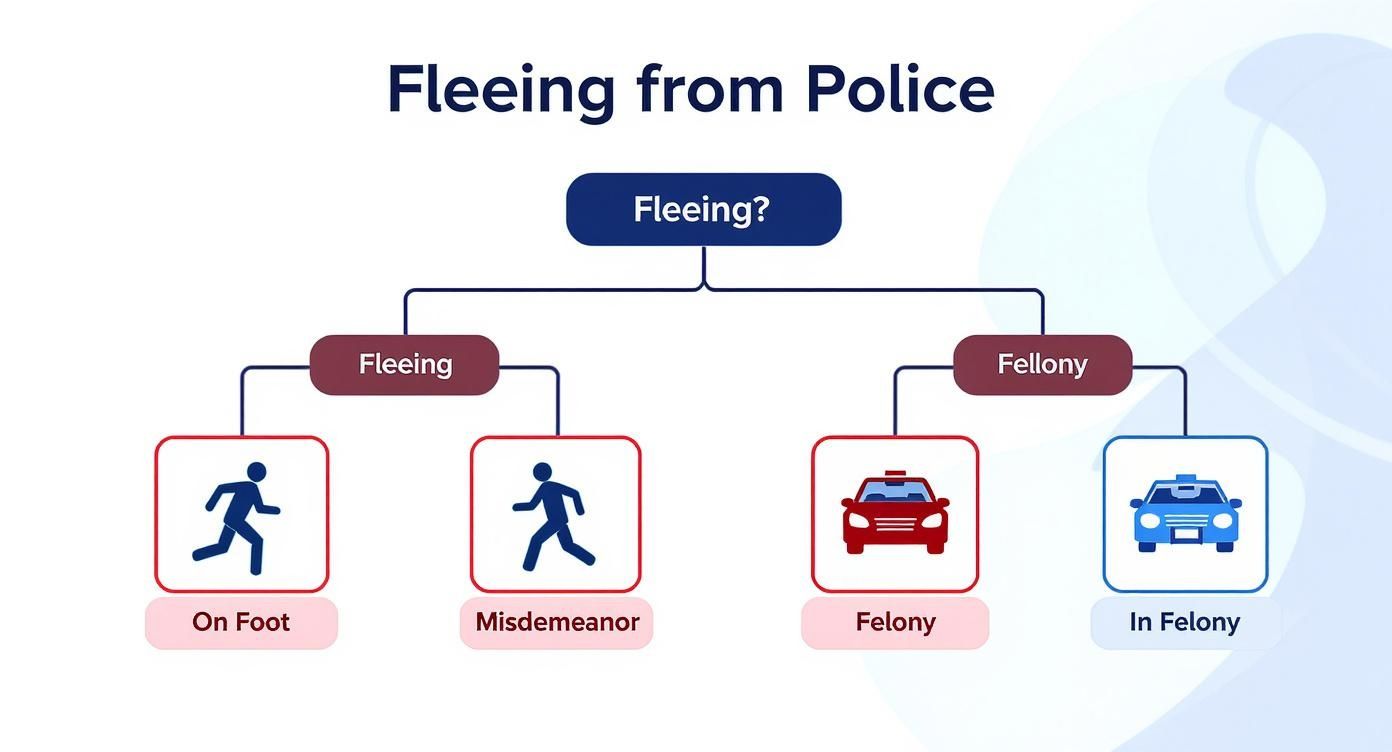
As the chart makes clear, there's a critical dividing line: how you choose to flee. Running on foot is a serious misdemeanor, but the second a vehicle gets involved, you're on a direct path to a felony—with the very real possibility of things getting much, much worse.
A Relatable Scenario with Devastating Consequences
Let's picture Mark, a young father with a clean record. He’s driving on an expired license simply because he couldn't spare the money for the renewal fee. When he sees police lights flashing in his rearview mirror, he panics. All he can think about are the fines he can't pay, the possibility of being arrested, and the call he’d have to make from jail to find someone to watch his kids.
In that split second of fear, he makes a terrible choice: he hits the gas. The officer gives chase, and the situation quickly escalates. Mark blows through a red light and clips another car, causing an accident. The other driver is left with a broken leg and a concussion.
All of a sudden, Mark is no longer just facing a state jail felony for evading, which tops out at two years. Because his actions led to a "serious bodily injury," his charge is now a third-degree felony. He is now looking at up to 10 years in prison.
This story shows how a non-violent mistake, driven entirely by fear, can have life-shattering consequences. Mark never intended to hurt anyone; he just wanted to get away. But under the law, he is held responsible for the direct results of his actions. This is exactly why having an experienced legal team isn’t a luxury—it's an absolute necessity to protect your future and your family.
Understanding the Penalties and Consequences
A criminal charge doesn't just put your freedom on the line; it can send shockwaves through every corner of your life—impacting your family, your career, and everything you've worked for. Getting a handle on the potential penalties for evading arrest in Texas isn't about fear-mongering. It's about understanding how seriously the state treats these charges and why having a solid defense is non-negotiable.
The consequences go way beyond what a judge might decide in a courtroom. A conviction, especially a felony, casts a long shadow. It creates a ripple effect of "collateral consequences" that can follow you for years, making it incredibly tough to rebuild your life and support your family.
Comparing Penalties from Misdemeanors to Felonies
The penalties for evading arrest can swing wildly depending on the specifics of the situation. What might start as a Class A Misdemeanor for running from an officer on foot can escalate into a serious felony if certain aggravating factors come into play.
Let's break down the potential legal penalties you could be up against.
Penalty Ranges for Evading Arrest Charges in Texas
This table gives you a clear picture of how the penalties stack up, from misdemeanors all the way to high-level felonies.
| Charge Level | Maximum Fine | Jail/Prison Sentence | Common Examples |
|---|---|---|---|
| Class A Misdemeanor | Up to $4,000 | Up to 1 year in county jail | Intentionally fleeing from a lawful detention on foot. |
| State Jail Felony | Up to $10,000 | 180 days to 2 years in a state jail facility | Using a vehicle to flee from an officer. |
| Third-Degree Felony | Up to $10,000 | 2 to 10 years in prison | Fleeing in a vehicle and causing serious bodily injury to another person. |
| Second-Degree Felony | Up to $10,000 | 2 to 20 years in prison | Fleeing in a vehicle and causing the death of another person. |
It's crucial to remember that these are just the standard ranges. Things like a prior criminal record can easily push a sentence higher within these brackets. Even a lesser charge, like a Class B Misdemeanor, carries significant consequences that you can learn more about in our detailed guide.
The Hidden Consequences That Affect Your Family
The penalties written into the law are only half the story. The "collateral consequences" of a conviction, particularly a felony, can be just as devastating and can truly last a lifetime. These are the real-world hurdles that Texas families have to clear long after the legal battle is over.
The impact of a felony conviction is like a shadow that follows you everywhere. It can close doors to opportunities you once took for granted and create immense stress for you and your loved ones.
Some of the most common and damaging collateral consequences include:
- Loss of Professional Licenses: Many careers—from nursing and teaching to commercial driving—demand a clean record. A felony conviction can lead to the suspension or even permanent loss of your professional license.
- Difficulty Finding Employment and Housing: Most job and rental applications these days include a background check. A felony conviction can be an automatic disqualifier, making it incredibly difficult to find stable work or a safe home for your family.
- Impact on Child Custody Cases: If you're involved in a CPS case or a custody battle, a felony conviction for evading arrest can be used against you as evidence of poor judgment and instability. Under the Texas Family Code, this could seriously harm your parental rights.
- Loss of Firearm Rights: Under both Texas and federal law, a felony conviction means you permanently lose your right to own or possess a firearm.
The gravity of these consequences is underscored by just how dangerous police pursuits can be. Data shows that from 2014 to 2018, police chases in the U.S. resulted in 2,005 deaths. Tragically, 56% of those killed were not the fleeing drivers but passengers, officers, or innocent bystanders. Texas had the highest number of total deaths at 268—a grim reminder of how fast these situations can turn tragic. You can discover more insights about these statistics on police pursuits. Protecting your future means understanding all these potential outcomes and building a defense to prevent them.
How to Build a Defense Against Evading Arrest Charges
Seeing those flashing lights in your rearview mirror can send a jolt of panic through anyone. In that split second, a decision made out of pure fear or confusion can snowball into a serious charge like evading arrest. But here's something you absolutely have to remember: an arrest is not a conviction.
The moments after an arrest aren't the end of your story; they're the beginning of your defense. The State of Texas carries the entire burden of proof, which means a prosecutor has to prove every single element of the charge against you beyond a reasonable doubt. If they can't prove even one part of their case, they lose. A good defense attorney's job is to dismantle their case, piece by piece, and make sure your side of the story is heard.
Challenging the State’s Case
Building a solid defense starts with a deep dive into the specific facts of your situation. No two cases are ever the same, and we often find that the police report only paints one side of the picture. There are several powerful strategies we can use to protect your freedom.
Common defense angles often include:
- Lack of Intent: The prosecutor has to prove you intentionally fled from an officer. What if you were having a medical emergency? Or maybe you were disoriented and simply didn't realize an officer was trying to pull you over right away. If your actions weren't a conscious choice to run, the state’s case gets a whole lot weaker.
- Mistake of Fact: Did you genuinely know it was a police officer trying to stop you? This comes up all the time with unmarked cars or plainclothes officers. If some vehicle starts aggressively tailgating you at night with no lights or siren, your first instinct might be to drive to a well-lit, public place for your own safety—not to flee from law enforcement.
- Unlawful Detention: A police officer can't just stop you for any reason they want; they need a lawful basis known as reasonable suspicion. If the initial traffic stop or attempt to detain you was illegal from the get-go, any evidence they gathered after that point—including the act of fleeing itself—could be thrown right out of court.
A strong defense is about more than just arguing in court. It’s about careful investigation, challenging assumptions, and ensuring your side of the story is heard and respected. The right strategy can expose weaknesses in the prosecution's argument.
Seeking Alternative Resolutions
Beyond fighting the charges head-on at trial, other paths can lead to a positive outcome, especially for first-time offenders. A skilled attorney can often negotiate with the prosecutor for a much better result than a felony conviction. One of the most important parts of this process is knowing how to choose a criminal defense attorney who has the experience and reputation to negotiate effectively for you.
These negotiations can lead to several favorable outcomes:
- Charge Reduction: It's often possible to get a felony evading charge knocked down to a misdemeanor, like reckless driving or a lesser fleeing offense. This can help you avoid the devastating life-long consequences of a felony conviction.
- Pretrial Diversion Programs: For some people, particularly those with a clean record, a pretrial diversion program might be on the table. This is basically an agreement where you complete certain requirements (like community service or classes), and in return, the charges against you are eventually dismissed.
- Plea Agreements: When the evidence against you is tough, a carefully negotiated plea agreement can limit your exposure to the harshest penalties. It provides a clear path forward without the massive risk of a lengthy prison sentence.
Facing an evading arrest charge feels like the weight of the world is on your shoulders, but you are not powerless. A strategic, well-planned defense can make a profound difference in protecting your rights, your family, and your future.
What to Do Immediately After an Arrest
The moments right after an arrest are a blur of confusion, fear, and high-stakes stress. It feels like the world is spinning out of control, and it’s incredibly easy to make a split-second mistake that could seriously damage your case down the road. But by taking a breath and focusing on a few critical steps, you can protect your rights and start building the foundation for a strong defense.

The single most important thing you can do is exercise your right to remain silent. It might feel unnatural or even rude, but this constitutional right is your strongest shield. Anything you say—even a simple apology or an attempt to explain what happened—can and will be twisted and used against you by the prosecution.
Politely but firmly state, "I am exercising my right to remain silent, and I would like to speak with my attorney." Repeat this as often as necessary. Don't answer questions, offer explanations, or get drawn into casual conversation about your case.
Taking Control of the Situation
Once you’ve asserted your rights, the next moves are all about taking proactive control. The sooner you act, the better your chances are of securing a positive outcome.
Your immediate priorities should be:
- Contact an Experienced Attorney: Don't wait. The second you’re able to make a phone call, it needs to be to a criminal defense lawyer. Early intervention is absolutely crucial. An attorney can get to work right away to preserve evidence, contact potential witnesses, and start mapping out a defense strategy.
- Do Not Discuss Your Case: Avoid talking about the details of your arrest with anyone who isn't your lawyer. This includes family members, friends, and especially cellmates. Conversations can be overheard or misunderstood, creating even more problems for your case.
- Follow Your Attorney’s Advice: Once you have a lawyer, listen carefully and follow their guidance. They understand the legal system inside and out and will navigate you through complex processes like bond hearings and understanding the specific charges against you, such as a capias charge you can learn more about in our detailed guide.
Acting quickly is essential, especially when you realize how high the stakes are. Tragic statistics show that since 1979, an estimated 11,500 people have died in police chases, with about half of them being innocent bystanders. Shockingly, studies reveal that 42% of these high-speed pursuits are triggered by simple traffic violations, not violent crimes. These facts highlight why a panicked decision can lead to devastating consequences, making a strong legal defense non-negotiable from the very beginning.
Common Questions About Evading Arrest in Texas
Getting charged with evading arrest can throw your life into a tailspin. It's completely normal to feel a rush of urgent questions. Finding clear, straightforward answers is the first step toward getting your feet back on the ground and figuring out what to do next. Let's tackle some of the most common concerns we hear from families across Texas.
Can a Passenger Be Charged with Evading Arrest?
Usually, no. The driver is the one controlling the car, so they're the one on the hook for evading. However, there's a big exception here in Texas called the "law of parties." If the prosecutor can show that you did more than just sit there—that you actively encouraged, directed, or helped the driver flee—you could be charged right alongside them. They would need real evidence of your involvement, not just proof that you were in the car.
What if the Initial Police Stop Was Unlawful?
This is a game-changer and often a powerful defense. For an evading arrest charge to stick, the officer has to be trying to lawfully detain you in the first place. If that initial traffic stop was illegal—meaning the officer didn't have the required reasonable suspicion to pull the car over—then everything that happened after that can be thrown out. Your attorney can file what’s called a motion to suppress evidence. If the judge agrees the stop was bad, the whole case can fall apart.
An unlawful stop can invalidate everything that follows. Proving the officer lacked a legitimate reason to pull you over is a key strategy that can completely change the outcome of your case.
How Does a Felony Conviction Affect Child Custody?
A felony conviction for evading arrest can be absolutely devastating in a child custody battle or a CPS case. When a family court judge makes decisions, their only legal standard is the "best interest of the child." A felony record, especially for something that suggests reckless and dangerous behavior, is a massive red flag. The other parent's lawyer or CPS could argue it proves you have poor judgment and are a risk to your child under the Texas Family Code. This can lead to your visitation being restricted or supervised, or in the worst-case scenario, you could lose your parental rights entirely under Chapter 161. It is critical to have a lawyer who understands how criminal charges bleed into family law to protect your rights as a parent.
A felony charge puts your freedom, your family, and your future on the line. You don't have to face it by yourself. At the Law Office of Bryan Fagan PLLC, our experienced criminal defense attorneys understand what’s at stake for Texas families. We are ready to stand up and fight for you, digging into every detail of your case to build the strongest defense possible and protect what matters most. For a free, confidential consultation to discuss your case, contact us today at https://texascpslawyer.net.