Skip to content
The knock comes on an ordinary day. A school pickup is coming up. Dinner is half-planned. Then a CPS investigator stands at your door, asks questions you were not ready to answer, and suddenly your family is dealing with fear, paperwork, and the possibility that your child may not come home tonight.
If you are a parent in that moment, you may feel two things at once. Panic for your child, and shame about your situation. That is true if CPS involvement overlaps with a criminal accusation, a protective order, a DWI arrest, or an assault allegation. One case can start affecting the other fast.
There is still a path that protects your child from being placed with strangers. In many Texas CPS cases, relative placement gives children a chance to stay with grandparents, aunts, uncles, adult siblings, or trusted family friends while the parent works through the case. In plain language, it is a way to keep your child inside the family circle when home is not an immediate option.
This guide is for scared parents and worried relatives. It is written in the same direct way I would explain it in an office meeting after a removal. You need to know what relative placement cps texas means, who qualifies, what deadlines matter, and what to do today if a criminal case is making everything harder.
A Knock at the Door Your Whole World Changes
Maria had never dealt with CPS before. She called her sister crying after investigators left. Her child had been removed after a domestic violence incident, and Maria was also facing a related protective order hearing. Her first question was not about the court. It was, “Where is my son sleeping tonight?”
Many parents begin with that question.
When CPS gets involved, the system can feel cold and fast. A parent may still be trying to process an arrest, hospital visit, or police report while CPS asks for names of relatives. If you are in that position, your mind may jump to the worst-case scenario. Foster care. Limited contact. A judge making decisions before your family can catch its breath.
Relative placement can be the first piece of hope in that chaos.
It means CPS looks for safe family members, or sometimes a close family friend with a genuine bond to the child, before turning to a stranger foster placement. For a child, that can mean sleeping in Grandma’s guest room, seeing a familiar face at breakfast, and keeping some connection to normal life while adults sort out the case.
Key point: Relative placement does not mean you are giving up on your child. In many cases, it is the safest way to protect your child while you work toward reunification.
Parents fear that agreeing to a relative placement will be used against them. The opposite is true. A parent who helps identify safe family options shows the court that they are acting in the child’s best interest. That matters when a criminal case is creating extra pressure.
If this is happening to your family, do not shut down. Names, phone numbers, addresses, and quick action can change where your child ends up. The system moves quickly, but families who move quickly can shape the outcome.
What Texas Law Says About Relative Placement
Texas law does not treat family placement as an afterthought. It treats it as a priority.

Under Texas CPS practice, kinship care or relative placement means placing a child with family members or other approved adults who have a meaningful connection to the child. The law favors that route because children do better when they stay connected to people they know, their routines, and their family identity.
Texas has leaned into that policy in practice. The state’s kinship placement rate was 39.9% in fiscal year 2024 year to date, compared to a national average of 34% from 2022 data, according to the Texas DFPS relative and other designated caregiver report.
Relatives and fictive kin both matter
A relative is not limited to one narrow category. Grandparents, aunts, uncles, and other family members may qualify. Texas also recognizes fictive kin, which means a non-relative who has a meaningful and family-like relationship with the child.
That could include:
- A godparent who has cared for the child regularly
- A longtime family friend the child knows well
- A coach, neighbor, or family support person with a genuine bond and stable role in the child’s life
This matters in real cases. Some parents do not have a safe blood relative nearby. But they do have someone who has been showing up for years. Texas law can make room for that.
Legal takeaway: Texas Family Code provisions and CPS policy are built around keeping children connected to familiar caregivers when safety allows.
Parents also need to understand that placement and custody are related, but not identical. If you are trying to understand how court decisions about children are generally made, this overview of Texas child custody laws can help you see how Texas courts approach the child’s best interest.
A short video can also help make the idea less abstract:
Why this matters when criminal charges are involved
A criminal case changes the immediate safety analysis. If a parent is accused of assault, facing a protective order, or arrested for DWI with a child in the car, CPS may decide the child cannot remain at home while facts are sorted out.
Relative placement becomes the bridge.
It gives the court a safer middle ground than stranger foster care. The parent can still work services, address the criminal case, and show progress. The child stays with someone known and trusted. That is why relative placement cps texas is not just a legal phrase. For many families, it is the difference between isolation and continuity.
Who Qualifies to Care for a Child in a CPS Case
Not every loving relative will be approved. CPS looks at safety first, then stability, then practical ability to care for the child day to day.
The question is not only, “Are you family?” The question is, “Can this child safely live in your home right now?”
Who may be considered
Texas recognizes both relatives and fictive kin. Exact family degrees can matter in paperwork, but families benefit from casting a wide net early instead of arguing over labels.
Here are common examples.
| Relationship Type | Examples |
|---|---|
| Blood relatives | Grandparent, aunt, uncle, adult sibling, cousin |
| Marriage-based relatives | Stepparent, step-grandparent, aunt by marriage |
| Fictive kin | Godparent, longtime family friend, trusted neighbor, close family mentor |
If your family wants a deeper practical guide on what this process can look like in court, this resource on how to get kinship custody is useful.
What CPS usually looks at
A relative may look strong on paper but still get delayed if the home is not ready or the family is not organized. CPS commonly focuses on:
- Household safety: Is the home clean, stable, and appropriate for a child?
- Adult household members: Everyone in the home may be screened.
- Ability to supervise: Can the caregiver handle school, medical care, and daily needs?
- Willingness to cooperate: CPS pays attention to whether the caregiver responds quickly and provides complete information.
- Boundaries with the parents: The caregiver must protect the child, even if that means saying no to a parent who wants unsupervised contact too early.
What can block a placement
Many families find themselves blindsided at this stage. A grandmother may assume blood relation is enough. It is not.
Texas policy can disqualify a potential caregiver if there is an open investigation involving that person or if the person has a Reason to Believe finding for certain abuse or neglect categories, unless a program director approves an exception, as explained on the Texas relative studies page for ICPC guidance.
That means a relative’s own CPS history may become the issue, even if they love the child and have helped for years.
Why parents should think strategically
If you are the parent, do not give CPS only one name and hope it works out. Give several names. Include people who are organized, reachable, calm under pressure, and likely to pass screening.
A few practical examples:
- A grandfather who owns a stable home but never answers unknown numbers may be overlooked if no one prepares him.
- An aunt who is loving but has an active CPS matter in her own household may be ruled out quickly.
- A family friend with a strong relationship to the child may be a better option than a distant relative who barely knows the child.
Practical tip: Before you submit a name to CPS, ask one hard question. “If a caseworker knocked on your door tonight, would your home and your history hold up?”
That one question saves families from wasting valuable time.
The CPS Relative Placement Process Step by Step
The process starts moving before most parents understand what happened. If you know the timeline, you can act instead of reacting.
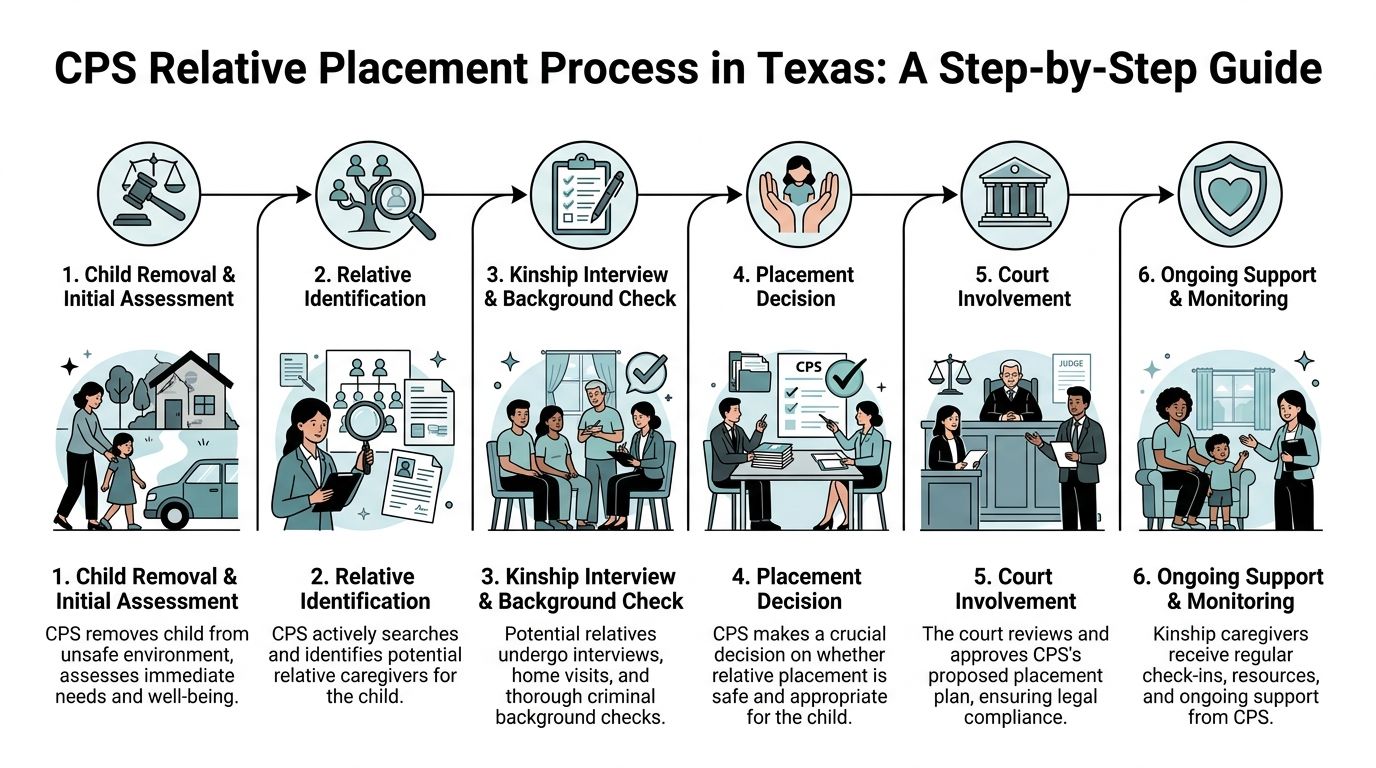
Consider a common example. A father is arrested after a family disturbance. The children are not accused of being harmed, but CPS decides the home is unsafe that night. The mother is also unavailable because of a related investigation. Their grandmother wants the children immediately.
This is how the process begins.
Right after removal
CPS first looks at immediate safety. The agency may ask the parents for names of relatives or close family friends. This is not the time to be vague.
Give complete information:
- Full names
- Phone numbers
- Home addresses
- Relationship to the child
- Whether the person can take the child now
If a parent is in jail, hospitalized, or subject to a no-contact order, the attorney needs to help get those names to CPS fast.
The first placement review
When a child is placed with a relative, Texas CPS policy requires caseworkers to initiate a full kinship assessment within 48 hours, according to the DFPS CPS handbook on kinship care procedures.
That short deadline matters because early movement can keep a temporary arrangement from turning into a longer stranger placement.
CPS may start with:
- A home visit
- Background checks
- Interviews with the caregiver
- Questions about sleeping arrangements, school transport, and supervision
- Review of who else lives in the home
Why some families stall out
Relatives get frustrated at this point. They assume saying “yes” should be enough. But CPS wants documents, scheduling, access to the home, and quick responses.
A grandmother who misses calls, delays fingerprints, or says an adult son in the home “will not need to be checked” can accidentally slow the entire process.
What helps most: Fast paperwork, full honesty, and a home that looks ready for a child to move in safely.
For many families, it also helps to understand how CPS supports and evaluates kinship homes over time. This explanation of the role of CPS kinship care in supporting families gives a useful overview.
The adversary hearing
The court becomes involved quickly. At the early hearing stage, the judge reviews what CPS has done and whether the child can safely remain out of the home. If relative options have been submitted and evaluated, that information needs to be in front of the court.
Criminal and CPS issues collide at this point.
A parent may be told not to contact the other parent because of a protective order. A relative may be trying to gather records while the parent is in custody on a DWI or assault charge. If nobody coordinates those pieces, the court may only hear CPS’s version of events.
After a relative is approved
Approval is not the end of the case. The caregiver may still have ongoing contact with CPS, court hearings, and rules about the parents’ access to the child.
The parent still needs to:
- Follow court orders
- complete services
- address the criminal case without creating new family law problems
- show the court that reunification is still realistic
A relative placement is the most stable temporary solution. But it works best when the family treats it like a serious legal process, not an informal family arrangement.
How Relatives Can Proactively Request Placement
Relatives do not have to sit by the phone and hope CPS finds them. If you want the child placed with you, act like time matters, because it does.
Start with direct contact
Call the CPS caseworker. If you do not know who that is, contact the local office and ask for the investigator or ongoing conservatorship worker assigned to the child’s case.
Be ready to say:
- Who you are: Give your full name and relationship to the child.
- Why you are calling: State clearly that you want to be considered for placement.
- What you can offer: A safe home, transportation, school support, and immediate availability if true.
Do not assume the parent’s verbal request was enough. Follow up yourself.
Ask about Form 2625
Under Texas Family Code §262.114, parents can identify possible caregivers on Form 2625, and CPS must evaluate those relatives. The court must review filed forms and home studies at the adversary hearing, according to the DFPS handbook section addressing caregiver information before hearing.
That creates a simple but powerful lesson. If the names and paperwork are not submitted in time, the judge may have less to work with when placement decisions are made.
If grandparents are trying to understand whether they can step in more formally, this guide on can grandparents get custody from CPS is a helpful place to start.
Present yourself like a safe option
Relatives undermine their own request by treating it casually. A better approach is to prepare like an interview.
Bring together:
- Identification documents
- Proof of address
- Contact information for all adults in the home
- Basic school and childcare plan
- A calm explanation of your relationship with the child
If there is a known issue, address it early. If an adult in the home has an old charge, say so. If a room is being set up for the child, tell CPS when it will be ready. Silence usually creates suspicion.
Practical tip: Parents and relatives should coordinate their message. The parent should identify the relative. The relative should separately contact CPS. The attorney should make sure the court knows the option exists.
That kind of organized effort can matter a great deal before the first major hearing.
Common Challenges and How an Attorney Can Help
The hardest relative placement cases are not the obvious ones. They are the cases where a family member is almost acceptable, but one issue keeps getting in the way.

A grandmother has an old misdemeanor. An uncle lives in the right school district but has a roommate CPS does not trust. A fictive kin caregiver is ideal for the child emotionally, but CPS questions whether the relationship is documented well enough.
Those are legal problems, not just family problems.
Criminal history does not always end the discussion
Minor criminal histories for relatives can be a barrier, but not always a dead end. DFPS requires checks, and nuanced approvals or waivers for non-violent offenses may be petitioned for, according to the 2025 DFPS relative and other designated caregiver report.
That matters a lot when the parent also has a criminal case. One side of the family may be the best placement, but an old record creates hesitation. If no one pushes the issue properly, the child may stay in foster care longer than necessary.
Delays, silence, and mixed messages
Another common problem is simple delay.
Families report things like:
- “The caseworker never called back.”
- “We submitted names, but nobody visited the home.”
- “CPS keeps saying they are still reviewing it.”
Some delays come from workload. Some come from missing paperwork. Some happen because the family never forced the issue into the court record.
An attorney can help by organizing records, pressing for status updates, raising the issue at hearings, and making sure the judge knows there is a real placement option being overlooked.
When criminal and CPS cases collide
Parents get overwhelmed.
A parent charged with assault may be under a protective order that limits contact with the household. A parent arrested for DWI may need to avoid statements that could hurt the criminal defense but still cooperate enough to work the CPS plan. A relative who wants placement may have a record that needs explanation at the same time.
Those cases require careful coordination. One legal move in criminal court can affect visitation, housing, or the court’s view of family safety.
The Law Office of Bryan Fagan PLLC represents Texans in criminal cases and related CPS matters, including situations involving protective orders, record issues, and family placement disputes. In a case with both CPS and criminal exposure, that overlap matters because the family needs one strategy, not conflicting advice.
Attorney insight: In difficult kinship cases, the legal work is less about arguing abstract law and more about getting the right facts, documents, and court attention at the right moment.
Families should not assume CPS has reached the final answer because a caseworker sounded doubtful. Sometimes the right response is more documentation. Sometimes it is a waiver request. Sometimes it is a court presentation the family never knew it could make.
Protecting Your Rights and Your Child's Future
A relative placement can feel like loss to a parent at first. Your child is not home. Another adult is making daily decisions. You may worry that the case is already slipping away from you.
That is not necessarily what is happening.
Your rights as a parent still matter
A child living with a relative does not automatically terminate parental rights. In many CPS cases, it is a temporary safety arrangement while the court watches what happens next.
Parents still have the right to:
- Participate in the case
- Work services
- Attend hearings
- Request visitation consistent with court orders
- Try to reunify with the child
Texas Family Code Chapters 262, 263, and in some cases 161 shape how removal, review, permanency, and possible termination issues unfold. Relative placement fits into those chapters as a way to protect the child while the parent works on the case.
Your child’s need for family connection matters too
Children do not experience these cases as legal files. They experience them as separation, fear, and uncertainty.
That is one reason familiar placement can be important. If you want a plain-language explanation of why reducing upheaval matters for children, this article on the long-term effects of childhood trauma gives helpful context for families trying to make sense of what their child may be feeling.
Relatives are part of the solution, not the replacement
A strong relative placement can support reunification rather than replace it. The healthiest cases involve a relative who protects the child, follows court rules, and still supports the parent’s lawful path back into the child’s life.
That means:
- A grandmother who gets the child to school and to counseling
- An aunt who respects the visitation schedule
- A parent who uses the time to complete services and stabilize life
- Attorneys who keep the court focused on a safe plan, not just the family conflict
Main takeaway: Relative placement works best when everyone treats it as a bridge toward stability, not as the end of the parent-child relationship.
If you are the parent, your job is to show the court that you can make use of that bridge.
Key Questions About Relative and Kinship Placement
What if the best relative lives in another state
That may still be possible, but the case usually goes through the ICPC process. That means the out-of-state home will need formal review, including home study steps and background checks. These cases can move more slowly, so families should raise the option as early as possible.
Can a parent object to a specific relative
Yes. Parents can raise concerns about a proposed caregiver, especially if there are real safety issues, past conflict affecting the child, or reasons the placement would not serve the child’s best interest. A parent’s objection is stronger when it is specific, documented, and brought to the court through counsel rather than just argued emotionally.
Will CPS place my child with a family friend instead of blood relatives
Sometimes, yes. Texas recognizes fictive kin in appropriate cases. If a trusted family friend has a real relationship with the child and can meet CPS requirements, that person may be considered.
What if the relative has an old criminal case
That depends on the record and the surrounding facts. It is not always an automatic no. The family may need to provide records, context, and legal advocacy to address the issue properly.
Is relative placement the same as losing my rights forever
No. Relative placement is temporary. It can be part of a reunification path if the parent addresses the issues that brought CPS into the case.
If CPS has removed your child, or if your family is fighting to secure a safe relative placement while criminal charges or a protective order are also in play, legal guidance early in the case can change what options remain on the table. Law Office of Bryan Fagan PLLC helps Texas families address the overlap between CPS cases, criminal allegations, and kinship placement issues. Contact the firm for a free consultation to talk through your facts, your deadlines, and the steps that may help keep your family connected.