Skip to content
When you're a parent, the thought of anything threatening your family's future is terrifying. If you're facing a new felony charge in Texas, that fear can become overwhelming, especially when you learn that mistakes from your past could be used against you. You’ve likely heard the term “Texas three strikes”—the common name for the state’s habitual offender law. It’s a statute that can take a difficult situation and turn it into a life-altering catastrophe, threatening to tear your family apart forever.
Here’s the bottom line: if you have two prior, separate felony convictions on your record, a new felony charge can trigger this law. It doesn’t even have to be a violent crime. The result is a mandatory minimum sentence of 25 years to life in prison. For a parent, this isn't just about jail time; it's about losing everything—your children, your home, and your future.
Understanding What The Texas Three Strikes Law Means For You and Your Family

Facing a new felony charge is terrifying enough. But the moment you learn that mistakes from your past—long since paid for—could escalate that single charge into a potential life sentence, a different kind of fear sets in. It’s the harsh reality of the Texas habitual felony offender statute, better known as the Texas three strikes law. It’s a law designed to punish repeat offenders severely, but its unforgiving nature often ensnares parents who have worked hard to build a new life for their families.
Let’s consider a real-life scenario. Imagine a father named Mark. Years ago, he was convicted of two separate, non-violent felonies—maybe a drug possession charge and a state jail theft. He served his time, paid his debt to society, and turned his life around. He built a career, got married, and is now raising two children. He is the dad who goes to parent-teacher conferences and coaches little league.
Then one day, he’s pulled over and charged with a new felony, something like possession of a controlled substance. Suddenly, those old cases he thought were buried are dragged back into the light. The prosecutor can now use them to label him a "habitual offender," and the sentencing range explodes from a few years to a minimum of 25 years behind bars. His entire life—and the stability of his family—now hangs in the balance because of a law that tethers his present to his distant past.
How The Stakes Are Raised
At its core, this law is all about sentence enhancement. It doesn't care if your past crimes were violent or how long ago they happened. The statute only cares about the number of prior felony convictions. This creates an incredibly high-stakes situation where the focus shifts from the crime you’re accused of today to your entire history.
This enhancement completely changes the game for your case:
- Plea Bargaining: The prosecutor holds all the leverage. Knowing they can threaten a life sentence, they will be far less likely to offer a reasonable plea deal.
- Bail and Pre-Trial Release: A judge might see you as a higher risk because of your record, which often means a much higher bail amount or no bail at all.
- Trial Strategy: Your defense isn't just about fighting the new charge anymore. It becomes a two-front war: challenging the current allegations and attacking the validity of the old convictions being used against you.
While learning about alternatives like how probation works in Texas is useful context, a habitual offender enhancement often takes options like probation completely off the table. The prosecution’s goal is simple: put you away for a very, very long time.
This is precisely why having an experienced lawyer in your corner isn't just a good idea—it's absolutely essential. You need a fierce advocate who knows how to challenge the state's case at every single turn, from the new charge to the dusty old records they plan to use against you. The law is severe, but an allegation is not a conviction. Your story is not over yet.
When you’re staring down a habitual offender enhancement, it can feel like you’re up against some new, unbeatable super-law. But to really understand how to fight the Texas "three strikes" law, it helps to know where it came from. The truth is, this isn't a recent invention born from the "tough-on-crime" wave that swept the country in the 1990s. Its roots run much, much deeper.
The philosophy behind it was brutally simple: get people considered "habitual criminals" off the streets, permanently. While you can appreciate the goal of public safety, the law was designed with a bluntness that leaves zero room for nuance, context, or rehabilitation. It operates like a cold mathematical equation, adding up old convictions without ever considering the person behind them or the circumstances that led to their mistakes.
This history isn’t just a trivia lesson. It's a critical piece of the puzzle. Knowing where this law came from demystifies it, showing that it’s an old statute with specific legal weak points—weak points that a skilled attorney can challenge.
Texas Forged Its Own Path Early On
Long before "three strikes" became a national buzzword, Texas was already carving out its own severe sentencing structure for repeat offenders. In fact, Texas has had a version of this law on the books since 1952, predating the more famous laws from other states by decades.
Its legal power was cemented by the U.S. Supreme Court in a landmark 1980 case, Rummel v. Estelle. To get the full picture of how this case shaped the law, you can explore the history of three-strikes legislation in the U.S. and Texas's unique role.
In the Rummel case, the defendant was handed a life sentence for three non-violent property crimes that, all told, added up to just over $200. The Supreme Court upheld the sentence, deciding it wasn’t cruel and unusual punishment. That decision sent a chilling message across the state: in Texas, it’s the number of offenses, not necessarily how serious they are, that can lock you away for life.
This decades-old precedent is exactly why the Texas three strikes law remains one of the most severe in the nation. It reveals a legal tradition focused more on permanent incapacitation than on proportional punishment or the idea that a person can change.
The Human Cost of a Decades-Old Law
The law was originally meant to target career criminals, but today, its application casts a much wider net. It's a major contributor to mass incarceration, trapping people who may have committed non-violent felonies years, or even decades, apart. A mistake someone made as a teenager can suddenly roar back to life to justify a life sentence for a completely unrelated, and sometimes relatively minor, new charge.
For families, the impact is devastating. A parent facing a habitual offender charge isn't just fighting for their own freedom. They're fighting for their future with their kids, their ability to provide, and their very place in their family.
But knowing this history gives you power. It turns this law from an invincible monster into what it actually is: a legal rule created by people, interpreted by courts, and wielded by prosecutors. It is a legal fight that can be won with the right strategy. It is not an automatic life sentence, and understanding its past is the first step toward building a defense for your future.
How Prior Convictions Trigger Life Sentences
Figuring out how Texas's "three strikes" law works can feel like navigating a minefield. It’s not as simple as getting three strikes and you’re out; it’s about how prior convictions stack on top of each other, creating a devastating domino effect. The Texas Penal Code spells out a very specific sequence for these sentence enhancements, and if your case fits the pattern, a manageable situation can quickly turn into a fight for your life.
The whole process is sequential. Your first felony conviction is just that—a conviction. But once it’s on your record, any felony that follows is automatically enhanced. For example, a third-degree felony that normally carries 2 to 10 years gets bumped up to the punishment range for a second-degree felony, which is 2 to 20 years. This is the first step in the escalation.
The Two-Strike Escalation
The real danger kicks in after your second felony conviction. Once you have two prior, separate felony convictions on your record, you are officially in the crosshairs of the habitual offender statute. This is the "two strikes" setup that primes you for the final, life-altering blow.
It’s absolutely critical to understand that these two prior convictions must be sequential. This means the second felony offense had to have been committed after the conviction for the first felony became final. If the timeline is off—if the offenses happened out of order—a skilled defense attorney has an angle to attack the enhancement. But if the sequence is correct, any new felony charge, no matter how minor, can trigger the three strikes provision.
The infographic below traces the troubling historical roots of this kind of severe sentencing.
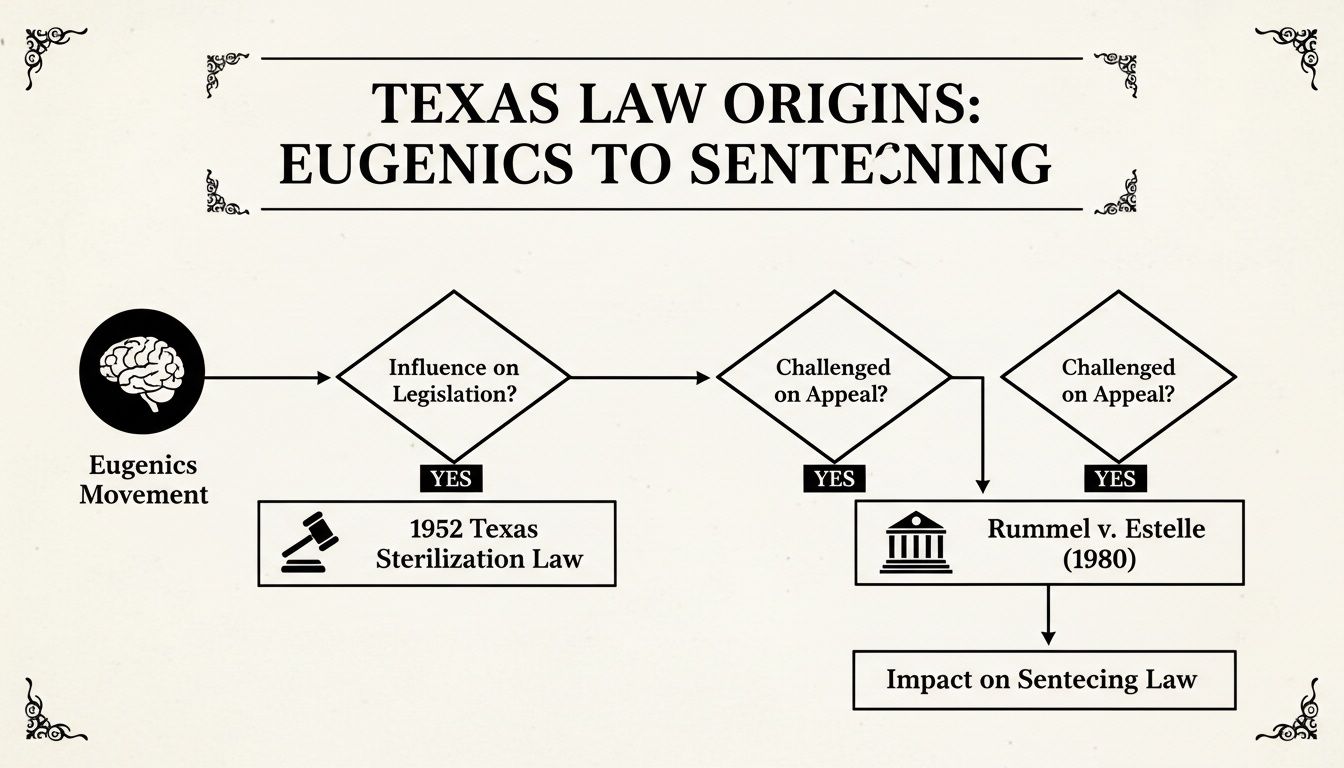
As you can see, there's a direct line from outdated, discredited theories about criminality to the harsh, inflexible sentencing laws we still deal with in Texas today.
From Years to a Life Sentence
The jump in potential prison time is just staggering. Under the Texas three strikes framework, a third felony conviction—whether it's a first, second, or third-degree offense—triggers a mandatory minimum sentence of 25 years to life in prison. This policy, which has its origins in 1950s habitual offender laws, completely changes the game for people facing repeat charges for things like assault, burglary, or even a felony DWI. You can get a deeper look into these sentencing guidelines and their history by reading further on Texas habitual offender laws.
Let’s walk through a real-world scenario to see exactly how this plays out.
Scenario: Sarah has two prior felony convictions from years ago:
- 2008: Felony DWI (a third-degree felony)
- 2015: Burglary of a Building (a state jail felony, but it was enhanced to a third-degree felony because of her prior DWI)
Fast forward to today. Sarah is arrested and charged with Aggravated Assault with a Deadly Weapon, a second-degree felony.
Without the habitual offender law, the punishment range for this new charge would be 2 to 20 years. But because she has two prior sequential felony convictions, the prosecutor can file a habitual offender notice. If she is found guilty, the judge’s hands are tied. Her sentence is automatically ratcheted up to 25 years to life in prison. Just like that, her past has turned a serious charge into a potential life sentence.
This mandatory sentencing strips away all judicial discretion. A judge can’t consider the specific circumstances, how much time has passed between offenses, or any evidence of rehabilitation. The law is a blunt instrument, plain and simple.
To really see how dramatically the punishment ranges escalate, take a look at the table below.
Texas Felony Sentencing Enhancements At A Glance
This table breaks down how prior felony convictions can drastically increase the potential punishment for a new felony charge in Texas.
| New Felony Offense | Sentence with No Priors | Sentence with One Prior Felony | Sentence with Two Prior Felonies (Three Strikes) |
|---|---|---|---|
| First-Degree Felony | 5 to 99 years or life | 15 to 99 years or life | 25 to 99 years or life |
| Second-Degree Felony | 2 to 20 years | 2 to 20 years (no change) | 25 to 99 years or life |
| Third-Degree Felony | 2 to 10 years | 2 to 20 years | 25 to 99 years or life |
This stark comparison makes it crystal clear why facing a habitual offender allegation demands an immediate, aggressive legal defense. The difference isn't just about a few extra years—it could be the rest of your life.
When people hear the term "three strikes," their minds usually jump to California's famous law that made national headlines back in the 90s. It's a catchy phrase, but it’s a dangerous mistake to assume the Texas three strikes law works the same way. In fact, the Texas version is often far more severe with a much broader reach, creating a uniquely perilous situation for anyone facing a felony charge with a prior record.
The biggest, most crucial difference comes down to what actually counts as a "strike." In many states, including California, three-strikes laws are typically reserved for a specific, pre-approved list of "serious" or "violent" felonies. That was the whole selling point of the legislation—to get the most dangerous offenders off the streets.
Texas, however, makes no such distinction.
A Broader and Harsher Net
Here in Texas, almost any felony can count as a strike. A non-violent drug possession charge, a theft case from a decade ago, or even a felony DWI can all be used to build the foundation for a habitual offender enhancement. This creates a shocking reality: someone with a history of lower-level, non-violent felonies can face the exact same life sentence as someone with a record of violent assaults.
This key difference can't be overstated. It creates a system where the punishment isn't about the crime you're facing today, but about the sheer number of checkmarks on your record.
The Texas law focuses on the quantity of your prior convictions, not the quality or nature of them. This is a fundamental and unforgiving distinction that sets it apart from many other states' laws.
Different Paths on Reform
California's original three-strikes law was so broad that it led to horror stories of people getting life sentences for things like stealing a slice of pizza. This caused massive prison overcrowding and a public outcry that, eventually, led to significant reforms. Voters passed initiatives to narrow the law's scope, requiring the third strike to be a serious or violent felony.
Texas has not followed that path. Our state's habitual offender statute has remained largely unchanged for decades, reflecting a continued "tough-on-crime" stance that leaves very little room for a judge's discretion or second chances. While other states have woken up to the human and financial costs of overly harsh sentencing, Texas law remains a blunt instrument.
Let's break down the core distinctions:
- Qualifying Offenses: In Texas, nearly any felony qualifies. In reformed states like California, it's typically limited to serious or violent felonies.
- Judicial Discretion: The Texas law is mandatory. Once the priors are proven, a judge has no choice but to impose the 25-to-life sentence. Other states often allow judges more flexibility.
- Path to Reform: California's law was softened by voter initiatives after its harsh consequences became clear. Texas has shown little legislative appetite for similar reforms.
Understanding this landscape isn't just an academic exercise—it's about recognizing the unique and severe battlefield you are on. The strategies that might work in another state are completely irrelevant here. You need a defense attorney who has deep, specific experience fighting cases within the unforgiving framework of Texas law. Your freedom and your family's future depend on it.
Defending Against Habitual Offender Allegations

Hearing a prosecutor label you a "habitual offender" can feel like the ground has crumbled beneath your feet. But it’s critical to remember one thing: an allegation is not a conviction. The state’s decision to pursue a "three strikes" enhancement is just the beginning of the fight, not the end. You have options, and with the right legal strategy, you can push back hard against this severe sentencing tool.
This is where hope and action intersect. The path forward demands a meticulous, aggressive defense that challenges the state’s case from every conceivable angle. It’s about dismantling the prosecutor's argument piece by piece, starting with the very foundation of their enhancement notice—your prior convictions.
Attacking the Validity of Prior Convictions
A prosecutor can’t just point to your record and call it a day. To use an old felony against you, they have to prove it’s a valid, final conviction. An experienced defense attorney will immediately launch an exhaustive investigation into those old cases, hunting for procedural errors or constitutional violations that could render them totally unusable.
Think of it like a structural inspection of the prosecutor’s case. If the foundation is cracked, the whole building can come down.
Here are some actionable steps you and your attorney can take:
- Scrutinize Prior Pleas: Did you truly understand the consequences when you took a plea deal years ago? Were you coerced, or did you have incompetent legal advice? If your plea wasn't made knowingly and voluntarily, it can be challenged.
- Investigate Prior Representation: The Constitution guarantees you the right to effective legal counsel. If your previous lawyer failed to investigate your case, advise you properly, or protect your rights, the conviction that resulted might be invalid.
- Demand Proper Documentation: The state needs a "pen packet"—a collection of certified court documents—to prove each prior conviction. Missing paperwork, clerical errors, or improperly prepared documents can create powerful grounds to get an enhancement thrown out completely.
Negotiating with the Prosecution
Beyond challenging the past, a strong defense also means skillful negotiation in the present. Even with what seems like a solid case, prosecutors are often willing to talk. They want to avoid the time and expense of a trial, especially a complex one involving a habitual offender enhancement.
A seasoned attorney can open a dialogue to have the enhancement waived entirely, arguing for a sentence based only on the new charge. Another powerful strategy is negotiating a plea to a lesser charge that doesn't trigger the Texas three strikes statute. For instance, pleading down to a misdemeanor or even a state jail felony without enhancements can mean the difference between a few months in jail and a life sentence.
An experienced lawyer doesn't just know the law; they know the local prosecutors and judges. This familiarity allows for more effective negotiation, leveraging relationships and a reputation for being a tough trial opponent to secure a better outcome for you.
Examining Options Like Deferred Adjudication
In some situations, it might be possible to negotiate a plea that avoids a final conviction altogether. Understanding what deferred adjudication is in Texas and how it works is crucial here, because successfully completing it means the charge never becomes a "final conviction" that could be used as a future strike.
This kind of forward-thinking strategy is vital. It's not just about winning the current battle but about protecting you and your family from future enhancements down the road.
The strategies needed to defend you are as complex as the law itself. Three strikes laws, including Texas's version which dates back to 1952, have a troubling history. Their origins are rooted in early 20th-century eugenics movements that aimed to permanently remove "habitual criminals" from society. You can learn more about the flawed history of these laws and see how their legacy continues today. Fighting back requires a lawyer who understands both the law's mechanics and its historical context. Your future depends on a defense that is proactive, strategic, and relentless.
Why Your Future Depends On An Experienced Attorney
Let's be blunt: facing a Texas three strikes enhancement isn't just a legal battle. It's a fight for your life. The information in this guide paints a stark and frankly terrifying picture where your freedom, your family, and everything you’ve built are on the line. A life sentence for what might be a non-violent crime isn't some far-off possibility; it's a real and present danger baked into Texas law.
This is absolutely not the time to roll the dice with an overworked public defender or an attorney who is just cutting their teeth on felony cases. You need a dedicated advocate in your corner, someone who lives and breathes the nuances of Texas felony law. You need a team with a proven history of dismantling the state’s habitual offender allegations and negotiating from a position of strength.
You Are More Than Just a Case File
Here at The Law Office of Bryan Fagan, we see the person, not just the paperwork. We know that behind every charge, there’s a human story, a family holding its breath, and a future that deserves to be defended with everything we’ve got. Our entire approach is built on listening to your side of the story, fiercely protecting your constitutional rights, and building the strongest, most strategic defense imaginable.
When a life sentence is on the table, hiring an experienced lawyer is non-negotiable. Understanding the strategies for marketing criminal defense lawyers can even give you an inside look at what separates truly top-tier representation from the rest. A skilled attorney doesn't just play defense; they anticipate the prosecutor's moves, they attack the evidence, and they control the narrative of your case.
Believe it or not, a strong defense can open up opportunities that might seem impossible right now. Successfully fighting the current charge or exploring post-conviction relief can create pathways to clearing your name. In our detailed guide on the subject, you can find out if felonies can be expunged in Texas.
Your next move is the most important one you'll make. The difference between a 5-year sentence and a life sentence often comes down to the quality of the legal counsel standing beside you.
Choosing the right attorney is the first—and most critical—decision in the fight to get your life back. Don't leave your future to chance. Let's take that next step together and build a defense designed to protect everything you hold dear.
Common Questions About The Three Strikes Law
If you're staring down the barrel of a Texas three strikes enhancement, your mind is probably racing with a million questions. It's a scary and isolating place to be, but you’re not the first person to walk this path. We've gathered some of the most common questions we hear from clients to give you the clear, direct information you need right now.
Think of these as clarifications to what we've already covered, adding detail to the nuances that can truly make or break a case.
Does A Misdemeanor Conviction Count As A Strike?
No, not at all. The Texas habitual offender law—what most people call the "three strikes" law—applies only to felony convictions. You could have a long history of misdemeanors, but they won't be used to trigger that life-altering 25-to-life sentence.
But there's a catch you need to watch out for. Some crimes, like DWI, can start as a misdemeanor and get bumped up to a felony on the second or third offense. Once an offense is officially a felony, it absolutely counts as a "strike" and can be used against you down the road.
What If My Prior Conviction Is From Another State?
This is a fantastic question, and the answer is a hard yes—an out-of-state conviction can definitely be used against you. The Texas Penal Code gives prosecutors the green light to use felony convictions from any other state, or even federal convictions, to enhance a new charge here in Texas.
However, it's not automatic. The prosecutor has to prove that the crime you were convicted of in another state would also be a felony under Texas law. A sharp defense attorney will dig into the laws of both states, looking for any inconsistencies to argue that the prior conviction isn't equivalent. It’s a crucial line of defense that can stop an enhancement in its tracks.
Is Parole Possible Under A Three Strikes Sentence?
Technically, yes, but the reality is brutal. Someone sentenced under the Texas three strikes law has to serve a minimum of 25 calendar years before they even get a chance to ask for parole. That's "flat time," meaning there are no shortcuts or credits for good behavior to shorten that sentence.
After those 25 years are up, parole is still no guarantee. The Texas Board of Pardons and Paroles will review the case, but the very nature of being labeled a habitual offender makes getting released incredibly difficult. This is exactly why the fight has to happen at the beginning, before the enhancement ever sticks.
Can A Habitual Offender Enhancement Be Removed?
Yes, and this is where a strong defense strategy is everything. An enhancement isn't a done deal the moment you're charged. The prosecutor has to formally file a notice of enhancement and then prove in court that your prior convictions are valid, sequential, and meet all legal requirements.
A good attorney can fight to get that enhancement thrown out by:
- Attacking the Priors: Digging into your old cases to find errors. Was it a bad plea? Did you have ineffective counsel? Are the court documents flawed? Any mistake can render a prior conviction invalid for enhancement purposes.
- Negotiating a Waiver: Sometimes, the best move is to convince the prosecutor to drop the enhancement notice. This often happens in exchange for a plea agreement on the main charge, but it gets that 25-to-life sentence off the table.
- Winning the Main Case: It sounds obvious, but if you're found not guilty of the new felony, the enhancement becomes completely irrelevant.
When you successfully remove the enhancement, you're not just fighting a legal notice—you're changing the entire outlook of your case and taking back your future.
When the stakes are this high, and your family's future hangs in the balance, you cannot afford to face the prosecution alone. The experienced and compassionate attorneys at The Law Office of Bryan Fagan understand how to dissect the state's case and build a powerful defense against habitual offender allegations. We know you are more than your past mistakes. Your story deserves to be heard, and your future deserves to be protected. Contact us today for a free, confidential consultation to discuss your case and learn how we can help you fight for your family. https://texascpslawyer.net