Skip to content
When you're a parent, the thought of any brush with the law is terrifying, especially when Child Protective Services (CPS) could get involved. The fear and confusion can be overwhelming. If you find yourself facing a criminal charge, the first step is understanding what it truly means for your family. In Texas, a Class A misdemeanor is the most serious type of non-felony offense, sitting just one rung below a state jail felony, and a conviction can have devastating consequences in a CPS case.
Defining a Class A Misdemeanor in Texas

The moment you're charged with a crime, your world can feel like it's spinning out of control. You'll hear legal terms like "misdemeanor" and "felony," but what do they really mean for your life, your job, and most importantly, your children? Let's be clear: a Class A misdemeanor is not a minor hiccup. It's a serious charge that can trigger a CPS investigation or severely damage your custody case.
Think of the criminal justice system as a ladder. Down at the bottom, you have minor infractions like a simple speeding ticket, which is a Class C misdemeanor. As you climb higher, the offenses—and the potential consequences—get much more severe. A Class A misdemeanor is right at the top of that misdemeanor ladder, just before you cross into the territory of felonies, which can carry state prison time.
The Potential Penalties Involved
Understanding the stakes is absolutely crucial. A conviction for a Class A misdemeanor can lead to significant penalties that directly impact your ability to work, provide for your family, and maintain custody of your children.
For a quick reference, here’s a look at the statutory range of punishment for a Texas Class A misdemeanor.
Texas Class A Misdemeanor Penalties at a Glance
| Penalty Type | Potential Range |
|---|---|
| Jail Time | Up to one year in a county jail |
| Fines | Up to $4,000 |
| Probation | A period of community supervision instead of, or in addition to, jail time |
As you can see, these consequences are designed to be punitive. To put it in perspective, it's helpful to contrast this with less severe charges. For example, you can learn more about the penalties for a Class B misdemeanor in Texas, which are generally half of what a Class A charge carries. That distinction matters because it shows just how seriously the state views the alleged offense.
The Texas Penal Code outlines these punishments to deter certain behaviors, but for a family caught in the crosshairs of the justice system and CPS, it feels less like a deterrent and more like a direct threat to your stability and future.
How Common Are These Charges?
These charges are more common than most people think. In 2022 alone, Texas saw over 100,000 misdemeanor convictions, and Class A misdemeanors made up a significant portion of those cases.
That statistic isn't meant to scare you—it's to show that you are not alone. Many good people, dedicated parents, find themselves in this exact situation, often because of one mistake or a complete misunderstanding. The key is not to panic. Instead, it's time to take immediate, informed action. Your first step should be contacting an attorney who understands both criminal defense and its impact on family law and CPS cases.
Getting Real: What Does a Class A Misdemeanor Look Like in Real Life?
Legal definitions can feel abstract and distant, like something from a textbook. But when you see how they play out in the real world, the stakes for your family become crystal clear. A Class A misdemeanor charge often springs from a single bad moment, a lapse in judgment that could happen to just about anyone. These aren't just legal terms; they're life-altering events that throw ordinary Texas families into crisis every single day.
It's especially critical for parents to grasp these examples. Why? Because many of these charges, if they turn into a conviction, can create a nightmare in family law cases or trigger a full-blown CPS investigation. Let's break down some of the most common situations that land people in front of a judge facing a Class A misdemeanor.
Common Charges and Everyday Scenarios
A whole range of actions can fall under the Class A misdemeanor umbrella. While the list is long, a few specific offenses pop up constantly on Texas court dockets, often intersecting with family life.
Here are some of the most common examples we see:
- Second DWI Offense: A first-time Driving While Intoxicated (DWI) charge is usually a Class B misdemeanor. The second time around, though, it’s automatically bumped up to a Class A charge, bringing much heavier penalties. For a parent, CPS can view this as evidence of endangerment or substance abuse.
- Assault Causing Bodily Injury: This can stem from a heated argument with a partner or another family member that gets physical. If it happens in front of your children, you could face not only this criminal charge but also a CPS investigation for domestic violence.
- Theft of Property ($750 – $2,500): Stealing property or services valued in this range lands you with a Class A misdemeanor. This could be shoplifting diapers and formula out of desperation or getting mixed up in a more complicated scheme.
- Violation of a Protective Order: If a judge has issued a protective order against you during a contentious divorce or custody battle, violating its terms—even through a text message—is a Class A misdemeanor. This is a perfect example of where family law and criminal law collide.
- Burglary of a Vehicle: Simply breaking into someone’s car with the intent to steal something is a serious offense that fits this category. It doesn't even matter if you ultimately take anything valuable.
These examples show just how fast a normal day can go wrong. One bad decision can lead to an arrest and a charge that puts your freedom, your job, and your family's future on the line.
How a Normal Night Can Become a Legal Crisis: A Story
Let’s look at a relatable scenario. Imagine a father named Mark going through a tough divorce. He goes to his old house to pick up some personal items, but his ex-wife isn't there. They had a verbal agreement that he could come by, but the stress of the divorce has made communication tense. A neighbor, seeing Mark at the house, misunderstands the situation and calls the police. When they arrive, his ex-wife, wanting to gain an advantage in their custody case, claims he was never supposed to be there and that she's afraid of him. Because of a temporary order from their divorce, he is arrested for violating that order.
Suddenly, Mark isn’t just dealing with a divorce. He's facing a Class A misdemeanor for Violation of a Protective Order. He’s a dedicated father who made a mistake based on a miscommunication. Now, he's terrified that this single charge will be used by his ex-wife’s attorney to argue he is unstable and a danger, potentially costing him custody of his children.
Mark’s story is a stark reminder of how a seemingly small misstep can become one of what are Class A misdemeanors in Texas, a harsh reality that can put your parental rights in jeopardy.
Navigating the Legal Process from Arrest to Trial
The sound of handcuffs clicking shut is a moment that changes everything. The world seems to stop, and for a parent, the first thought is always, "What about my kids?" Trying to make sense of the Texas criminal justice system can feel like navigating a maze blindfolded. But you don't have to stumble through it in the dark. Understanding the path ahead is your first step toward getting back in control.
Think of this section as your roadmap. We’re going to walk through every single stage of a Class A misdemeanor case, from the moment of arrest all the way to a final resolution. This isn't just a dry rundown of legal steps; it’s about knowing how to protect your rights, your freedom, and your family at every turn.
This infographic breaks down a few common examples of Class A misdemeanors to show how quickly an everyday situation can escalate.
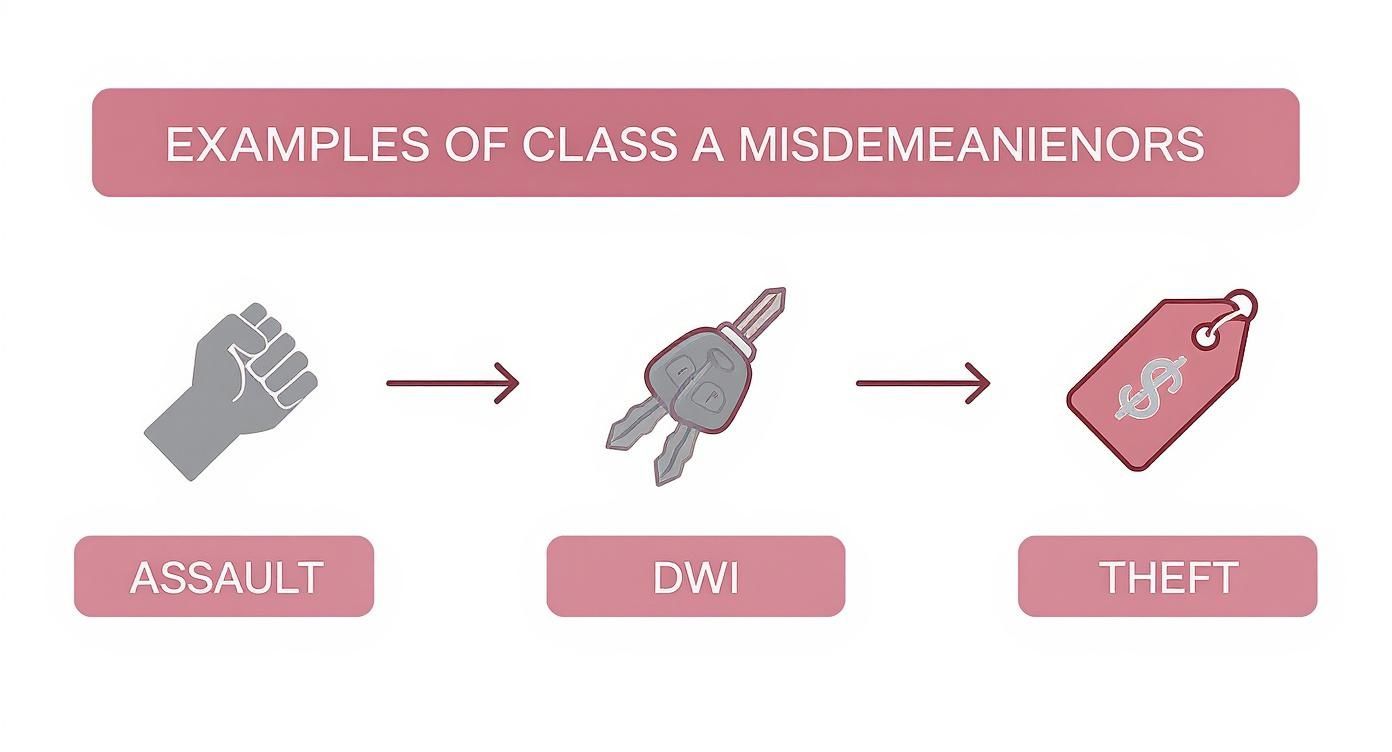
As you can see, offenses that seem completely different—like getting into a physical fight, being pulled over for DWI, or a shoplifting charge—all funnel into the same serious legal category, carrying consequences that can alter your life.
The Initial Arrest and Booking
It all starts with an arrest. From there, you'll be taken to a local jail for booking. This is the administrative process where they take your fingerprints, your mugshot, and your personal information. During this time, you have two critical rights: the right to remain silent and the right to an attorney. It is absolutely vital that you use them. Do not answer any questions about what happened until you have a lawyer.
Police are trained interrogators. Anything you say can be twisted and used against you in court and potentially by a CPS investigator. The best thing you can do is politely but firmly state, "I am not answering any questions without my lawyer present."
The First Court Appearance: Arraignment and Bail
Within 48 hours of your arrest, you’ll be brought before a judge for your first court appearance, called an arraignment. This hearing is a huge deal, and a few key things happen here:
- Formal Charges: The judge will officially read the criminal charges filed against you.
- Your Rights: You will be reminded of your constitutional rights.
- Enter a Plea: You'll be asked how you plead: "guilty," "not guilty," or "no contest." Pleading "not guilty" is almost always the right move at this point to keep all of your legal options open.
- Bail is Set: The judge will set your bail. If the alleged offense involves family violence, the judge may also issue a temporary protective order that prevents you from returning home or contacting your children.
A good lawyer can make a big difference here, arguing for a lower bail amount and fighting against restrictive bond conditions. Understanding what happens at an arraignment hearing can take a lot of the fear and mystery out of this first, critical step.
Pre-Trial Negotiations and Plea Bargaining
Once you're out on bond, your case moves into the pre-trial phase. Your attorney will be busy filing motions, demanding evidence from the prosecutor (a process called "discovery"), and digging into the state's case to find any weaknesses.
This is also when plea bargaining happens. The prosecutor might offer you a deal—like reducing the charge or recommending a lighter sentence—if you agree to plead guilty. Having an experienced attorney is non-negotiable here. They can evaluate how a plea deal might impact your CPS case or custody rights and push for an outcome that protects your family.
For instance, a skilled lawyer might negotiate a deferred adjudication. With this outcome, if you successfully complete probation, the entire case gets dismissed. This is often the best possible result for parents worried about how a criminal record could impact their future.
The Possibility of a Trial
The vast majority of Class A misdemeanors are resolved with a plea bargain. But if you and the prosecutor can't reach an agreement that protects your parental rights, your case will be set for trial. You have a constitutional right to a trial by a jury of your peers. It's their job to listen to all the evidence and decide if the state has proven its case against you beyond a reasonable doubt.
Going to trial is a serious decision, but sometimes it's the only path to justice. It might be your only chance to prove your innocence, clear your name, and prevent a conviction from being used against you in family court.
The Hidden Consequences of a Conviction on Your Family

The penalties you read about in the Texas Penal Code—the potential jail time and hefty fines—are really just the tip of the iceberg. For a parent, the true weight of a Class A misdemeanor conviction is the collateral consequences that ripple through every part of your family’s life, especially when CPS is involved.
A conviction creates a permanent criminal record. Think of it as a digital ghost that follows you everywhere, creating very real barriers that can slam the door on opportunities. It can stop you from getting a job, prevent you from renting a safe apartment for your family, and even strip you of your constitutional right to own a firearm.
These aren't just abstract possibilities. They are real-world roadblocks that can make providing for and protecting your children incredibly difficult.
The Impact on Your Professional and Personal Life
Imagine trying to build a better future for your kids, only to be constantly held back by one past mistake. A conviction for a Class A misdemeanor can feel like a scarlet letter in the eyes of employers and licensing boards, jeopardizing your ability to simply earn a living.
-
Employment Struggles: Most employers run background checks. A conviction for assault, theft, or DWI could mean your application gets tossed aside immediately, no matter how qualified you are.
-
Professional Licenses: If you're a nurse, teacher, or hold any other state-issued professional license, a conviction could trigger a review by your licensing board, potentially leading to suspension or revocation.
-
Housing Instability: Landlords almost always run background checks. Having a criminal record can make it incredibly difficult to find safe, affordable housing, creating a constant sense of instability for your entire family.
This domino effect can create a cycle of financial and emotional stress, making it that much harder to be the stable, present parent your children need you to be.
When a Criminal Charge Threatens Your Parental Rights
For any parent, the most terrifying consequence of a criminal conviction is the threat it poses to your relationship with your children. This is especially true if you are already involved with Child Protective Services (CPS) or are in the middle of a difficult child custody dispute.
A conviction for certain offenses can be used as direct evidence against you in family court. For example, a conviction for assault causing bodily injury, particularly if it involves a family member, can be used by CPS to argue that you are a danger to your children. This could become a key factor in a judge’s decision to remove your children from your home under Texas Family Code Chapter 262, which governs emergency removals.
In a similar vein, a conviction for a second DWI can easily be framed as proof of a substance abuse problem that endangers your kids. Under Chapter 263 of the Family Code, the court must consider any history of substance abuse when making decisions about your child's placement. An opposing attorney in a custody battle won't hesitate to use this against you to argue for restricted or supervised visitation.
The stakes could not be higher. A Class A misdemeanor isn't just about you—it’s about your ability to protect your family and hold on to your fundamental rights as a parent. This is why building a strategic defense is an absolute necessity from the moment you are charged.
How to Clear Your Record After a Misdemeanor Charge
Being charged with a crime can feel like a permanent storm cloud has settled over your family’s future. The fear and uncertainty are overwhelming, but you need to hear this loud and clear: a criminal charge does not have to define the rest of your life. Texas law provides real pathways for good people to move past a mistake and get their lives back. Hope is not lost.
Understanding your options for clearing your record is a powerful step toward putting this chapter behind you for good. The two primary legal tools we use are expunctions and orders of nondisclosure. They might sound similar, but they operate in very different ways.
Expunction vs. Nondisclosure: What is the Difference?
Let’s break this down. Think of an expunction as completely destroying the record of your arrest and charge. Once it’s done, you can legally deny the whole thing ever happened. It is the most complete form of record-clearing available.
An order of nondisclosure, on the other hand, is more like putting that record in a locked safe. The record is sealed from public view. This means that when a potential employer or landlord runs a background check, they won't see it. Law enforcement and certain state agencies, however, can still access it if needed.
So, how do you know which one you might qualify for? Let's compare them side-by-side.
Expunction vs. Nondisclosure in Texas: Which is Right for You?
When it comes to clearing a criminal record in Texas, expunction and nondisclosure are the two main roads you can take. While both offer a fresh start, they are designed for very different case outcomes. The table below breaks down the key differences to help you see which path might be open to you.
| Feature | Expunction (Record Destroyed) | Nondisclosure (Record Sealed) |
|---|---|---|
| Common Eligibility | Your case was dismissed, you were found not guilty at trial, or you were pardoned. | You successfully completed deferred adjudication probation. |
| Effect on Record | All records are physically destroyed. You can legally deny the arrest. | The record is sealed from public view but not destroyed. |
| Who Can See It | No one. The records are gone. | Only law enforcement and specific government agencies. |
| Waiting Period | Varies based on the offense, but you can often file immediately after a dismissal or acquittal. | A waiting period is typically required after completing probation. |
The crucial takeaway here is that the outcome of your case is the single most important factor determining your eligibility. This is precisely why having a strong, strategic defense from the very beginning is so critical. An experienced attorney can fight for an outcome—like a complete dismissal—that opens the door for an expunction. To get a better sense of how that works, you can read our guide on how to get criminal charges dropped.
Taking Action to Reclaim Your Future
While the core classifications for Class A misdemeanors have stayed fairly consistent in Texas, there's been a noticeable shift in recent years. The justice system is placing a greater emphasis on alternatives to jail time, which makes outcomes like deferred adjudication—the key to getting a nondisclosure—more accessible than ever before. You can learn more about sentencing trends for Class A misdemeanors in Texas and see how this evolution might benefit your case.
The most important thing to remember is that your record will not clear itself. You must take proactive legal steps by filing a petition with the court.
Navigating the specific waiting periods, filing requirements, and court procedures can feel like a maze. An actionable first step is to gather all your court paperwork from the original case. Then, consult with an attorney to review the final disposition and determine your eligibility. This isn’t just about a legal process; it’s about restoring your reputation and protecting your family’s opportunities.
Why You Need an Experienced Defense Attorney Now
While this guide is designed to give you knowledge, only the right legal partner can provide true protection when your family's future is on the line. The moments immediately following an arrest for a Class A misdemeanor in Texas are the most critical for building a strong defense, especially when children are involved.
Evidence can disappear. Witness memories can fade. A single misstep can cause irreparable harm to your case and your standing as a parent.
An experienced attorney who understands the intersection of criminal law and family law can act swiftly to preserve crucial evidence, file motions to challenge the prosecution's case, and offer the calm, steady guidance you need. We will advise you on exactly what to say—and what not to say—to law enforcement and CPS investigators.
Your Advocate and Your Shield
Facing the power of the state alone is an overwhelming and isolating experience. The prosecutor has one goal: to secure a conviction. They aren't there to consider the devastating impact a conviction would have on your children, your career, and your livelihood. You need someone in your corner who is just as dedicated to protecting you.
We understand the fear and stress that a criminal charge brings into a home. It's a heavy weight to carry, especially when you're trying to hold your family together. You do not have to navigate this complex and unforgiving system by yourself.
Let us stand beside you as your shield and your advocate. We will fight to protect your constitutional rights at every stage, from the initial bail hearing to plea negotiations and, if necessary, a jury trial. Our job is to tell your story, challenge the state's evidence, and work tirelessly toward the best possible outcome—one that protects both your freedom and your parental rights.
Don’t wait for the system to decide your family's fate. Take control of your future today. If you are a parent facing a Class A misdemeanor, we invite you to call The Law Office of Bryan Fagan for a free, completely confidential consultation. Together, we can create a powerful strategy to protect your rights, your reputation, and everything you hold dear.
Got Questions? We've Got Answers.
When you're facing the justice system, your mind is probably racing with urgent questions. It's completely normal. Here are some clear, straightforward answers to the concerns we hear most often from Texas families caught in the middle of a Class A misdemeanor charge.
Can My Misdemeanor Turn Into a Felony?
Yes, it absolutely can. Under certain circumstances, what starts as a Class A misdemeanor can be "enhanced" to a felony charge. This usually happens when you have prior convictions on your record.
The classic example is a DWI. A second DWI is a Class A misdemeanor, but a third DWI is automatically filed as a third-degree felony in Texas. A charge for Assault Causing Bodily Injury involving a family member can also be enhanced to a felony if you have a previous domestic violence conviction.
Does a Conviction Automatically Mean Jail Time?
Not necessarily. While the law allows for a sentence of up to one year in county jail, it's far from a mandatory outcome. A lot of factors come into play—the unique facts of your case, your criminal history (or lack thereof), and the strength of the defense you present.
An experienced attorney can often negotiate alternatives to jail. Things like community supervision (probation) or deferred adjudication are common outcomes, especially for first-time offenders. For parents, avoiding jail time is paramount to maintaining stability for their children and complying with any CPS service plans.
How Long Will This Stay on My Record?
Forever, unless you take action. A conviction for a Class A misdemeanor in Texas is permanent. It will show up on public background checks indefinitely and won't just "fall off" after a few years.
The only way to get an arrest or conviction off your record is to go back to court and petition for an expunction (which completely destroys the record) or an order of nondisclosure (which seals it from public view). Whether you're eligible for one of these powerful legal tools depends entirely on how your case was resolved. This is a critical step for any parent wanting to pass background checks for volunteering at their child's school or coaching their sports team.
Facing a Class A misdemeanor can feel like you're navigating a storm alone, especially with the added fear of CPS involvement. You don't have to. The team at The Law Office of Bryan Fagan, PLLC is here to offer the compassionate guidance and aggressive defense your family deserves. We understand both sides of this coin—the criminal charge and its impact on your family. We invite you to contact us for a free, confidential consultation to discuss your case and learn how we can help protect your future.