Skip to content
The moment you're notified of a court date, especially after an arrest, a wave of fear and confusion can wash over you. For Texas parents, this anxiety is often magnified, particularly if the situation could lead to Child Protective Services (CPS) involvement. Suddenly, your family's future feels uncertain, and the complex legal jargon only adds to the stress.
If this sounds familiar, please know that your feelings are completely valid. An arraignment hearing is your first formal appearance in court, but it's not a trial to determine guilt. Think of it as the official starting point for the court process. Understanding what happens at an arraignment hearing is the first step toward replacing fear with empowerment and protecting your family.
Your First Day in Court: The Purpose of an Arraignment
An arraignment is where a judge officially reads the charges against you, ensures you understand your constitutional rights, and asks you to enter an initial plea. For families navigating the justice system, this hearing is a critical first step where the foundation for your defense is laid.
A Relatable Scenario for Texas Parents
Imagine this: a parent—we'll call her Maria—has a heated argument with her ex-spouse during a custody exchange. A neighbor misinterprets the loud voices, calls the police, and Maria is arrested for a misdemeanor offense. Now, she has an arraignment date and is terrified. Her main concerns are not just the criminal charge, but what this means for her children and a potential CPS case.
For Maria, and for many parents in her position, the arraignment is the court's way of officially starting the case. The judge will state the formal accusations, explain Maria's rights, and ask how she wishes to proceed. It's a procedural step, but one where the right guidance is crucial to prevent the situation from escalating and impacting her parental rights under the Texas Family Code.
The Core Steps of an Arraignment
The primary purpose of an arraignment is to ensure the process is fair and transparent from the beginning. It’s where the court confirms you know what’s happening and asks if you have a lawyer. The infographic below breaks down the simple, three-step flow of the hearing.
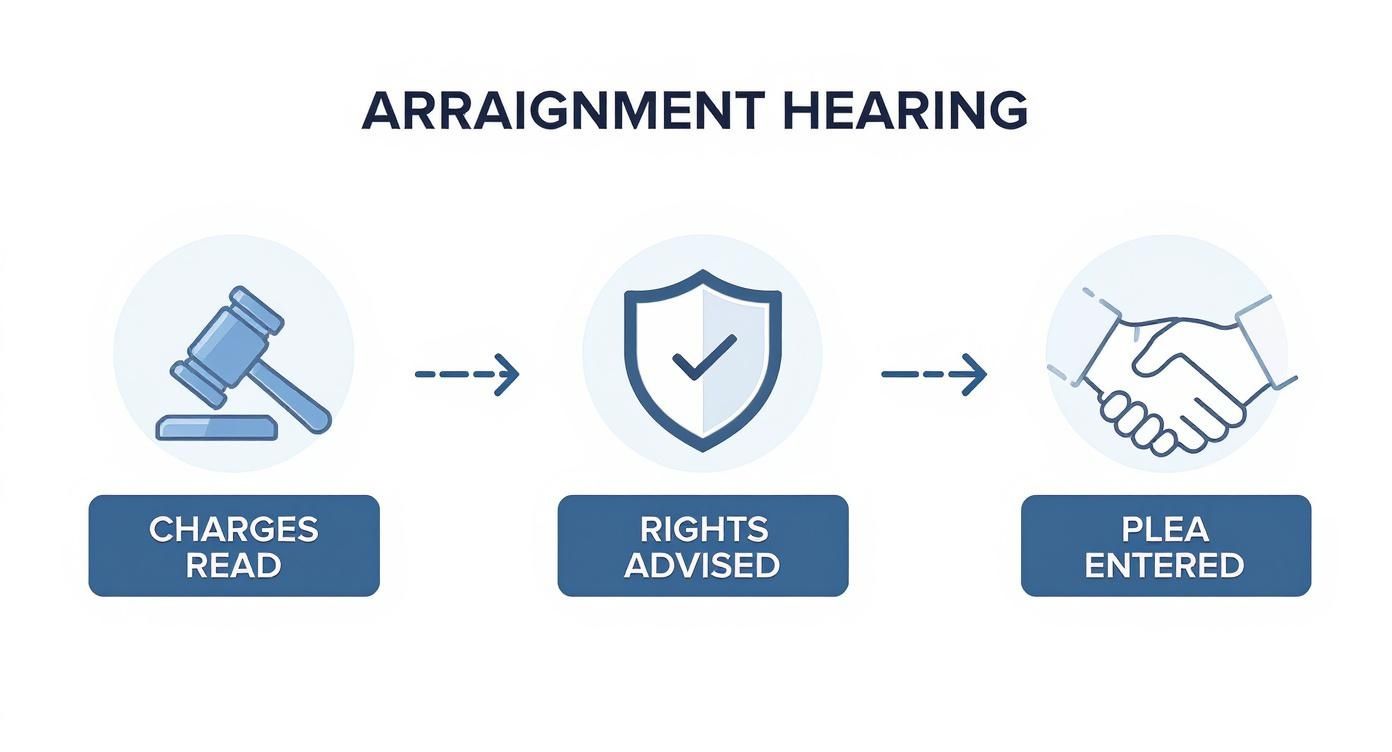
As you can see, the process is straightforward: the charges are stated, your rights are explained, and you enter a plea. This sets the stage for everything else. The decisions you make here are critical, which is why it's important to understand what happens if you plead guilty before you ever step into the courtroom.
Key Events During Your Texas Arraignment Hearing
To give you a clear summary of what to expect, here’s an overview of the core components of an arraignment hearing.
| Event | What It Means for You |
|---|---|
| Case Called | Your name and case number are announced, and you approach the judge. |
| Charges Read | The judge formally reads the criminal charges filed against you by the prosecutor. |
| Rights Advised | You are informed of your key constitutional rights, including the right to an attorney. |
| Counsel Inquiry | The judge will ask if you have a lawyer or if you need one appointed to you. |
| Plea Entry | You will be asked to enter an initial plea: Guilty, Not Guilty, or No Contest. |
| Bail/Bond Review | The judge may review and set the conditions for your release while the case is pending. |
| Next Court Date | A date for your next appearance (like a pre-trial conference) will be scheduled. |
Each of these steps is a formal part of the legal process designed to ensure fairness and clarity as your case moves forward.
The Four Main Goals of an Arraignment Hearing
An arraignment can feel like a blur of legal formalities, but it’s a crucial, highly structured hearing with a clear purpose. Think of it as the official "kick-off meeting" for your criminal case, where the judge lays down the ground rules and makes sure everyone is on the same page. Knowing what the court is trying to accomplish can take you from being a nervous observer to an informed participant in your own defense.
This first major court appearance is built around four primary goals. Each one is a fundamental step in the Texas criminal justice process, designed to protect your rights while moving the case forward.

Formally Notifying You of the Charges
The first and most basic goal is simply to make sure you know exactly what the State of Texas is accusing you of doing. The judge will read the formal charges aloud from the official charging document, which could be a complaint or an indictment.
This isn't just a casual mention. It's a formal declaration of the specific laws you are alleged to have broken. This step is designed to eliminate any confusion and ensure you understand the legal foundation of the case against you.
Advising You of Your Constitutional Rights
Next, the court takes a moment to formally explain your fundamental constitutional rights. This is a critical safeguard in our legal system, and it's not something to take lightly.
These rights include the right to an attorney, the right to remain silent (so you don't incriminate yourself), and the right to a trial by jury. If you can't afford a lawyer, the judge will also explain how you can request a court-appointed one. This is the court’s way of ensuring you are equipped with the knowledge needed to protect yourself.
"The arraignment hearing is where the court formally guarantees your constitutional protections. It's the system's way of hitting pause to say, 'Before we go any further, you need to know your rights and have legal counsel to help you exercise them.'"
Accepting Your Initial Plea
Once you understand the charges and your rights, the court will ask you to enter an initial plea. In Texas, you generally have three options: guilty, not guilty, or no contest (also known as nolo contendere).
- Not Guilty: This is almost always the plea entered at an arraignment. It preserves all of your legal rights and gives your attorney the time needed to review the evidence and start building a defense.
- Guilty or No Contest: Pleading guilty or no contest at this early stage effectively ends your case and moves you straight to sentencing. This is rarely a good idea without first having an experienced attorney thoroughly review your case.
Setting Conditions for Pretrial Release
Finally, the judge will address your release status while the case moves forward. This is where bail is officially set or reviewed.
The judge looks at several factors, like the seriousness of the charge and your connections to the community, to decide if you can be released on your own recognizance (a personal promise to appear) or if a bond is required. For Texas families, this is often the most stressful part of what happens at an arraignment hearing, as it directly impacts your freedom and ability to work and care for your children.
Understanding these four goals helps demystify the entire arraignment process. It isn’t a trial, but a structured proceeding with very specific objectives. Knowing this allows you to focus on what matters most: taking the next right step for your family's future.
How to Protect Your Rights During the Hearing
When you walk into an arraignment, your constitutional rights are your most powerful shield. This is the moment the court officially reminds you of these protections, but hearing about them from a judge is a world away from knowing how to use them effectively. For any parent caught in the Texas legal system, understanding what these rights mean in practical terms is absolutely critical for protecting your family’s future.
The two big ones at this stage are the right to remain silent and the right to an attorney. Think of them as a one-two punch that safeguards your interests before you can make any moves you can't take back.
Insist on Your Right to an Attorney
If you only do one thing at your arraignment, make it this: insist on having a lawyer. The judge will ask if you have one or if you need one appointed because you can't afford it. You should never, ever proceed without legal counsel.
Your attorney’s job is to speak for you, poke holes in the state's case, and guide you down the best path. They act as a critical buffer, preventing you from accidentally saying something that could wreck your case down the road. This confidential communication is a cornerstone of your defense, and it’s worth understanding attorney-client privilege rules so you know just how protected those conversations are.
Exercise Your Right to Remain Silent
Your right to remain silent—often called "pleading the Fifth"—is not an admission of guilt. Far from it. It’s a fundamental protection designed to keep you from accidentally incriminating yourself. This means you shouldn’t discuss the details of your case with the prosecutor, the police, or anyone else without your lawyer by your side.
An arraignment is not the time to tell your side of the story. It is a procedural hearing where your primary job is to listen, not to talk. Let your attorney do the talking for you.
For example, a parent trying to be helpful might try explaining the heated context of a family argument to the prosecutor, only to accidentally admit to key elements of an offense. Your lawyer’s job is to control the flow of information and protect you from these common, devastating mistakes. The same principle applies in other legal fights, where a skilled lawyer can show you how to fight a DWI in Texas by carefully managing everything you say.
Always Plead Not Guilty at Arraignment
Unless your attorney has already worked out a specific plea deal beforehand—which is extremely rare at this early stage—the safest and smartest plea is "not guilty." Pleading not guilty doesn't mean you're claiming you'll be proven innocent at trial. It's a strategic move.
Here’s what a "not guilty" plea really does for you:
- It preserves all your legal options. This gives your attorney the breathing room needed to review every piece of evidence the state has against you.
- It forces the state to prove its case. The burden is entirely on the prosecutor to prove guilt beyond a reasonable doubt. Don't do their job for them.
- It gives you time to build a defense. Now, your lawyer can get to work filing motions, interviewing witnesses, and negotiating on your behalf.
Pleading guilty or "no contest" at an arraignment is like forfeiting the game before it even begins. You surrender your right to a trial and jump straight to sentencing, losing any chance to challenge the accusations. Protecting your rights at this first hearing is your first—and best—step toward a positive outcome.
Navigating Bail and Pretrial Release in Texas
For most families in Texas, the single most stressful moment of an arraignment hearing is when the judge gets to the topic of bail. It’s a decision that can feel like it holds your entire life in the balance—determining whether you can go home to your kids and your job, or if you have to sit in jail while your case slowly moves forward. The outcome here can shake your family's stability to its core.
This part of what happens at an arraignment hearing isn’t supposed to be arbitrary. A Texas judge is legally required to weigh several key factors before setting the conditions for your pretrial release.
How Judges Determine Bail
The main goal of bail isn't to punish you; it's simply to make sure you'll show up for future court dates. To figure that out, a judge is supposed to look at the whole picture:
- The Alleged Offense: How serious are the charges? This definitely plays a big part in the bail amount.
- Your Ties to the Community: Do you have a steady job, own a home, or have deep family roots in the area? These things show you're not likely to just disappear.
- Any Perceived Risk: The judge will also consider whether you might pose a danger to the community or a specific person if you're released.
- Your Criminal History: A past record, especially one with missed court dates, can unfortunately lead to a higher bail.
This is where having an experienced attorney is absolutely vital. They can build a strong argument that highlights your community ties and low flight risk, pushing for your release on a personal recognizance bond (which is just a promise to appear) or at least a reasonably low cash bond.
The Reality of Bail in Texas Courts
Unfortunately, the system doesn’t always operate the way it’s designed to. The law clearly states that judges must consider a person’s ability to pay when setting bail, but this crucial step is often skipped over. Shocking research shows that in 77% of cases where cash bonds were set, judges completely failed to consider the defendant's ability to pay—a direct violation of state law.
This practice means thousands of people are stuck in jail not because they're a flight risk, but simply because they can't afford the price tag on their freedom. You can dig into the specifics of these judicial practices and their devastating impact in the full report.
This gap between law and practice is where families get hit the hardest. An unaffordable bail can make a parent lose their job, fall behind on rent, and put their ability to care for their children in jeopardy—all before they've even had their day in court.
Why Your Attorney's Argument Matters So Much
Think about a single parent who is the sole provider for their family. Setting a bail of several thousand dollars might as well be a million. Without the money to post bond, they could be forced to sit in a jail cell for weeks or even months while their life completely unravels on the outside.
This is exactly why having an attorney fighting for you at the arraignment isn't a luxury—it’s a necessity. We can bring evidence of your financial situation to the judge's attention, argue for non-financial release conditions, and hold the court accountable to follow the law. A fair bail decision isn’t just about legal strategy; it’s about keeping your life and your family from falling apart while you fight your case.
Understanding Disparities in the Court System

It’s an uncomfortable truth, but the scales of justice don't always feel perfectly balanced for everyone who walks into a courtroom. For many parents, especially those from minority communities, there’s a deep, nagging worry that factors completely outside the facts of their case could color how they’re treated.
This fear isn’t just in your head; it’s a valid concern, rooted in systemic issues that can—and do—affect legal outcomes. We bring this up not to scare you, but to acknowledge that what you're feeling is real. Part of understanding what happens at an arraignment hearing is recognizing that biases, conscious or not, can exist.
The Impact of Bias on Bail Decisions
It’s not just a feeling—research backs it up. Study after study has shown that a defendant's background can unfortunately play a role in critical decisions like setting bail, which has an immediate and direct impact on families.
For instance, one study found that Black defendants were hit with systematically higher bail requests from prosecutors than their white counterparts during arraignment. You can read more about these research findings to see exactly how these disparities are measured and documented.
This data confirms why having a fierce legal advocate in your corner isn't a luxury—it's an absolute necessity. A dedicated attorney’s job is to force the court to focus only on the facts and the law, not on personal characteristics.
Why a Strong Legal Advocate is Your Best Defense
This is where a skilled defense attorney steps in to level the playing field. Our entire purpose is to actively push back against potential biases by building a powerful, fact-based argument for fair and equal treatment under the law. We make sure your story is heard, your ties to the community are front and center, and your rights are defended with everything we've got, no matter who you are or where you come from.
The presumption of innocence isn't just a nice idea; it's a fundamental right that belongs to every single person. Our commitment is to fight for you from day one, ensuring this principle is upheld at your arraignment and every single step that follows.
Ultimately, your attorney acts as a shield, standing between you and a system that sometimes has its flaws. We are here to fight for you, your family, and your future.
What Happens After Your Arraignment Hearing
Once you walk out of that courtroom, the biggest question on your mind is probably, "What's next?" The arraignment might feel like a huge deal, but in the grand scheme of your case, it’s really just the starting line. The real work—the behind-the-scenes strategy—begins now.
This next stage is called discovery. Think of it as your attorney’s investigation period. The law actually requires the prosecutor to hand over every piece of evidence they have collected against you. This isn’t just a summary; it’s everything—police reports, witness statements, lab results, and any video or audio recordings they plan to use.
Building Your Defense Strategy
Your legal team will go through every single piece of this evidence with a fine-tooth comb. We’re hunting for weaknesses in the prosecution's case, inconsistencies in testimony, and any violations of your constitutional rights that may have happened during the arrest or investigation. This deep dive is the bedrock of your entire defense.
Based on what we find, a few things start to happen:
- Negotiations with the Prosecutor: Your attorney may start talking with the prosecutor about the case. This could mean exploring a potential plea bargain or even showing them evidence we've found that might convince them to dismiss the charges.
- Filing Legal Motions: If we discover evidence that was obtained illegally or find other major procedural screw-ups, we will file motions to have that evidence suppressed. If a judge agrees, it means the prosecutor can't use it against you.
- Preparing for Future Court Dates: The court will set more dates on the calendar, like pre-trial conferences. These are checkpoints where your attorney updates the judge on how the case is progressing.
The time between your arraignment and your next court date isn’t quiet time; it's proactive time. This is when a dedicated legal team works tirelessly, challenging the state’s evidence and building the strongest possible defense for you.
This intensive prep work is absolutely essential. It’s how we map out the best path forward, whether that means negotiating a favorable outcome or gearing up for a potential trial. For many families, this is also the period where we explore every possible avenue, including understanding how to get criminal charges dropped altogether.
The arraignment is just step one; the strategic work that comes next is what truly shapes the final outcome of your case.
Frequently Asked Questions About Texas Arraignments
Facing any court date, especially one as important as an arraignment, naturally brings up a lot of practical questions. The unknown can be a major source of stress, so let's tackle some of the most common concerns we hear from Texas families head-on.
Should I Hire an Attorney Before My Arraignment Hearing?
Yes. Without a doubt. Walking into your arraignment with an experienced attorney is one of the most powerful moves you can make.
Think of it this way: the arraignment is the official kickoff of your case. Your attorney can immediately start protecting your rights, advising you on the best way to plead, and arguing for reasonable bail conditions. Showing up alone puts you at a serious disadvantage from the very beginning.
What Should I Wear and Bring to Court?
How you present yourself sends a message. It’s all about showing respect for the judge, the court, and the gravity of the situation.
- Attire: Dress conservatively. Think business casual—something you’d wear to a job interview or a church service is a good rule of thumb. Steer clear of shorts, graphic t-shirts, hats, or anything that looks too casual.
- What to Bring: Make sure you have any paperwork related to your case, along with a pen and notepad for taking notes. Leave your cell phone in the car unless you've been given explicit permission to bring it in. If you do bring it, make sure it is completely turned off, not just on silent.
The goal is to appear respectful, responsible, and engaged in the process. Your appearance can subtly influence perceptions, so it’s best to present yourself in a serious and thoughtful manner.
Can My Case Be Dismissed at the Arraignment?
It is extremely rare for a case to get thrown out at the arraignment. This first hearing is almost entirely procedural—its purpose is to formally read the charges and get the legal process rolling.
A dismissal is something that typically happens much later in the game. It usually comes after your attorney has had the chance to dig into the evidence, find weaknesses in the prosecution's case, and file specific legal motions arguing for it. It's really important to manage your expectations about what can realistically happen at this early stage.
Navigating the justice system is daunting, but you don't have to do it alone. At The Law Office of Bryan Fagan, we understand the fear and uncertainty that Texas parents face when their family's future is at stake. We are here to provide the authoritative legal guidance and compassionate support you deserve. If you have an upcoming arraignment or are concerned about how a criminal charge could affect your family and parental rights, contact us for a free consultation. Let us stand with you and fight for the best possible outcome for you and your children.