Skip to content
When you're staring down a domestic violence accusation, the fear and confusion can be overwhelming, especially when it threatens to involve Child Protective Services (CPS) and tear your family apart. The single most important move you can make is to find a domestic violence lawyer near me who understands both the criminal charges and the Texas Family Code. The Law Office of Bryan Fagan is here to help with free, confidential consultations so you can understand your rights and start building a solid defense right away.
Your First Steps After a Domestic Violence Accusation

The moment police lights flash outside your window, your world can grind to a halt. What started as a private family argument suddenly explodes into a very public legal crisis, and the shock can be paralyzing. For Texas parents, the immediate fear isn't just about jail—it's about CPS showing up and threatening to take your children. In these first few hours, every single decision you make—or don't make—will echo through your case, affecting your freedom, your reputation, and your ability to keep your family together.
Think about how quickly it can happen. A heated argument with your spouse gets too loud. A neighbor calls 911. Minutes later, officers are at your door, separating you, asking sharp questions. Before you can get your bearings, you're in handcuffs, being arrested for Assault Family Violence. The next day, you might get a call from a CPS investigator.
This isn't the time to panic. It's the time for a calm, strategic response. What you do next sets the entire stage for your defense.
What to Do Immediately
In the chaos, your instinct might be to explain your side of the story, hoping to clear things up. This is almost always the most damaging mistake you can make. The most critical actions are often counterintuitive but are essential for protecting your rights.
You need to remember three things above all else:
- Invoke Your Right to Remain Silent: Politely but firmly tell the officers, "I am exercising my right to remain silent, and I want to speak with a lawyer." Anything you say can and will be used against you.
- Do Not Resist Arrest: Even if you feel the arrest is unfair, resisting will only get you more charges. Comply calmly.
- Contact a Lawyer Immediately: Do not talk to anyone—not the police, not detectives, and especially not a CPS investigator—without your attorney present. Your lawyer is your shield.
The following table breaks down these crucial first steps and why they matter.
Immediate Actions Following a Domestic Violence Allegation
| Action | Why It Is Critical | Potential Consequence of Inaction |
|---|---|---|
| Remain Silent | Anything you say can be misinterpreted or used to build a case against you. Your words become the prosecution's evidence. | Accidentally admitting to key elements of the offense, which can make a defense nearly impossible. |
| Do Not Resist Arrest | Resisting adds new criminal charges (like Resisting Arrest), making your legal situation worse and complicating your release on bond. | Facing additional criminal charges, higher bail, and a negative perception by the judge and prosecutor from the start. |
| Call a Lawyer | An attorney immediately protects your rights, handles communication with law enforcement and CPS, and starts working on your defense. | Waiving your rights without realizing it, making statements that damage your case, and missing opportunities to preserve evidence. |
Taking these steps isn't about admitting guilt; it's about protecting your future and your family.
Why Your First Call Should Be to a Lawyer
An experienced domestic violence attorney does more than just show up in court. They become your guide through a legal system that feels designed to intimidate you. From the moment you call, they can start working to get you out of jail.
A domestic violence accusation in Texas can trigger an immediate Emergency Protective Order, forcing you out of your home and cutting off contact with your children. It can also be the catalyst for a full-blown CPS investigation under Chapter 262 of the Texas Family Code.
Your attorney will prepare you for your first court appearance, called an arraignment hearing. This is where you are formally charged. Having skilled legal counsel with you from this first step is crucial.
Ultimately, your lawyer is your advocate. They challenge the prosecution's story, find evidence that supports your side, and fight to minimize the damage. That fight starts the moment you pick up the phone.
When you’re staring down a domestic violence charge in Texas, it can feel like the prosecution is speaking a different language. Words like “family violence,” “household member,” and “dating relationship” aren't just casual terms; they are legal definitions with razor-sharp edges under the Texas Family Code. Getting a handle on what they mean is the first step in building a defense. It’s about understanding precisely what the State has to prove to get a conviction.
The law casts a wide net. "Family violence" isn’t just for married couples. It covers any act meant to cause physical harm, injury, or assault—or even just a threat that makes someone fear those things are coming.
Who the Law Considers "Family"
It's a common mistake to think "family violence" only applies to blood relatives or spouses. The Texas Family Code defines these relationships much more broadly, which is how a simple argument can quickly spiral into a life-altering criminal charge.
A basic assault charge gets upgraded to "family violence" if the incident allegedly happened between:
- Current or former spouses: This is the one most people think of.
- Parents of the same child: It doesn't matter if you were ever married or lived together.
- Members of a household: This includes anyone who lives in the same home now or did in the past.
- People in a "dating relationship": This is often a major point of conflict in court, as it's defined as an ongoing romantic or intimate relationship.
Grasping these definitions is critical. They are the legal switch that flips a standard assault case into a far more serious family violence charge, one that comes with consequences that can follow you for life. You can see how these charges differ in our detailed breakdown of assault charges in Texas.
From Misdemeanors to Felonies
Not all domestic violence allegations are treated equally. The specific accusation and your criminal history will determine if you’re looking at a misdemeanor or a felony. The penalties ramp up fast.
For a first-time accusation of Assault Family Violence with no serious injury, the charge is usually a Class A Misdemeanor. A conviction means up to a year in county jail, a fine of up to $4,000, and a permanent criminal record that can never be sealed.
"The reality of domestic violence is staggering. In the United States, an average of 24 people per minute are victims of rape, physical violence, or stalking by an intimate partner."
These statistics are why prosecutors and judges take these allegations so seriously. The national numbers are jarring: over 1 in 3 women and 1 in 4 men have been victims of severe physical violence by a partner. This reality hangs over every domestic violence case. You can learn more from the World Health Organization's findings on violence against women.
The charges get much more severe in certain situations. If you have any prior family violence conviction, a new accusation is automatically a third-degree felony, carrying a potential prison sentence of 2 to 10 years.
Things can escalate even without a prior conviction. If the allegation involves impeding someone's breathing or circulation—what most people call choking—it’s immediately a third-degree felony. If a deadly weapon was allegedly involved, the charge jumps to Aggravated Assault, a second-degree felony with a punishment range of 2 to 20 years in prison. An experienced domestic violence lawyer will immediately assess where your case falls on this spectrum.
How a Lawyer Can Defend You Against These Charges
When you're accused of domestic violence, it can feel like the walls are closing in. But an accusation is not a conviction. That time between your arrest and your final court date is your opportunity. It’s when a skilled domestic violence lawyer gets to work, building a defense designed to protect your freedom, your family, and your future.
Think of your attorney as your strategist, advocate, and shield, standing between you and the full weight of the State.
A real defense starts the second you hire an attorney. Their first move is often getting you out of jail with reasonable bond conditions. Then, they immediately kick off their own investigation, refusing to take the police report at face value. This means digging into every piece of evidence—witness statements, 911 calls, medical records, photos—hunting for inconsistencies, exaggerations, or falsehoods that can turn a case.
This is where the prosecution's case often starts to show cracks. A thorough lawyer doesn't just read the reports; they tear them apart.
Uncovering the Full Story to Build Your Defense
Every domestic dispute has a backstory that a one-sided police report almost never captures. Your defense attorney's job is to paint that full picture for the prosecutor and, if necessary, a judge or jury. This means exploring proven defense strategies that fit the facts of what actually happened.
Some of the most effective defense angles include:
- Challenging the Accuser's Credibility: Is there a history of making things up? Does the accuser have a motive to lie, like trying to get the upper hand in a divorce or a child custody battle? Your lawyer will dig deep for anything that casts doubt on their story.
- Asserting Self-Defense: The law is clear: you are allowed to use reasonable force to protect yourself. If you were defending yourself or someone else, your attorney will gather the evidence to show your actions were justified, not criminal.
- Demonstrating Lack of Intent: To convict you for assault, the prosecutor has to prove you acted intentionally, knowingly, or recklessly. If the contact was an accident, it might not meet the legal standard for a crime.
- Exposing Inconsistent Evidence: Does the accuser's story keep changing? Do the alleged injuries match their description of what happened? An experienced lawyer is an expert at spotting these contradictions.
A good "domestic violence lawyer near me" understands that many of these cases explode out of misunderstandings or arguments that got out of hand—not from genuine criminal intent. Their job is to separate the heat of the moment from the cold, hard facts of the law.
Fighting for You at Every Single Stage
Defending a domestic violence charge is a marathon. Your attorney is your champion at every step, always pushing for the best possible outcome.
A strong legal defense isn't just about what happens in a courtroom. It's about the strategic work done behind the scenes—negotiating with prosecutors, filing motions, and preparing a case so thoroughly that the other side starts to doubt they could ever win at trial.
Let's walk through the journey of a typical case. Your attorney will:
- Fight Unfair Bond Conditions: Argue against restrictive terms that could lock you out of your home or keep you away from your kids.
- Challenge Protective Orders: Defend you in civil court against Emergency Protective Orders, which have immediate and devastating impacts.
- Negotiate with the Prosecutor: Present your side of the story and evidence in your favor to get the charges dismissed before you ever see a courtroom.
- Prepare for Trial: If a dismissal isn't possible, your lawyer will meticulously prepare your case for trial, developing a clear, compelling strategy to present to a jury and fighting for a "not guilty" verdict.
Consider this relatable scenario: a father is trying to leave a heated argument when his ex-partner blocks the door. In the process of moving past her, an accidental scratch occurs. She calls the police, claiming assault. The father is arrested. His attorney obtains text messages from just before the incident showing he was trying to de-escalate and leave. The attorney presents this evidence, along with the fact that the father immediately called his own family member for help, demonstrating a lack of criminal intent. Faced with this context, the prosecutor agrees to dismiss the case, preventing a devastating conviction and a negative finding in his ongoing CPS case.
Navigating Texas Protective Orders
Getting hit with a protective order can feel like a verdict has been handed down before you've had a chance to speak. The moment a judge signs that paper, your world can flip upside down.
Suddenly, you could be forced out of your own home. You might be legally barred from seeing or even talking to your children. Your Second Amendment right to own a firearm can be stripped away.
These orders are serious legal instruments, issued fast. Understanding what you're up against is the first step in fighting back. In Texas, there are two main types of protective orders, and knowing the difference is critical.
The Two Types of Orders You Must Understand
Initially, you'll most likely be served with a Temporary Ex Parte Protective Order. This order is issued by a judge based on one thing: the accuser's side of the story. You won't even be in the room to defend yourself.
It’s designed for immediate, emergency protection and can be put in place very quickly. Typically, it lasts for 20 days.
The real battle comes with the Final Protective Order. This order can only be issued after a formal court hearing where both sides present evidence. If a judge grants a Final Protective Order, it can stay in place for up to two years—and in some situations, even longer. This isn't a temporary hiccup; it's a long-term legal barrier. For a deeper look, you can learn more about what a protective order is in Texas and what it truly means.
To help you see the differences clearly, here's a quick breakdown:
Emergency Protective Order vs Final Protective Order
| Feature | Emergency Protective Order (EPO) | Final Protective Order |
|---|---|---|
| How It's Issued | By a judge based only on the accuser's request, without a hearing. | After a full court hearing where both sides can present evidence. |
| Duration | Typically lasts for 20 days. | Can last for up to two years, sometimes longer. |
| Your Involvement | You are not present and have no chance to defend yourself initially. | You have the right to attend the hearing, have a lawyer, and present your case. |
| Purpose | To provide immediate, temporary protection until a hearing can be held. | To provide long-term protection after the court has heard from both parties. |
Understanding these distinctions is crucial, because the stakes are incredibly high from day one.
A protective order is more than a piece of paper. It's a court command that carries the weight of a new criminal charge—a Class A Misdemeanor—for any violation, no matter how small. Accidentally sending a text could land you right back in jail.
The consequences ripple out far beyond just legal trouble. The financial and social fallout can be immense.
Defending Against a Wrongfully Filed Order
Just because someone asks for a protective order doesn't mean it will be granted. You have the right to fight it, and a smart, strategic defense is your best weapon. These cases are often won or lost at that final hearing.
Unfortunately, protective orders are sometimes used as a tactical weapon in ugly divorce or custody disputes. This makes mounting a robust defense even more critical.
Think about a common scenario: a couple is going through a nasty divorce. One spouse, hoping to get the upper hand, files for a protective order based on a blown-out-of-proportion argument. Without a lawyer, the other spouse might walk into court unprepared, unable to effectively cross-examine their accuser or present evidence—like text messages or witness testimony—that shows what really happened.
With a skilled attorney, that same hearing becomes an opportunity. It's a chance to expose the real motivations behind the filing and protect their client's rights.
An experienced lawyer will attack the order from multiple angles. The infographic below gives you a glimpse into the core pillars of a strong defense.
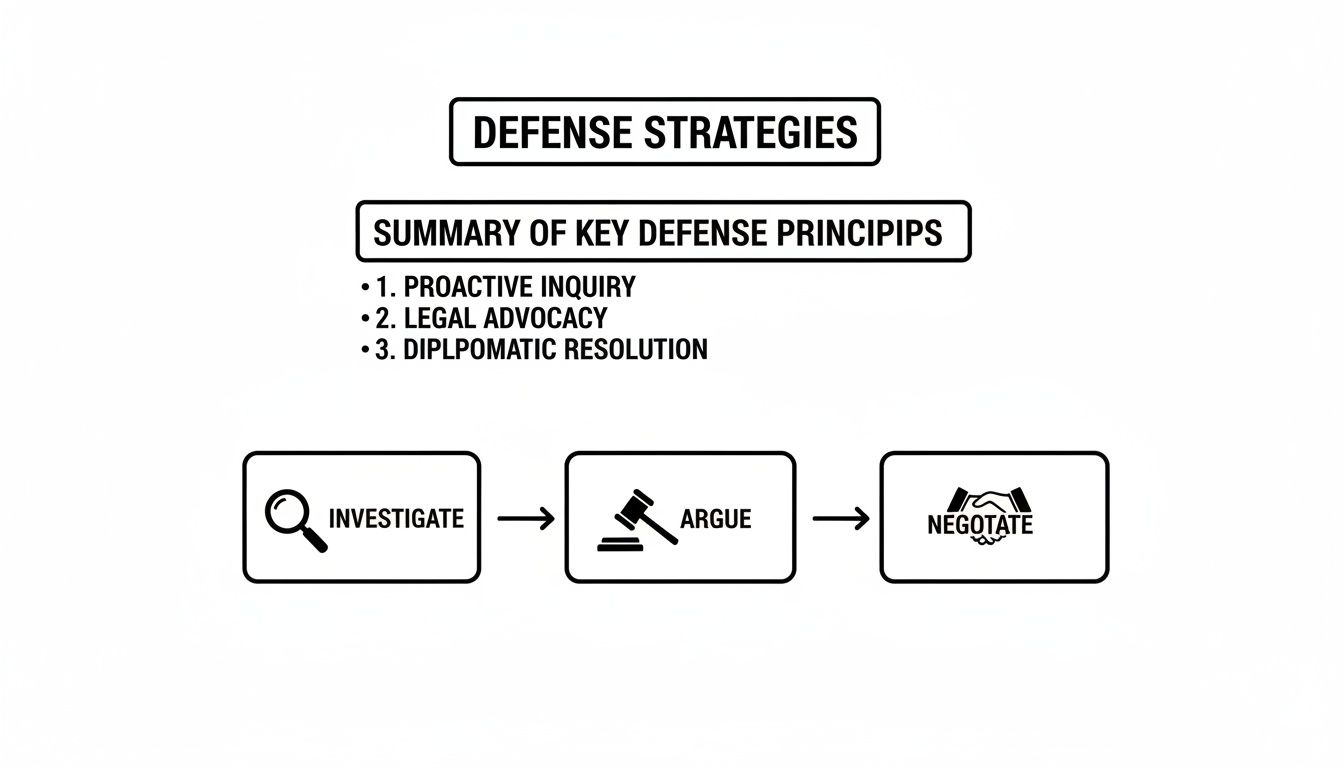
As you can see, a successful defense isn't just about showing up to court. It involves investigating the claims, building a solid counter-argument, and negotiating from a position of strength. Because these cases sit at the crossroads of criminal and family law, it's vital to have an attorney who is an expert in both worlds. They know the legal standards that must be met and how to build a case that protects you from the order and its devastating ripple effects on your family.
How to Choose the Right Lawyer for Your Case

When your freedom and future are on the line, the lawyer you hire is the single most important decision you'll make. This isn't just about finding someone with a law degree. It's about finding a true advocate who sees you as a person in a crisis, not just another case number. This choice demands careful thought.
It's vital to do your homework. There are cautionary tales that highlight the critical importance of vetting legal professionals, and your future is too important to leave to chance.
The stakes in domestic violence cases are sky-high. This is a global issue that hits close to home, with nearly 1 in 3 women worldwide having faced physical or sexual violence. That is why the Texas legal system treats these allegations with such seriousness. The World Health Organization's comprehensive report provides more detail on these global statistics.
Key Qualities to Look for in an Attorney
Not every lawyer is cut out for the pressures of a domestic violence case. You need to look for specific strengths that match what you’re up against. The right attorney will have deep experience in this specific area of Texas law, be familiar with the local courts and prosecutors, and approach your situation with compassion.
As you search for a "domestic violence lawyer near me," make sure these criteria are non-negotiable:
- Specialized Experience: Does the lawyer focus on domestic violence and related family law cases, including CPS defense, or are they a generalist? A specialist knows the nuances that can make or break a case.
- Local Court Knowledge: An attorney who is a regular in your county’s courts will know the prosecutors and judges. This is an invaluable strategic advantage.
- A Human-Centered Approach: Do they listen to your side of the story? Do you feel heard and respected? You need an advocate who will fight for you with empathy and grit.
Questions to Ask During a Consultation
Your first consultation is an interview. This is your chance to gauge if an attorney is the right fit. Don't be shy about asking direct questions about their experience and how they would handle your case.
A great lawyer won't just tell you what you want to hear. They will give you a clear, honest assessment, explain the potential challenges, and outline a realistic strategy for moving forward.
Be ready with questions like these:
- How many domestic violence cases have you specifically handled in this county?
- How does a criminal charge like this impact a CPS case?
- How will you and your team keep me updated on my case?
- What are all the potential outcomes here—the good and the bad?
At The Law Office of Bryan Fagan, our multiple locations across Texas ensure you have access to a top-tier legal team right where you live. We combine an aggressive defense with the compassionate support you need during this difficult time.
Answers to Your Pressing Questions
When you’re staring down a domestic violence charge, your mind is racing with a thousand questions. The uncertainty can feel crushing. Here, we provide clear, straight answers to the questions we hear most often from Texas families. Our goal is to replace fear with the practical, legally sound information you need to start taking back control.
Can the Charges Be Dropped if the Accuser Changes Their Mind?
This is one of the biggest misunderstandings in Texas domestic violence law. The short answer is no. The person who called the police does not have the power to "drop the charges."
Once law enforcement is involved and the state files a case, that decision is out of the accuser's hands. The power to prosecute belongs solely to the State of Texas. The person who made the allegation is now a witness for the prosecution.
Even if your accuser tells the prosecutor they want the whole thing to go away, the case can move forward. The prosecutor can use other evidence, including:
- The original 911 recording
- Body camera footage from responding officers
- Photos of alleged injuries or property damage
- Any statements you made to the police at the scene
However, an accuser’s reluctance is something a skilled domestic violence lawyer knows how to use. It can become powerful leverage, helping us convince the prosecutor that getting a conviction at trial will be difficult. This is often the key to getting a case dismissed.
What Are the Long-Term Consequences of a Conviction?
A domestic violence conviction, even for a first-offense misdemeanor, is a life sentence of consequences. It’s a permanent stain on your record that you can never wash away.
Unlike many other criminal offenses in Texas, a conviction for an assault involving family violence can never be sealed or expunged. It will follow you, showing up on every background check for the rest of your life.
This has a ripple effect that can devastate your future:
- Your Job: Most employers are wary of hiring someone with a violent offense on their record.
- Your Home: Landlords can legally deny your rental application based on a domestic violence conviction.
- Your Career: It can stop you from getting or keeping professional licenses for careers in nursing, teaching, and countless others.
- Your Second Amendment Rights: A conviction triggers a lifetime federal ban on owning a firearm.
- Your Family: It will absolutely be used against you in any future divorce or child custody battle, and it can be used by CPS to justify the termination of your parental rights under Chapter 161 of the Texas Family Code.
How Does a Domestic Violence Charge Affect Child Custody?
For any Texas parent, this is the question that keeps them up at night. An allegation of domestic violence can have an immediate and catastrophic impact on your parental rights.
Under the Texas Family Code, a judge must consider any history of family violence when deciding child custody (conservatorship). If a judge makes an official "finding of family violence," it creates a legal presumption that it is not in the child's best interest for you to be named a Joint Managing Conservator.
This legal presumption is a huge mountain to climb. It means the judge begins the case with the default belief that you shouldn’t share in the basic rights and duties of raising your child. The burden is then on you to prove otherwise.
This can lead to devastating restrictions, such as:
- Being demoted to a "Possessory Conservator."
- Having your time with your children reduced to supervised visitation only.
- Being ordered to complete long, expensive battering intervention programs as part of a CPS service plan.
Because these situations live at the intersection of criminal defense and family law, you must have a legal team that is an expert in both worlds to have any chance of protecting your rights as a parent. Practical advice for parents includes documenting everything, following all court orders precisely, and actively participating in any required services to show the court your commitment to your children's well-being. This can be crucial during the reunification stages outlined in Chapter 263 of the Texas Family Code.
Can My Domestic Violence Charge Be Expunged From My Record?
In Texas, an expunction completely destroys all records related to an arrest. A different process, an order of nondisclosure, seals the record from public view. When it comes to a domestic violence charge, the rules are incredibly strict.
Generally, you are only eligible for a full expunction if:
- The prosecutor dismissed your case completely.
- A jury or judge found you "not guilty" at trial.
- You were acquitted by a higher court or received a pardon.
Here's the critical part: if you accept a plea bargain for deferred adjudication on a family violence charge, you are permanently blocked from ever having that charge expunged or sealed. This is a trap that many people fall into. It's why fighting for a clean dismissal from day one is the single most important goal.
The weight of these questions is immense, but you don't have to carry it by yourself. At The Law Office of Bryan Fagan, we understand the fear and confusion you're feeling as a Texas parent facing these allegations. We are here to offer the compassionate guidance and aggressive defense you deserve. If you're searching for a "domestic violence lawyer near me" who truly understands what’s at stake for your family, your search is over. Contact us today for a free, confidential consultation to talk about your case and learn how we can protect your family and your future.