Skip to content
That phone call from a CPS caseworker—followed by a notice to appear in court—is a moment no parent is ever ready for. It's a disorienting, terrifying experience that floods you with a mix of fear, anger, and confusion. One minute, you’re just living your life; the next, you’re caught in a legal whirlwind where your family’s future hangs in the balance. We understand that shock is real, but you are not alone, and this process, while intimidating, has a clear structure.
The legal process moves incredibly fast. The clock starts ticking the moment your child is removed, kicking off an intense series of court hearings governed by the strict timelines of the Texas Family Code. This journey begins with an emergency court hearing often held within one business day and is designed to reach a permanent, safe outcome for your child within 12 to 18 months.
To help you get a bird's-eye view of the road ahead, this guide breaks down the main hearings you'll encounter in a Texas CPS case. It outlines what each hearing is for and when you can expect it to happen, giving you a clear roadmap of the court process.
Quick Guide to Texas CPS Court Hearings
| Court Hearing | Purpose (What It's For) | When It Happens (Per Texas Family Code) |
|---|---|---|
| Emergency/Show Cause Hearing | The judge reviews CPS's decision to remove your child without a prior court order. | Within 1 business day of removal. |
| Adversary Hearing | A more detailed hearing where CPS must prove there's a continuing danger to the child. | Within 14 days of removal. |
| Status Hearing | The court reviews the child's placement and the parents' progress on their service plan. | Within 60 days of CPS being named temporary conservator. |
| Permanency Hearing | The court establishes a long-term plan for the child (reunification, adoption, etc.). | Within 180 days of removal, then every 120 days. |
| Final Hearing | The court issues a final order, which could be reunification, conservatorship to a relative, or termination of parental rights. | Within 12 months of removal (with a possible 180-day extension). |
Think of these hearings as critical checkpoints. Each one is an opportunity for the judge to assess the situation and for you to show you're taking the right steps to bring your child home. Now, let's zoom in on that very first, most urgent court appearance.
The First 24 Hours: Your Initial Texas CPS Court Encounter
That phone call from a CPS caseworker—followed by a notice to appear in court—is a moment no parent is ever ready for. It's a disorienting, terrifying experience that floods you with a mix of fear, anger, and confusion. One minute, you’re just living your life; the next, you’re caught in a legal whirlwind where your family’s future hangs in the balance. We get it. That shock is real, but you're not alone, and this process, while intimidating, has a clear structure.
Let's put it in real terms. Maybe your toddler took a tumble at the park, and a well-meaning stranger overreacted and called CPS. Now, a caseworker is at your door talking about "imminent danger," and before you can even wrap your head around it, your child has been removed. You're handed a piece of paper telling you to be in court the very next day. This is the harsh reality for so many Texas families, and it’s why understanding what happens at that first CPS court date is so vital.
Why Is the First Hearing So Fast?
The first court date, often called an Emergency Removal Hearing or a Show Cause Hearing, happens at a breathtaking pace. Under Chapter 262 of the Texas Family Code, if CPS removes your child from your home without getting a court order beforehand, a judge must review that decision on the very next business day.
This lightning-fast timeline isn't designed to punish you. It’s actually a constitutional safeguard meant to protect your rights as a parent. The hearing has one single, focused purpose: for a judge to listen to CPS and decide if there was enough evidence of an "immediate danger" to justify taking your child in the first place.
This timeline shows just how quickly things move.
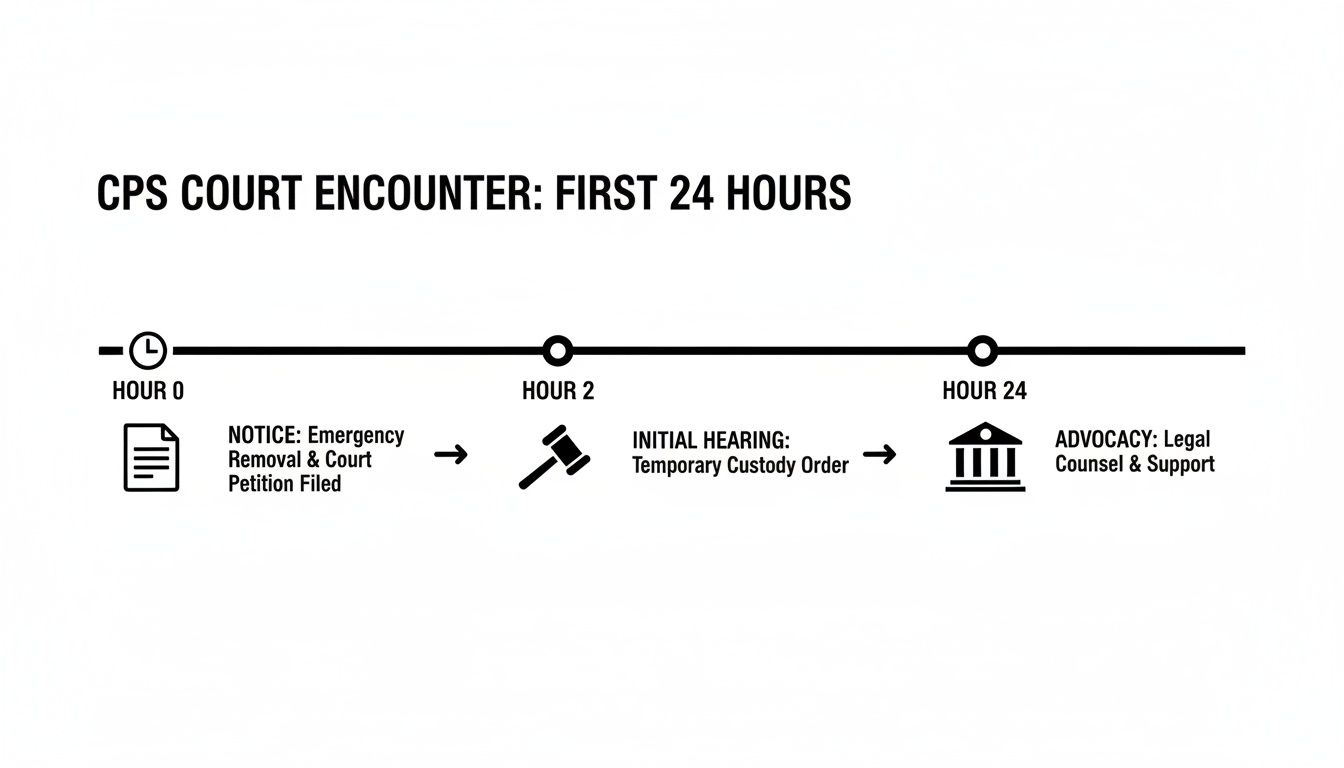
As you can see, there’s almost no gap between getting that notice and having to stand before a judge. It highlights just how critical it is to find legal help immediately.
What to Expect at This First Appearance
This initial court date is usually brief and to the point. CPS will present a sworn statement, or affidavit, explaining why they believed your child was in danger. You'll get to hear the allegations against you, and the judge will appoint an attorney for you if you can't afford one.
Here’s what to keep in mind for this first hearing:
- It’s Not the Final Word: The judge isn't deciding the final outcome of your case. They are only looking at whether CPS had a good enough reason for the emergency removal.
- You Have Rights: This is when you are formally told about your legal rights, including your right to an attorney and your right to a full hearing later on.
- Stay Calm: How you act in court matters. Listen carefully, be respectful, and let your attorney do the talking.
This hearing really just sets the stage for the next, more significant event: the Adversary Hearing. To get a better handle on the events leading up to this urgent court date, it helps to read up on the emergency removal by CPS in Texas and the legal standard CPS must meet. The road ahead is tough, but armed with knowledge and the right support, you can face it head-on.
The First 14 Days After A CPS Removal
When CPS removes your child, the world stops. The shock, the grief, the panic—it's overwhelming. But as impossible as it sounds, this is the moment when you have to act fast. The law doesn't wait for the shock to wear off.
Under Chapter 262 of the Texas Family Code, the second your child is taken, a legal clock starts ticking down to one of the most important hearings in your entire case. You have just two weeks.
This initial period builds toward the Adversary Hearing, a court date that must happen no later than 14 days after the removal. This isn't a quick check-in; it's a full-blown evidentiary hearing. It’s your first real opportunity to stand before a judge, challenge CPS's story, and fight to bring your child home.

What CPS Must Prove at the Adversary Hearing
At this hearing, the pressure is all on CPS. The caseworker can't just stand up and point to their initial report. A CPS attorney has to present actual evidence—testimony, police reports, photos, medical records—to convince the judge of two critical points:
- There is a continuing danger to your child's physical health or safety if they are returned to you.
- It is in your child’s best interest to stay in the temporary care of the state.
The judge is going to zero in on that phrase: "continuing danger." This isn’t about a messy house or a one-time argument. CPS has to show a serious, ongoing risk that could significantly harm your child.
This hearing is a make-or-break moment. If CPS can’t meet its burden of proof, the judge is legally required to order your child returned to you immediately. This is precisely why having a skilled lawyer to pick apart the state's evidence is non-negotiable.
Your First Real Chance to Fight Back
The Adversary Hearing is your turn to go on the offensive. Guided by your attorney, you get to present your own evidence and witnesses to dismantle the state's narrative. It’s not about just saying "that's not true"—it's about proving it.
Let's say CPS removed your kids because your ex claimed you have a drug problem, and the investigator found an old pipe during a walkthrough. At the Adversary Hearing, your lawyer can systematically take that accusation apart.
What happens at this CPS court in Texas is that your attorney can show the judge concrete proof, such as:
- A negative drug test you took right after the removal.
- Pay stubs proving you’re holding down a steady job.
- Testimony from a neighbor or teacher who can speak to your responsible parenting.
By presenting this type of hard evidence, you’re not just denying an allegation—you are actively proving your child is safe in your care. This proactive strategy can be the difference between your child staying in foster care and coming home with you that day. Remember, what happens after CPS removes your child is not a foregone conclusion, and this hearing is your chance to change the entire trajectory of your case.
Your Absolute Right to an Attorney
One of the most critical things you will do in this 14-day window is hire a lawyer. If you cannot afford one, the court is legally required to appoint one for you. Under no circumstances should you waive this right.
Your attorney is your most powerful tool. They know the rules of evidence, they know how to cross-examine a caseworker, and they know how to build a defense that a judge will listen to.
As soon as you have an attorney, start working with them. Be completely honest, give them every document they ask for, and listen to their advice. Your cooperation with your lawyer is the first and most important step toward getting your family back together.
Your Reunification Roadmap: The Family Service Plan
If the court decides after the Adversary Hearing that your child needs to stay in foster care, it’s easy to feel completely defeated. But this isn't the end of the line. It's actually a pivot point. The case now shifts its entire focus to one thing: what you need to do to bring your child home.
This journey is laid out in a formal document called the Family Service Plan. Think of this as your official roadmap from the court, detailing every single step you need to take to resolve the issues that brought CPS into your life in the first place. CPS creates the plan, often with input from you and your attorney, but the judge has the final say.

What's on a Family Service Plan?
It’s tempting to look at the service plan as just a list of chores or punishments. That’s the wrong way to see it. Instead, think of it as a structured opportunity—a checklist for proving to the judge that you are a safe, capable, and committed parent.
Every item on that plan is meant to address a specific concern CPS raised.
Common requirements usually include:
- Counseling or Therapy: To work through things like anger management, past trauma, or mental health struggles.
- Parenting Classes: To learn new skills for handling your child's behavior and creating a more nurturing home.
- Substance Abuse Treatment: This could be anything from attending AA/NA meetings to completing an intensive outpatient or inpatient rehab program.
- Stable Housing and Employment: You might need to provide proof of a safe place to live and a steady income.
- Cooperating with Visitations: Showing up to every single scheduled visit with your child is absolutely critical. It’s non-negotiable and proves your dedication.
Your job is to tackle this plan head-on. Document every single thing you do. Keep your certificates from classes, sign-in sheets from therapy, and pay stubs from your job. This tangible proof will be your most powerful ally in court. You can get a more in-depth look at these plans in our guide on the CPS Family Service Plan in Texas.
The People Reporting on Your Progress
As you work through your service plan, you’re not doing it alone in the dark. The court appoints several key people to watch over your progress and speak up for your child's best interests. Believe me, their reports carry a lot of weight with the judge.
Two of the most important figures you'll encounter are:
- The Ad Litem Attorney: This is an attorney appointed specifically to represent your child’s legal interests. They will talk to everyone—your child, you, the foster parents, the caseworkers—to form an independent opinion on what’s best for your child.
- The CASA Volunteer: A Court Appointed Special Advocate (CASA) is a trained volunteer from the community who gets to know your child and your family’s situation. They give the judge a detailed report about your child’s well-being and how you're doing.
These individuals will update the judge on your progress at recurring Status Hearings and Permanency Hearings, which follow the strict timelines laid out in Texas Family Code Chapter 263. Their opinion on whether you're completing your services and making your home safe can make or break your case.
Fortunately, there's some good news on the efficiency front. Recent trends show the Texas CPS system is handling cases more effectively. The DFPS FY25 Q2 Report Card noted that both opened and closed cases were trending lower in FY25 Q1-Q2 compared to the previous year. This has led to a drop of over one case per worker since FY24, which means caseworkers and courts aren't as overwhelmed. For you, this can mean fewer delays in a system where timelines are everything. You can dig into more of this data in the official court reports for 2025.
The Final Hearing: Dismissal, Reunification, Or Termination
Navigating a CPS case is a marathon, not a sprint, but every race has a finish line. In Texas, that finish line is called the Final Hearing. This isn't just another court date; it's the one the entire case has been building toward.
This hearing is legally required to happen within 12 to 18 months after your child was first removed from your home. It’s the culmination of every class you took, every service you completed, and every visit you cherished. This is the day the judge makes a permanent, life-altering decision about your child’s future.
The Three Possible Outcomes of Your Case
When you walk into court for that Final Hearing, the judge has three main roads they can take. Each one is a monumental decision, built on the evidence and progress (or lack thereof) from the past year.
- Dismissal and Reunification: This is the outcome every parent is fighting for. If you’ve successfully completed your Family Service Plan and the judge agrees your home is now safe, the case gets dismissed. Your child comes home, and CPS is out of your life for good.
- Permanent Conservatorship: If the judge feels reunification isn't quite safe yet but doesn't believe termination is warranted, they might name someone else as the permanent managing conservator. This is often a relative, but it can also be CPS. Your child would live with that person long-term, but you would likely still have visitation rights.
- Termination of Parental Rights: This is the most extreme and devastating outcome, often called the “death penalty” of family law. It permanently and irrevocably severs the legal bond between you and your child.
It's absolutely critical to understand these possibilities from day one. While bringing your child home is always the goal, preparing for every scenario with your attorney is the smartest way to protect your rights and your family.
Understanding Termination of Parental Rights
The very thought of losing your child forever is a parent's worst nightmare. The state of Texas understands how severe this step is, which is why the legal standard for termination is incredibly high.
Under Chapter 161 of the Texas Family Code, CPS has to prove two things by clear and convincing evidence—a much tougher legal standard than in most other civil court cases.
First, CPS must prove you committed at least one of the specific acts listed in the law, such as endangering the child, failing to complete your court-ordered services, or having a substance abuse issue that puts the child at risk. Second, they must also prove that terminating your rights is in the “best interest of the child.” This isn't a simple checklist; the judge weighs many factors to make that call.
Let's look at a real-world scenario. Imagine a mother, Sarah, whose child was removed because of a substance abuse problem. Over the next year, she did everything asked of her. She diligently attended every counseling session, graduated from an intensive outpatient program, found a stable job, and never once missed a supervised visit with her daughter.
At the final hearing, CPS still argued for termination, pointing to her past drug use as the reason.
But Sarah’s attorney was ready. They presented a mountain of evidence showing her progress: certificates from her programs, recommendation letters from her sponsor and employer, and glowing reports from the CASA volunteer who witnessed her loving interactions with her daughter. By showing a consistent, documented pattern of real change, Sarah proved that even though the initial grounds existed, reunification was now in her child's best interest. The judge agreed and ordered her daughter returned home.
This just goes to show that your actions throughout the case matter immensely. Consistent effort, paired with solid documentation, can absolutely turn the tide and lead to the best possible outcome: bringing your family back together.
Fortunately, recent reforms in Texas are helping courts achieve these positive outcomes more efficiently. These changes have led to a 47% reduction in the foster care population and a 43% drop in children waiting for adoption. In practice, this means about 90% of cases now reach a final, permanent decision within that 12 to 18-month timeline, preventing children from getting stuck in the system. You can read more about how these changes are creating a child welfare revolution in Texas and what it means for families.
How To Prepare For Court And Protect Your Rights
Walking into a courtroom can feel like your world is spinning out of your control, especially when your family's future is on the line. But here’s the truth: understanding your rights and knowing how to prepare is your greatest source of power. This isn't just about legal jargon; it's about taking proactive steps to show the judge you're a responsible parent and ensure your voice is heard.

This preparation is more important now than ever. Thanks to sweeping reforms aimed at keeping families together, Texas has seen a staggering 55% drop in children being removed by Child Protective Services from peak levels. What does this mean for you? It means judges are increasingly focused on family preservation and getting parents swift access to services.
If you engage with the process early and effectively, you stand a much better chance of keeping your kids at home. You can learn more about these significant changes in the Texas DFPS performance reports.
Know Your Fundamental Legal Rights
The Texas Family Code isn't just a rulebook for the court; it grants you specific rights to ensure you get a fair shot. Your attorney will be your champion in exercising them, but you need to know what they are from day one.
- The Right to an Attorney: You have an absolute right to have a lawyer represent you. If you can't afford one, the court is required to appoint one for you at no cost.
- The Right to See the Evidence: You are entitled to review everything CPS plans to use against you—caseworker notes, reports, photos, and witness statements. This process, called "discovery," is how your lawyer builds your defense.
- The Right to Present Your Own Case: This is your chance to tell your side of the story. You have the right to bring your own witnesses, submit documents, and present evidence to challenge the allegations CPS has made.
Knowing these rights is the first step. The second, and most critical, is working hand-in-glove with your attorney to build a solid strategy. They are your advocate, your guide, and your defender throughout this entire complex process.
Practical Tips For Your Day In Court
Beyond the legal technicalities, how you present yourself in the courtroom matters—a lot. The judge is human, and they are observing everything. Your behavior and appearance can either bolster your case or tear it down.
Let's imagine a real-life scenario. Think of a father, Mark, who is fighting to get his kids back. He shows up to every single hearing in a clean shirt and tie. He sits attentively next to his lawyer, takes notes, and always addresses the judge as "Your Honor." Even when a caseworker says something he completely disagrees with, he never interrupts.
That quiet, respectful demeanor sends a powerful, unspoken message. It tells the judge that Mark takes this process deadly seriously and respects the court's authority. This simple act of professionalism can genuinely shift how a judge perceives you as a person and as a parent.
Your Court Preparation Checklist
Before you head to any hearing, run through this simple checklist to make sure you’re putting your best foot forward:
- Communicate With Your Lawyer: Always meet with your attorney before court. Go over the plan for the hearing so you know exactly what’s going to happen and what your role will be.
- Dress Professionally: Treat court like the most important job interview of your life. Business casual is the absolute minimum—no shorts, graphic t-shirts, or ripped clothing.
- Arrive Early: Punctuality shows respect for everyone's time, especially the judge's. Arriving late can make a terrible impression and, in a worst-case scenario, lead to the judge proceeding without you.
- Be Respectful to Everyone: Your conduct matters, both inside and outside the courtroom. Be polite to the judge, the bailiff, the court staff, and yes, even the opposing counsel.
- Let Your Attorney Speak: Your lawyer is there for a reason—to speak for you. Resist the overwhelming urge to blurt out answers, argue, or correct someone. When it’s your turn to speak, be calm, clear, and honest.
Following this guidance is how you start to take back a measure of control in a situation that feels uncontrollable. It's how you prove you are the responsible, capable, and loving parent your child needs.
Common Questions Texas Parents Have About the CPS Court Process
When Child Protective Services steps into your life, it feels like your world has been turned upside down. Your mind floods with urgent, panicked questions. The unknown is terrifying, but we want you to know you're not the first parent to feel this way. We've compiled straightforward answers to the questions we hear most often from parents in your shoes, hoping to bring you a little more clarity in a confusing time.
Can I Refuse to Talk to CPS in Texas?
You absolutely have the right to remain silent when dealing with a CPS investigator, and it's almost always in your best interest to exercise it. This is especially true if there’s even a remote possibility of criminal charges being involved.
However, a flat-out refusal to cooperate at all can look bad in front of a judge. The smartest move is to politely but firmly state that you are happy to cooperate, but all communication will go through your attorney. This shows you have nothing to hide while protecting your rights—a delicate balance that a skilled lawyer knows exactly how to manage.
How Long Does a CPS Court Case Last in Texas?
Texas law is built for speed. The entire system is designed to get children into a stable, permanent home as quickly as possible. Because of this, a final decision in your case must be made within 12 months from the day your child was removed.
The court can grant one six-month extension for what it calls "extraordinary circumstances," but even then, the case must be completely resolved within 18 months at the absolute latest. This tight timeline means every single hearing, every deadline, and every action you take is critical.
What Happens if I Miss a CPS Court Date in Texas?
Missing a court date is one of the single most destructive mistakes you can make. If you don't show up, the judge can—and almost certainly will—hold the hearing without you.
This means they will make monumental decisions about your children's future based only on the story CPS tells them. It can easily lead to a default judgment against you, which is a legal term for losing your case automatically, and it could even result in the termination of your parental rights. If a true emergency keeps you from court, you must call your lawyer immediately so they can notify the judge.
The stress of a CPS case impacts the entire family. Parents often seek ways to support their children through such difficult periods; finding strategies for learning about how to support children and the importance of engaging in activities for building resilience in children can be incredibly helpful for their well-being.
Can I Get My Kids Back at the First Hearing?
Yes, it is possible. At the very first major court hearing, called the Adversary Hearing, the judge has one primary question to answer: Is there an immediate and ongoing danger to your child at home?
If you and your lawyer can present powerful evidence showing that CPS’s claims are wrong and that your child would be safe with you, the judge has the power to order them returned to your care right then and there. This is precisely why hiring an experienced attorney and moving quickly from day one is so essential.
The stakes in a CPS case are higher than in any other area of law—your family’s future is on the line. You do not have to face the court system alone. The experienced attorneys at The Law Office of Bryan Fagan, PLLC have dedicated their careers to defending Texas parents. We understand the fear and confusion you're feeling, and we are here to provide the compassionate, strategic defense you need. For a free, confidential consultation to discuss your case, contact us today at https://texascpslawyer.net.