Skip to content
The sound of handcuffs is terrifying. For any Texas parent, that metallic click brings a rush of fear—not just for your own freedom, but for your children, your job, and your family's future. The confusion and panic can be overwhelming, leaving you feeling helpless and isolated. In that moment, questions flood your mind. What happens now? Who do I call? How do I protect my family from this?
This chaotic experience is the start of a complex legal journey, but it is not the end of your story. For parents in Texas, an arrest can trigger immense anxiety, especially with the fear of potential Child Protective Services (CPS) involvement. Understanding your rights and the steps ahead is your most powerful shield. This guide is here to provide the clear, practical guidance you need to navigate this process and protect what matters most: your family.
The First Moments of a Texas Arrest
Imagine this scenario: A parent gets into a heated argument with their ex-spouse during a child exchange. A neighbor calls the police, and based on a one-sided story, an arrest is made for alleged family violence. Suddenly, you're in the back of a squad car, terrified about who will care for your kids and what this means for your custody agreement. The fear is real, but so is your ability to navigate what comes next with strength and knowledge.

In Texas, after the handcuffs go on, you should be read your Miranda Rights. These rights are your first line of defense against self-incrimination. You have the right to remain silent. You have the right to an attorney. Anything you say can—and will—be used against you in court.
What to Do Immediately After an Arrest
In these critical first moments, your actions can set the tone for your entire case. Staying calm and saying nothing is your most powerful tool. The police are trained to gather information, and even a casual chat can hand them evidence on a silver platter. Your focus needs to be singular: protecting your rights.
Here are the first three things you must do:
- Politely Invoke Your Right to Remain Silent: You do not have to answer questions about what happened, what you were doing, or anything else. Simply state, "I am exercising my right to remain silent."
- Clearly Request an Attorney: As soon as you can, say, "I want to speak with my lawyer." Once you say those words, police are legally required to stop questioning you.
- Do Not Resist: Resisting arrest, even if you feel it's completely unfair, will only lead to more charges. Comply with physical instructions calmly. Don't argue. An officer needs probable cause to arrest you, which sometimes involves a warrant. You can learn more by checking out our guide on how warrants work in Houston, TX.
The most important thing to remember is that an arrest is not a conviction. It is the beginning of a legal journey. By understanding the process and invoking your rights, you take the first and most critical step toward defending yourself and protecting your family’s future.
Understanding Your Constitutional Rights During an Arrest
Getting arrested can make you feel like you've lost all control. But it's in this exact moment that the U.S. Constitution steps in, acting as a powerful shield to protect you. Knowing your rights isn't just about legal jargon; it's the single most important tool you have to defend yourself and protect your family, especially when facing potential CPS scrutiny.
Think of these rights as the official rulebook for law enforcement. The most important protections are found in the Fourth, Fifth, and Sixth Amendments, which stop unreasonable searches and guarantee you the right to stay silent and the right to have a lawyer.
Your Fifth Amendment Right to Remain Silent
This is the one everyone knows: "You have the right to remain silent." But what does that really mean when you're face-to-face with an officer? It means you have zero obligation to answer any questions that could get you into trouble. That includes questions about your personal life, your parenting, or the events leading to the arrest.
Many parents, especially those who know they're innocent, feel a powerful urge to explain everything. It’s a natural instinct, but it's also a dangerous one. Police are trained investigators, and even a statement you think is harmless can be twisted, misinterpreted, and used against you later, both in criminal court and in a CPS case.
The second you're being questioned, you need to say this clearly and politely:
“I am exercising my right to remain silent. I will not answer any questions without my lawyer present.”
Once those words are out of your mouth, the interrogation is supposed to stop. You're not being uncooperative—you are simply using a right guaranteed to every American.
Your Sixth Amendment Right to an Attorney
Working hand-in-hand with your right to silence is your right to have a lawyer. This is your lifeline in a confusing and intimidating legal system. As soon as you are in police custody, you can—and absolutely should—ask for a lawyer.
The magic phrase is simple and direct: "I want a lawyer."
Once you say that, police are not allowed to question you any further until your attorney is there. Don't let them try to convince you to "just answer a few quick questions." Your silence and your request for a lawyer are your two strongest shields.
Your Fourth Amendment Right Against Unreasonable Searches
The Fourth Amendment is what protects you from having your body, your car, or your home searched without a valid reason. For the most part, police need a warrant from a judge to conduct a search. However, there are exceptions.
During a lawful arrest, an officer is legally allowed to:
- Search Your Person: They can pat you down and go through your pockets to look for weapons or evidence connected to the crime. This is called a "search incident to arrest."
- Search the Area Within Your Immediate Control: This covers the area right around you—anywhere you could realistically reach to grab a weapon or destroy evidence.
So, what about your car or home? If you're arrested during a traffic stop, the police can typically search the passenger compartment of your car. Searching your home is much more protected and almost always requires a warrant, unless there are emergency circumstances or someone with authority consents.
This brings us to a crucial point: You never have to consent to a search. If an officer asks, "Do you mind if I take a look around?" you have every right to say, "I do not consent to a search." If they search anyway, your lawyer can later fight to have any evidence they found thrown out of court. By clearly stating your refusal, you keep your constitutional protections intact.
The Booking Process: From Handcuffs to a Holding Cell
That quiet, tense ride to the police station is where the shock starts to wear off and the dread creeps in. When you arrive, the next phase begins: the booking process. For a parent worried about their kids and their future, it can feel overwhelming. Knowing what happens, step by step, can strip away some of that fear and help you focus on the single most important thing: getting home.
Booking is the system creating an official file on your arrest. It's a methodical intake process designed to formally identify you and record the offense. While this is a standard procedure, it's a critical juncture where your rights remain paramount. For a wider look at what follows this stage, you can find more information on What Happens After an Arrest.
What Happens During Booking
The journey from the back of a patrol car to a cell involves several key steps.
Here’s a simple breakdown of what to expect:
- Recording Personal Information: An officer will ask for your full name, address, date of birth, and other identifying details. Stick to the facts. Do not volunteer any information about the arrest itself.
- Mugshot and Fingerprints: You'll be photographed for a "mugshot," and your fingerprints will be taken electronically. This information goes into local and state databases.
- Inventory of Personal Belongings: Everything you have on you—your phone, wallet, keys—will be collected, itemized, and stored. You should be given a receipt.
- Health and Background Questions: They may ask basic questions about your health to ensure your safety in custody. A criminal background check will also be run.
This simple chart is a powerful reminder of the constitutional rights that serve as your shield throughout this entire ordeal.
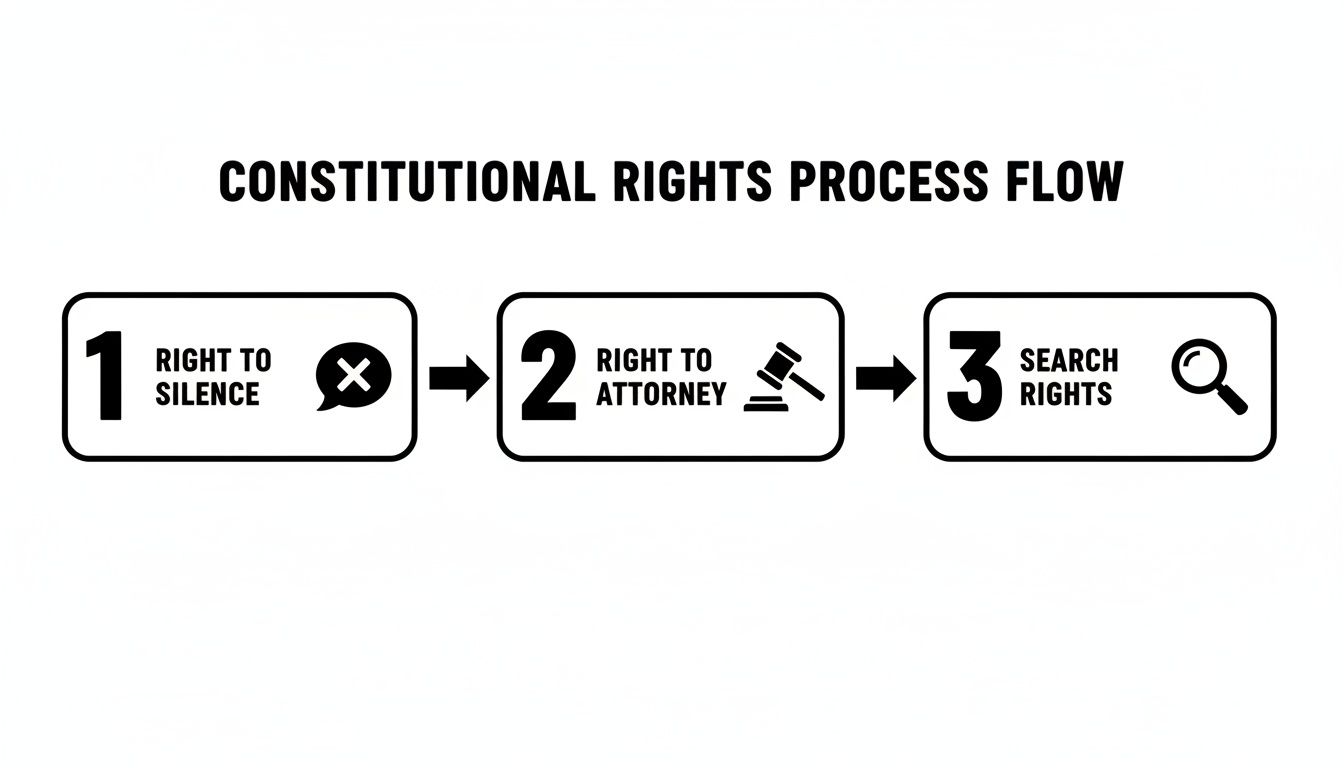
These three rights—the right to remain silent, the right to an attorney, and the right to be free from unreasonable searches—are your most powerful tools from the moment of arrest through booking and every step that follows. Use them.
The Texas Arrest and Booking Timeline: What to Expect
| Stage | Typical Actions | Estimated Timeframe |
|---|---|---|
| Initial Arrest | Officer makes the arrest at the scene. You are read your Miranda rights. | 0-30 minutes |
| Transport | You are transported from the scene to a police station or county jail. | 15-60 minutes |
| Booking Intake | Collection of personal information (name, DOB), mugshot, and fingerprinting. | 1-2 hours |
| Property Inventory | Your personal items are cataloged and stored for safekeeping. | Included in intake time |
| Background Check | Officers run a check for any prior criminal history or outstanding warrants. | 1-3 hours |
| Placement | You are placed in a temporary holding cell to await the next steps. | Varies widely |
From Booking to a Holding Cell
After the booking process is complete, you’ll most likely be placed in a temporary holding cell. This is often the hardest part—the waiting. Resist the urge to talk about your case with anyone. The only person you should be focused on speaking with is your attorney. That first phone call is your lifeline. Getting a lawyer involved as early as possible is the single most important action you can take to protect yourself and get your life back on track.
Securing Your Release Through Bail and a Magistrate Hearing
After the cold, sterile process of booking, every parent has one thought screaming in their mind: How do I get home to my kids? The fear of being stuck in a cell while your family is left wondering and worrying is a heavy, isolating feeling. This is where you get your first real shot at freedom: the magistrate hearing.
In Texas, the law gives you a crucial protection: you can't be held indefinitely without seeing a judge. The Texas Code of Criminal Procedure demands you be brought before a magistrate "without unnecessary delay," typically within 48 hours of your arrest. This hearing is your lifeline.

The Role of the Magistrate
At this first appearance, the magistrate will officially read the charges against you and ensure the arrest was legal. Most importantly for your immediate freedom, the judge will decide the conditions of your pretrial release, which all comes down to setting bail.
A judge must weigh several factors:
- The seriousness of the charge: Harsher accusations almost always mean higher bail.
- Your ties to the community: A steady job, a home, and family nearby suggest you're not a flight risk.
- Your criminal history: A clean record is a huge plus.
- Your ability to pay: Bail is meant to ensure you come back to court, not to punish you before trial.
Understanding Your Bail Options
Bail is a financial promise that you'll show up for all your future court dates. If you make every appearance, the money is returned when the case is over.
Here are the common ways to post bail in Texas:
Personal Recognizance (PR) Bond: This is the best-case scenario. The judge releases you on your written promise to appear, no money needed. PR bonds are usually for low-level offenses when someone has strong community ties.
Cash Bond: This means you or your family has to pay the full bail amount directly to the court. This can be a massive financial burden.
Surety Bond: This is the most common route. You hire a bail bonds company and pay them a non-refundable fee, which is typically 10% of the total bail. The bondsman then posts the full amount with the court. Learning how bail bonds work can demystify this process.
The Impact of Legal Support for Parents
Imagine a mom, Maria, arrested for a first-time DWI after dinner with friends. She's terrified, has never been in trouble before, and all she can think about are her two young kids at home. Without a lawyer, she stands before the magistrate, and the judge sets a standard $5,000 bail. Her family has to scramble to come up with $500 for a bondsman, delaying her release by hours or even a full day.
Now, picture the same situation, but Maria's family called an attorney right away. The lawyer shows up at the magistrate hearing. They present proof of her stable job, her deep roots in the community, and the fact that she's the primary caregiver for her children. The attorney makes a strong case that she is not a flight risk and a high bond would create an unnecessary hardship on her family.
Because of this advocacy, the judge agrees to grant a PR bond. Maria is released that day on her signature. She gets to go home, hug her kids, and start building her defense from a position of freedom—not from behind bars. The difference is night and day. Having an experienced attorney at your bail hearing isn't a luxury; it's often the single most important factor in securing a fast and affordable release. You can learn more about what to expect by reading our guide on what happens at a bail hearing.
The Arraignment: Your First Formal Court Appearance
After the fog of booking and the relief of seeing a magistrate, the next major milestone is the arraignment. This is your first formal appearance in the court that will handle your case, and it officially kicks off the legal battle ahead.
For parents, hearing the official charges read aloud in a courtroom can be paralyzing. The pressure to just make it all go away is immense. But this is not the time to explain your side of the story or admit anything. It’s a purely procedural step, and how you act here is a tactical decision.
Entering Your Plea
When you stand before the judge, they will ask how you plead: guilty, not guilty, or no contest. In almost every situation, the only strategic answer at this stage is "not guilty."
Pleading not guilty isn't about denying that something happened. It’s a legal formality that accomplishes two critical things:
- It Preserves All Your Rights: A "not guilty" plea keeps every legal option on the table. It gives your attorney the breathing room they need to dig into the prosecution's evidence, file motions to suppress anything obtained illegally, and start negotiating from a position of strength.
- It Forces the Prosecution to Prove Its Case: In our system, you are innocent until proven guilty. Pleading not guilty puts the full burden on the State of Texas to prove every element of the crime beyond a reasonable doubt.
Entering a guilty plea at arraignment is like throwing in the towel before the first bell rings. You surrender your right to a defense, your right to challenge the evidence, and your right to fight for a better outcome. Always plead "not guilty" and let your legal team build the strategy.
Why You Should Never Plead Guilty at Arraignment
Let’s play this out. Imagine you were arrested for possession of a controlled substance found in your car during a traffic stop. You're overwhelmed and scared. If that initial traffic stop was illegal, an experienced attorney would immediately start investigating. They could file a motion to have the evidence thrown out, which could lead to a complete dismissal of your case.
By pleading guilty upfront, you forfeit that opportunity forever. This is just one of many reasons why understanding what happens at an arraignment hearing is so absolutely crucial for protecting your future.
Arguing for Bail Reduction
If you weren't able to post bail after the magistrate hearing, the arraignment is another chance for your attorney to argue for your release. Your lawyer can present new information or re-emphasize your strong ties to the community—like your job, your home, and your family responsibilities—to ask the judge for a bail reduction or a personal recognizance (PR) bond. Getting you home is always a top priority. It allows you to better assist in your own defense and, most importantly, be there for your kids.
Defending Your Case and Protecting Your Family
After you plead not guilty, the methodical, often slow process of building your defense starts. For any parent, this phase is a tense mix of fear and hope. The fear is natural—your future and your family’s stability are on the line. The hope comes from knowing a dedicated professional is now fighting for you, scrutinizing every detail to protect your freedom.
The Discovery Process: Seeing the State's Evidence
The first move your attorney will make is to demand discovery. This is a legal right to get copies of every piece of evidence the State intends to use against you, including:
- Police reports and officer notes
- Statements from any witnesses
- All body camera and dashcam videos
- Lab results, like blood alcohol content or breathalyzer readings
This review is where cases are often won or lost. A tiny inconsistency in a report or a procedural mistake caught on camera can become the cornerstone of a powerful defense.
Challenging the Evidence with Pre-Trial Motions
Once your attorney has all the evidence, they look for weaknesses and legal errors. Were your constitutional rights violated? If any evidence was gathered illegally, your attorney can file a pre-trial motion—a formal request to the judge to throw that evidence out.
A successful motion to suppress can completely cripple the prosecution's case. If a key piece of evidence is excluded, the prosecutor might not have enough left to proceed, often leading them to dismiss the charges altogether.
The Art of the Plea Bargain
The vast majority of criminal cases in Texas are resolved through plea bargaining, a negotiation between your defense attorney and the prosecutor. A savvy negotiator can often secure a much better outcome without the risk and expense of a trial, potentially achieving:
- A complete dismissal of the charges
- A reduction to a less serious crime
- An agreement for probation instead of jail time
- Entry into a diversion program, which often leads to a dismissal upon completion
This is a strategic move designed to get the best possible result for you and your family, allowing you to move forward with the least amount of damage.
Common Questions After a Texas Arrest
When you or a loved one is arrested, your mind races with urgent questions. The uncertainty can be suffocating, especially when you're worried about your family. Here are straightforward answers to the questions we hear most often from Texas parents.
How Long Can Police Hold Me In Texas Before I See A Judge?
In Texas, the law says you must be brought before a magistrate “without unnecessary delay,” which almost always means within 48 hours of your arrest. This first appearance is incredibly important—it's where bail is set and you're formally told the charges against you. Significant delays could be a violation of your rights.
Should I Talk To The Police If I Am Innocent?
No. This might be the single most important piece of advice you will ever get. Even if you are 100% innocent, you must exercise your Fifth Amendment right to stay silent. It is far too easy for your words to be twisted, misunderstood, or taken out of context by investigators.
The smartest and safest thing you can do is politely but firmly say, "I am going to remain silent, and I would like to speak with a lawyer." This statement shuts down the questioning and lets your attorney handle all future talks with the police.
What Is The Difference Between A Misdemeanor And A Felony Arrest?
The biggest difference comes down to the severity of the potential punishment, which has a huge impact on everything from the bail amount to the long-term fallout for you and your family.
- Misdemeanors are less serious crimes. The penalties are usually limited to fines, probation, or a sentence of up to one year in a county jail.
- Felonies are the most serious offenses. A conviction can lead to years in state prison, massive fines, and the permanent loss of civil rights, like your right to vote or own a gun.
Can An Arrest Affect My Child Custody Case and Involve CPS?
Yes, absolutely. A criminal arrest, especially one involving family violence, drugs, or assault, can trigger an investigation by Child Protective Services (CPS) and severely impact your custody arrangement. Under the Texas Family Code, particularly Chapters 262 and 263, an arrest can be considered evidence of a risk to your child's safety. This could lead to a CPS removal, court-ordered supervised visits, or a complete change in custody. An allegation alone can even lead to the termination of parental rights under Chapter 161 if not handled correctly. It is critical to have a legal team that understands both criminal and family law to protect your parental rights when you are most vulnerable.
The hours and days after an arrest are a critical window where every decision counts. You don't have to face this alone. The fear for your future and your family is real, but you have the power to fight back with the right legal support. At The Law Office of Bryan Fagan, we provide the authoritative yet compassionate guidance your family deserves. We understand the stakes when your freedom and your children are on the line. For a free, confidential consultation to discuss your case and protect your rights, contact us today at https://texascpslawyer.net.