Skip to content
When a loved one is facing criminal charges, especially when it could impact your family and your children, the world suddenly feels like it’s closing in. The fear of a permanent conviction, the confusion of the legal process, and the anxiety about the future can be overwhelming for any parent. In these moments, understanding your options is the first step toward finding solid ground.
For many Texans, deferred adjudication represents that path forward—a glimmer of hope in a difficult time. It’s not just a legal term; it’s a potential turning point that can protect a person's future from the lifelong consequences of a criminal conviction, ensuring you can continue to provide for your family.
So, What Is Deferred Adjudication in Simple Terms?
Imagine getting a new job with a one-year probationary period. You have to follow all the company rules, meet performance expectations, and show up on time. If you do everything right for that year, you become a permanent employee in good standing. Mess up, and you’re let go.
Deferred adjudication works in a very similar way. But instead of a job, it's your freedom and future on the line.
A judge essentially says, "I see your plea, but I'm going to put a pause on entering a guilty verdict. Instead, I'm placing you on community supervision. If you follow every single rule and complete this program, I will dismiss this case entirely."
This outcome is a critical tool in the Texas justice system. In fact, according to recent statistics from the Texas Department of Criminal Justice, more than 83,000 cases involved some form of community supervision like deferred adjudication, showing just how often it's used to give people a chance to avoid a permanent stain on their record. You can find more data in the full statistical report on the TDCJ website.
Deferred Adjudication at a Glance
To make this concept crystal clear, let's break down the essential components of what "deferred adjudication" really means. Understanding these core parts demystifies the process and helps you see it not as a complex legal maze, but as a structured opportunity.
| Component | Simple Explanation |
|---|---|
| The Plea | You must first plead "guilty" or "no contest." This is a non-negotiable first step. |
| The Deferral | The judge agrees to put off—or "defer"—finding you guilty. This is the magic ingredient. |
| Community Supervision | This is the probationary period, complete with strict conditions like reporting, fines, and classes. |
| The Dismissal | If you successfully complete the supervision, the judge dismisses the case. No conviction goes on your record. |
In short, it’s a high-stakes agreement between you and the court. You hold up your end of the bargain by staying out of trouble and following the rules, and the court agrees to dismiss the charge, giving you a clean slate.
The Step-by-Step Path to Deferred Adjudication
Facing the legal system can feel like trying to find your way through a dense fog, especially when your family's future is on the line. When you hear a term like "deferred adjudication," it's natural to feel a bit lost. But understanding the process, one step at a time, can turn that confusing journey into a clear, manageable path forward.
Let’s walk through the typical roadmap. Think of this less as a series of legal hurdles and more as a structured opportunity for a true second chance.
This flowchart shows the simplified journey from an arrest to a final dismissal through deferred adjudication.
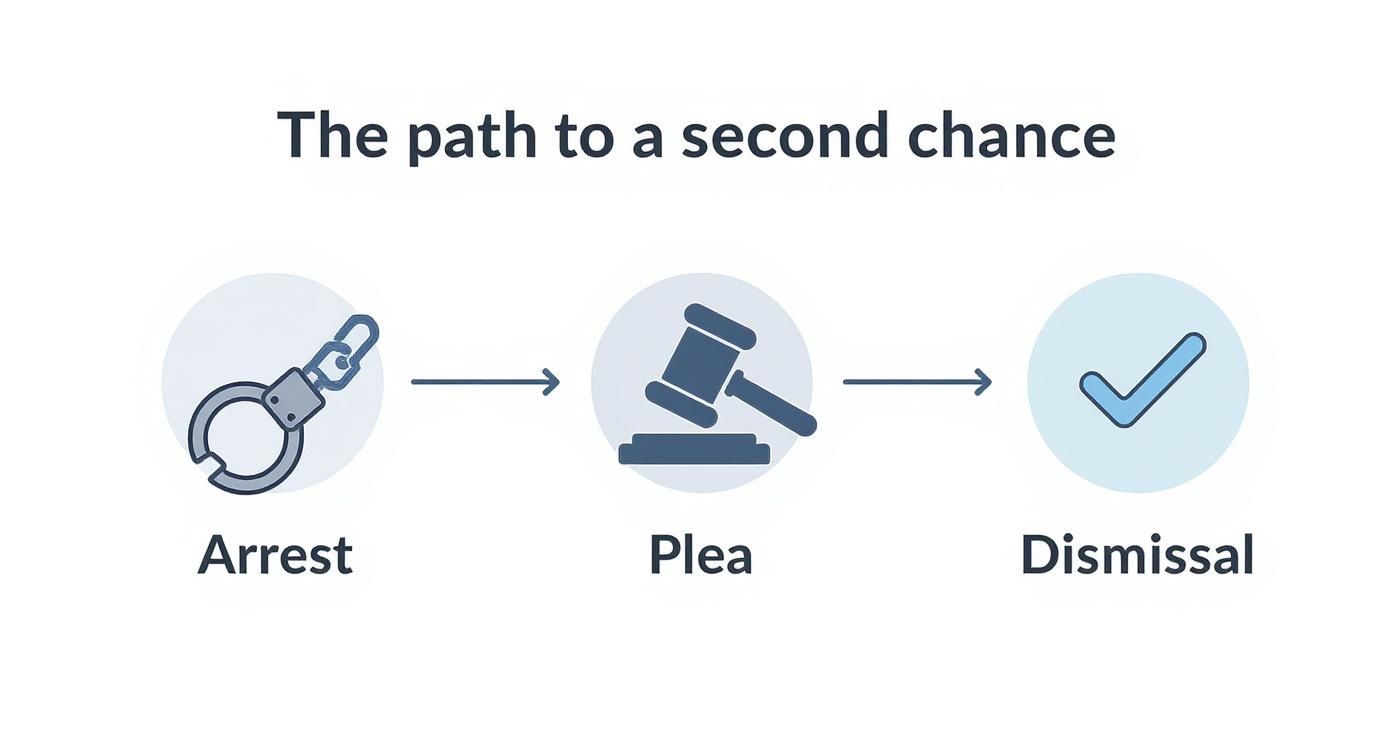
As you can see, the plea agreement is that critical fork in the road. It directs the case away from a conviction and onto the path toward dismissal—as long as you hold up your end of the bargain.
The Plea Agreement
The whole process starts with a critical decision in the courtroom. To even be considered for deferred adjudication, the defendant has to plead either "guilty" or "nolo contendere" (no contest). This is the first, non-negotiable step.
Pleading "no contest" isn't an admission of guilt, but you are telling the court you won't fight the state's charges. For the court's purposes, it has the same immediate effect as a guilty plea. This plea is the very foundation the entire deferred adjudication agreement is built on.
The Judge's Decision
After the plea, the power shifts entirely to the judge. Getting deferred adjudication isn't a rubber stamp; it's completely at the court's discretion. The judge will carefully weigh several factors before agreeing to put off a finding of guilt.
These factors almost always include:
- The Nature of the Offense: Less serious, non-violent crimes are far more likely to get the nod.
- Criminal History: Deferred adjudication is most common for first-time offenders with a clean slate.
- The Prosecutor's Recommendation: Usually, this is something your defense attorney has already negotiated with the prosecutor.
- The Defendant's Demeanor: Showing genuine remorse and taking responsibility can make a big difference in the judge's eyes.
Community Supervision: The Probation Period
If the judge grants deferred adjudication, you'll be placed on community supervision, which is just the Texas legal term for probation. This is the "testing period." It’s your chance to prove you can follow the rules and stay out of trouble.
The terms of supervision are tailored to each case, but they almost always require you to:
- Report to a probation officer on a regular schedule.
- Pay all your fines, court costs, and supervision fees.
- Complete a set number of community service hours.
- Go to counseling, substance abuse treatment, or specific educational classes.
- Submit to random drug and alcohol tests.
- Keep a job or stay enrolled in school.
- Avoid any new arrests or criminal charges. Absolutely no exceptions.
A Real-Life Scenario: Picture a young mother, "Maria," charged with shoplifting baby formula and diapers during a tough financial period. Terrified of losing her kids, her attorney negotiates for deferred adjudication. In court, Maria pleads "no contest." The judge sentences her to six months of community supervision, requiring her to attend a financial management class and complete community service. It’s a stressful six months, but Maria knows that completing it means she can avoid a conviction that could impact her custody and job prospects, and she can finally move forward with her life.
Successful Completion and Dismissal
This is the final step—and the most rewarding one. Once you have successfully completed every single requirement of your community supervision for the entire term, the judge will dismiss your case.
That original plea is set aside, and no conviction is ever entered on your record. For Maria, this means that after six months of hard work, the theft charge is dismissed. While the arrest record still exists, the case did not result in a guilty verdict, which keeps doors open for future jobs, housing, and, most importantly, protects her role as a parent.
It's important to know that a dismissal isn't the same as having the charges dropped from the start. To learn more about that process, check out our guide on how to get criminal charges dropped in Texas. Successfully finishing your probation is the ultimate goal of deferred adjudication—a real second chance.
Who Can Get Deferred Adjudication in Texas?
When a loved one is facing a criminal charge, this is often the first, most urgent question families ask: "Can they even get this deal?" It's a question loaded with hope, and you deserve a straight answer. Here’s the most important thing to understand right off the bat: deferred adjudication is not a right. It’s a privilege, one that the court has the complete discretion to grant or deny.
This outcome is never handed out automatically. It’s a path that has to be carefully negotiated by your attorney with the prosecutor and then signed off on by the judge. Several critical factors come into play, and knowing what they are from the start helps set realistic expectations for your family. This is where understanding how the system works becomes your best defense.
Key Factors the Court Considers
When a prosecutor and judge are weighing whether to offer deferred adjudication, they’re really trying to answer one question: is this person a good candidate for a second chance? While every case is different, their decision almost always boils down to who the defendant is and what they’re accused of doing.
- Criminal History: The ideal candidates for deferred adjudication are almost always first-time offenders. A clean record sends a powerful message to the court that the alleged offense was likely an out-of-character mistake, not part of a larger pattern.
- The Nature of the Offense: This is huge. The seriousness and specific circumstances of the crime are front and center. Non-violent misdemeanors and lower-level state jail felonies are far more likely to get a green light than violent or more serious offenses.
- The Prosecutor’s Position: The prosecutor has a massive amount of say in this. Your attorney's ability to present your loved one’s situation in a compelling, human way can often persuade the prosecutor to agree to a deferred offer.
- The Defendant’s Attitude: It might seem small, but it's not. Showing genuine remorse and a real willingness to take responsibility can make a world of difference in how a judge views the case.
Ultimately, the court wants to see that the person is someone who can be rehabilitated and is unlikely to re-offend. Your lawyer’s job is to build that exact case.
Common Offenses That Often Qualify
While there are absolutely no guarantees, some charges are resolved through deferred adjudication more often than others. This option is typically on the table for people who made a mistake but aren't considered an ongoing danger to the community.
Commonly eligible offenses include:
- First-Time Drug Possession: Charges involving small, personal-use amounts of a controlled substance are frequently considered for deferred.
- Theft or Shoplifting: Misdemeanor theft, especially for a first-time offender, is a classic example of a crime where this option may be offered.
- Criminal Mischief: Vandalism or property damage cases, especially those involving younger defendants, can sometimes be resolved this way.
- Certain Assault Cases: A simple assault, particularly a Class A Misdemeanor, might be eligible, but it really depends on the specific facts. To get a better handle on these charges, you can learn more about what Class A misdemeanors are in Texas.
Offenses That Are Usually Ineligible
Just as some offenses are common candidates, Texas law slams the door shut on others. It's crucial for families to know right away if deferred adjudication simply isn't an option.
In Texas, some offenses are statutorily ineligible for deferred adjudication. This means a judge is legally forbidden from offering it, no matter how sympathetic the circumstances might be.
The most common example is Driving While Intoxicated (DWI). If the defendant holds a commercial driver's license, or if they are charged with a DWI where their blood alcohol was 0.15 or higher, deferred adjudication is off the table by law. Other serious felonies, especially those involving violence or that require sex offender registration, are also typically excluded.
Trying to figure out these complex eligibility rules on your own is tough. An experienced attorney can look at the specific charge and your loved one’s history to give you a realistic assessment of whether deferred adjudication is a goal worth fighting for—and then build the strongest possible argument to make it happen.
Deferred Adjudication vs. a Permanent Conviction

When your family is up against the justice system, terms like "deferred adjudication" and "conviction" might just sound like legal jargon. But in reality, they represent two completely different futures.
One path leads to a second chance with your opportunities intact. The other creates permanent, life-altering barriers that can be nearly impossible to overcome. Understanding the massive difference between these outcomes is the first step toward fighting for the best possible future.
The Immediate Impact: A Tale of Two Pleas
At its heart, the distinction is straightforward. A conviction is a permanent finding of guilt. It's a black mark that follows you forever, showing up on public records for any employer, landlord, or licensing board to see.
Deferred adjudication, however, is a temporary agreement with the court. If you successfully complete all the terms of your community supervision, the judge dismisses the case. Crucially, there is no final conviction. This is the key that unlocks a much brighter future.
Deferred adjudication is a fairly common outcome in Texas courts, accounting for about 10% of all criminal case dispositions statewide. Convictions, by comparison, make up around 41%. It’s important to know, though, that even with a dismissal, the arrest record doesn't just vanish. It often requires a separate legal action—a petition for nondisclosure—to seal it from the public. You can see more data in the Texas Judiciary's Annual Statistical Report.
Comparing Long-Term Impacts: Deferred Adjudication vs. Conviction
The true weight of a conviction really becomes clear over time. It slams doors shut that most people don’t even think about, creating a ripple effect that impacts not just the individual, but their entire family. A dismissal through deferred adjudication helps keep those doors wide open.
To really get a sense of the stakes, it helps to see the long-term impacts side-by-side.
| Life Area | Impact of a Criminal Conviction | Impact of Successful Deferred Adjudication |
|---|---|---|
| Employment | Automatically disqualifies you for many jobs, especially in licensed fields. You must always check "yes" on the felony/misdemeanor conviction box. | Preserves eligibility for most jobs. After a nondisclosure order, you can legally deny the arrest to most private employers. |
| Housing | Makes it extremely difficult to pass background checks for apartment rentals or get a home loan. Many landlords won't rent to those with convictions. | Greatly improves your chances of securing housing. A sealed record is not visible to most landlords, removing a major barrier. |
| Professional Licenses | Can prevent you from obtaining or renewing licenses in fields like nursing, teaching, real estate, or law, effectively ending a career. | Protects your ability to pursue a licensed profession, as there is no final conviction on your record to report. |
| Civil Rights | A felony conviction means losing the right to vote (until the sentence is complete), the right to own a firearm, and the right to serve on a jury. | All civil rights remain fully intact. You never lose your right to vote, own a firearm (unless a specific probation term), or serve on a jury. |
| Education | Can make you ineligible for federal student loans and admission to many colleges and universities. | Your eligibility for financial aid and higher education is not affected, allowing you to continue building your future. |
This comparison isn't just a list of consequences; it's a map of two entirely different life paths. A conviction is a permanent roadblock. Successful deferred adjudication is a detour that, with the right steps, leads you right back to the main road.
The value of this second chance can't be overstated. It is the difference between a future defined by a past mistake and a future full of possibilities. This is why having a strong legal advocate fighting for deferred adjudication isn't just a good idea—it’s absolutely essential for protecting everything you and your family have worked for.
Clearing Your Name After Deferred Adjudication
Finishing deferred adjudication feels like crossing a finish line. For many families, it brings a huge wave of relief—a feeling that the nightmare is finally over and the record has just… vanished.
But this is a critical and dangerous misunderstanding. While the case itself is dismissed, the record of the arrest doesn't disappear. It stays right there, visible to the public.
This is often a heartbreaking shock for families who believed their loved one had earned a completely clean slate. The hard truth is, that dismissal is just the first step. To truly clear your name and step out from under that shadow, you have to take further legal action.
The Next Crucial Step: An Order of Nondisclosure
The key to getting your future back after deferred adjudication is securing an Order of Nondisclosure. This is a court order that effectively "seals" your criminal record from public view. Think of it like putting a sensitive document into a locked filing cabinet.
The document still exists, but the general public—including most employers, landlords, and colleges—can no longer see it. Once a record is sealed, you can legally deny the arrest and the case on most applications for jobs or housing.
This legal process is what turns the promise of deferred adjudication into a reality. Without it, the arrest record can keep slamming doors shut, defeating the entire purpose of earning that dismissal in the first place.
Nondisclosure vs. Expunction: What's the Difference?
It’s vital to understand that sealing a record is not the same thing as destroying it. People often use the terms interchangeably, but in Texas law, they mean very different things.
- Nondisclosure (Sealing): This limits public access to your record. Government and law enforcement agencies can still see the information under specific circumstances. This is the solution available for most successful deferred adjudications.
- Expunction (Destroying): This is a complete destruction of the record. It's as if the arrest never even happened. Expunction is usually only an option if your case was dismissed outright (not through deferred adjudication), you were found not guilty at trial, or you were pardoned.
For most people who finish deferred adjudication, an Order of Nondisclosure is the best and only path to clearing their public record.
Why You Must Be Proactive
Imagine a young person named Sarah who successfully completes deferred adjudication for a minor theft charge. She works hard, pays her fines, and finishes probation without a single issue. A year later, she applies for her dream job and gets rejected after a background check turns up the arrest.
This happens all the time. Sarah and her family assumed the dismissal wiped the slate clean, but the public arrest record told a different story. If they had proactively petitioned for an Order of Nondisclosure, that employer would likely never have seen it.
Securing a clean record isn't an automatic process. It requires filing a formal petition with the court and navigating a specific legal procedure. Understanding how to seal criminal records in Texas is the critical final step in your journey. Don't let a past mistake define your future; taking this proactive step is essential to truly moving on.
What Happens When You Break the Rules of Probation?
While deferred adjudication is a path filled with hope, it’s built on a foundation of absolute trust and strict compliance. This second chance isn't a free pass; it's a high-stakes agreement with the court that demands your full attention. Even a small misstep can have catastrophic consequences, quickly turning an opportunity for a clean slate into the very conviction you fought so hard to avoid.
Understanding the gravity of this agreement is crucial for every family navigating this process. The terms of community supervision aren't just suggestions—they are direct orders from a judge. A violation, no matter how minor it seems, gives the prosecutor the power to take immediate and severe action.
The Motion to Adjudicate Guilt
When a probation officer reports a violation, the process to revoke your deferred adjudication kicks off. The prosecutor files a legal document called a Motion to Adjudicate Guilt. This motion essentially tells the judge, "This person broke the rules of our agreement, and now we're asking you to find them guilty of the original crime."
This isn't just a slap on the wrist. The moment this motion is filed, a new legal battle begins. A warrant can be issued for your arrest, and a hearing is set where a judge will decide your fate. The hope of getting your case dismissed vanishes, replaced by the immediate threat of a permanent criminal record.
A violation puts you back at square one, but in a much worse position. You have already pleaded guilty or no contest, so the state doesn't have to prove the original case—only that you violated the terms of your probation.
This is a critical detail that many families don't realize until it's too late. The legal bar for proving a probation violation is much lower than for proving a criminal case, which makes it a tough, uphill battle for the defense.
The Consequences of a Violation
Let’s look at a scenario that happens all too often. Imagine a single parent on deferred adjudication who misses a mandatory drug test because their child suddenly gets sick and needs to be rushed to the emergency room. They did the right thing for their child, but in the eyes of the court, they failed to comply with a direct order.
At the hearing, the judge really only has two options:
- Reinstate the Probation: If the violation was minor and there's a compelling reason, the judge might add stricter conditions but allow the person to continue on probation.
- Adjudicate Guilt: The judge can find the person guilty and impose the full range of punishment for the original offense. This could mean years in prison, depending on the charge.
That’s the real danger here. That second chance is completely revoked, and you’re facing the maximum penalties as if the deferred adjudication agreement never existed. All the hard work and progress you made can be erased in an instant.
Despite these risks, deferred adjudication remains a powerful tool. Research shows that Texas’s deferred adjudication program led to a 75% reduction in future convictions over a decade for defendants without prior felony records. Participants also saw a 50% increase in employment rates, proving its profound positive impact when completed successfully. You can explore more about these remarkable findings on the program's benefits.
If you or a loved one is accused of violating community supervision, time is of the essence. You must contact an attorney immediately to start building a defense and protecting your future.
When your family is tangled up in the Texas legal system, the nights can feel endless, filled with worry and what-ifs. The legal jargon alone is enough to make anyone's head spin. This section is designed to cut through the noise and give you direct, clear answers to the most pressing questions we hear from families about deferred adjudication.
Can You Get Off Deferred Adjudication Early in Texas?
Yes, in many cases, you can. Texas law allows a judge to grant a Motion for Early Termination of Community Supervision. The general rule of thumb is that you need to have completed at least one-third of your probationary term (or two years, whichever is less) before you're even eligible to ask.
But eligibility is just the first step. To have a real shot, you need a perfect track record—no violations, every fine paid, and all required classes finished. Your attorney will file the motion, making the case that you've been fully rehabilitated and that keeping you on supervision no longer serves a purpose. Ultimately, though, the decision is entirely in the judge's hands.
Does Deferred Adjudication Show Up on a Background Check?
This is a critical point that trips a lot of people up. While you are actively on deferred adjudication, the pending charge and the original arrest will absolutely show up on a background check. After you successfully finish and the judge dismisses the case, that arrest record doesn't just vanish. It stays publicly visible until you take another legal step.
To keep that old arrest from popping up on most background checks run by private employers, landlords, and schools, you need to get an Order of Nondisclosure. This order seals the record from public view. It's not gone entirely—law enforcement and certain state agencies can still see it—but it’s hidden from almost everyone else.
Don't skip this last step. Without an Order of Nondisclosure, that arrest record can continue to be a roadblock to jobs and housing opportunities, even years after your case was dismissed.
How Is This Different from Regular Probation?
The single biggest difference comes down to the final outcome. Regular probation, what lawyers often call "straight probation," comes after a permanent conviction. The judge finds you guilty, hands down a sentence, and then agrees to let you serve that time in the community instead of behind bars. That conviction is now a permanent part of your criminal record.
Deferred adjudication is a completely different path—one that offers a chance to avoid a conviction entirely. The judge essentially hits pause and defers a finding of guilt. If you hold up your end of the bargain and complete the community supervision successfully, the case is dismissed. No conviction is ever entered. This is the most powerful benefit of deferred adjudication, as it protects your future in a way that regular probation simply cannot.
The legal system is a maze, and when your family's future is at stake, you shouldn't have to find your way through it alone. If you are a parent facing a criminal charge and are worried about how it could affect your children and your life, our team at The Law Office of Bryan Fagan is here to help. We understand the fear and confusion you're feeling, and we are dedicated to providing the compassionate and experienced guidance your family deserves. We offer a free, confidential consultation to go over your case and explain your options. Contact us today and let us start fighting for you.