Skip to content
A traffic stop can turn an ordinary day into a family crisis in a matter of minutes. One moment you're driving home from work or leaving a child exchange. The next, you're looking at flashing lights in the mirror, trying to remember where your insurance card is, wondering if this is “just a ticket” or the start of something much bigger.
For many Texas parents, that fear isn't only about fines. It's about a suspended license, missed work, trouble getting children to school, or a traffic case surfacing in a CPS investigation or custody dispute. That concern is justified. A traffic matter can stay small, but it can also grow quickly when deadlines are missed, a warrant issues, or a DWI allegation enters the picture.
A texas traffic lawyer helps bring order to that chaos. Good defense work starts by identifying the exact charge, the court involved, the risk to your license, and whether the case touches any other legal issue in your life. If your family is already under stress, that kind of focused plan matters.
Your Guide After the Flashing Lights Appear
A common scenario looks like this. A parent is pulled over on the way home after picking up a child. The officer says the driver was speeding, asks a few questions, then starts looking more closely because the driver seems nervous. By the end of the stop, the driver has a citation, a court date, and a rising sense that paying the ticket online might be the fastest way to make it go away.
Sometimes that works. Often, it doesn't.
The first mistake many people make is treating every citation the same. A simple ticket, a charge tied to an accident, and a DWI investigation all move differently and carry different risks. The second mistake is waiting too long. Traffic cases tend to feel minor until a deadline passes, a license problem appears, or the case starts affecting work, custody, or a pending CPS matter.
Practical rule: Don't assume the amount printed on the ticket tells you the real cost of the case.
When I talk with worried parents, the same questions come up again and again. Will this go on my record? Will I lose my license? Do I have to go to court? Can this hurt me if CPS is already involved? Those are the right questions. They shift the focus from panic to strategy.
What to do in the first days
A calm response usually helps more than a rushed one.
- Read the citation carefully. Check the court name, appearance date, and the exact offense listed.
- Write down what happened. Note the location, traffic conditions, what the officer said, and whether any testing or search occurred.
- Preserve documents. Keep the ticket, bond paperwork, towing papers, proof of insurance, and any court notices together.
- Look for overlap with family issues. If you have a custody case, protective order, probation condition, or open CPS case, tell your lawyer early.
That early review can change the outcome. It can also lower the temperature in your home, because uncertainty is often the hardest part.
Not All Texas Traffic Offenses Are Created Equal
Some traffic matters are little more than expensive nuisances. Others are criminal cases with consequences that can follow you into employment screens, custody hearings, and license suspension proceedings. You need to know which kind you're facing.
In Texas, traffic enforcement is not a small issue. In 2023, Texas recorded over 500,000 reported traffic accidents. That led to 250,335 injuries, with a reportable crash occurring every 56 seconds. Speeding or unsafe driving fueled 25.7% of crashes according to Texas traffic accident statistics. That volume of accidents is one reason courts and prosecutors take traffic enforcement seriously.

The lower end of the spectrum
Many drivers first encounter the system through a Class C misdemeanor style ticket, such as routine speeding or another common moving violation. These cases may look simple, but they still deserve attention because paying the ticket is usually the same as entering a conviction.
Non-moving violations can also appear less serious on paper while still creating practical problems, especially if the case involves registration, insurance, or a failure to appear. For a parent trying to hold together work, transportation, and school schedules, even a “small” case can become disruptive fast.
The middle category most people underestimate
Some offenses are clearly more serious because they suggest dangerous driving, disregard of police instructions, or harm to another person. These can include allegations connected to an accident scene, reckless behavior, or a suspended-license issue. At that point, the case is no longer just about paying money and moving on. It becomes a criminal defense problem.
A lawyer's job here is narrower and more technical than many people expect. The question isn't “Were you stopped?” The questions are whether the officer can prove the charge, whether the stop and investigation were lawful, whether the paperwork supports the accusation, and whether the case can be reduced, dismissed, or resolved in a way that protects your record.
DWI stands apart
A DWI case is different from an ordinary ticket because it can create two fights at once. One happens in criminal court. The other often concerns your driving privileges through an administrative process. For a parent with school pickups, medical appointments, or a CPS service plan, that distinction matters.
Consider this simple perspective:
| Charge type | Typical concern | Why classification matters |
|---|---|---|
| Routine ticket | Fine, record, insurance | Often easier to resolve, but still risky if paid without review |
| Criminal traffic offense | Record, court appearances, possible harsher penalties | Requires a defense tailored to the specific elements of the charge |
| DWI-related allegation | Criminal exposure and license risk | Demands fast action and a coordinated strategy |
A texas traffic lawyer doesn't treat every citation as interchangeable. The defense starts with the legal category of the allegation.
The True Cost of a Traffic Conviction
The posted fine is usually the least important number in the case. What hurts families more is what comes after the conviction. Insurance premiums rise. A commercial driver can lose standing at work. A parent with limited transportation options can suddenly be choosing between getting to court, getting to work, and getting children where they need to go.

Texas drivers often learn this too late. Even minor tickets can cause insurance rates to spike by 10 to 20 percent, while serious violations can lead to increases of 30 percent or more. Houston also saw a 15% rise in traffic fatalities in 2024, intensifying enforcement according to this discussion of Texas traffic law and enforcement trends.
Why paying the ticket can be the expensive choice
Paying a ticket feels efficient. It ends the immediate stress. It avoids taking a day off work. But it often locks in the result without testing the case first.
That matters because a conviction can trigger consequences that reach beyond court.
- Insurance pressure. Premium increases can last much longer than the court case itself.
- License complications. Repeated problems, more serious charges, or missed court obligations can put your ability to drive at risk.
- Employment stress. Delivery drivers, CDL holders, sales staff, and traveling workers can feel the impact immediately.
- Family disruption. If you can't drive legally, every routine part of parenting gets harder.
Some drivers also end up needing specialized insurance filings after a suspension or serious conviction. If that's part of your situation, a basic overview of SR22 car insurance requirements can help you understand the compliance side while your lawyer handles the legal one.
Moving violations and record consequences
Not every ticket hits the same. A moving violation usually carries more concern than a paperwork issue because it relates directly to driving behavior. But I'd caution against making assumptions. A non-moving case can still cause trouble if it leads to a warrant, missed appearance, or later accusation that you ignored court obligations.
That's one reason case review matters. You need to know not just what the officer wrote, but how the court and the state will treat it.
For a quick explanation of how these consequences can snowball, this video is a useful starting point.
The cheapest path at the front end often becomes the most expensive path later.
Navigating the Texas Court and DMV Process
The process feels less intimidating once you separate it into stages. Individuals aren't overwhelmed by one court date. They're overwhelmed because they don't know what happens first, what can wait, and what can't.
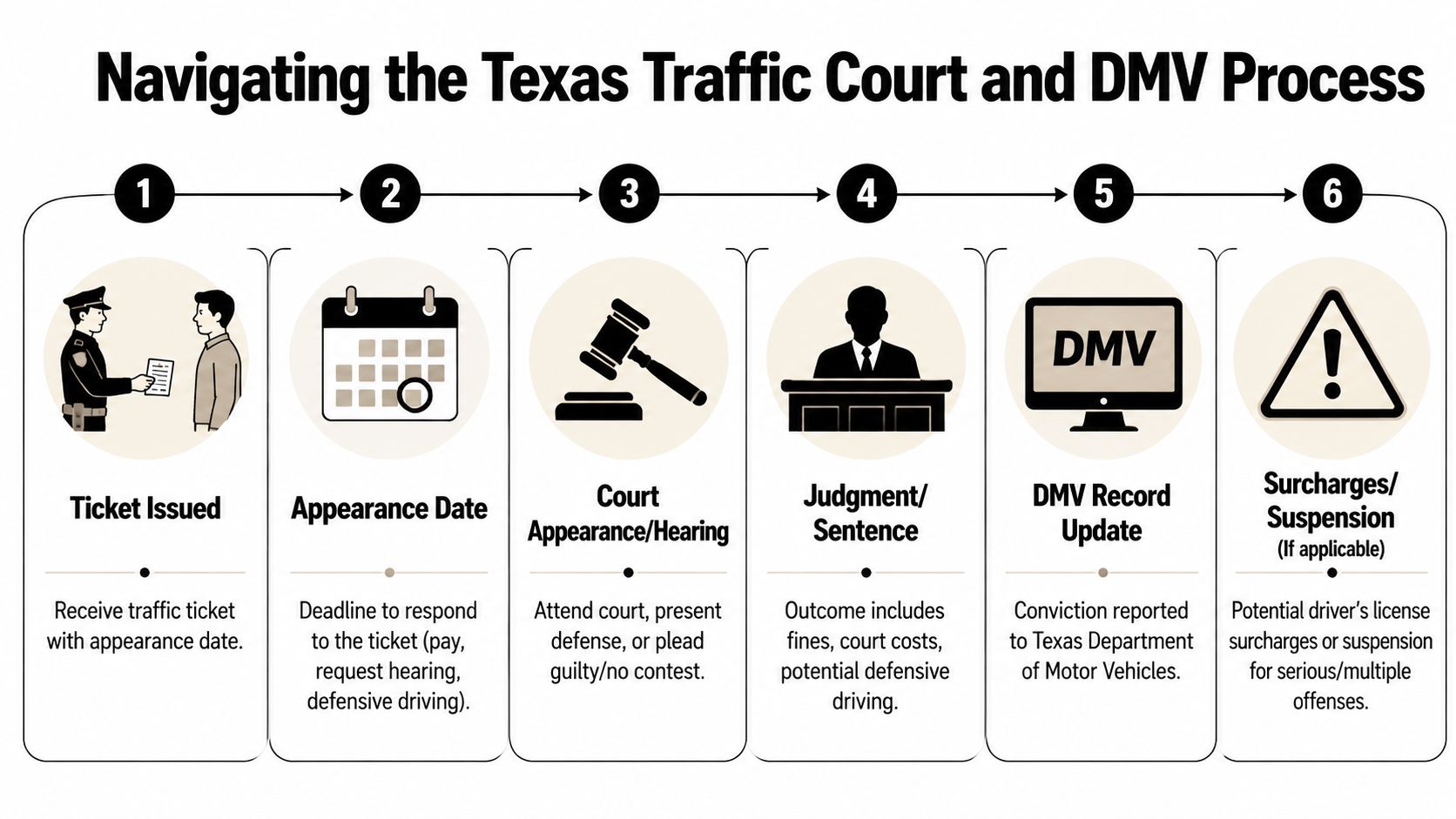
Start with the citation and calendar
The ticket itself usually tells you where to respond and by when. That date matters. If you ignore it, a manageable case can become a warrant problem.
For many drivers, the first decision is whether to contest the ticket, seek a form of alternative resolution, or accept responsibility. The right answer depends on the charge, your record, the court, and whether your license or family situation adds urgency.
Court and license issues may run on separate tracks
One of the most confusing parts of a serious traffic case is that the court process and the license process don't always move together. A person can focus on the criminal charge and miss the separate issue affecting driving privileges.
That's especially dangerous for parents involved with CPS. Under Texas Family Code Chapters 262, 263, and 161, parents are often trying to meet service plan tasks, maintain contact with their children, attend hearings, and show stability over time. Losing the ability to drive can interfere with visitation, counseling, substance abuse treatment, employment, and compliance with court orders. A traffic problem can become “evidence” of instability if it causes repeated missed obligations.
A practical timeline
Here's how many cases unfold in real life:
The stop or citation
You receive the ticket, complaint, or arrest paperwork. Save everything.The response deadline
The court expects action by the date on the citation or notice.The first setting
This may involve entering a plea, requesting discovery, or setting the case for later review.Case evaluation
Your lawyer examines the officer's basis for the stop, witness issues, records, video, testing, and procedural errors.Negotiation or contested hearing
Some cases resolve through reduction, deferred options, or dismissal. Others need a hearing or trial.Record and license follow-up
After the court outcome, you may still need to address reinstatement, occupational driving privileges, or record-cleanup options.
If your ability to drive is already affected, this resource on how to reinstate a suspended license in Texas is a helpful next read.
Why out-of-state resources can still help
Sometimes drivers compare what they're being asked to do in Texas with education or compliance programs in other states. The laws aren't interchangeable, but seeing how another state structures post-DUI education can make the process less mysterious. For example, DUI classes in Georgia show how courts often use education requirements as part of broader compliance planning.
If you're a parent in an active CPS case, tell your traffic lawyer immediately. Transportation issues can affect service-plan compliance long before the criminal case ends.
The family law overlay many people miss
In CPS matters, judges often look for patterns. They want to know whether a parent follows court orders, appears when required, maintains stable transportation, and reduces risk around the child. A missed court date in a traffic case may look minor to you. In a Chapter 263 review setting, it may be one more sign that the parent isn't managing responsibilities consistently.
That doesn't mean a ticket decides a CPS case. It does mean the traffic case should be handled with the family case in mind.
Common Defenses and Proven Legal Strategies
You get pulled over on the way home, accept the ticket, and assume the case will come down to whether the officer shows up. In Texas traffic court, that is rarely the main issue. The better question is whether the State can prove each part of the charge with admissible, reliable evidence, and whether the case can be resolved in a way that protects your record.
Good traffic defense is usually technical work done early. A lawyer reviews the citation, the statute, the officer's notes, any video, the radar or pacing method if speed is alleged, and the court's local practices. Small proof problems matter. So does timing.
Where useful defenses usually come from
A texas traffic lawyer starts with the elements of the offense and the quality of the State's evidence. The driver's explanation may matter, but it usually comes second.
Common pressure points include:
- The basis for the stop. If the officer did not have a lawful reason to stop the vehicle, that can weaken the case from the start.
- Driver identification. Some cases involve a plate number, a brief observation, or confusion about who was driving.
- Speed measurement or observation issues. Radar, lidar, pacing, training, calibration, and visual estimates all need to hold up.
- Charging and paperwork errors. A defective complaint, missing information, or procedural mistakes can create room to challenge the case or improve the outcome.
- Witness and video problems. Dash cam, body cam, and dispatch records do not always line up cleanly with the citation.
- Resolution options short of trial. Deferred disposition, driving safety courses in eligible cases, and negotiated amendments can matter more than winning a dramatic courtroom argument.
Local experience helps here. Lawyers who spend time in the same courts learn which prosecutors will correct a bad charge, which judges expect motions filed early, and which cases are better set for trial than bargained.
What usually helps, and what usually does not
Some defenses sound reasonable but do little in court. Keeping up with traffic is usually not a legal defense. Needing a license for work may support a better negotiated result, but it does not defeat the charge by itself. Arguing with the officer almost never improves the file.
A focused case review does.
| Approach | Usually weak | Often useful |
|---|---|---|
| Emotional explanation | Yes | Rarely enough by itself |
| Careful review of the stop and the proof | No | Frequently important |
| Early action by counsel | No | Often preserves more options |
| Paying first and asking questions later | Yes | Usually reduces negotiating power |
If the goal is to avoid a conviction, these ways traffic tickets may be dismissed in Texas show the kinds of openings a lawyer looks for before the case hardens into a final judgment.
One more point gets missed in a lot of traffic articles. The best result is not always a straight dismissal. Sometimes the right move is a result that keeps the allegation from turning into a conviction you have to explain later in a custody dispute, a CPS investigation, a professional licensing application, or a background check. That is especially true with traffic misdemeanors, including some no-insurance, suspended-license, or DWI-related charges, where the long-term record consequences can outlast the fine.
The Law Office of Bryan Fagan PLLC handles criminal defense matters that include DWI allegations, traffic-related criminal cases, protective-order overlap, and post-conviction record relief. That range matters when a traffic case is part of a larger problem and the goal is not just to close the ticket, but to protect the client's position afterward.
Beyond the Ticket Hidden Risks and Opportunities
Most traffic articles stop at fines, insurance, and court dates. For many Texas families, that's where serious trouble begins, not where it ends.
When a traffic case touches custody or CPS
A traffic conviction can surface in a custody dispute or CPS investigation at exactly the wrong time. A Texas traffic violation is a criminal conviction that can impact child custody and CPS investigations. Post-2025 HB 299, traffic-related license suspensions now auto-flag in CPS databases, increasing removal risks. Texas law also allows expunction of many Class C offenses after successful deferred adjudication, according to this discussion of traffic violations and family law consequences in Texas.
That matters because CPS cases move under strict timelines. Chapter 262 addresses emergency removal and early court involvement. Chapter 263 governs review hearings, permanency planning, and service-plan compliance. Chapter 161 deals with termination grounds. A traffic issue won't automatically control those proceedings, but repeated missed hearings, warrants, suspended licenses, or a DWI allegation can become part of the larger narrative about judgment, stability, and child safety.
Here is a relatable example. A parent already involved in a CPS case gets cited, misses the court date because transportation is shaky, then gets pulled over later on a license issue. By the time the next family court hearing arrives, the traffic matter is no longer minor. It has become another item the agency can point to when arguing that the parent isn't following rules consistently.
The opportunity many people miss
The hidden risk has a mirror image. Sometimes there's also a hidden opportunity.
If you already resolved a traffic case badly, that doesn't always mean the record is stuck forever. In some situations, record cleanup may be available. If your license is restricted and you still need to get to work, school, treatment, or visitation, an occupational license in Texas may become part of the practical solution while the larger case is addressed.
Why post-conviction relief matters for parents
Parents in CPS or custody matters often need more than a short-term court result. They need a long-term record strategy.
- Employment screening can affect housing and financial stability.
- Background checks can shape how the other side portrays you in family court.
- Record relief can remove obstacles that keep resurfacing long after the traffic stop is over.
A smart legal plan looks beyond the next hearing date. It asks what this case will look like six months from now, after the CPS review hearing, after the job application, and after the immediate stress has passed.
Hiring Your Advocate and Taking the Next Step
Choosing the right lawyer for a traffic case is less about slogans and more about fit. You want someone who can identify the charge accurately, move quickly on deadlines, and understand whether the case affects your family law or CPS position.
Questions worth asking before you hire
A consultation should leave you clearer, not more confused.
- Ask about the exact charge. Is this a simple ticket, a criminal traffic offense, or a DWI-related matter?
- Ask about the record strategy. If the case resolves, can the result protect your record or improve later cleanup options?
- Ask about court logistics. Will you need to appear? Can parts of the case be handled remotely?
- Ask about overlap issues. If CPS, custody, or a protective order is in play, how will that affect strategy?
If you want a general consumer-friendly overview before that consultation, this guide to fighting traffic tickets is a useful companion piece.
Why record cleanup should be part of the conversation
Don't hire a lawyer who only talks about the first court date. Some of the most important advice comes after the case ends.
Texas law allows expunction for many Class C traffic offenses if no conviction or after successfully completed deferred adjudication under Art. 55.01 CCP, but success rates hover at 40% without specialized counsel. Since 2025, virtual expungement hearings have surged 150%, making statewide access easier for clients in major Texas cities, according to this overview of traffic expunction and virtual hearing trends.
That should affect how your case is handled from day one. A quick plea that feels convenient now may create avoidable record problems later. A more strategic resolution may take more effort upfront but protect your future more effectively.
When families are under pressure, they need legal advice that accounts for transportation, employment, court compliance, and parenting obligations at the same time. That's especially true if CPS is already involved.
If a traffic stop, ticket, license problem, or DWI allegation is creating stress for your family, don't try to sort it out alone. The Law Office of Bryan Fagan PLLC helps Texans address criminal cases that intersect with custody, protective orders, and CPS concerns. A free consultation can help you understand the charge, protect your license, and build a plan that supports your family's next step.