Skip to content
A DWLI charge usually lands at the worst possible moment. You were already trying to hold life together. Then a traffic stop turns into a criminal case, and suddenly the practical questions hit all at once. How do you get to work? How do you pick up your child? What happens if you're already dealing with court dates, probation terms, or family obligations that require reliable transportation?
For many Texas parents, the fear isn't abstract. It's immediate. Missing one hearing, one school pickup, or one required appointment can start a chain reaction. If your life already touches the family court system or a CPS matter, losing the ability to drive can affect much more than your commute.
The good news is that how to get driving with suspended license dismissed often starts somewhere simpler than people expect. In many cases, the strongest move is not a courtroom speech. It's fixing the suspension first, getting the right paperwork, and putting the prosecutor in a position to dismiss the case before trial. That doesn't work in every case, but it works often enough that it should usually be your first focus.
The Shock of a DWLI Charge in Your Daily Life
Maria is a good example of how this happens in real life. She was driving home after handling errands for her children when she got pulled over for a routine stop. She expected a warning or maybe a minor ticket. Instead, the officer told her her license was invalid and handed her a DWLI citation.
By the time she got home, the charge had already grown in her mind. She wasn't just worried about court. She was worried about everything that depended on her driving. Work. School pickup. Grocery runs. Appointments she couldn't miss.

That reaction is normal. A DWLI charge feels personal because it immediately threatens your routine. Texas courts treat it seriously, and you should too. But serious does not mean hopeless.
Why this charge feels bigger than a traffic ticket
A DWLI case usually tells you there's a second problem hiding underneath the charge. The ticket from the officer is only the visible part. The actual issue is the suspension, hold, or invalid status already attached to your license.
That's why people get stuck when they approach this the wrong way. They focus only on the court date and ignore the reason their license was suspended in the first place. Then they show up in court with excuses but no proof that anything has been fixed.
Practical rule: If you want the best chance at dismissal, treat the criminal case and the license problem as connected, but separate, problems.
The first goal is stability
Before you think about trial strategy, think about damage control. You need to know whether you can legally drive, what triggered the suspension, and what can be cured quickly. In many cases, the first few days after the citation matter more than people realize.
Start with these immediate moves:
- Stop guessing about your status. Don't rely on memory or old paperwork.
- Don't miss your court date. A missed appearance creates a new problem.
- Gather every document you already have. Old tickets, proof of payment, insurance records, court notices, and DPS correspondence can all matter.
- Think about family obligations now. If transportation affects parenting exchanges, school attendance, or required services, plan around that immediately.
If you're frightened, that's understandable. But panic leads people to do the two things that hurt them most. They either ignore the case, or they rush into court before fixing the underlying suspension.
Diagnosing the Root Cause of Your License Suspension
A DWLI dismissal usually starts with diagnosis. You need the exact reason your license is invalid, not a rough guess. “I think it was an old ticket” is not enough. “I'm pretty sure I paid that already” is not enough either.
The first task is to pull your driving status and identify every active hold, suspension, or reinstatement requirement tied to your record. That gives you a map. Without it, you're moving blind.

For a broader overview of the charge itself, review this page on driving while license is suspended in Texas.
What to check first
Use the Texas Department of Public Safety tools and your court paperwork to answer a few basic questions:
- Why is the license invalid?
- Is it a suspension or a revocation?
- Is the problem tied to an unpaid ticket, insurance issue, court noncompliance, or a prior alcohol-related matter?
- Has anything already been cured, but not properly recorded?
- Are there multiple holds from different courts or agencies?
A suspension is usually temporary and tied to compliance. A revocation is more serious and often requires a more involved process to restore driving privileges. That distinction matters because a suspension often gives you a more direct administrative path toward cleanup and dismissal.
Build a paper trail before you build an argument
Clients often want to explain what happened before they've gathered documents. The better approach is to collect proof first, then decide what argument fits the evidence.
Focus on records like these:
- Court receipts for old fines or ticket payments
- Insurance records showing whether a lapse existed and when coverage resumed
- DPS notices about suspension dates or reinstatement conditions
- Course certificates if a class was required
- Mailing records or address history if notice is an issue
The cleanest defense is often a clean file. Prosecutors respond better to documents than to explanations.
A short comparison that matters
| Issue | Why it matters |
|---|---|
| Unpaid fines or ticket defaults | Often curable if you resolve the court obligation and document it |
| Insurance-related suspension | May require current coverage and specific proof filings |
| Course requirement | You need the completion certificate from the correct provider |
| Record error | May require correction through DPS or court clerks before the criminal date |
| Revocation instead of suspension | Usually calls for a different strategy than simple reinstatement |
Many suspensions come from problems that are more administrative than criminal. That matters because the strongest move may be correcting the agency record before your court date, not waiting to argue in front of the judge.
Your Primary Path to Dismissal Curing the Suspension
You get stopped on the way to work, and by that afternoon you are holding a DWLI ticket and wondering whether one old insurance problem or unpaid case just turned into a criminal record. In many Texas cases, the first and strongest route to dismissal starts before you ever walk into court. Fix the suspension, get proof that it was fixed, and get that proof to the prosecutor early.
That approach does not guarantee a dismissal. It does put you in the best position available in a large share of these cases because prosecutors tend to treat a cured suspension very differently from an active one.
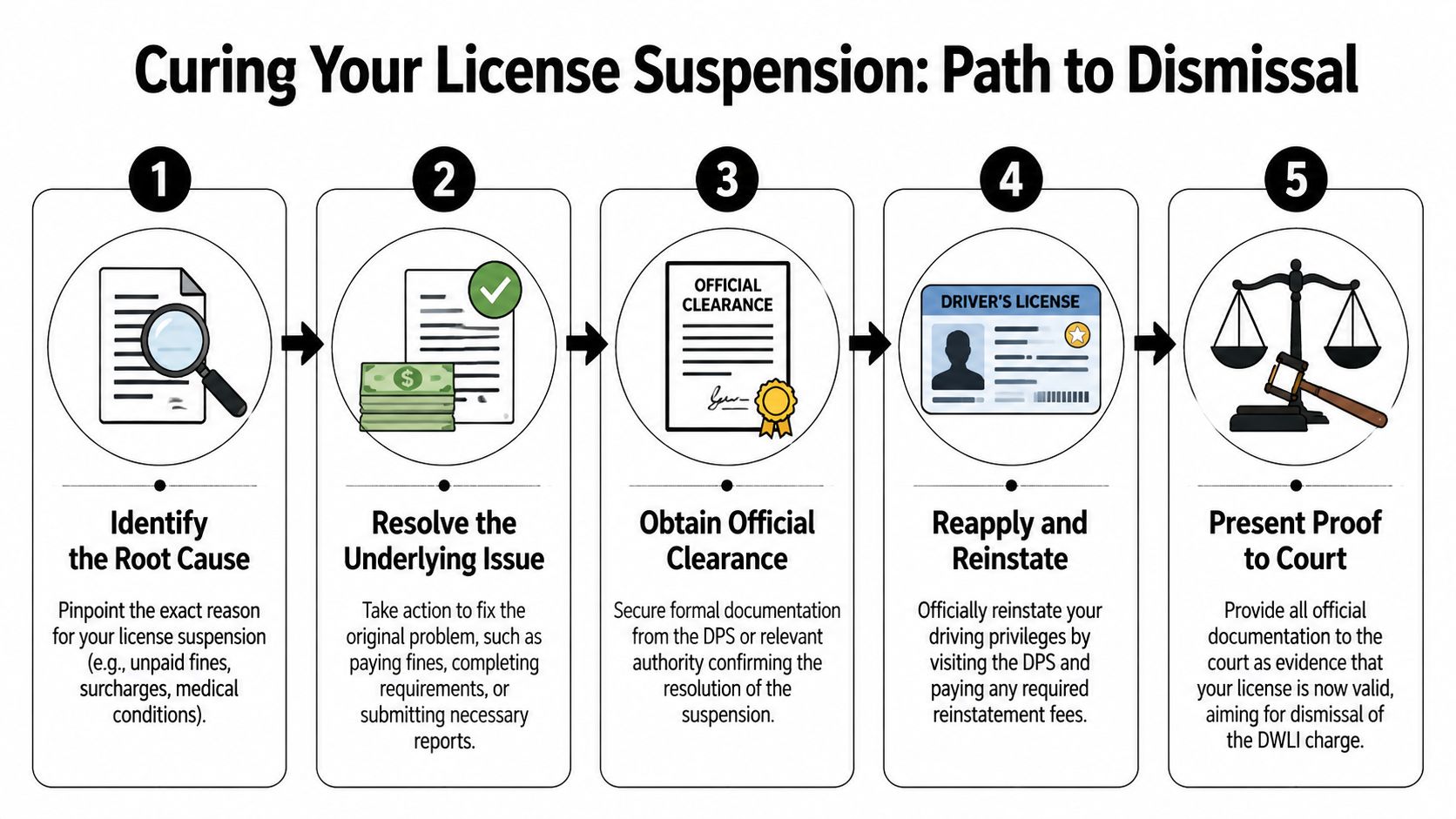
A lot of drivers assume the court date is where the problem gets solved. Often, the court date is just where the paperwork gets judged. If the DPS record still shows a suspension, explanations usually do not carry much weight. If the file shows the underlying problem has been cleared and processed, the conversation changes.
What “curing the suspension” actually means
Curing the suspension means eliminating the reason Texas still considers you ineligible to drive. The required fix depends on the cause of the suspension, but it usually involves one or more of these steps:
- Paying old fines, fees, or defaulted tickets
- Getting current insurance and filing SR-22 if your case requires it
- Finishing any class or program tied to reinstatement
- Paying the reinstatement fee
- Making sure DPS or the reporting court processes the update
That last point matters more than people expect.
I regularly see drivers who paid money, bought insurance, or completed a course, but never confirmed that the right agency received it and updated the record. From a prosecutor's standpoint, partial cleanup is still noncompliance if the system has not changed by the court date.
Why timing matters
The greatest risk is waiting.
Fixing everything a day or two before court may feel productive, but it can leave you with proof that you tried, not proof that the suspension was cured. Processing delays are common. Court clerks need time. DPS needs time. Insurance filings and course records do not always post the same day.
A stronger file shows three things: what was required, when it was completed, and when the record was updated. That is the packet prosecutors can act on.
What helps: “Here is my receipt, my SR-22 filing, and the DPS record showing eligibility restored before court.”
What to gather before the first court setting
The most useful dismissal packet is usually straightforward and complete:
Payment proof
- receipts for old tickets or court obligations
- reinstatement fee confirmation
- any compliance notice from the originating court
Insurance proof
- current insurance declarations page
- SR-22 confirmation, if required
Program or course proof
- completion certificate
- provider information if approval status matters
Status proof
- DPS clearance, eligibility update, or reinstatement confirmation
- any notice showing the hold or suspension was removed
If you need help sorting out the administrative side, this guide on how to reinstate a suspended license in Texas is a useful starting point.
Why compliance-first usually works better than argument-first
In a DWLI case, the state usually cares about one practical question first. Are you still suspended?
If the answer is yes, legal arguments become harder to sell. If the answer is no, and you can prove the issue was corrected before court, the prosecutor has a sensible off-ramp. That does not mean every case gets dismissed. Some courts want additional conditions. Some prosecutors want extra verification. But curing the suspension often improves the outcome more than showing up with a long explanation about why things went wrong.
Other states use the same compliance model in alcohol-related reinstatement systems. For example, the Georgia DUI license reinstatement SAP program ties driving privileges to completed program requirements. Texas uses different rules, but the lesson is familiar. Agencies and prosecutors respond to completed requirements and accepted documentation.
Mistakes that hurt dismissal chances
These problems come up again and again:
- Showing up without documents
- Bringing proof that a payment was made, but not proof the suspension was cleared
- Using a class provider that does not meet the requirement
- Waiting until trial week to start the reinstatement process
- Assuming the judge will sort out agency problems from the bench
A clean administrative fix is often the best first move in a Texas DWLI case. Then, if the state still refuses to dismiss, your lawyer can press the legal issues from a much stronger position.
Building a Legal Defense Beyond Compliance
You can fix the suspension and still walk into court with a case to answer. That surprises a lot of people. In Texas, pre-court compliance is usually the best path to dismissal, but it is not the only one. If the State will not dismiss after you clear the underlying problem, the defense shifts to whether the suspension was valid, whether the State can prove the required facts, and whether the record is as clean as the prosecutor claims.
That work starts with documents, not speeches. I want the driving record, the notice history, the court paperwork, proof of insurance or surcharges if those matter, and any reinstatement correspondence from DPS. Small errors matter in these cases. A bad date, a mailed notice sent to the wrong address, or a mismatch between the suspension basis and the State's records can change how the charge should be handled.
First line of legal review: was the suspension legally sound?
Some DWLI cases have a weak foundation because the suspension itself was not properly entered or cannot be clearly proven. The problem may be clerical. It may be procedural. It may come down to whether the notice was sent the way the law requires and whether the file supports the dates alleged in the complaint.
That is a narrow, fact-heavy defense. Courts do not dismiss these cases because someone says the records seem unfair. They dismiss or reduce them when the paperwork does not hold up.
Second line of defense: use your compliance record the right way
By the time this section matters, the administrative fix should already be underway or complete. That remains the strongest practical position in a Texas DWLI case. Legal arguments are much easier to press when you can show the prosecutor that the license problem has already been corrected and there is no continuing public-safety issue tied to the charge.
Legal commentary across jurisdictions has noted the same pattern. Cases often resolve more favorably when the driver cures the suspension before trial and brings proof the agency accepted the fix. That does not guarantee dismissal. It does give the prosecutor and judge a concrete reason to resolve the case without spending court time on a problem that has already been corrected.
Third line of defense: what the State can actually prove
Knowledge can matter. So can context.
A lot of clients tell me, "I did not know I was suspended." Sometimes that statement does not help much. Sometimes it matters a great deal, especially if the notice was misaddressed, delayed, or buried in an agency mess that no ordinary person would have understood. The stronger version of that argument is usually this one: the State may not be able to prove you had the notice or knowledge required under the facts of your case.
That is different from asking for sympathy. It is a proof problem.
Administrative repair and criminal defense are connected, but they are not the same job
The administrative side is about fixing the license status, removing holds, paying what must be paid, filing what must be filed, and getting clear proof from DPS or the court system. The criminal side is about using that corrected status, or exposing defects in the State's case, to seek dismissal, reduction, or another result that protects your record as much as possible.
Here is the practical breakdown:
| Path | Main purpose |
|---|---|
| Administrative remedy | Clear the suspension, correct the record, or challenge the basis for the hold |
| Criminal defense | Test the State's proof and use the corrected status or legal defects to push for dismissal or reduction |
Sometimes those tracks need to run at the same time. If you still need limited driving rights while the case is pending, getting a Texas occupational driver's license for work and essential household needs can help protect your job and family routine while the defense is being built.
The main point is simple. In Texas, courtroom arguments work best after the administrative problem has been cleaned up, or after a careful review shows the suspension record itself is flawed. That is how strong DWLI defenses are usually built.
Navigating Plea Bargains and Occupational Licenses
You get stopped on the way to work, the officer tells you your license is suspended, and now you are worried about two things at once. The court case, and how you are supposed to keep your job while it is pending.

When a plea bargain makes sense
In a Texas DWLI case, I usually treat a plea bargain as the backup plan, not the first move. The first move is still to cure the suspension if that can be done and to walk into court with proof. But sometimes the suspension cannot be fixed fast enough, the record is messy, or the prosecutor will not agree to dismiss even after compliance. That is when negotiation matters.
A good plea deal should solve a real problem. It might reduce the charge, avoid a conviction on the original allegation, or create a path to finish conditions and protect your record as much as the facts allow. The right choice depends on your driving history, the county, the judge, and whether the State has weaknesses in its proof.
There is a trade-off here. Holding out for trial can make sense in some cases. It can also increase cost, stress, missed work, and risk. If the offer is better than your trial exposure, and your license problem is being repaired in the background, a negotiated result may be the smarter call.
Occupational licenses can keep your life stable while the case is pending
An occupational license does not dismiss the DWLI charge. It does something different, and for many families it matters just as much in the short term. It gives you a lawful way to drive for limited purposes such as work, school, household duties, and court obligations while the suspension issue is still being addressed.
That matters before court, not just after.
If you are the person who takes children to school, drives to a job site, or handles medical appointments, waiting for the criminal case to end without getting legal driving privileges can create new problems fast. In many cases, applying early for a Texas occupational driver's license for work and essential household needs helps steady daily life while your lawyer keeps pressing the primary dismissal strategy.
How these two options work together
Plea discussions and occupational licenses serve different purposes.
An occupational license helps you drive legally now, under court-ordered limits. A plea bargain addresses how the criminal case will end if dismissal is not available. One protects your day-to-day life. The other protects your record as much as possible under the circumstances.
Clients sometimes assume asking for an occupational license looks like giving up on dismissal. It does not. In practice, it often shows the court that you are taking the problem seriously, following the rules, and fixing what can be fixed before the next setting.
If you are also trying to evaluate legal representation, this guide on choosing a Forsyth County defense lawyer gives a general overview of what to look for in criminal defense counsel.
Here's a short explainer that helps many clients understand how these licensing issues interact with court strategy:
Questions to ask before you choose a path
Ask these questions:
- Can you finish the remaining compliance steps before the next court date? If yes, keep pushing that route because it still gives you the best shot at dismissal.
- Do you need legal driving privileges right away to avoid job or family disruption? If yes, look at an occupational license now.
- Is the prosecutor offering a result that is better than the risk of trial? Review the exact terms, not just the label.
- Would more time help because your suspension is close to being cleared? Sometimes the best move is asking for time to complete the repair, not rushing into a plea.
The goal is not to grab the first offer or file paperwork for the sake of filing it. The goal is to protect your future while keeping the administrative cure front and center. In Texas DWLI cases, that sequence often makes the difference.
Protect Your Future by Partnering with an Attorney
DWLI cases look simple from the outside. They aren't. They mix agency rules, court procedure, deadlines, filing requirements, and local prosecutor practices. A person representing themselves usually sees one case. The prosecutor and judge see a stack of them every docket.
That difference matters.
What a lawyer actually does in these cases
A good defense lawyer does more than appear in court. The work often starts before the hearing date by identifying the suspension source, coordinating reinstatement steps, gathering proof, and deciding whether the best route is administrative correction, negotiated dismissal, or a direct legal challenge.
That can include:
- Reviewing the driving record for defects
- Contacting the right court or agency for old holds
- Checking whether notice was adequate
- Organizing a pre-trial compliance packet
- Pursuing an occupational license where needed
- Negotiating from proof instead of apology
The Law Office of Bryan Fagan PLLC handles criminal defense and related license issues for Texans whose criminal cases can also affect work, parenting, and family stability.
Local knowledge changes outcomes
A court-regular lawyer knows which prosecutors want complete packets in advance, which courts respond well to documented compliance, and which arguments tend to fall flat. That kind of knowledge doesn't appear on the citation. It comes from repeated work in the same system.
If you're trying to evaluate counsel, even guidance written for another jurisdiction can help you ask the right questions. This article on choosing a Forsyth County defense lawyer is useful for thinking through experience, communication, and fit. The county is different, but the screening logic still applies.
The real risk of waiting
The people who usually make these cases worse are not the people with the worst facts. They're the people who wait. They miss deadlines, fail to fix what can be fixed, show up without records, or keep driving without a legal plan.
A DWLI charge can often be improved. Sometimes it can be dismissed. But delay closes options.
The strongest position usually comes from early action, complete paperwork, and a defense plan built around the real cause of the suspension.
If your ability to drive affects your job, your children, your court obligations, or your household stability, this is not a case to treat casually.
If you're facing a DWLI charge in Texas and need clear answers about dismissal, reinstatement, or an occupational license, contact Law Office of Bryan Fagan PLLC for a free consultation. We help Texans sort out the underlying suspension, protect their record where possible, and build a practical plan that supports work, parenting, and family stability.