Skip to content
A call from Child Protective Services (CPS) can turn your world upside down, leaving you feeling scared, confused, and powerless. When they hand you a document called a behavior support plan, it's easy to see it as an accusation or just another impossible hurdle. But what if you could see it differently? What if this plan was actually your roadmap to getting your family back together and closing your case for good?
In the eyes of Texas law, this plan isn't about punishment. It’s a structured, proactive tool designed to address the specific concerns that brought CPS to your door. Think of it as a guide created to teach and reinforce positive behaviors for both you and your children, giving you a clear path to prove you can provide a safe, loving home.
Understanding the Purpose of a CPS Behavior Support Plan

The primary goal of the Texas Family Code is to ensure child safety while making every effort to keep families intact. A behavior support plan is one of the key tools CPS uses to achieve this balance. It's your opportunity to demonstrate your commitment to your children and work collaboratively toward reunification. Viewing this plan not as a judgment but as a structured path forward can make all the difference in your case.
A Relatable Scenario
Imagine a single mother in Houston, working two jobs to make ends meet and raising two young children. Exhaustion and financial stress are constant. One evening, after a particularly draining day, she yells at her oldest child in a moment of frustration. A neighbor hears the shouting, misunderstands the situation, and calls CPS.
The agency's concern isn't that she's a bad mother, but that the immense stress is leading to negative coping mechanisms. Instead of moving to remove the children, CPS works with her to create a behavior support plan focused on:
- Enrolling her in a free, local stress management course for parents.
- Connecting her with a family therapist to improve communication with her children.
- Helping her establish predictable evening routines to create a calmer home environment.
This plan doesn't punish her for being overwhelmed; it gives her the resources and actionable steps to build a more stable and supportive home. It turns a moment of crisis into a genuine chance for healing and growth.
A critical first step in developing an effective behavior support plan involves taking the time to truly understand your child's unique learning behavior and profile, as this informs every aspect of the plan. When you can show CPS you are invested in understanding your child’s needs, it strengthens your position significantly.
Ultimately, a behavior support plan is your documented roadmap to reunification. It allows you to provide clear, undeniable evidence that you are actively working to create the safe and nurturing environment your children deserve. At The Law Office of Bryan Fagan, we help parents see this plan not as an obstacle, but as a structured path toward a positive outcome. If you're facing a CPS investigation, you don't have to navigate this alone.
What a Texas CPS Support Plan Actually Includes

When CPS hands you a document called a "behavior support plan," the legal language and list of requirements can be intimidating. But these plans aren't random; they are built on specific, concrete components designed to map out a clear path forward for your family.
Under the Texas Family Code, particularly Chapter 262, these plans—often referred to as service plans—must be tailored to your family's unique situation. This isn’t a generic checklist. It's a framework designed to help you make meaningful changes that both CPS and the family courts will recognize as progress. The entire purpose is to shift from reacting to problems to proactively building new skills and a healthier family dynamic.
Breaking Down the Core Components
A well-drafted behavior support plan won't just set a vague goal like "be a better parent." Instead, it will identify concrete actions and observable changes, breaking down large concerns into smaller, manageable steps.
Here are the key elements you should expect to see in your plan:
- Identifying Specific Behaviors of Concern: The plan will clearly state the exact behaviors that led to CPS involvement. This could range from harsh verbal discipline and lack of supervision to inconsistent routines that create instability for your child.
- Pinpointing Triggers: It’s not just about what is happening, but why. The plan will explore the root causes. Is it financial stress? A lack of a support system? Are you struggling to manage a challenging developmental stage your child is going through? Identifying triggers is essential for finding lasting solutions.
- Developing New Skills: This is where the real work—and real change—begins. The plan will outline specific, teachable skills for you to learn. This often involves services like parenting classes, individual or family therapy to learn better communication strategies, or joining a stress management support group.
- Creating a Positive Reinforcement System: The focus is on encouraging positive actions, not just punishing negative ones. Your plan will likely include strategies for praising your child, creating a reward system for good behavior, and establishing more positive, predictable family routines.
For example, if a family is struggling with a child's frequent tantrums, a good plan won't just say, "Stop the tantrums." Instead, it will help identify the triggers (like hunger or transitions between activities), teach the parent practical de-escalation techniques, and give the child tools to express their needs with words instead of outbursts.
This structured approach removes the guesswork, turning what feels like a list of demands into a logical, step-by-step guide. Understanding how these plans function within the larger CPS case is crucial. You can gain valuable insight by breaking down CPS plans of service to see how all the pieces connect.
Key Components of a CPS Behavior Support Plan
This table breaks down the official terms into what they actually mean for you and your family on a daily basis.
| Component | What It Means for You | Real-World Example |
|---|---|---|
| Behaviors of Concern | The plan will list the specific actions CPS wants you to change. It's not about being a "bad parent" but about addressing observable behaviors. | "Parent uses yelling and threats as the primary form of discipline when the child misbehaves." |
| Triggers/Causes | This section identifies why the behavior is happening. Understanding the root cause is key to changing the pattern for good. | "Parent reports feeling overwhelmed and unsupported, leading to emotional outbursts when stressed by child's defiance." |
| Proactive Strategies | These are the new skills and tools you'll learn to prevent the behavior before it starts. It’s about building a better toolbox. | "Parent will attend a 12-week 'Positive Parenting' course to learn non-physical discipline techniques." |
| Reactive Strategies | This is your game plan for what to do in the moment when the behavior occurs. It's about responding differently. | "When feeling angry, parent will practice a 'cool-down' technique: walk away for 5 minutes and take deep breaths before re-engaging." |
| Reinforcement Plan | This outlines how you will encourage and reward positive behavior from your child to build a more positive home environment. | "Create a sticker chart to reward the child for using 'inside voices' and following directions the first time." |
By seeing the plan laid out this way, you can begin to view it not as a list of failures, but as a constructive roadmap for building a stronger, healthier family dynamic that satisfies the court's requirements.
How to Create a Plan That Protects Your Family
When CPS is involved in your life, it's easy to feel like things are happening to you. But when it comes to your behavior support plan, your active involvement is not just helpful—it’s critical. This is your chance to help shape the roadmap for your family's future and demonstrate your commitment to providing a safe, stable home.
Your most powerful tool is proactive collaboration with your CPS caseworker, therapists, and especially your attorney. You have the right to advocate for realistic goals, suggest strategies that align with your family's values, and ensure every requirement is clear and measurable. Your voice matters.
Your Role in Building the Plan
Never be afraid to offer your perspective. A generic, one-size-fits-all plan often fails because it doesn't account for a family's unique circumstances. You know your child, your strengths, and your challenges better than anyone.
Actionable Advice: Instead of passively accepting a plan, come to the meeting with your own ideas. If CPS requires a parenting class, research local options and propose one that specifically addresses your family's needs. For example, if you have a child with special needs, suggest a class focused on that topic. This shows initiative and a genuine desire to improve.
A well-crafted plan, developed with your input, becomes powerful evidence in court hearings under Texas Family Code Chapter 263, showcasing your unwavering commitment. As you prepare, it can be helpful to review a range of effective behavior management strategies, even those used in schools, to broaden your understanding of what's possible.
Partnering with Your Legal Team
Never agree to or sign a behavior support plan without a thorough review by your attorney. This is not a step to be rushed. Your attorney’s job is to protect your parental rights and ensure the terms are fair, achievable, and legally sound.
Your lawyer will analyze the plan to:
- Ensure the goals are directly related to the original CPS concerns, not overreaching.
- Confirm that expectations are specific and measurable, not vague or open to interpretation.
- Negotiate realistic timelines and requirements that fit your life and circumstances.
Your attorney is your strongest advocate, ensuring the plan is a tool for your success, not a trap designed for failure. Their legal review prevents you from agreeing to terms that could be used against you later if you struggle to meet impossible standards.
The process of creating a behavior support plan is very similar to developing other critical documents in a CPS case. Understanding the overall process can give you more confidence. Our guide on creating a CPS safety plan offers valuable insights that will help you feel more prepared for what's ahead.
Ultimately, your active participation, guided by experienced legal counsel, is the key to creating a plan that truly protects your family.
Putting Your Plan into Action and Proving It
A plan on paper is just that—paper. For it to mean anything to CPS or a judge, you have to bring it to life through consistent, dedicated action. This is where you build the tangible proof you'll need for court reviews, showing your unwavering commitment to your family.
Progress is rarely a straight line. You will have good days and bad days, and that is okay. What matters most to CPS and the court isn't perfection; it’s your persistent effort to learn, adapt, and keep moving forward. Your resilience when things get tough speaks volumes about your dedication as a parent.
This infographic gives a solid overview of what goes into creating a strong, collaborative plan, which is the foundation for everything that comes next.
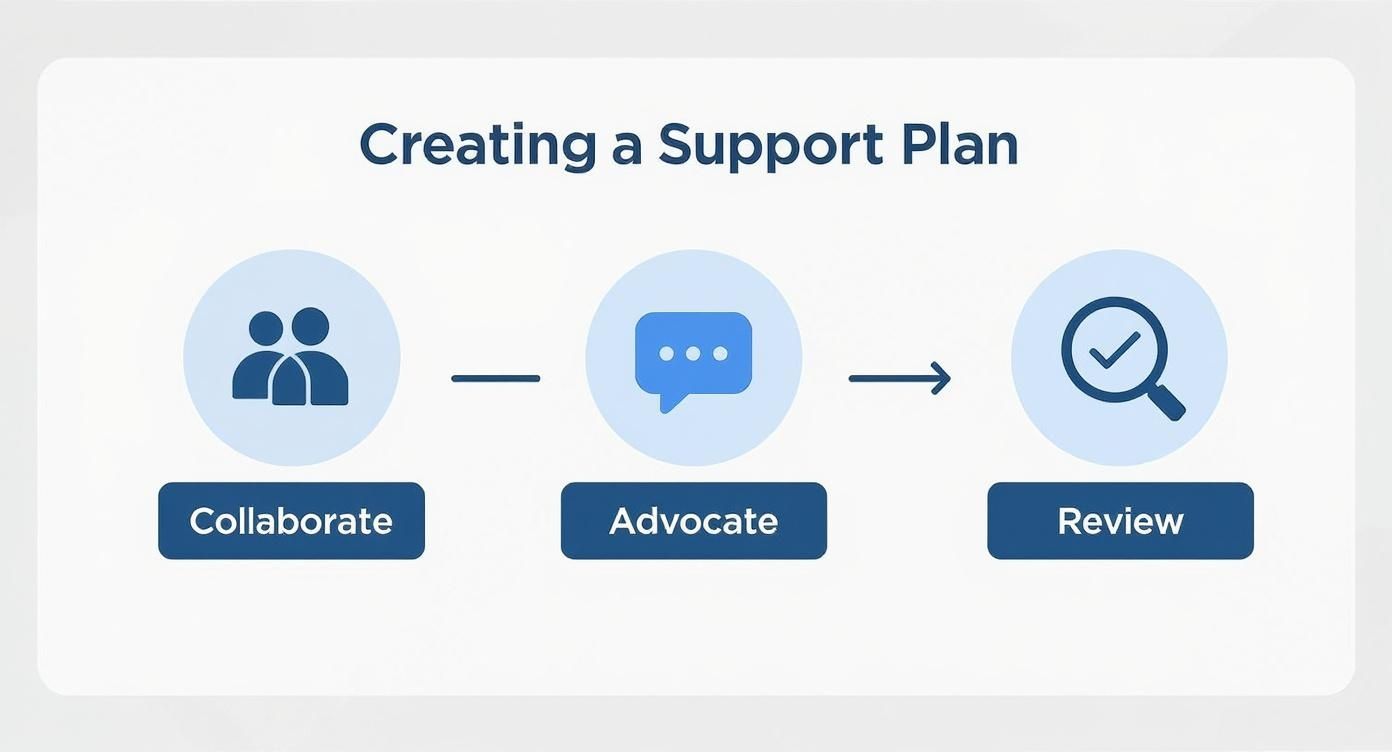
The main takeaway here is that a successful plan is built on teamwork, strong advocacy for what your family truly needs, and a careful review with your legal team before you sign off on anything.
Document Everything: Your Proof for Court
In a courtroom, your word alone is not enough. You must create a compelling, undeniable record of your efforts, turning your daily actions into solid evidence. This documentation will be your most powerful tool during hearings and reviews.
Actionable Advice: Start a dedicated "CPS Progress" binder or digital folder today. Every time you complete a task, add the proof. This organized record is invaluable for your attorney.
Here are practical ways to build that record:
- Keep a Daily Journal: At the end of each day, jot down a few sentences about how you used the plan. What worked? What was a struggle? How did your child respond? Be honest.
- Save Every Certificate: Whether it's from a parenting class, counseling session, or anger management course, keep both a physical and a digital copy of every certificate of completion.
- Collect Letters of Support: Ask counselors, therapists, or program facilitators to write letters confirming your attendance, active participation, and progress. These professional endorsements carry significant weight.
A Real-World Example of Consistent Effort
We represented a family struggling with chaotic morning routines that often ended in yelling and missed school buses. Their behavior support plan was simple: they created a visual checklist for the kids (get dressed, eat breakfast, brush teeth) and a new rule for themselves: use calm tones, no matter what.
To track their progress, they kept a simple log on the fridge. A checkmark meant a calm morning; an 'X' meant it was stressful. They added quick notes like, "Used deep breathing today. It helped," or "Kids argued, but we didn't yell."
These small, consistent actions created a powerful record. Over several weeks, the growing pattern of checkmarks demonstrated the sustained improvement needed to fight back against the termination of parental rights under Texas Family Code Chapter 161.
The Power of Consistent Implementation
The success of your plan is tied directly to how consistently you put it into practice. Research shows that with proper coaching, parents can dramatically increase how well they implement support strategies—sometimes jumping from a baseline of 26% correct usage to as high as 95%. This proves that your commitment to following the plan leads directly to better outcomes.
This documented consistency is what your attorney will use to advocate for you in court. When CPS questions your progress, your lawyer can present a file full of proof—journals, letters, and certificates—that tells a story of a parent who is working tirelessly to create a safe and stable home.
If you're doing your part, but CPS isn't providing promised services, you have recourse. Learn how a Motion for Enforcement can be used to hold CPS accountable and ensure everyone involved is meeting their obligations.
Common Challenges Parents Face and How to Respond
Following a behavior support plan is challenging. It's completely normal to feel overwhelmed by the requirements or to disagree with a caseworker's decisions. Hitting these roadblocks is part of the process. What matters to CPS and the court is how you respond—with persistence and a commitment to finding a way forward.
No one expects perfection. They expect you to keep trying. This is where your support system, especially your lawyer, becomes essential.
When You Disagree With The Plan
What do you do if you believe the plan is unfair, unrealistic, or simply won't work for your family? Your first instinct might be frustration, but the key is to channel that into professional communication and constructive alternatives.
Actionable Advice: Do not just refuse to cooperate, as this is a major red flag for the court. Instead, work with your attorney to formally document your concerns and propose specific, well-reasoned changes.
- Be Specific: Don't just say, "This is impossible." Explain why. For example: "The required therapy sessions conflict with my mandatory work hours. Could we explore providers with evening or weekend appointments?"
- Propose Solutions: Offer an alternative that achieves the same goal. If a generic parenting class feels irrelevant, research and suggest one that addresses your family's specific challenges.
This proactive, solution-focused approach shows the court you are an engaged and committed partner in your family's success, not a defiant parent.
Your willingness to collaborate and find common ground is a powerful statement. It tells the judge and CPS that you are taking this process seriously and are dedicated to doing what’s best for your children.
Feeling Overwhelmed By The Requirements
A behavior support plan can look like an impossibly long to-do list. The secret to managing it is to break it down into small, daily actions.
Focus on one or two key goals each week. Creating a simple checklist or putting tasks on a calendar can make the plan feel more manageable and creates a written record of your consistent efforts.
If you still feel completely swamped, it's a sign you need more support. Ask for help from family, a counselor, or your attorney. Research on support systems shows that strong leadership and a collaborative team are critical for success, while inexperience or resistance to change are common hurdles. You can explore these findings on implementation challenges to better understand the dynamics at play.
At The Law Office of Bryan Fagan, we understand these challenges intimately. We are here to be your advocate and your support system, helping you navigate disagreements, manage requirements, and present your best case.
Answering Your Toughest Questions About Behavior Support Plans
When you’re in the middle of a CPS case and handed a behavior support plan, it’s normal to have a million questions. The legal jargon, the unclear expectations, and the high stakes can be overwhelming. Here are straightforward answers to the questions we hear most often from Texas parents.
Can I Just Refuse to Sign a Behavior Support Plan?
Technically, yes, you can refuse to sign. But doing so without first consulting your attorney is almost always a serious mistake. From a judge's perspective, refusing to sign often looks like refusing to cooperate—a red flag that can severely harm your case.
The smarter strategy is to work with your attorney to negotiate the plan’s terms. Your lawyer can advocate for changes until the goals are fair, reasonable, and achievable for your family. Remember, your signature indicates your agreement to try, so it’s critical that you fully understand and are on board with the requirements before signing.
What Happens If I Don't Follow the Plan?
Failing to make a consistent, good-faith effort to follow your behavior support plan can have severe consequences. CPS will report non-compliance to the court, which will almost certainly delay reunification with your children.
In the most serious scenarios, a pattern of not following the plan can be used as legal grounds for CPS to seek the termination of your parental rights under Texas Family Code Chapter 161. This is why meticulously documenting everything you do is absolutely essential to protecting your family.
If you’re struggling with a requirement, don't ignore it. Be proactive. Contact your caseworker and your attorney immediately to ask for help or discuss modifying that part of the plan. Addressing a problem head-on is always better than explaining a failure after the fact.
How Long Does a Behavior Support Plan Last?
There is no fixed timeline; the duration of a behavior support plan depends entirely on the facts of your case. Generally, the plan remains in effect until you have consistently demonstrated the required changes and CPS agrees that the original safety concerns have been resolved.
In many Texas cases, this aligns with the legal deadlines for CPS cases, often lasting up to 12 months, with a possible six-month extension if the court deems it necessary. The goal isn’t to check boxes for a few weeks—it’s to prove you can maintain progress over the long term. Successfully completing your plan is one of the most critical steps toward closing your case and bringing your family back together for good.
Navigating a CPS case is one of the most difficult challenges a parent can face, but you do not have to do it alone. At The Law Office of Bryan Fagan, PLLC, we provide the compassionate guidance and tenacious legal defense Texas families need to protect their rights and their futures. If you are facing a CPS investigation, the fear and uncertainty can be overwhelming. Let us help. Contact us today for a free, confidential consultation to discuss your case.
Contact The Law Office of Bryan Fagan, PLLC for a Free Consultation