Skip to content
A CPS call often lands in the middle of ordinary life. You're getting kids ready for school, heading to work, or trying to finish dinner, and suddenly someone says there's a report about your child. Most parents feel the same rush of fear. Am I losing my child today? Do I have to let them in? What happens if I say the wrong thing?
That panic is real. It doesn't mean you're guilty, and it doesn't mean the case is already decided. It does mean you need to understand how a Texas judge will look at your case, because courtroom decisions in CPS matters are driven by legal standards, deadlines, and evidence, not just emotion.
Parents often search for what judges look for in Texas CPS cases and find vague lists about “best interest.” That's only part of the picture. A judge is also managing risk, reviewing whether CPS followed the law, and deciding whether the proof is strong enough to justify court control over your family.
The Knock on the Door That Changes Everything
Maria had never dealt with CPS before. A caseworker showed up after a report claimed her apartment was unsafe and her child wasn't being supervised. She felt embarrassed, angry, and frozen all at once. She wanted to defend herself immediately, but she also didn't know what the rules were or what a judge would care about if the case ended up in court.
That first moment matters because it shapes the record. Parents often think the case turns on whether the accusation feels unfair. In court, the bigger question is usually whether anyone can prove a present safety concern with enough detail to justify intervention.

What parents usually feel in the first hours
The first day of a CPS case is often a blur. You may worry that cooperating too much will hurt you, but you may also fear that asking questions will make things worse.
Common reactions include:
- Panic about removal: Parents often assume CPS can take a child immediately just because a report was made.
- Confusion about authority: Many people don't know when CPS needs a court order and when emergency action is claimed.
- Pressure to explain everything at once: That urge is understandable, but rushed statements can create inconsistencies that follow you into court.
- Fear of being judged: Parents worry that one messy room, one missed call, or one old mistake will define the entire case.
If CPS has come to your home, it helps to learn the basics before reacting. This Texas guide on responding when CPS shows up at your door walks through those first decisions in practical terms.
Practical rule: The first question isn't “How do I prove I'm a perfect parent?” It's “What facts are being claimed, and what evidence exists to support or challenge them?”
Why understanding the judge matters
Judges don't walk into CPS hearings looking for a villain. They walk in looking for risk, proof, and legally workable next steps. That's why some parents feel blindsided. They're trying to tell the whole story of their family, while the judge is often focused on a narrower question right now.
If you understand that mindset early, your choices become more strategic. You stop arguing only from emotion and start building a record. That shift can change how your case develops from the first hearing forward.
The Two Pillars of a Judge's Decision Safety and Best Interest
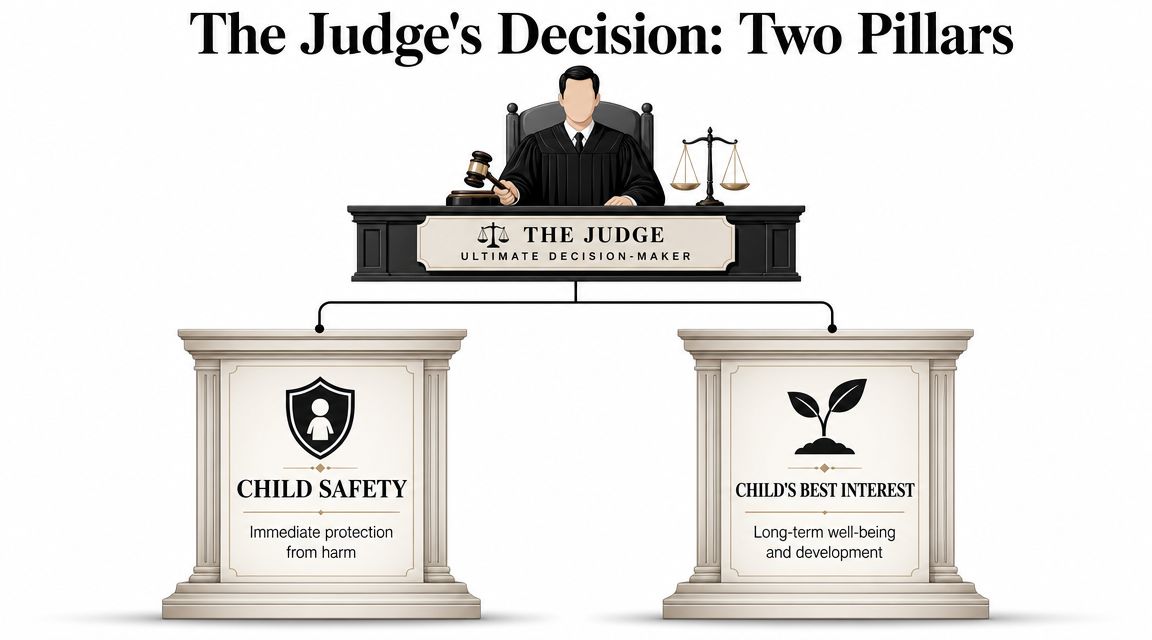
When parents ask what judges look for in Texas CPS cases, the answer usually begins with two pillars. First, is the child safe right now? Second, what outcome serves the child's best interest over time?
Those ideas sound similar, but they aren't the same. Safety is immediate. Best interest is broader and longer term.
Safety comes first
Texas judges handle CPS matters in a high-volume system. In 2022, 207,429 referrals were screened in for a CPS response in Texas, which means judges have to focus hard on whether the record shows credible safety concerns rather than bare accusations, according to Texas child welfare data summarized by CWLA.
At the agency level, DFPS defines a “Reason to believe” finding as abuse or neglect established by a preponderance of the evidence, which means the proof must show something is more likely than not, as described in DFPS investigation guidance. In court, that practical mindset carries over. Judges want corroborated facts. They look for records, photos, injuries, school concerns, statements that line up, and conditions that show actual danger.
A simple way to understand is this:
| Question | What the judge is trying to decide |
|---|---|
| Is there immediate danger? | Does the current situation put the child at risk right now? |
| Is the evidence specific? | Are there concrete facts, not just suspicion or rumor? |
| Is court intervention necessary? | Can safety be managed without removal or continued state control? |
Best interest is wider than one bad day
A judge also has to think beyond the emergency. Even if a parent made a mistake, the court still asks what arrangement best protects the child's emotional and physical well-being going forward.
That can include things like stability, supervision, school attendance, medical care, the child's bond with the parent, and whether the parent can make safe choices consistently. A judge isn't looking for perfection. A judge is looking for reliability.
Children often thrive when they have structure outside the courtroom too. If your family is trying to rebuild routine and confidence, activities like youth sports can help support healthy stability. This guide to kids sports in Atascocita offers ideas for safe, confidence-building involvement.
Why this feels harsh to parents
Many parents hear “best interest” and think the judge is comparing them to an ideal parent. That's not quite it. The court is comparing available options and asking which one protects the child most effectively under current circumstances.
That's why a parent can love a child and still face court restrictions if the judge believes the home is not safe enough yet. Understanding that distinction helps you present the facts the court needs.
Evidence That Speaks Loudest in a Texas Courtroom
Not all proof carries the same weight. In CPS court, judges often have to sort through conflicting stories fast. The stronger the documentation, the more likely it is to shape the court's decision.
Texas child-protection data shows why judges are cautious. A statewide presentation reported that 4 in 10 families involved in Family-Based Safety Services were re-reported within 5 years, and the Texas Public Policy Foundation reported about a 22% confirmation rate of maltreatment reports in Texas, as discussed in the TexProtects State of the State presentation. That means judges know some families face recurring concerns, but they also know many reports are not confirmed. So they look for a pattern of corroborated risk, not just one accusation.
Hard evidence versus soft evidence
A useful way to think about evidence is by how easily it can be checked.
Evidence judges often find more persuasive:
- Medical records: Injury notes, treatment history, missed follow-up care.
- School records: Absences, tardiness, behavior reports, staff observations.
- Drug test results: Especially when tied to timing, caregiving, or prior concerns.
- Photos and videos: Home conditions, injuries, or unsafe sleeping arrangements.
- Police reports: Not because they end the case automatically, but because they provide dated, third-party documentation.
- Messages and call logs: Texts, emails, and timestamps can confirm or disprove timelines.
Evidence judges treat more cautiously:
- Secondhand statements: “My neighbor said she heard…”
- Old grudges: Claims from an ex-partner without supporting records.
- Vague generalizations: “The house is always bad” without details, dates, or photos.
- Inconsistent testimony: When the story changes in important ways.
A courtroom example
Suppose someone reports that a child “looks neglected.” That phrase alone doesn't tell a judge much. Neglected how? Was the child hungry, injured, repeatedly absent from school, left alone, or without medical care?
Now compare that with a file containing school notices, attendance records, and testimony from a nurse or teacher. The second record gives a judge something concrete to evaluate. Courts respond to detail.
If you want a clearer sense of the proof issues that often drive removal decisions, this explanation of what evidence CPS needs to remove a child in Texas breaks down the question in parent-friendly terms.
What parents should start gathering
When you're under stress, it's easy to focus only on defending yourself verbally. That's rarely enough. Start organizing documents that show daily parenting and stability.
Consider collecting:
- Attendance records and report cards: These can show routine and involvement.
- Medical appointment confirmations: Helpful if someone claims missed care.
- Lease documents or utility records: These help establish stable housing.
- Screenshots of communication: Save respectful messages about visitation, appointments, and school.
- Names of neutral witnesses: Teachers, daycare staff, counselors, or relatives with direct knowledge.
The judge doesn't need a dramatic presentation. The judge needs a believable one.
Navigating the Key Hearings on the CPS Court Timeline
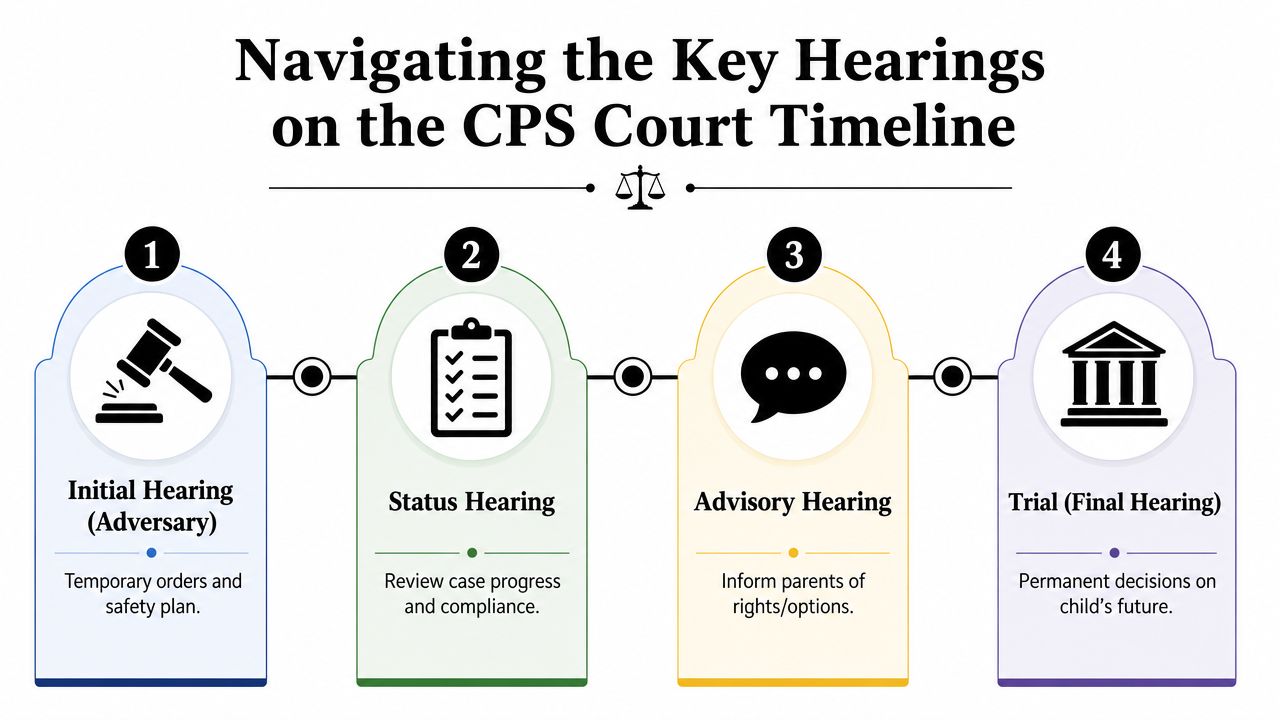
CPS cases move quickly, especially at the start. One hearing may focus on removal. Another may focus on whether you're following services. Later hearings shift toward permanency and whether the case is moving toward reunification, placement with a relative, or a more permanent order.
Early in the case, timing can feel brutal. Under Texas Family Code Section 262.201, the full adversary hearing generally must happen within 14 days after removal, as discussed in this Texas CPS hearing deadline overview. At that hearing, the judge's focus is narrow. Did CPS prove an imminent danger that justified taking the child and keeping temporary custody?
A simple way to understand the sequence
Think of the court process as a series of checkpoints, not one giant decision.
| Hearing | What the judge is usually looking at |
|---|---|
| Full adversary hearing | Whether removal and continued temporary custody are legally justified |
| Status hearing | Whether the service plan fits the case and whether parties understand expectations |
| Permanency hearings | Whether progress is happening and what the long-term plan should be |
| Final trial | Whether the child can safely return, whether rights will be restricted, or whether termination is sought |
For a fuller roadmap, this Texas CPS court hearings and timelines guide for parents and guardians can help you place each hearing in context.
How this feels in real life
A parent may walk into the first hearing hoping to tell the court every detail about the relationship, the family history, and how unfair the report was. But at that stage, the judge may interrupt and bring the conversation back to immediate danger, where the child is staying, and whether a less drastic option exists.
Later hearings open the picture wider. Then the judge starts asking different questions:
- Are services being completed?
- Is visitation happening consistently?
- Has the home become safer?
- Is CPS making progress toward a stable outcome?
This short video helps illustrate how parents can think about hearings and preparation over the life of a case.
Why parents get tripped up on Chapters 262, 263, and 161
These chapters matter because they shape the judge's job.
- Chapter 262 deals with emergency action and removal issues.
- Chapter 263 governs review hearings, permanency, and case progress.
- Chapter 161 becomes critical when CPS seeks termination of parental rights.
If you know which chapter your hearing is really about, you can better understand why the judge keeps returning to certain topics. The legal focus changes as the case develops.
Showing the Judge You Are a Safe and Fit Parent
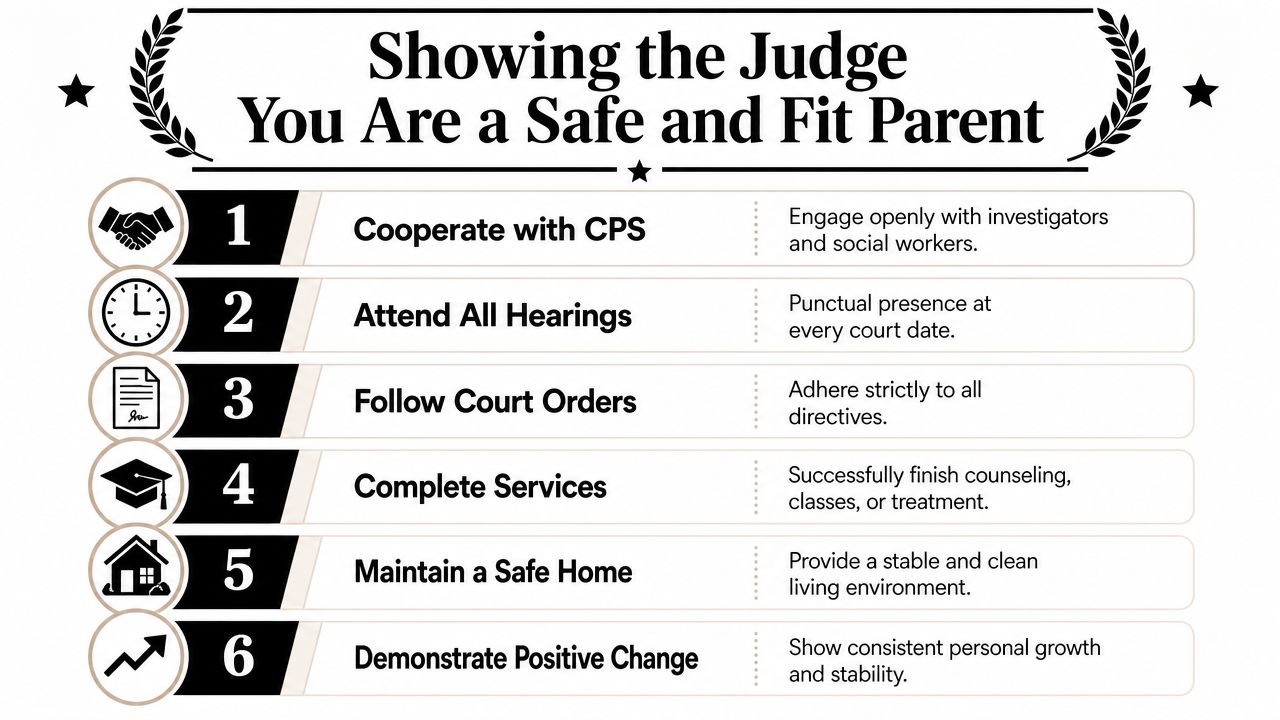
Parents sometimes feel like the service plan is just hoop-jumping. That's understandable, but in court it serves another purpose. It becomes a record of whether the concerns that brought CPS into the case are being addressed.
Texas courts also look at whether the plan was realistic. Guidance discussing reasonable efforts in Texas CPS cases notes that judges may examine long waiting lists, transportation problems, work conflicts, and generic referrals when deciding whether a service plan was fair and accessible, as explained in this discussion of reasonable efforts in Texas CPS cases. A parent who couldn't access the right service is in a very different position from a parent who refused.
Build a record the judge can trust
Think of your job as creating a paper trail of change. If you complete something, document it. If you try to complete something and hit a barrier, document that too.
Here are practical steps that matter:
- Attend every hearing: Judges notice presence. So do caseworkers and attorneys.
- Keep every certificate and receipt: Counseling, classes, treatment, testing, and parenting courses should all be organized in one place.
- Show housing stability: Photos, lease paperwork, and proof of utilities can help.
- Protect visitation time: Arrive early, stay calm, and avoid conflict at exchanges.
- Communicate in writing when possible: Respectful messages create a cleaner record than verbal disputes.
If services are hard to access
This issue causes a lot of confusion. Parents are told, “Finish your services,” but reality doesn't always cooperate. Providers may have waitlists. Appointments may be across town during work hours. Transportation may fall through.
If that's happening, don't stay silent.
Keep a dated log of every call, referral, waitlist notice, missed bus, work conflict, and request for help. A judge can only consider barriers that are actually in the record.
You also want to ask for alternatives quickly. A different provider, a virtual option, a letter confirming waitlist status, or a schedule adjustment can all matter. Courts often respond better to parents who identify the problem early and propose a solution.
Conduct matters more than speeches
Judges watch behavior as much as paperwork. A parent who is respectful, prepared, sober, consistent, and child-focused often builds credibility over time. A parent who argues with everyone, misses visits, or blames others for every setback usually hurts their own position.
A relatable example: if CPS says substance use is the concern, then clean tests, treatment attendance, stable routines, and calm visitation do more for your case than angry denials ever will. Your conduct becomes evidence.
How Your Attorney Protects Your Rights and Tells Your Story
A CPS courtroom can feel like a room where everyone has a file about your family except you. The judge hears from CPS, investigators, service providers, relatives, and sometimes the other parent. Each person may bring only part of the picture. Your attorney's job is to gather those pieces, test them, and present a clear account that answers the judge's actual concern: what can be proven, what risk exists now, and what order best protects the child under Texas law.
That matters because judges do not decide these cases based on suspicion alone. They work inside legal limits. They have to make decisions from admissible evidence, sworn testimony, documents, timelines, and the level of risk shown in the record. If your side is scattered, incomplete, or buried under emotion, the judge may never hear the facts that would put your situation in context.
A good attorney works like a translator and a shield at the same time. The translator turns your lived experience into evidence the court can use. The shield protects your rights when CPS asks for too much, moves too fast, or relies on weak proof.
What legal representation actually does
Much of your lawyer's work happens outside the few minutes you spend in front of the judge. That work often includes:
- Examining CPS allegations carefully: Is the claim specific? Is it current? Is it based on firsthand knowledge or repetition of someone else's statement?
- Testing witnesses under oath: Your attorney can question investigators, caseworkers, and other witnesses to expose gaps, assumptions, and contradictions.
- Organizing your proof: Drug test results, counseling records, housing documents, employment records, school information, visitation history, and helpful witness testimony all carry more weight when presented in a clear way.
- Protecting procedure: Your lawyer can object when notice was inadequate, deadlines were missed, or required steps were skipped.
- Showing change over time: Judges often focus on present safety, not only past mistakes. Your attorney helps connect the dots between the concern that brought CPS in and the concrete steps you have taken since then.
Parents often worry that telling the truth about past problems will ruin the case. Often, the greater danger is leaving the court with an incomplete story. If there was a problem, but you entered treatment, stayed sober, found stable housing, or ended contact with a dangerous person, your attorney helps make that progress visible and legally relevant.
Why this can affect the result
Judges hear fear every day. What they need is a record they can rely on.
That is why an attorney does more than argue. A lawyer helps you stay focused on the facts that fit the legal standard. For example, if the issue is neglectful supervision, a long dispute with your ex may matter far less than your current childcare plan, work schedule, and the adults who now help with the child. If the issue is substance use, the court usually learns more from treatment compliance, testing history, and daily stability than from broad promises that it will never happen again.
This is also where many parents get tripped up. They assume the judge sees the whole picture automatically. The judge does not. The court sees only what is introduced properly, explained clearly, and tied to the legal question in front of it.
Law Office of Bryan Fagan PLLC handles Texas CPS-related matters and publishes guidance for parents dealing with investigations, hearings, and service-plan issues. The larger point is to find counsel who can connect the law, the timeline, and your evidence into one clear presentation the court can act on.
Strong CPS advocacy usually sounds plain. Here was the allegation. Here is what the evidence actually shows. Here is what the parent did in response. Here is why the child can be protected.
Your attorney protects more than your case file
Temporary orders can shape the entire case. They affect where your child lives, how often you see your child, what services you must complete, and how the judge views your progress later. If those early decisions are based on a one-sided or poorly tested record, they can become hard to undo.
That is why legal representation matters so much in a CPS case. Your attorney is protecting your chance to be heard fully, your relationship with your child, and in serious cases, your parental rights under Chapter 161. No lawyer can promise a result. A good one can make sure the court hears a disciplined, credible, legally grounded account of who you are as a parent and what your child needs now.
Taking the First Step to Bring Your Family Back Together
A Texas CPS case can make you feel powerless, but you're not powerless. Judges follow legal standards. They look for safety concerns, credible evidence, and signs that a parent can provide stability. They also pay attention to whether CPS acted fairly and whether barriers, not refusal, slowed progress.
If you remember anything from this article, remember this: accusations start cases, but evidence and conduct shape outcomes. The better you understand what judges look for in Texas CPS cases, the better prepared you'll be to protect your family and present your side clearly.
If your case has already started, don't wait for the next hearing to get organized. Gather your records. Write down dates. Save messages. Ask questions. Show up. Small steps taken early can make a real difference in how the court sees your case.
If CPS is involved with your family, a confidential conversation can help you understand your options and next steps. Contact Law Office of Bryan Fagan PLLC for a free consultation to discuss your Texas CPS case, your rights, and what you can do now to protect your relationship with your child.