Skip to content
When CPS shows up at your door, calls your child's school, or removes your child, most parents don't start by asking a legal question. They start with something more personal.
How could this happen to my family?
Then the anger follows. Then the panic. Then the question that brings many parents here: Can you sue CPS in Texas?
The honest answer is yes, sometimes. But for most families, a lawsuit is not the first fight that matters, and it's often not the fight that gets your child home. The more urgent battle usually happens in the family court case, in the administrative process, and in the early decisions that shape what happens next.
Introduction Acknowledging Your Pain and Your Question
A mother sits at her kitchen table staring at paperwork she barely understands. One page mentions allegations. Another lists hearing dates. Her child's drawings are still taped to the refrigerator, but the house feels empty. She's angry because she believes CPS got it wrong. She's terrified because the state has power, and she doesn't know how to push back.

That parent's reaction is understandable. Some CPS cases involve real danger to children. Others involve misunderstandings, rushed judgments, bad communication, or conduct that feels deeply unfair. If you believe CPS wrongfully accused you, it helps to start with a practical guide like what to do if you are wrongfully accused by CPS, because your next steps matter immediately.
Practical rule: If CPS is involved, treat every phone call, every meeting, and every hearing as important. Small mistakes early can affect the whole case.
Texas family law gives parents rights during CPS cases, and the Texas Family Code matters here, especially Chapters 262, 263, and 161. Chapter 262 governs emergency removals and early hearings. Chapter 263 deals with review hearings, permanency, and timelines once the case is underway. Chapter 161 covers termination of parental rights, which is the most serious outcome a parent can face.
So yes, can you sue CPS in Texas is a real question. But the better question for many families is this: what can you do right now to protect your child, your rights, and your future?
The Legal Fortress Why Suing CPS Is So Difficult
The law treats CPS like a government actor surrounded by heavy legal protection. Think of it as a fortress. The agency sits behind one wall, and the individual caseworker may stand behind another.

In Texas, suing Child Protective Services is legally possible, but it's extremely difficult because sovereign immunity generally protects state agencies from lawsuits unless a narrow exception applies, and individual workers may also raise qualified immunity unless a parent can show the worker violated rights that were clearly established at the time, as explained in this discussion of suing CPS in Texas.
What sovereign immunity means in real life
Sovereign immunity protects the agency itself. That means you usually can't sue CPS just because you believe it made the wrong call, handled your case badly, or caused emotional pain through ordinary decision-making.
That feels unfair to parents, especially when the agency's actions have turned life upside down. But the legal system doesn't open the courthouse door for every harmful government mistake. It requires something more specific and more serious.
In practical terms, these claims usually fail when the complaint is based on routine CPS actions, ordinary investigations, or decisions the court sees as part of the agency's day-to-day role.
What qualified immunity means for caseworkers
Qualified immunity protects the individual worker. Even if a parent is furious at a specific investigator, that worker may still avoid liability unless the evidence shows a violation of clearly established rights.
That standard matters. A bad judgment call isn't always enough. A sloppy investigation isn't always enough. The law usually asks whether the worker crossed a line that the Constitution or controlling law clearly forbade.
The difference between “they were wrong” and “they violated my rights” decides many of these cases.
Parents also need to understand a hard trade-off. A lawsuit focuses on misconduct after the damage is done. Your active CPS case focuses on where your child lives, what services are required, what the court believes, and whether reunification stays possible under Chapters 262 and 263.
That's why parents should pay close attention to the family court side of the case, including CPS legal rights in Texas for protecting families and children. If CPS has put a service plan in place, The CPS Service Plan: Requirements and Reunification can help you understand what the plan requires and how completing it affects reunification.
Finding the Cracks Exceptions to CPS Immunity
The fortress has gates, but they're narrow. Most successful legal theories against CPS don't rest on hurt feelings, frustration, or a belief that the agency acted unfairly. They rest on specific misconduct that fits a recognized exception.
One of the main paths is a federal civil rights claim under 42 U.S.C. § 1983. Another, in limited situations, may involve the Texas Tort Claims Act.
Federal civil rights claims under Section 1983
A parent usually gets the strongest footing when the facts point to a civil rights violation. Suing CPS for emotional distress alone is generally unsuccessful, but legal relief may be available when a parent can show a civil rights violation, and 42 U.S.C. § 1983 can provide a way to sue in federal court if CPS removed a child without proper cause or conducted unlawful searches, as discussed in this article on suing CPS for emotional distress.
What does that look like in practice?
- Falsifying evidence: A worker changes or invents facts to support removal.
- Ignoring clear proof of innocence: The file contains obvious exculpatory information, but the worker pushes forward anyway.
- Unlawful searches: CPS enters or searches without valid legal authority.
- Discriminatory animus: Decisions are driven by race, national origin, gender, or another protected classification.
- Skipping required procedures: A worker fails to follow legal steps before removing a child or seeking court action.
Those are not routine complaints. They are serious allegations that require serious proof.
Texas Tort Claims Act and limited negligence claims
The Texas Tort Claims Act may create a path in some situations if a CPS worker's negligence directly causes injury or death and there is a legally recognized breach of duty. This area is narrow, and parents often assume it covers far more than it does.
Claims built only on general emotional harm usually don't get far. Texas courts are far more likely to entertain a case when the facts show unlawful conduct, gross negligence, or a recognized waiver of immunity.
What usually does not work
Parents often ask whether they can sue because CPS was rude, dismissive, biased, or plainly wrong. Those facts may matter in your family court defense, but standing alone they often do not create a viable damages claim.
A workable case usually needs more than poor judgment. It needs evidence that can prove one of the recognized exceptions, with documents, records, witnesses, or testimony that shows exactly what happened and why it crossed the line.
A Parent's Story A Scenario of a CPS Lawsuit
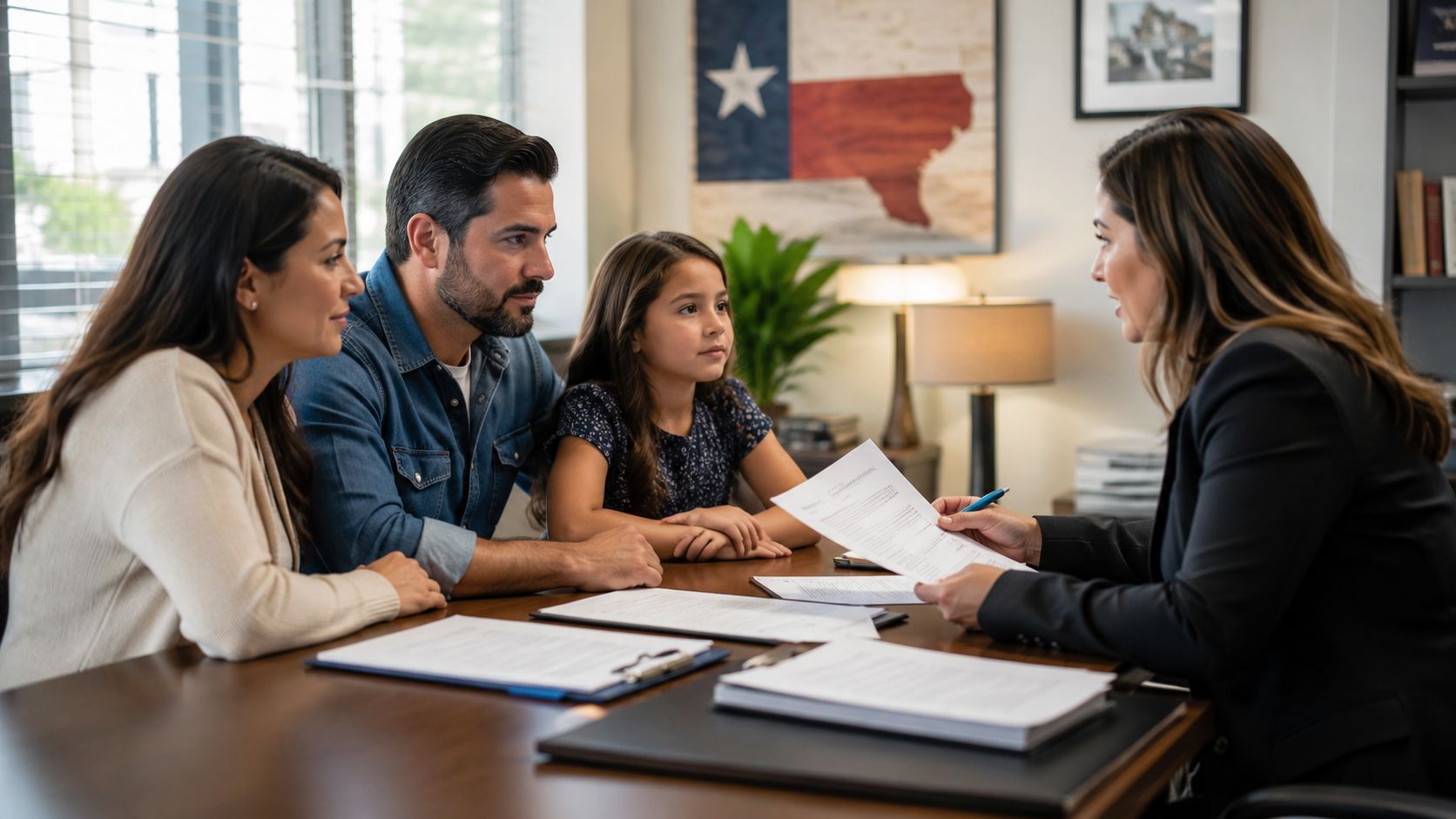
The Garcia family's story is a composite of the kind of case parents describe in Texas. Mr. Garcia worked long shifts. Mrs. Garcia stayed on top of school meetings, doctor visits, and the household routine. Then a malicious report accused them of abuse.
At first, they assumed the truth would clear everything up. They showed school records, medical records, and messages that contradicted the accusation. They pointed out who had made the report and why that person might have had a grudge. But the investigator kept moving forward.
Where the case changed
The family's lawyer did not begin by talking about money damages. The lawyer focused on records, court filings, and the basis for removal under Chapter 262. In reviewing the file, the attorney found something important. The worker had received clear evidence undermining the accusation and still presented the case as if that evidence did not exist.
That kind of fact pattern can matter. Not because every mistake leads to a lawsuit, but because a worker who ignores exonerating proof may move from poor investigation into possible civil rights territory.
A CPS lawsuit is built on proof, not outrage. Parents need documents, timelines, hearing records, and witness accounts.
The human cost matters too
The Garcias also faced something many parents don't expect. Even when a family eventually proves that CPS overreached, the emotional impact on the children can linger. If your family is trying to understand that side of the harm, this overview of the effects of early life trauma offers useful context.
Their case did not resolve quickly. It required collecting records, preserving communications, and separating what felt unjust from what was legally actionable. That's the reality in these cases. Even when a lawsuit may exist, it is usually slower, narrower, and harder than parents expect.
Fighting Back Without a Lawsuit Alternative Paths to Justice
For most parents, the fastest way to regain control is not a separate lawsuit. It's using the tools already available inside the CPS case and through administrative review. That approach often gives families a more immediate chance to correct the record, challenge removal, and work toward reunification under Chapters 262 and 263.
The hearing that can change everything
Under Texas law, a parent has the right to a court hearing within 14 days after CPS removes a child. That hearing, called the adversary hearing, is where the court decides whether the removal was necessary and what temporary arrangements should be made, as explained in this summary of the Texas adversary hearing after CPS removal.
That hearing matters because it's your first real chance to challenge CPS in court.
If you are preparing for it, focus on concrete evidence:
- Documents: Medical records, school records, photographs, text messages, and anything else that directly addresses the allegation.
- Witnesses: Relatives, teachers, doctors, counselors, neighbors, or anyone with firsthand knowledge.
- Home stability: Proof of housing, employment, childcare, sobriety efforts, counseling, or family support.
- Safe alternatives: Relatives or family friends who can serve as placement options if the court won't return the child immediately.
Administrative complaints can create pressure
A lawsuit isn't the only accountability mechanism. Parents can also file complaints through the DFPS Office of Consumer Affairs or the Texas Ombudsman. The Office of Consumer Affairs accepts complaints by telephone at (800) 720-7777, online form, email, fax at (512) 339-5892, or mail.
That process won't replace a courtroom defense, but it can document concerns about investigator conduct, procedure, and communication failures. Sometimes that record matters later.
For broader child-safety planning during a legal conflict, some families also find practical value in outside reading such as Austin family law advice for protecting children, especially when they are trying to balance immediate protection with long-term custody strategy.
Lawsuit vs. Alternative Remedies A Comparison
| Factor | Federal Lawsuit (§ 1983) | Family Court Defense & Admin Appeals |
|---|---|---|
| Primary goal | Seek relief for civil rights violations | Protect custody, challenge removal, address findings |
| Timing | Usually slower and evidence-heavy | Immediate and tied to active CPS deadlines |
| What must be shown | Unlawful conduct and a clearly established rights violation | Facts showing the child can safely return or that CPS action should be limited |
| Best use | Serious misconduct such as falsified evidence or unlawful search | Most families trying to reunify, correct findings, and stabilize the case |
| Emotional distress alone | Usually not enough | Can still matter as part of the family's story and requested relief |
| Practical result | May provide accountability if the legal standard is met | Often the most direct path toward getting your child back or improving case conditions |
What usually works better at the start
Parents often want to know how to “fight CPS and win.” The answer is rarely dramatic. It is disciplined. It involves controlling what you say, showing up prepared, complying where appropriate, challenging what is improper, and documenting everything. A practical starting point is how to fight CPS and win in Texas.
If you are looking at the phrase can you sue CPS in Texas, keep this in mind. A lawsuit may be possible in a narrow set of cases. But your most valuable advantage may be in the live case sitting in front of a family court judge right now.
Critical Deadlines and Procedural Hurdles You Cannot Miss
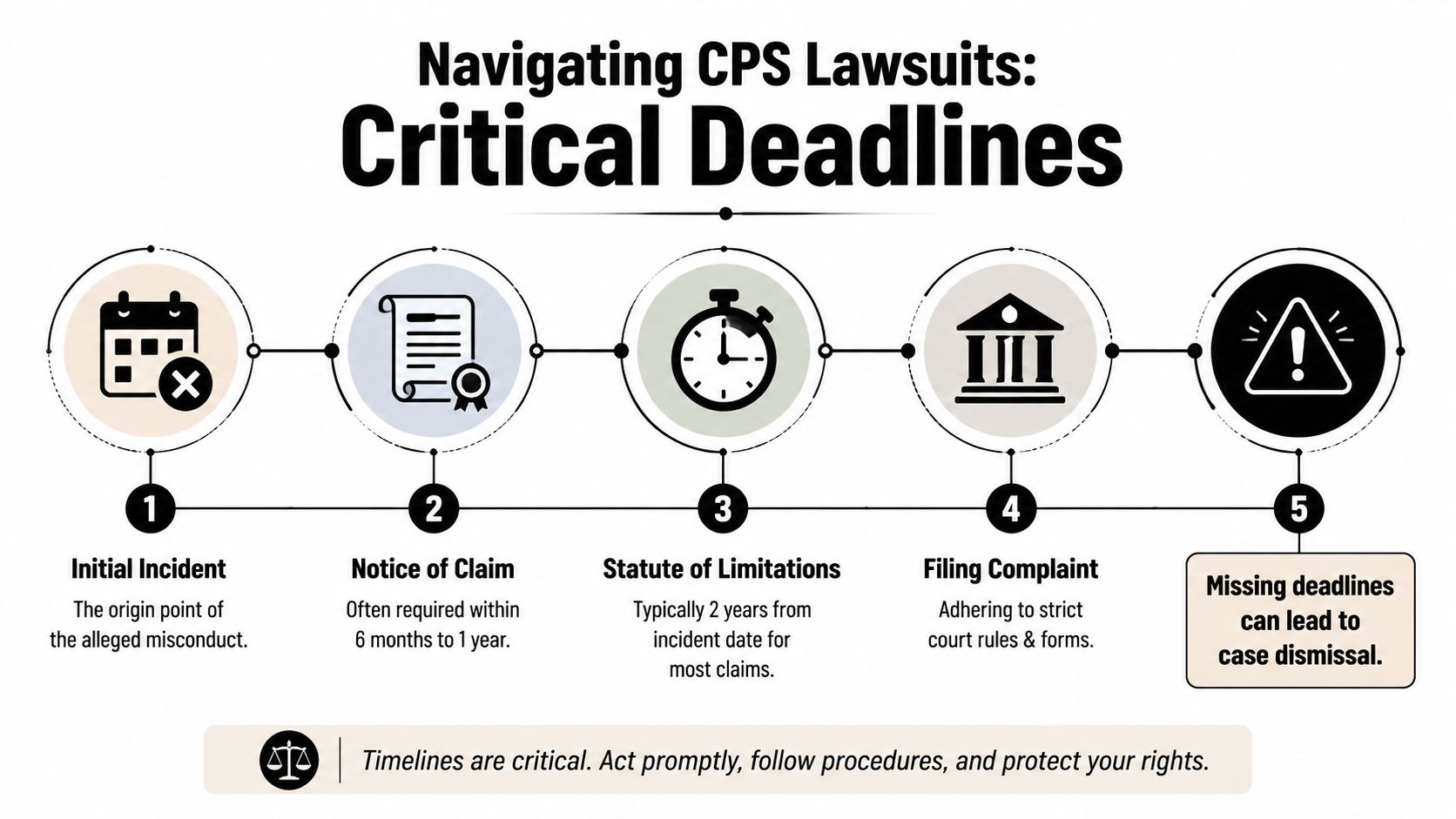
Deadlines can destroy a valid claim before the facts are ever heard. Parents often lose rights not because their complaint lacked merit, but because they waited too long or failed to follow the required process.
The deadlines that matter first
If you are considering a tort-based claim against a government entity, you may have to give notice of your intent to sue within six months of the initial injury. That short notice requirement is one of the biggest traps for families.
The proof standard is also demanding. You must usually show more than error. You need evidence of conduct outside legal authority, gross negligence, or a violation of clearly established rights.
A practical checklist
- Preserve every record: Keep court papers, safety plans, service plans, texts, emails, call logs, and names of everyone involved.
- Build a timeline: Write down what happened, when it happened, who was present, and what documents exist.
- Identify the legal theory early: A tort claim, a civil rights claim, and an administrative complaint are not the same thing.
- Don't assume emotional harm is enough: It may be real and severe, but by itself it often doesn't support a viable lawsuit.
- Get legal advice quickly: Waiting can close off options before a lawyer can evaluate them.
Missing a filing requirement can end a case even when the underlying conduct was serious.
The burden of proof is the real hurdle
Parents often believe that if they can show CPS was wrong, they should win. That's not how these cases work. In a lawsuit, you are usually trying to prove unlawful conduct by a protected government actor.
That is why speed matters. Evidence disappears. Memories shift. Records get harder to obtain. If you're thinking about legal action, treat the timeline as urgent from the first day.
When to Call a Lawyer Protecting Your Family and Your Rights
If CPS is investigating you, has removed your child, or has filed a case affecting conservatorship or termination, call a lawyer immediately. Don't wait to see whether things “settle down.” They often don't.
The most important legal work usually happens early. A lawyer can evaluate removal under Chapter 262, track review and permanency issues under Chapter 263, and protect against the severe risks that arise under Chapter 161 when parental rights are on the line.
When appointed counsel may apply
Texas does provide appointed counsel in some CPS cases, but only under specific conditions. A parent is entitled to a court-appointed lawyer only if the parent is indigent, CPS has filed a lawsuit asking to be appointed temporary managing conservator or to terminate parental rights, and the parent opposes the petition. All three requirements must be met, as explained in this guide on the right to a court-appointed lawyer in a CPS case.
If you do not have a lawyer by the first hearing after removal, ask the court immediately. Don't assume the request is automatic.
What a lawyer actually does in these cases
A CPS attorney doesn't just “go to court.” Counsel can:
- challenge unsupported allegations
- prepare for the adversary hearing
- object to overbroad demands
- help you respond carefully to service plans
- identify relatives for placement
- preserve evidence for a possible later claim
- protect you if the facts overlap with criminal allegations
For families seeking representation, a Texas CPS lawyer can handle both the urgent family court issues and the separate question of whether any later legal claim against CPS is realistic. The Law Office of Bryan Fagan PLLC is one such Texas firm handling CPS-related matters.
The right first goal
Most parents who ask whether they can sue CPS are really asking something deeper. How do I protect my child? How do I stop this from getting worse? How do I get my family back?
Those are the right questions.
A lawsuit may become part of the picture in a narrow category of cases involving serious misconduct. But the first priority is usually building the strongest defense, making the best record, following smart strategy instead of fear, and keeping the court focused on safe reunification whenever possible.
If CPS is involved in your life right now, you do not have to sort through this alone. The Law Office of Bryan Fagan PLLC helps Texas parents understand their rights, prepare for hearings, respond to CPS allegations, and make informed decisions about both immediate defense and possible claims for misconduct. Contact the firm for a free consultation so you can get clear answers, a practical plan, and steady guidance for the next step.