Skip to content
One knock at the door can split your life into a before and after. A CPS investigator stands outside. Your child is confused. You're scared, angry, embarrassed, and trying to answer questions while your mind races toward the only thing that matters: How do I get my child back from CPS?
That question has a legal answer, not just an emotional one. In Texas, parents who move quickly, stay organized, and use the Texas Family Code the right way often put themselves in a far stronger position than parents who freeze, argue, or wait for CPS to “do the right thing” on its own.
A lot of parents also need to hear this early: a CPS case is not proof that you are a bad parent. In Texas, only about 22% of maltreatment reports are ultimately confirmed, which means many families are drawn into investigations based on reports that do not hold up under review, as discussed by the Texas Public Policy Foundation on registry reform.
Your World Turned Upside Down When CPS Arrives
If CPS has contacted you or already removed your child, your body probably feels like it's running on panic. Parents in this situation often tell me the same thing. They can't eat, can't sleep, and can't think past the next hour. That reaction is normal.

Consider a familiar scenario. A mother gets a visit after a school report. The allegation sounds bigger on paper than it does in real life. The house is cluttered, money is tight, and one child mentioned being left alone for a short time while she worked. By evening, she is terrified that one misunderstanding has become a custody fight with the State of Texas.
That fear is real, but fear by itself makes parents do damaging things. They overshare. They lash out at the investigator. They sign papers they haven't read. They miss deadlines because they're emotionally flooded. That's why your first job is to slow the moment down enough to make good decisions.
You do not need to win the entire case in one day. You do need to stop making unforced errors today.
What many parents don't realize
Some removals begin with allegations that are exaggerated, mistaken, or rooted in judgments about poverty, parenting style, schooling choices, or household stress rather than immediate danger. That doesn't mean every case is wrongful. It does mean you should not assume CPS's first version of events is the final one.
When the stress becomes overwhelming, it helps to use practical mental health support while your legal case is unfolding. If you're struggling to stay steady enough to function, this guide on coping with feelings of hopelessness can help you get through the next few days without shutting down.
The right mindset from the start
Parents who reunify faster usually do three things early:
- They get specific fast. They ask what allegation was made, where the child is, and what court date comes next.
- They stop arguing facts emotionally. They save their proof for the hearing and for documented communication.
- They act like every contact matters. Because in a CPS case, it does.
You are not powerless. But you do need a plan.
The First 48 Hours What to Do Immediately
The first two days matter more than most parents realize. They shape the evidence, the court record, and the judge's first impression of whether you are capable of protecting your child and following court direction.
Under Texas law, CPS can't merely remove a child because an investigator is uneasy. Under Texas Family Code Chapter 262, CPS cannot remove a child without a court order unless “exigent circumstances” exist, meaning there is credible evidence of immediate danger to the child's physical health or safety that cannot wait for a judge's review, as explained in this discussion of what Texas law really says about CPS removal.
What to do today
Start with discipline, not emotion.
Write down everything
Record the investigator's name, phone number, office, the time of contact, what was said, and who was present. Keep screenshots, voicemails, and every paper you receive.Ask direct questions
Ask why your child was removed, whether CPS claims there was an emergency, where your child is now, and when the next hearing will happen.Get a lawyer involved immediately
If CPS has filed a case, time is now your enemy. You need legal advice before signing anything, agreeing to broad accusations, or making “helpful” statements that can be used against you later.Stay calm in every interaction
Cooperative does not mean submissive. Calm parents look safer to judges than combative parents, even when the parent is frustrated for good reason.
What not to do
The common mistakes are painfully consistent.
- Don't admit things loosely. Saying “I guess I should've done better” may sound humble, but it can be framed as an admission.
- Don't attack the caseworker personally. Anger may feel justified. It rarely helps your child come home.
- Don't rely on phone calls alone. Follow important conversations with written confirmation when possible.
- Don't disappear. Silence gets interpreted as instability, noncompliance, or worse.
Practical rule: Be respectful, be brief, and be document-focused.
Why Chapter 262 matters right away
Many parents focus only on compliance after removal. Sometimes that is necessary. But you should also examine whether the removal itself met the legal standard. If the facts involve poverty, homeschooling, medical disagreements, or lifestyle choices rather than immediate danger, your attorney should be looking closely at whether CPS can support emergency removal under Chapter 262.
A helpful primer is how to respond when CPS shows up at your door in Texas. If the agency has already acted, Emergency CPS Removal in Texas: What Parents Must Know gives a useful overview of what happens after removal and the strict deadlines that follow under Chapter 262.
Preparing for Your Most Important Day in Court The Adversary Hearing
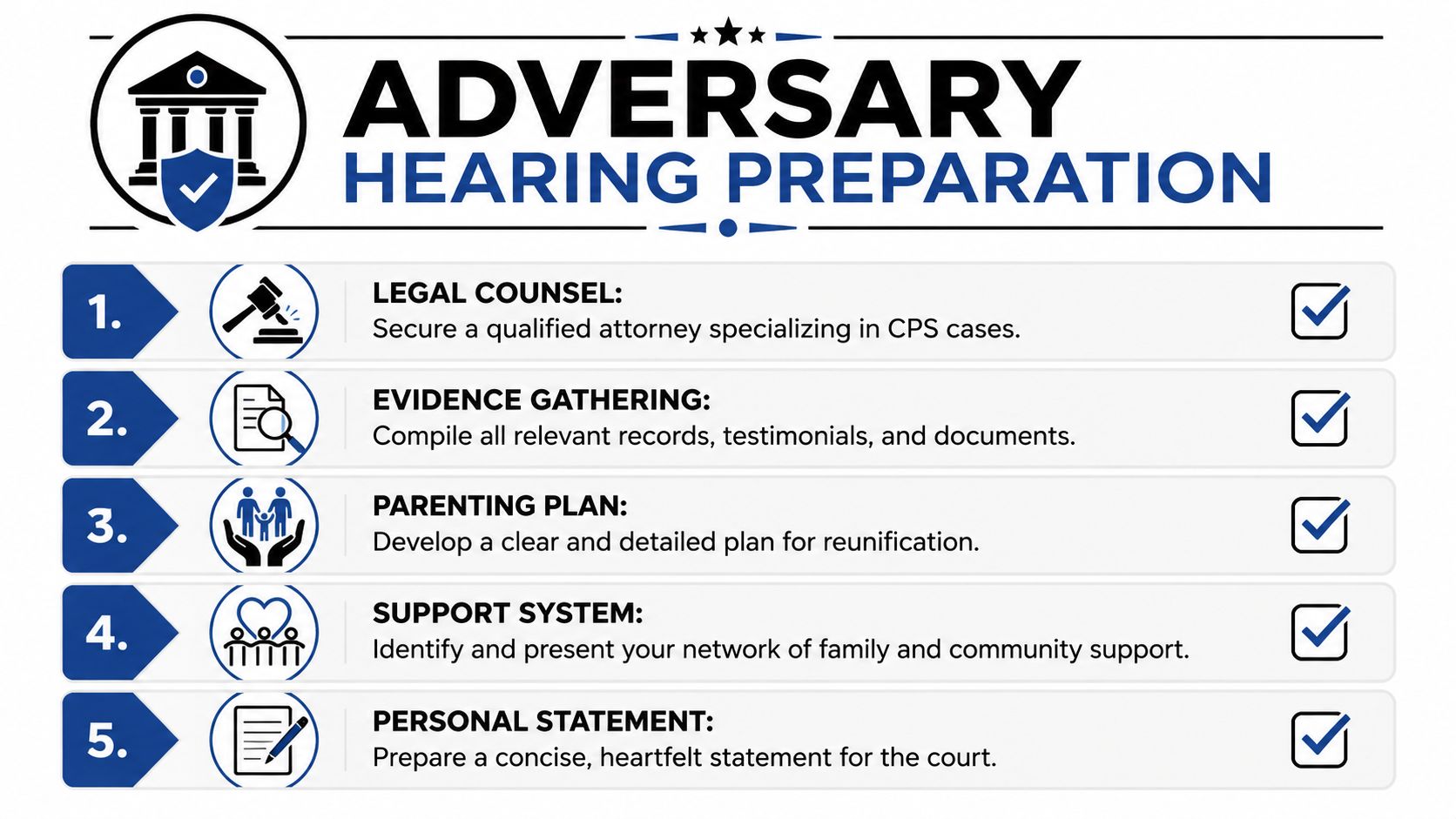
If your child has been removed, the Full Adversary Hearing is the hearing that can change everything. Texas law requires it within 14 days of removal under Texas Family Code § 262.201, and parents are in a stronger position when they come prepared with proof, not promises. Parents do better when they present documented evidence of a safe home, character references, and witness testimonies, as outlined in this discussion of the first legal step after removal.
Why this hearing matters so much
At this stage, the court is deciding whether your child stays in CPS custody or can return home. Waiting to “show progress later” is a mistake. If you have evidence that your child can be safe now, this is the time to put it in front of the judge.
Parents sometimes walk into this hearing with nothing but a denial. That's rarely enough. Judges need facts they can rely on.
What strong preparation looks like
Bring a package of proof that answers the court's actual concerns.
| What the judge needs to see | What you should bring |
|---|---|
| A safe home | Current photos, lease or housing paperwork, utility proof, sleeping arrangements |
| A stable adult | Negative assumptions don't matter as much as records, completion certificates, work schedule, childcare plan |
| Support around the child | Statements or live testimony from relatives, clergy, neighbors, teachers, or other reliable adults |
| A plan, not excuses | A simple explanation of what changed, what you've already done, and how the child will be protected |
A tale of two hearings
One parent shows up angry, interrupts the judge, insists the case is stupid, and blames everyone else. The court hears emotion but not structure.
Another parent arrives with photos of a cleaned and prepared home, a letter from a counselor, a relative ready to supervise if needed, and a short statement focused on the child's routine, safety, and school. That parent doesn't have to be perfect. That parent looks credible.
The court is not looking for a speech. The court is looking for a parent who can reduce risk and follow through.
Challenge the removal, not just the fallout
This is also where the unique legal angle matters. If CPS based the removal on conditions tied more to poverty or lifestyle differences than immediate danger, your attorney should press that issue. Texas judges must evaluate whether the legal basis for keeping the child out of the home exists.
Use the hearing to do more than promise future compliance. Ask whether CPS can prove the level of danger the law requires. Ask whether less drastic alternatives existed. Ask whether a relative placement could address concerns without prolonged separation.
For a fuller explanation of what happens at this stage, review what an adversary hearing is in Texas CPS cases. If you want the broader sequence, Texas CPS Court Hearing Timeline: Status, Permanency & Trial walks through the full sequence of CPS court hearings from the adversary hearing through final trial.
Mastering Your CPS Family Service Plan
If the judge does not return your child at the adversary hearing, your case moves into a different phase. Now the Family Service Plan becomes the center of your reunification effort. Treat it like a legal contract, because that's how the court will treat your performance under it.

A hard truth many parents learn too late is this: missing a single appointment can delay reunification by months, and parents need to keep receipts, certificates, and visitation logs to prove compliance to the court, as emphasized in this video discussion on working a Texas CPS case strategically.
Read the plan like it will be an exhibit
Do not skim it. Do not assume the caseworker will remember what you completed. Do not trust verbal assurances that “we'll count that later.”
Look for each requirement and ask:
- What exactly must I complete
- Who provides it
- By when
- How do I prove I did it
- What happens if a provider cancels
If transportation, work schedules, language barriers, disability issues, or cost affect your ability to comply, raise that early and in writing.
What usually helps and what usually hurts
Some services are routine. Parenting classes, counseling, substance abuse assessment, therapy, psychological evaluation, and supervised visitation are common. The content of the plan matters less than your consistency in completing it and documenting it.
What helps:
- Show up early. Lateness gets noticed.
- Save every record. Keep a binder and digital backups.
- Confirm completion in writing. If a provider says they'll send attendance, verify that they did.
- Use visits well. Be calm, child-focused, and appropriate.
What hurts:
- Skipping one item because it seems minor
- Arguing with supervisors during visitation
- Waiting until the review hearing to gather paperwork
- Assuming effort counts without proof
Supervised visits are evidence
Parents often think visits are private family moments with a monitor in the room. They are not. They are observed interactions that can influence how the judge sees your parenting, judgment, and emotional control.
If your child cries at the end of a visit, don't make promises you can't control. Don't discuss the case. Don't ask the child to take sides. Spend the time doing what steady parents do: comfort, listen, play, help with homework, and stay regulated.
A structured support system can also matter here. If counseling is part of the plan, any reputable local provider may be appropriate if approved by the caseworker or court. For families looking at counseling models and what family-focused therapy can involve, resources like family counselling in Grande Prairie can give a useful sense of how therapeutic support is often framed.
Later in the case, many parents benefit from watching a plain-language overview like this one:
For a more strategic breakdown of compliance, documentation, and communication, review how to work your CPS service plan strategically.
Navigating the Long Road of Hearings and Reviews
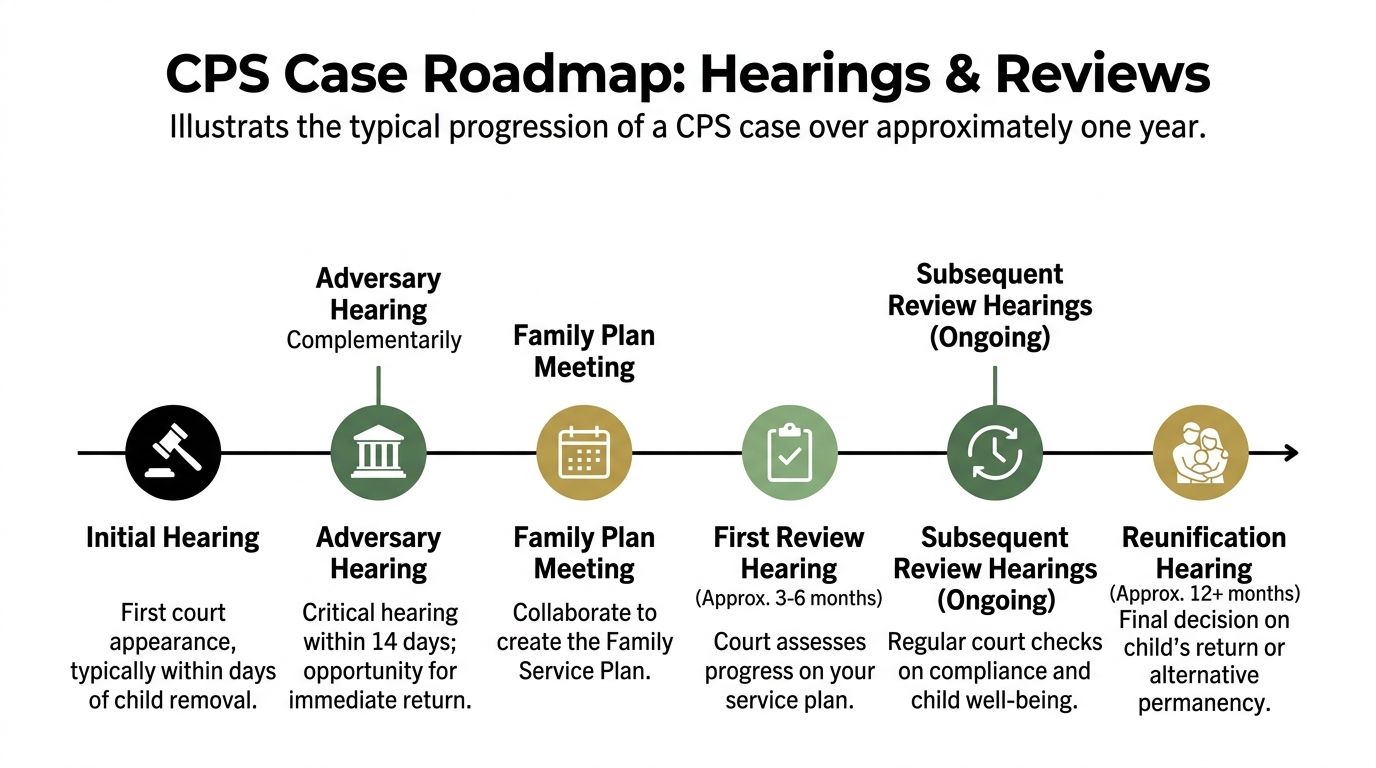
A CPS case doesn't end with one hearing. It moves through a sequence of court reviews that test whether reunification is still realistic or whether the court will begin looking at other permanency options. That is why parents need endurance, not just urgency.
Texas law generally requires these cases to be resolved within 12 months, with a status hearing within 60 days of removal and an initial permanency hearing by 180 days to decide whether reunification remains the goal, as explained in this guide to getting your kids back from Texas CPS.
What the court is doing at each stage
The judge is not just checking whether you attended classes. The court wants to know whether the original concerns are being reduced in a real, measurable way.
Status hearing
The court looks at the service plan and whether it fits the case. This is an early point to raise practical problems, confusion, or unrealistic requirements.Permanency hearing
The court asks whether reunification is still the right goal and whether the child's placement remains appropriate.Review settings
The court measures consistency. One burst of effort right before court won't carry the same weight as steady compliance over time.
What to track between hearings
Keep your own case file. Do not assume DFPS's records will tell your story accurately.
| Keep this record | Why it matters |
|---|---|
| Attendance records | Shows you completed services on time |
| Visitation log | Helps establish consistency and quality of parent-child contact |
| Communication log | Tracks what the caseworker asked for and when you provided it |
| Home updates | Documents repairs, cleanliness, sleeping arrangements, and stability |
| Relative information | Supports kinship placement options if reunification is not immediate |
Courtroom insight: Judges often respond best to parents who can show steady progress without turning every hearing into a fight.
The long-range legal risk
By this stage, Chapter 161 starts to matter in a very real way because termination of parental rights becomes a possible outcome if the case deteriorates. Parents should understand that every missed service, missed visit, or hostile interaction can be used to build a larger narrative about noncompliance or instability.
The answer is not panic. It is disciplined proof.
If CPS says you are not making progress, answer with records. If the agency ignores completed services, produce certificates and provider letters. If a relative can safely care for the child while you finish remaining tasks, make that option concrete with names, contact information, and willingness to appear.
The required internal link for this section was provided as unusable text. Rather than inventing a URL, the safer course is to focus on the legal roadmap itself and keep this section accurate.
Answering Your Most Pressing CPS Questions
Parents in CPS cases usually ask the same urgent questions. The answers matter because one wrong move can make the case harder than it needs to be.
Can I refuse services CPS offers
Sometimes yes. Texas law grants parents the right to refuse voluntary services offered by DFPS unless court-ordered, but DFPS must notify parents of the potential steps the agency may take if services are refused, which is why this choice should be discussed with counsel first, as explained in this article on whether CPS can take your child in Texas.
That does not mean refusal is always wise. It means voluntary is not the same as mandatory. The strategic question is whether refusing helps your legal position or gives CPS more room to argue you are uncooperative.
What if the report was false or malicious
Do not make the case about revenge against the reporter. Make it about evidence. Gather school records, medical records, photos, witness statements, text messages, and anything else that contradicts the allegation.
If the investigation results in an adverse finding, there may also be administrative review or appeal options depending on the posture of the case. If registry consequences are in play, act quickly. Delay can make a bad record harder to undo.
Can my child go to a relative instead of foster care
Often that is one of the smartest immediate goals. A stable relative placement can reduce the trauma to the child and keep family connections intact. It can also show the court that your family has a safety network, which matters.
Do not vaguely tell CPS that “my aunt could help.” Provide names, phone numbers, addresses, and adults who are ready to step forward now.
What if I completed everything and CPS still won't return my child
That happens. Agencies do not have the final word. The court does.
If you have completed the plan, maintained appropriate visits, stabilized the home, and addressed the stated concerns, your attorney can ask the court to review the status of reunification directly rather than waiting for CPS to volunteer a recommendation. Parents who wait passively often lose time they did not need to lose.
Do I need a lawyer if I'm trying to cooperate
Yes. Cooperation without legal guidance can turn into harmful over-compliance, vague admissions, or acceptance of conditions that don't match the actual issue in the case.
A lawyer helps you do two things at once: comply where you should, and challenge what should never have happened in the first place. That is especially important in cases involving poverty, homeschooling, disability, or disputed medical decisions where the line between concern and overreach can become blurry.
One practical resource worth knowing about is Getting Your Children Back: Reunification After Removal, which focuses on the path to reunification after removal and what courts look for. It's useful when you need a grounded picture of what successful reunification work looks like.
If CPS has removed your child, or you believe removal is being threatened without a valid legal basis, you do not have time to guess your way through Chapter 262, Chapter 263, and the risks that can grow into a Chapter 161 termination case. The Law Office of Bryan Fagan PLLC offers free consultations for Texas parents facing CPS investigations, emergency removals, service plans, and reunification fights. If you're scared but ready to act, contact the firm and get a clear legal strategy for bringing your child home.