Skip to content
A lot of Texans read a traffic ticket the same way they read a utility bill. Pay it, move on, try not to think about it again.
That instinct is understandable. You got stopped on the way to work, while picking up your kids, or during the rushed drive home after a long day. Your stomach dropped, the officer handed you a citation, and now the paper is sitting on your kitchen counter next to everything else competing for your attention. But a ticket can affect more than one afternoon. It can affect your driving record, your insurance, and in some situations, how a minor traffic matter intersects with a larger criminal issue.
Traffic tickets dismissed cases don't happen by magic. They happen because someone read the citation carefully, met deadlines, chose the right procedural option, and raised the right challenge at the right time. That is where many people either protect themselves or accidentally give away good options.
A common scenario looks like this. A parent in Houston gets a speeding ticket, assumes the fine is the fastest way out, pays online, and only later realizes that payment was a guilty plea. Another driver in Dallas takes the opposite approach, enters a not guilty plea, appears in court prepared, and learns there were multiple ways the case could have been resolved without a conviction. The difference usually isn't luck. It's information and timing.
That Sinking Feeling Seeing Flashing Lights
Most drivers remember the exact second they saw the lights.
Maybe you checked your mirror and saw red and blue behind you. Maybe your kids were in the back seat asking what was happening. Maybe you were already running late and knew this stop was about to turn one bad day into a more expensive one. That mix of stress, embarrassment, and uncertainty is real.

For many Texans, the next mistake happens before they even get home. They assume the ticket is minor, that everyone just pays it, or that contesting it will waste a day in court with no upside. That's not always true. A ticket is often the beginning of a legal process, not the end of a bad traffic stop.
What most people are worried about
The fear usually isn't just the fine. It's everything attached to it.
- Cost pressure: Court costs, insurance consequences, and time away from work can all matter more than the number printed on the citation.
- Record concerns: Parents often worry about background checks, driving history, or what happens if another stop occurs later.
- Confusion: Many people don't know whether they can ask for dismissal, defensive driving, deferred disposition, or a trial.
If you're trying to get your bearings after a stop, a practical starting point is this BDISchool traffic ticket guide, which walks through what typically happens after a citation is issued.
The most expensive traffic ticket is often the one you pay too quickly.
Control starts with the next decision
The stop already happened. What matters now is what you do next.
In practice, people usually have more options than they think. Some drivers qualify for a route that ends in dismissal. Others can avoid a conviction through compliance terms. Others need to challenge the case directly because the stop, the officer's proof, or the paperwork has weaknesses. The key is not treating every ticket as if it deserves the same response.
That matters even more in Texas because a simple traffic matter can sometimes overlap with larger legal problems. A routine citation may uncover license issues, create pressure in a pending criminal case, or become part of a broader record problem that follows you longer than expected.
Your Ticket Is a Legal Document Not a Bill
When an officer hands you a citation, you are not receiving a casual payment request. You are receiving a legal notice to answer an accusation.

That distinction changes how you should read every line on the page. The ticket lists the alleged violation, identifies the court, and gives you an appearance date or instructions for responding. If you miss that deadline, you can create a much bigger problem than the original citation.
A lot of Class C traffic matters sit in the same general world as lower-level offenses. If you want a clearer sense of how Texas treats these allegations, this overview of a Class C misdemeanor in Texas is a useful companion.
What to review immediately
Read the citation slowly. Do not rely on memory from the roadside.
Look for these details:
- Court information: Which court has jurisdiction over the case.
- Appearance instructions: The date and method for responding.
- Charge description: What the officer says you did.
- Location and time: Facts that may matter later if you challenge the stop.
- Officer notes or code references: Sometimes these details matter more than drivers expect.
If you've ever wondered why signatures, notices, and formal wording matter so much, the broader principles behind enforceable paperwork are explained well in this discussion of the elements of legally binding agreements. A citation isn't a contract, but it is still a formal legal document with consequences tied to your response.
Paying is usually a plea
When you pay a traffic ticket, you are usually resolving the case by accepting guilt. People often focus on convenience and ignore the legal effect.
That is why the question is not just, "How much is this ticket?" The better question is, "What happens to my record if I dispose of it this way?"
Practical rule: Never decide how to handle a ticket until you know whether payment will create a conviction, points, or other downstream consequences.
There is also a practical reason not to assume fighting is pointless. While Texas-specific outcomes vary by court, data from another large jurisdiction shows how favorable contesting can be. In Miami-Dade County, 55 percent of contested non-criminal moving violations were dismissed outright, which meant no fine, no points, and no conviction, according to this Miami-Dade dismissal analysis.
That doesn't mean every Texas court works the same way. It does mean drivers should stop assuming that paying is the only sensible option.
A short video overview can help if you're trying to understand how lawyers and courts tend to approach these cases in real life.
Choosing Your Path Dismissal vs Reduction in Texas
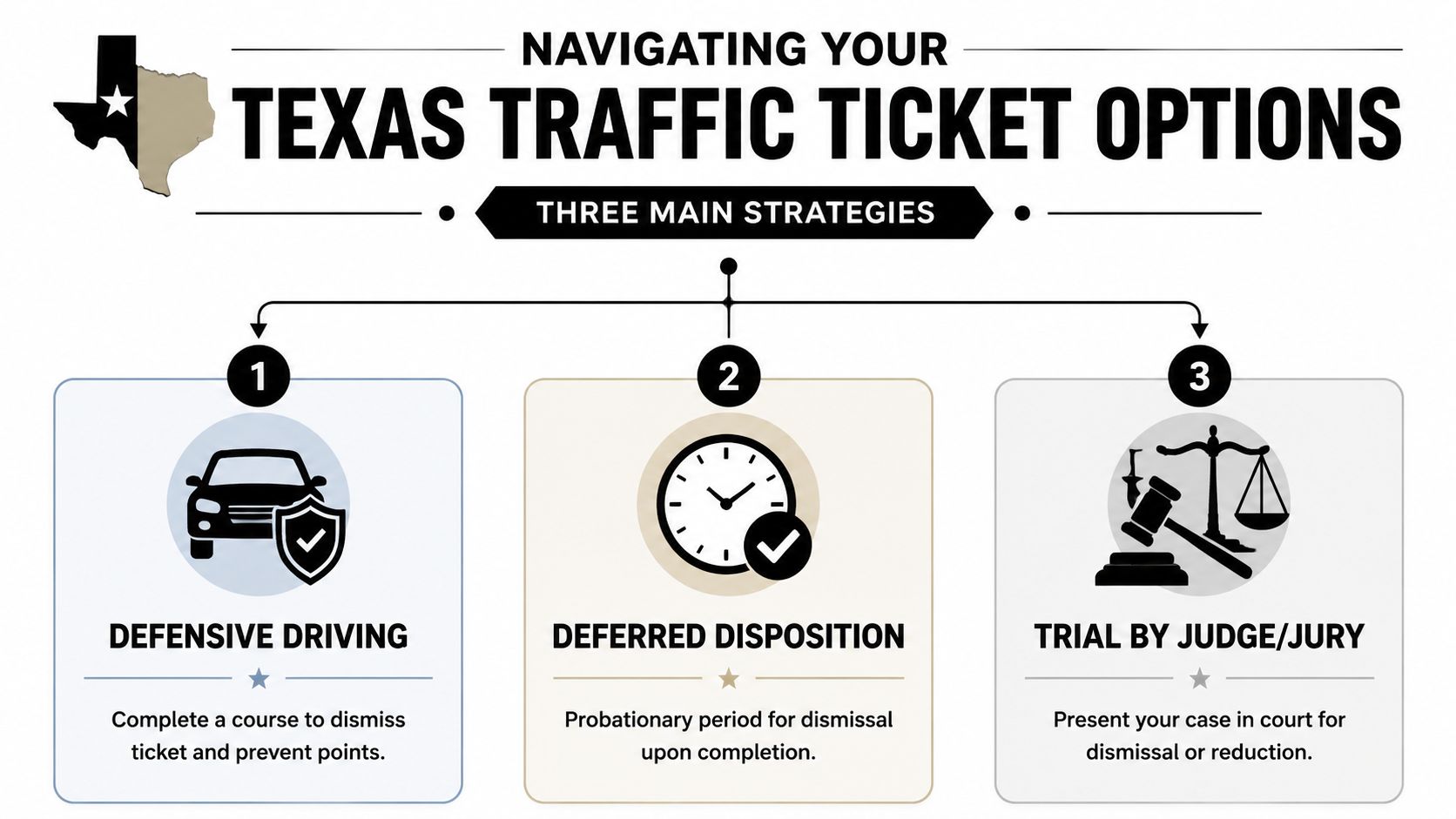
Texas drivers usually have three broad paths after a routine ticket. They are not interchangeable, and the right choice depends on your record, the charge, and what outcome matters most.
A lot of people ask a simple question: can a traffic ticket just be dropped? Sometimes yes, but the mechanism matters. This related guide on whether a Class C misdemeanor can be dropped helps explain why dismissal often depends on procedure, eligibility, and court action rather than wishful thinking.
Option one is defensive driving
For eligible drivers, a driving safety course can be one of the cleanest ways to resolve a ticket. This route is usually attractive for people who want a practical, non-adversarial solution and are willing to complete the required class and paperwork.
The benefit is straightforward. If the court grants that option and you comply fully, the case can be dismissed under that process. The risk is also straightforward. If you assume you qualify without checking, or you miss the filing and completion requirements, you can lose the opportunity.
This option works best when:
- Your goal is efficiency: You want a route designed to avoid a final conviction through compliance.
- The court allows it: Eligibility depends on the charge and your circumstances.
- You can follow instructions carefully: Administrative mistakes ruin good options every day.
Option two is deferred disposition
Deferred disposition is often misunderstood. It is not the same as walking out with no strings attached. Think of it as a probation-style arrangement for a lower-level case. The court postpones final disposition and gives you conditions to meet.
If you comply, the court can dismiss the charge at the end of the deferral period. If you don't, the court can move forward in a way that leaves you in a worse position than if you had handled the matter carefully from the start.
A practical comparison helps:
| Path | Main appeal | Main trade-off |
|---|---|---|
| Defensive driving | Clear compliance route for eligible cases | Not everyone qualifies |
| Deferred disposition | Can avoid a final conviction if completed | Conditions and deadlines matter |
| Not guilty plea and contest | Preserves your right to challenge the case directly | Requires preparation and strategy |
Option three is pleading not guilty
This is the path for drivers who want to challenge the state's proof, the officer's observations, the stop itself, or the legal sufficiency of the citation and evidence.
That does not mean every case goes to a dramatic courtroom showdown. Many contested tickets are resolved through negotiation, procedural review, or dismissal before a full hearing becomes necessary. But once you choose this path, you need to treat the case like a real legal matter.
Some drivers need convenience. Some need a clean record. Some need to fight because the ticket is tied to a larger legal risk. Those are different problems, and they require different strategies.
Building Your Defense Common Challenges That Win
When traffic tickets dismissed outcomes happen after a contest, they usually come from very ordinary legal work. Someone reviewed the stop, requested the right materials, challenged weak proof, and showed up prepared.
You do not need a theatrical defense. You need a disciplined one.
Start with the stop and the paper trail
The first question is simple. Why did the officer stop the vehicle in the first place?
If the basis for the stop is weak, inconsistent, or unsupported by the surrounding facts, that can matter. The next layer is the paperwork. Time, location, driver identity, vehicle information, and the stated offense all need to line up in a way that supports the accusation.
Useful places to focus include:
- Reason for the stop: Was there a clear, articulable basis for pulling you over?
- Citation accuracy: Do the details on the ticket match what transpired?
- Officer report consistency: If a report exists, does it fit the citation and expected testimony?
Challenge the proof, not just the fairness
Drivers often come to court wanting to explain that they are careful, respectful, or usually law-abiding. That may make you sympathetic, but sympathy is not a defense.
What matters is whether the court believes the state can prove the allegation. In many cases, that means testing speed measurement, visual estimation, identification, signage, or the officer's recollection. If you're organizing documents and want a structured way to review a citation before court, tools like PDF AI's ticket analysis agent can help you spot issues and questions worth discussing with counsel.
Good defenses usually sound boring. That is often a sign they are working.
Officer no-show matters more than people think
One of the most practical dismissal paths in Texas has nothing to do with dramatic cross-examination. It starts when the officer does not appear.
In some Texas courts, including courts in Harris County, officer non-appearance can lead to automatic dismissals in as many as 40 to 60 percent of contested cases, and that result can improve when an attorney uses discovery to pressure attendance, according to this Texas officer no-show discussion.
That doesn't mean you should count on a no-show and do nothing else. It means showing up matters. Filing properly matters. Preserving your contest matters. Many people lose winnable cases because they assume the court will sort things out for them.
A strong defense file often includes:
- Your copy of the ticket
- Notes written the same day
- Photos of the scene if signage or visibility matters
- A calendar with every deadline
- Questions aimed at the state's proof, not your personal frustration
The Lawyer Advantage When to Call for Backup
Some traffic cases are simple enough for a careful person to manage. Others only look simple until they touch your license, your work schedule, your insurance, or a related criminal matter.
A lawyer's value in this setting is practical. Counsel knows local procedure, filing habits, common prosecutor positions, and the weak points in routine traffic evidence. In many cases, the difference is not courtroom drama. It is avoiding preventable mistakes and choosing the right pressure point early.
Where representation changes the outcome
Nationally, contested speeding tickets are dismissed in 20 to 25 percent of cases, but that figure rises to 40 to 50 percent when the driver has an attorney who can challenge evidence and procedure, according to this nationwide attorney dismissal overview.
That tracks with what defense lawyers see in day-to-day practice. People representing themselves often focus on fairness or excuses. Lawyers focus on burden of proof, procedural advantages, admissibility, and resolution options.
Common reasons to call for help include:
- Your ticket is tied to something bigger: Maybe the stop involved questions about insurance, warrants, a suspended license, or possible DWI investigation.
- You cannot miss work for repeated court settings: In some matters, counsel can reduce the disruption by handling appearances or negotiations more efficiently.
- You care about the record outcome more than the fine amount: That is where strategy matters most.
If you're weighing whether private representation is worth it, this comparison of a public defender vs private lawyer gives a useful framework for thinking about access, attention, and case strategy.
One option among several
For Texans who want help evaluating deferral, dismissal strategies, and record consequences, the Law Office of Bryan Fagan PLLC handles criminal defense matters that include traffic-related issues and post-case record work.
Hiring a lawyer for a traffic matter is usually not about making the case dramatic. It's about making the result less damaging.
Navigating Courts in Houston Dallas Austin and San Antonio
Traffic practice in Texas is local. The statewide legal principles matter, but the day-to-day experience often depends on which court has your case, how that court handles settings, and how quickly you respond.
A Houston ticket may land in a municipal court setting with one set of procedures. A ticket in another metro area may move through a different administrative rhythm. That is why drivers get into trouble when they rely on generic online advice instead of reading the actual citation and court instructions.
City by city practical realities
Houston drivers often deal with busy dockets and should verify the exact court listed on the citation before doing anything else. A wrong assumption about venue can cost time and lead to a missed appearance.
Dallas drivers should pay close attention to whether the case is moving through a municipal court or a justice court. Those differences affect forms, scheduling, and how you request relief.
Austin drivers tend to benefit from getting organized early. Save screenshots of any online account activity, confirmation pages, and filed requests so there is a clear record of your response.
San Antonio drivers should read every notice from the court carefully. A lot of avoidable problems come from treating follow-up correspondence as routine paperwork when it contains the next required step.
A practical checklist before any court contact
- Match the citation to the court: Don't assume the nearest courthouse is the correct one.
- Save proof of every submission: Keep confirmations, emails, and receipts in one folder.
- Write down your objective: Dismissal, deferral, reduction, or trial preparation are not the same thing.
- Don't improvise at the window: Court staff can explain process, but they do not give legal advice specific to your case.
The biggest local advantage is often simple discipline. Drivers who track deadlines and choose a strategy early usually stand on firmer ground than drivers who wait until the week of court.
After the Court Date Protecting Your Record and Future
A dismissal is important. It is not always the end of the story.
Many people hear that their case was dismissed and assume the event has disappeared from every system that matters. In Texas, that assumption can create trouble later, especially when a job application, insurance issue, or related criminal background question appears.
Dismissal and record clearing are not the same thing
In Texas, a dismissed civil traffic ticket can still appear on your driving record for three years, and clearing the broader impact may require a petition for nondisclosure or expunction, according to this Texas record impact discussion.
That matters most when a supposedly minor ticket was not so minor in practice. Some traffic stops overlap with allegations involving intoxication, license problems, contraband, or other criminal accusations. In those situations, the courtroom result on the citation is only one part of the bigger record problem.
Think about the long view
After court, ask these questions:
- What exactly was the final disposition? Dismissal, deferred completion, payment, and amended outcomes are not the same.
- What record system are you worried about? A court file, a criminal history issue, and a driving record issue may require different responses.
- Do you need a second legal step? Some people need follow-up work to pursue nondisclosure or expunction where the law allows it.
A favorable courtroom result is valuable. A clean record is a separate objective, and sometimes it takes separate action.
For parents and families, that distinction matters even more. Even a low-level case can feel larger when there are employment concerns, custody concerns, or any fear that legal trouble will spill into home life. The safest approach is to confirm what was dismissed, what was reported, and whether any additional filing is needed to protect your future.
If you're dealing with a ticket and you don't want to guess your way through it, contact Law Office of Bryan Fagan PLLC for a free consultation. We can help you assess whether dismissal is realistic, whether a deferred option makes more sense, and whether anything needs to be done after court to protect your record. A traffic stop may feel small in the moment, but the right response can make a lasting difference for you and your family.