Skip to content
When you learn there’s a warrant in your name, the fear usually isn’t just about jail. For many Texas parents, the first thought is, “What happens to my kids if I’m picked up?” If you already have CPS in your life, or you’re in the middle of a custody fight, that fear gets sharper fast.
A missed court date often starts with something ordinary. A child wakes up sick. Your car won’t start. You change addresses and never receive the notice. You thought the ticket was paid, or you thought your lawyer was handling the setting. Then a routine traffic stop, job screening, or courthouse check brings back a word that feels much bigger than the original case: warrant.
That’s where families get blindsided. A failure to appear warrant can create criminal trouble and family-court trouble at the same time. In CPS cases under Texas Family Code Chapters 262 and 263, parents are already being judged on stability, reliability, and follow-through. In termination cases under Chapter 161, even a small legal problem can be framed as part of a larger pattern. The good news is that a warrant problem usually has a path forward. The key is to deal with it quickly, carefully, and with the family-law consequences in mind.
The Unsettling Discovery of a Warrant
A parent misses one court date on an old traffic matter because a child has a fever and needs to be seen the same morning. Days turn into weeks. Life stays crowded. Then during a background check for a new apartment, the parent finds out a judge issued a failure to appear warrant.
That moment feels surreal. The original matter may have seemed minor. The warrant does not.

For a Texas parent dealing with CPS or a custody case, the worry expands immediately. You may be asking whether CPS will find out, whether the other parent can use it against you, or whether you could be arrested on the way to a visitation, hearing, or drug test. Those are reasonable fears.
This problem is also far more common than generally understood. In the United States, failure to appear warrants are a major driver of the pretrial jail population, and a 2016 National Institute of Justice survey estimated about 7.8 million outstanding warrants nationwide, a figure that likely understates the true total because it does not fully capture municipal or local-court warrants, as noted in this Data Collaborative for Justice summary.
When worry turns into paralysis
Parents in this position often freeze. They know they should act, but they’re afraid that calling the court will trigger an arrest. They replay every possibility at night and struggle to focus during the day. If that sounds familiar, this short resource on overthinking and anxiety may help you calm the spiral enough to make a plan.
Practical rule: A warrant rarely improves with time. Delay usually increases risk, not options.
The first step is simple. Confirm what exists, which court issued it, and whether there is an active setting tied to it. If you’re unsure where to start, this guide on how to find out if you have a warrant can help you identify the court and basic status before you make a move.
What Exactly Is a Failure to Appear Warrant
A failure to appear warrant is usually a bench warrant. A judge issues it because a required court appearance was missed.
That matters because people often assume the warrant is the same thing as the original charge. It isn’t. The missed appearance creates its own problem.
It is not the same as a new criminal accusation
An arrest warrant is generally tied to probable cause that a person committed an offense. A bench warrant is different. It comes from the court’s authority to require attendance and enforce its orders.
A helpful way to think about it is this. The original case is the library book. The failure to appear warrant is the late fee that keeps growing until someone addresses it. Even if the book issue later gets resolved, the court may still expect a separate fix for the missed appearance.
That separate-track problem is not just theory. A failure to appear is technically not a criminal charge itself, but a judicial enforcement mechanism, and the warrant can remain active and enforceable even if the underlying case is later dismissed or expunged unless it is specifically addressed, as explained in this discussion of expunging a failure to appear charge.
Why Texas families need to understand the distinction
Many parents get caught off guard. They think, “The ticket was old,” or “The underlying case should have been dismissed by now,” so they assume the danger has passed. But the court may still show an active warrant.
That can affect more than your criminal record. In a CPS case, a caseworker may view an unresolved bench warrant as a sign that you’re not in compliance with court expectations. In a private custody case, the other side may argue that you don’t respect legal orders. Those arguments are not always fair, but they are common.
If you’ve heard the term capias warrant and aren’t sure how it overlaps with a failure to appear problem, this page explaining what a capias warrant means in Texas can clarify the terminology. For a plain-language outside explanation, this overview of Cherokee County failure to appear also shows how these warrants are typically described to the public.
Treat the warrant and the original case as two files on the same desk. They may be related, but they often require separate attention.
The Serious Consequences for You and Your Family
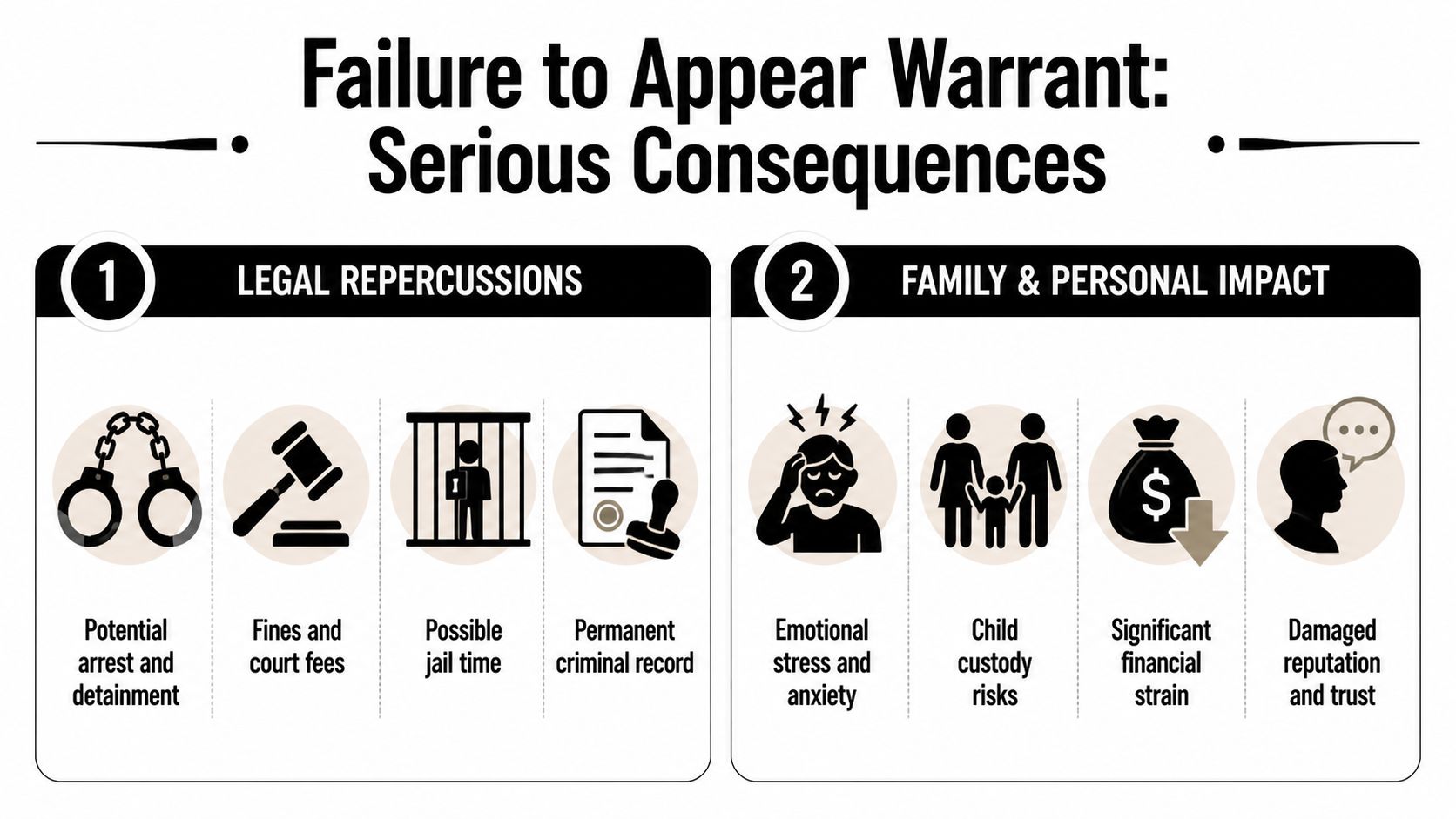
An active warrant changes daily life. It can turn a normal traffic stop into an arrest. It can disrupt work, child exchanges, school pickups, and court appearances in unrelated cases.
And these warrants are not rare side issues. In St. Louis City, about 14% of all police arrests involved only an outstanding bench warrant, and in Louisville, Kentucky, 19% did. In both cities, most of those warrant-only arrests stemmed from minor offenses. That shows how quickly a missed court date can become incarceration even when no new charge is involved.
What happens on the criminal side
In Texas, the practical consequences often include:
- Arrest risk at inconvenient moments: You may be taken into custody during a traffic stop, at the courthouse, or after contact with law enforcement for something unrelated.
- Bond complications: If you were already out on bond, missing court can create new problems with the bond and make future release harder.
- Additional charge exposure: Depending on the facts and court involved, prosecutors may look at bail-jumping or related allegations.
- Driver’s license and administrative headaches: Court noncompliance can spill into other areas of life, making ordinary tasks harder.
Some parents focus only on whether they can avoid jail for a day or two. The bigger issue is often the ripple effect after that arrest. Missed work leads to lost income. Missed visitation leads to conflict. Missed CPS services can be labeled noncompliance.
What happens in CPS and custody court
This is the part many criminal-defense articles skip.
In a CPS removal case under Chapter 262, the court is looking closely at immediate safety and the parent’s ability to provide stability. In review and permanency hearings under Chapter 263, the court tracks whether the parent is completing services, appearing when required, and making consistent progress. In a termination case under Chapter 161, an opposing lawyer may try to turn any unresolved legal issue into evidence that the parent hasn’t changed.
An active warrant gives the other side easy talking points:
- “The parent does not follow court orders.”
- “The parent is at risk of arrest and cannot provide stable care.”
- “The parent has unresolved criminal problems.”
- “The parent may miss future hearings, visits, or services.”
Those claims may oversimplify what happened. A missed date caused by a child’s medical crisis is not the same as intentional defiance. But in court, unresolved facts often get interpreted in the harshest light.
A warrant doesn’t just create legal exposure. It creates a narrative. If you don’t address it, someone else will tell that story for you.
Why quick action matters for parents
Judges in family cases often care less about the existence of a problem than about how a parent responds to it. Parents who deal with the issue promptly, gather records, appear appropriately, and stay engaged with their CPS plan usually stand in a far better position than parents who hide from the warrant and miss more obligations.
That doesn’t mean you should walk into court blindly. It means the right strategy should account for both court systems at once.
A Real-Life Scenario How a Warrant Complicates a CPS Case
Maria is a fictional example, but her situation is familiar.
She is a mother in a CPS case. Her children were removed under an emergency order, and she is working a service plan. She attends parenting classes, keeps a steady job, tests clean, and shows up for visits. The case is finally moving in the right direction.
Then her youngest child has an asthma flare-up on the same morning as a municipal court setting tied to an old ticket. Maria goes to the emergency room. She thinks she can sort the ticket out later. She never does. A failure to appear warrant issues in the background.

At the next permanency hearing, CPS raises the warrant. The agency’s argument is not, “Maria is a bad parent because of a traffic case.” The argument is subtler and more dangerous. CPS suggests the warrant shows a pattern of failing to handle legal responsibilities.
How the issue gets framed in court
Maria tries to explain that she chose her child’s breathing emergency over court. Most judges understand that kind of real-life conflict. The problem is that she has no hospital discharge papers with her, no proof of the time she arrived, no proof that she tried to notify the court, and no active plan for getting the warrant recalled.
That allows the conversation to shift away from the emergency and toward compliance.
The court may begin asking questions such as:
- Has Maria resolved the warrant yet
- Could she be arrested before the next hearing
- Will this interfere with services or visitation
- If she missed one court date, will she miss others
Maria’s progress did not disappear. But the unresolved warrant gave the case a new point of attack.
In CPS court, small legal problems become bigger when they look unmanaged.
A parent in Maria’s position often has a better outcome when the warrant issue is addressed before the next family-court hearing, with documentation ready and a clear explanation that connects the facts to responsible parenting rather than irresponsibility.
Your Step-by-Step Options for Resolving the Warrant
Once you confirm there is an active warrant, the goal is to resolve it in a way that protects both your liberty and your family case. The right option depends on the court, the underlying charge, your prior record, and whether you have a pending CPS or custody matter.
Three common paths in Texas
Some courts allow a walk-in appearance. That means showing up voluntarily and asking to address the warrant. In the right courthouse, with the right case, that can work. In the wrong setting, it can lead to immediate custody.
Another option is to have counsel pursue an attorney bond or communicate directly with the court to secure a new appearance date without you being taken into custody first. In many counties, that route gives families more control and reduces surprises.
The third route is a motion to quash or motion to recall the warrant. That usually asks the judge to withdraw the warrant based on the circumstances and reset the case. This is often strongest when there is a documented reason for the missed appearance or a clerical problem.
Comparing Warrant Resolution Options in Texas
| Method | Risk of Immediate Arrest | Typical Process | Best For |
|---|---|---|---|
| Walk-in at courthouse | Higher | You appear voluntarily before the court or clerk and ask to address the warrant | Lower-level matters where local practice is predictable |
| Attorney bond | Lower to moderate | Counsel coordinates bonding and appearance logistics | Parents who need to avoid sudden custody disruptions |
| Motion to quash or recall | Varies by court | Lawyer files a request and presents reasons to withdraw the warrant | Cases with strong documentation, notice problems, or emergencies |
What usually works best for parents with CPS issues
If you have an open CPS case or a live custody dispute, the safest legal move is not always the fastest-looking move. A same-day courthouse appearance may sound efficient, but it can create immediate childcare problems, missed work, missed services, and avoidable damage in family court if you’re unexpectedly detained.
That’s why parents often benefit from a strategy built around documentation and communication first.
A practical checklist looks like this:
- Confirm the court and cause number. Don’t rely on memory.
- Get the setting history if possible. We want to know what date was missed and whether notice appears in the file.
- Collect family-impact records. School records, ER papers, work schedules, text messages, and address-change proof all matter.
- Map the CPS calendar. Avoid creating conflicts with visits, drug tests, or upcoming hearings.
- Choose the resolution path based on risk. The answer in municipal court may not be the answer in county court.
The guide to getting a warrant lifted in Texas explains the basic process, but parents should also think one step further. Ask not only, “How do I clear the warrant?” Ask, “How do I clear the warrant without harming my custody position?”
Where legal counsel fits
In some cases, private counsel can contact the court, file the appropriate motion, coordinate bond issues, and present the missed appearance in a way that reduces fallout in both the criminal and family systems. The Law Office of Bryan Fagan PLLC handles criminal matters that intersect with family law and CPS, which is often important when the warrant is only half the problem.
No attorney can promise that a court will withdraw a warrant without conditions. But good preparation improves your position and reduces the chance that the issue gets framed as recklessness when it was really a life problem, paperwork problem, or notice problem.
Common Defenses and Mitigating Your Situation
Missing court does not automatically mean you ignored the judge. Courts know people miss settings for real reasons. What matters is whether you can prove what happened and present it clearly.
Lack of notice is a serious issue
Some of the strongest warrant defenses involve notice failures. People move. Mail gets sent to old addresses. Phone numbers change. Automated reminders don’t go through. In practice, many parents know they had a court issue but never knew the exact date, time, or reset.
Recent research on court notification systems shows that automated reminders can reduce FTA rates by 10 to 25 percent, yet system failures such as wrong phone numbers can disproportionately hurt people with unstable housing or limited internet access. The same research also notes that proving a systemic notification failure can be an important part of a defense, as discussed in this Prison Policy Initiative article on court appearances and reminders.

The evidence matters more than the excuse
Judges hear “I didn’t know” all the time. The phrase alone won’t carry much weight. Documents do.
Useful records often include:
- Medical proof: ER discharge papers, appointment confirmations, ambulance paperwork, or pharmacy records.
- Address history: Lease documents, utility records, mail forwarding records, or texts discussing a move.
- Communication logs: Screenshots, voicemail records, call logs, and emails showing attempts to contact the court or lawyer.
- Custody-related proof: School pickup records, visitation schedules, or CPS service appointments that show a real conflict.
- Detention records: If you were jailed elsewhere, booking and release records can be decisive.
Don’t just tell the court why you missed. Show the paper trail that makes your explanation hard to dismiss.
Common situations that can soften the court’s response
A parent may have a stronger request to recall the warrant when the missed appearance involved:
- A documented child emergency
- A clerk or scheduling error
- Notice sent to the wrong address
- Incarceration in another place at the time
- Confusion created by reset dates or overlapping courts
What usually does not work is silence followed by delay. If months pass and there is no effort to fix the problem, even a decent explanation becomes harder to sell. Courts often respond better when the person takes responsibility for the missed date, explains the reason, and acts quickly once the warrant is discovered.
Life After the Warrant Clearing Your Record
Resolving the warrant is the immediate crisis. Cleaning up the record is the next chapter.
In Texas, an active warrant blocks expunction. Texas law prohibits expunction of active warrants, and once the warrant is resolved, the waiting period depends on the level of the case: 180 days for Class C misdemeanors, 1 year for Class A or B misdemeanors, and 3 years for felonies, measured from the original arrest date before an expunction can be filed, according to this explanation of whether warrants can be expuncted in Texas.
Why record cleanup matters in family cases
For parents, record clearing is not only about jobs and housing. It can also matter when a future custody dispute arises, when background checks are run, or when an old criminal issue keeps resurfacing long after the underlying case is over.
That process may involve expunction, nondisclosure, or verifying that every database reflects the court’s final order. Keep copies of everything. Organize your papers carefully. Even a simple evidence log or chain of custody form can help you track what documents you received, when you received them, and who has copies if questions come up later.
The larger point is hopeful. A failure to appear warrant can feel like proof that everything is unraveling. It isn’t. It is a legal problem that needs a plan. When the plan accounts for your criminal case and your family case together, you have a much better chance of protecting your record, your parenting time, and your path forward.
If you’re a Texas parent dealing with failure to appear warrants while CPS is involved or custody is on the line, don’t try to guess your way through it. The stakes are too high, and the wrong move can create new problems in both courts. Contact Law Office of Bryan Fagan PLLC for a free consultation. We can help you evaluate the warrant, the missed court date, the CPS or custody impact, and the steps needed to protect your rights and your family.