Skip to content
When a simple traffic stop suddenly involves words like "felony," your entire world can feel like it's grinding to a halt. It’s one thing to face a standard DWI charge, but a felony DWI in Texas is a completely different animal. It brings a level of fear and uncertainty that nobody is ever prepared for, and understanding why your charge was elevated is the first, most critical step in figuring out how to fight back.
How a DWI Charge Becomes a Felony in Texas

The moment a police officer or prosecutor mentions "felony," everything changes. You’re no longer just worried about fines or a suspended license. Suddenly, you’re staring down the barrel of potential prison time, a permanent criminal record that follows you forever, and consequences that could impact your family for the rest of their lives.
It’s a terrifying place to be, but knowledge is your first line of defense.
In Texas, the law draws a very clear line in the sand between a misdemeanor and a felony DWI. This escalation isn't random; it’s triggered by specific factors that the state views as exceptionally dangerous. Let's break down exactly what those triggers are.
The Three Main Paths to a Felony DWI
Think of a standard first-offense DWI as a serious warning shot from the legal system. But when certain aggravating factors are involved, the charge gets upgraded significantly. A DWI charge is typically escalated to a felony DWI in Texas for one of three main reasons:
- Repeat Offenses: If you have two or more prior DWI convictions on your record, your third DWI arrest is automatically filed as a third-degree felony. It’s important to know that Texas has no "lookback period," which means a DWI from 10, 20, or even 30 years ago still counts toward this total.
- Causing Serious Injury (Intoxication Assault): If you are driving while intoxicated and cause an accident where another person suffers a "serious bodily injury," you can be charged with Intoxication Assault. This is a third-degree felony, and it applies even if it’s your very first offense.
- Causing a Fatality (Intoxication Manslaughter): In the most tragic circumstances, if an accident while you are intoxicated results in someone's death, the charge becomes Intoxication Manslaughter. This is a second-degree felony and one of the most serious charges a person can face in Texas.
To put this in perspective, let’s quickly compare the triggers.
Misdemeanor vs Felony DWI Triggers in Texas
This table offers a quick snapshot of the circumstances that can turn a standard DWI into a much more serious felony charge.
| DWI Classification | Key Triggering Factor | Typical Charge Level |
|---|---|---|
| Misdemeanor DWI | First offense (no aggravating factors) | Class B or Class A Misd. |
| Felony DWI | Third or subsequent DWI conviction | Third-Degree Felony |
| Felony DWI | DWI with a child passenger under 15 | State Jail Felony |
| Felony DWI | Causing serious bodily injury (Intoxication Assault) | Third-Degree Felony |
| Felony DWI | Causing a death (Intoxication Manslaughter) | Second-Degree Felony |
As you can see, the presence of prior offenses or harm to others dramatically raises the stakes.
The Special Case of a Child Passenger
There’s one other situation that instantly turns a DWI into a felony, no matter what your driving history looks like.
Under Texas Penal Code § 49.045, operating a vehicle while intoxicated with a passenger younger than 15 years old is a state jail felony.
This law is designed to protect children from incredibly dangerous situations. Picture a parent driving home from a family barbecue after having a couple of beers, with their child asleep in the back seat. Even if they get pulled over for a minor traffic violation and have a perfectly clean record, the presence of that child automatically elevates the charge from a misdemeanor to a felony.
Figuring out which of these scenarios applies to your case is absolutely essential. It defines the battle ahead and shapes the entire defensive strategy needed to protect your future and your family. Each path to a felony charge requires a completely different legal approach, making experienced guidance critical from the very start.
What Are the Real Penalties for a Texas Felony DWI?
A felony DWI conviction in Texas isn't just about fines and potential jail time. It’s a seismic event that sends shockwaves through every corner of your life, long after the legal battle is over. We’re not just talking about numbers on a court document; we're talking about lost time with your family, financial devastation, and the stripping away of fundamental freedoms.
To build a powerful defense, you first have to grasp the full weight of what’s at stake. Unlike a misdemeanor, a felony charge means the state isn't just trying to punish you—they're looking to put you in prison for a significant amount of time. Your future, your career, your ability to provide for your loved ones, and even your right to drive all hang in the balance.
Third-Degree Felony DWI Penalties
Most felony DWI cases in Texas are classified as third-degree felonies. This is the charge you’ll face for a third DWI offense, no matter how long ago the prior convictions were. It also applies to Intoxication Assault, where an accident results in someone else suffering a serious bodily injury.
A conviction at this level is life-altering. Here’s what you’re up against:
- Prison Time: A sentence of 2 to 10 years in a Texas state prison.
- Fines: A crippling fine of up to $10,000.
- Driver’s License Suspension: Your license can be suspended for up to two years.
And that’s just the beginning. The court will almost certainly tack on other requirements, like community service, mandatory DWI education programs, and the installation of an ignition interlock device (IID) on your vehicle once you can legally drive again. Each of these adds another layer of financial and logistical stress. An IID alone—from installation to monthly monitoring fees—can easily run into thousands of dollars.
Second-Degree Felony DWI Penalties
Things get even more serious when the charge is a second-degree felony. This is what you face for Intoxication Manslaughter—when an intoxicated driving incident tragically ends in someone's death. In these cases, the state pursues some of the harshest punishments available.
The consequences are devastating:
- Prison Time: A sentence ranging from 2 to 20 years in a Texas state prison.
- Fines: A fine of up to $10,000.
- Driver’s License Suspension: A suspension that can last for up to two years.
These penalties are designed to reflect the irreversible loss of life and the immense pain inflicted on the victim's family. Whether it's a repeat offense or a single incident causing serious injury or death, Texas law turns what might have been a misdemeanor into a felony with truly punishing consequences.
Below is a table that breaks down these potential penalties so you can see them side-by-side.
Texas Felony DWI Penalties at a Glance
| Felony DWI Offense | Felony Degree | Prison Sentence Range | Maximum Fine | Driver's License Suspension |
|---|---|---|---|---|
| Third DWI Offense | Third-Degree | 2 to 10 years | Up to $10,000 | Up to 2 years |
| Intoxication Assault | Third-Degree | 2 to 10 years | Up to $10,000 | Up to 2 years |
| Intoxication Manslaughter | Second-Degree | 2 to 20 years | Up to $10,000 | Up to 2 years |
Seeing these numbers laid out makes it clear just how high the stakes are. But the statutory penalties are only part of the story.
A felony DWI conviction is not just about serving time. It's about navigating a future with a permanent criminal record that can close doors to employment, housing, and educational opportunities for the rest of your life.
The Pile-On: Additional Court-Ordered Consequences
Beyond prison walls and bank-draining fines, a felony DWI conviction brings a whole host of other mandatory requirements. These aren't suggestions; they are court-ordered conditions that will control your life long after your official sentence is served. If you want to dive deeper into what this looks like, check out our guide on the felony probation rules in Texas.
Common additional penalties include:
- Ignition Interlock Device (IID): Mandatory installation on any vehicle you drive. This device is essentially a breathalyzer that stops your car from starting if it detects alcohol.
- Substance Abuse Evaluation and Treatment: The court will almost certainly order you to be evaluated and force you to complete any recommended counseling or treatment programs.
- DWI Education Programs: You'll be required to attend and complete specific, intensive courses designed for felony DWI offenders.
- Community Service: It's not uncommon to be ordered to complete hundreds of hours of community service.
Facing these escalating penalties can feel crushing, but it’s so important to remember that an arrest is not a conviction. Every single detail of your case matters, and a smart, strategic defense can make a world of difference in the final outcome.
Navigating the Legal Process After a Felony DWI Arrest
Getting arrested for a felony DWI in Texas is a terrifying, disorienting experience. One minute you’re driving, and the next, you’re in handcuffs, thrust into a complex legal system that feels designed to intimidate and confuse you. The fear of the unknown—what’s next, what are my rights, how will this wreck my family’s life?—is completely overwhelming.
This section is your roadmap through that maze. We’re going to walk through the criminal justice process step-by-step, from the minute you’re arrested through the critical pretrial stages. Our goal is to replace that anxiety with a clear understanding of the road ahead, showing you exactly where the key moments and opportunities lie in building your defense.
From Arrest to Arraignment
Your legal journey kicks off the second you’re taken into custody. This initial phase is pure chaos, but knowing the sequence of events can help you feel a little more grounded and prepared for what’s to come.
Booking and Processing: Once arrested, you’ll be taken to a local jail for booking. This is where they take your fingerprints, snap your mugshot, and record your personal information. All of your personal property will be inventoried and stored until your release.
Initial Appearance (Arraignment): Next, you'll be brought before a magistrate judge for your arraignment. This is your first official court appearance. The judge will inform you of the felony charge, explain your constitutional rights, and set your bail amount.
Bail and Pretrial Release: Bail is the money you must pay to get out of jail while your case is pending. The amount depends on the seriousness of the charge, your criminal history, and whether the court thinks you're a flight risk. You can post the full amount yourself or hire a bail bondsman. For many families, this is the first major hurdle, as coming up with these funds can be a huge financial strain.
The Critical Pretrial Phase
Once you're out on bail, your case moves into the pretrial phase. This is, without a doubt, the most important stage of your defense. It’s where all the groundwork for a successful outcome is laid through investigation, negotiation, and sharp legal strategy.
During the pretrial phase, your attorney has the chance to challenge the prosecution's evidence before it ever gets in front of a jury. This is where many felony DWI cases are won, lost, or significantly improved through skilled legal work.
Your attorney will immediately get to work on several fronts:
- Discovery: Your lawyer will file a "motion for discovery," which legally forces the prosecutor to hand over every piece of evidence they have against you. This includes police reports, witness statements, and the results from any breath or blood tests. You might want to learn more about your rights when it comes to these tests by reading our article on whether you can you refuse a breathalyzer test.
- Filing Motions: Based on what’s in the evidence, your attorney may file pretrial motions to gut the state’s case. A common and powerful tool is a Motion to Suppress Evidence. This motion argues that key evidence—like the breath test or things you said—was obtained illegally (maybe from an unlawful traffic stop) and should be thrown out of court.
- Negotiations: With a clear picture of the evidence, your attorney will start negotiating with the prosecutor. These talks could be about getting the felony charge knocked down to a misdemeanor or agreeing to a more favorable plea bargain that avoids the worst penalties.
This infographic shows a simplified overview of the penalties that prosecutors use as leverage during these negotiations.
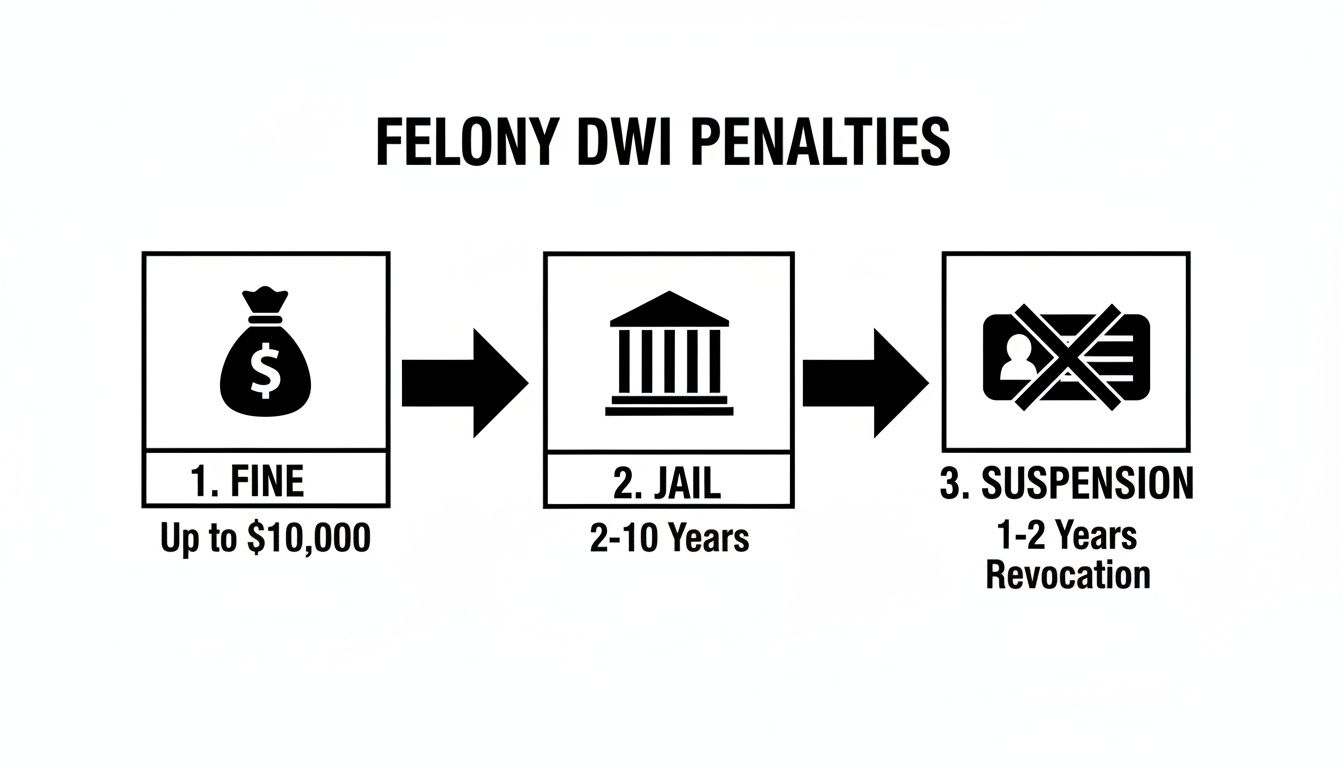
This image highlights the three pillars of punishment—fines, jail time, and license suspension—that really define the severity of a felony DWI conviction in Texas.
The Fork in the Road: Plea Bargain or Trial
Ultimately, the pretrial phase leads to a crucial decision point. After all the evidence is reviewed and motions are argued, your case will head down one of two paths.
Your attorney will lay out the options and give you their honest assessment of the state's case and the potential risks of going to trial. Understanding this process demystifies the journey and empowers you to make informed decisions alongside your lawyer, ensuring your rights are protected every single step of the way.
Effective Defense Strategies for Felony DWI Charges

Hearing the word "felony" can feel like the fight is already over. But let me be clear: nothing could be further from the truth. An arrest is just an accusation, not a conviction. The state carries the entire burden of proving its case against you beyond a reasonable doubt—and that's often a much steeper hill to climb than they want you to believe.
Every piece of evidence, every police action, and every test result is an opportunity for a skilled defense attorney to challenge the prosecution’s narrative. For families facing the terrifying prospect of a felony DWI in Texas, understanding these defense strategies is the first step toward reclaiming hope. It’s about shifting your focus from the potential penalties to the proactive steps you can take right now to protect your future.
Questioning the Initial Traffic Stop
The whole case starts with the traffic stop. If the officer didn't have a legally valid reason to pull you over in the first place, any evidence they collected afterward could get thrown right out of court. We're talking about field sobriety tests, your statements, and even breath or blood tests.
This all comes down to the Fourth Amendment, which protects you from unreasonable searches and seizures. An officer can't just pull you over on a whim; they need "reasonable suspicion" that you've actually violated a law.
- Valid Reasons: Things like speeding, running a red light, or weaving out of your lane.
- Invalid Reasons: Simply driving late at night, being in a certain part of town, or an officer’s vague "hunch."
If your attorney can show the stop was unlawful, it can lead to the suppression of all the evidence that followed. In many cases, this results in a complete dismissal.
Challenging Sobriety and Chemical Tests
The heart of the state's case usually beats with two things: field sobriety tests (FSTs) and chemical tests (breath or blood). But here's the reality: both are far from foolproof and are ripe for a strong challenge. The state's reliance on prior offenses is exactly why it's so critical to fight every single charge. Recidivism is what turns Texas DWIs into felonies so quickly, as a third offense or one involving injury sends penalties soaring. By 1990, recidivists made up 38% of all DWI offenders, a jump from 33% in 1987, pointing to a persistent issue. You can dig deeper into these historical trends with this DWI offender data.
An experienced attorney will put this evidence under a microscope:
- Field Sobriety Tests: These tests are notoriously subjective. Things like medical conditions, being tired, bad weather, or even the officer giving improper instructions can cause a perfectly sober person to "fail."
- Breathalyzer Tests: These machines aren't magic boxes. They need precise calibration and regular maintenance. A good lawyer will subpoena the device’s logs to check for a history of errors or to see if the officer who ran the test was even properly certified.
- Blood Tests: The chain of custody for a blood sample is everything. If the sample was stored improperly, mislabeled, or contaminated at any point from your arm to the lab, the results become unreliable and can be successfully challenged in court.
A classic example we see is a blood draw done without a proper warrant or valid consent. If the police pressure you into giving a blood sample or just fail to get a warrant when it's required, that crucial piece of evidence can be deemed inadmissible. A case built on that evidence can quickly fall apart.
By systematically dismantling the evidence the state is leaning on, a strong defense can create the reasonable doubt needed to win. This isn't about finding "loopholes"; it's about holding the prosecution to its high legal standard and making sure your constitutional rights are protected every step of the way.
The Lifelong Consequences of a Felony Conviction

When the judge’s gavel falls, that isn't the end of the story. It's just the beginning. A felony DWI in Texas casts a long, dark shadow that will follow you for the rest of your life, reaching into corners you might never have considered. The prison time and fines are severe, no doubt. But it's often the collateral consequences—the hidden penalties—that can be just as devastating to your future and your family's stability.
These consequences don't magically disappear when you walk out of prison or finish probation. They create a new reality. A reality where everyday opportunities you once took for granted suddenly become difficult, if not completely impossible, to access. This permanent mark on your record forces you to navigate life with a whole new level of resilience.
Your Career and Livelihood at Risk
One of the most immediate and painful impacts of a felony conviction is on your ability to simply earn a living. Most employers run background checks, and for many, a felony is an automatic deal-breaker. That dream job you've worked towards for years could vanish in an instant.
If you're in a licensed profession, the situation is even more dire. A felony DWI conviction can trigger the revocation or suspension of professional licenses, effectively ending careers for:
- Nurses and healthcare professionals, who are held to an incredibly high standard of public trust.
- Teachers and educators, who are entrusted with the care and safety of children.
- Pilots, commercial drivers, and other transportation professionals, for whom public safety is absolutely paramount.
The financial strain this puts on a family can be immense. Rebuilding a career with a felony on your record is a monumental challenge that affects not just you, but everyone who depends on your income.
The Permanent Loss of Fundamental Rights
Beyond your career, a felony conviction strips away rights that are fundamental to American life. This isn't a temporary punishment; these are permanent losses that redefine your status as a citizen.
In Texas, a felony conviction means you permanently lose your right to own or possess a firearm under both state and federal law. This is not a right you can earn back. For many Texans, this is a significant and deeply personal loss of a constitutional right.
This is a stark reminder of how a single event can alter your legal standing forever. On top of that, if you are not a U.S. citizen, a felony DWI can trigger severe immigration consequences, including deportation—regardless of how long you've lived in this country.
Barriers to a Normal Life
The obstacles keep piling up in other areas of life, too. A felony record can make it extremely difficult to find safe and stable housing, as many landlords and apartment complexes will reject applicants with felony convictions. The same often applies to securing personal loans or student loans, which can slam the door shut on educational opportunities.
The rising number of alcohol-related crashes only intensifies the focus on these cases. Alcohol-impaired fatalities in Texas have surged, directly feeding felony DWI prosecutions when crashes cause injury or death. In 2022, Texas was the third-highest in the nation, with 42% of its traffic fatalities being alcohol-related. You can find more details in these official traffic safety facts.
Understanding that this conviction is a permanent mark is crucial. It's the foundation for all these other consequences. To get more clarity on this, you can learn more about how long a DWI stays on your record in Texas in our detailed guide. These lifelong consequences are precisely why fighting the charge from day one with an aggressive legal strategy is not just an option—it is an absolute necessity.
Got Questions About Felony DWI in Texas? We've Got Answers.
When you're staring down a potential felony DWI in Texas, the questions can feel like they're coming from all directions. The uncertainty keeps you up at night, replaying every possible scenario. This section is designed to cut through the noise and give you direct, clear answers to the most common concerns we hear from families going through this incredibly stressful time.
We've handpicked these questions to address some of the big "what ifs" that might not have been fully covered earlier. The goal is simple: provide solid, legally-sound information in a way that makes sense, so you can feel more informed and prepared for the road ahead.
Can a Felony DWI Be Knocked Down to a Misdemeanor in Texas?
Yes, it's possible—but it's far from a given. Getting a felony DWI charge reduced to a misdemeanor takes serious legal skill and a bit of luck. An experienced defense attorney can dig into the prosecutor's case, find the weak spots, and negotiate to have a charge like a third DWI reduced to a lesser offense.
Sometimes, this means getting it reduced to a first-offense DWI or even a completely different charge, like Obstruction of a Highway. This usually only happens when your lawyer uncovers a major flaw in the state's evidence.
For example, maybe the evidence for "serious bodily injury" in an Intoxication Assault case just doesn't meet the high legal bar. A prosecutor might agree to a lesser charge rather than risk losing the whole case at trial. Other weak points could be a questionable traffic stop or unreliable blood or breath test results. Pulling this off requires a deep-dive investigation and aggressive negotiation.
If I'm Convicted of a Felony DWI, Is Prison Guaranteed?
Not automatically, but the risk is incredibly high. While a prison sentence is always on the table for any felony DWI, a judge does have the authority to sentence someone to probation instead, which is known as 'community supervision' in Texas.
Whether you're a good candidate for probation depends on a lot of moving parts. We're talking about the specific details of your case, your past criminal history, and how effectively your lawyer presents mitigating evidence on your behalf.
For a third DWI (a third-degree felony), probation is a possibility. However, things get trickier if there's a deadly weapon finding, which is common in Intoxication Assault or Manslaughter cases. In that scenario, you'd have to serve a portion of your sentence in prison before even becoming eligible for parole. This is where your attorney's ability to argue for probation over prison time becomes absolutely critical.
How Long Will a Felony DWI Haunt My Record?
Forever. A felony DWI conviction in Texas stays on your criminal record permanently. It cannot be expunged, which is the legal process for completely destroying a record. This is exactly why fighting the charge from day one is so important.
In some incredibly rare situations involving felony-level offenses, you might be able to get an order of non-disclosure (which seals the record from the public) if you completed a special kind of probation called deferred adjudication. But let's be realistic: deferred adjudication is almost never offered in felony DWI cases.
The permanent nature of a felony conviction is one of its harshest collateral consequences, impacting your life for decades to come. The only real strategy is to work with a skilled lawyer to avoid the conviction entirely, whether that's through a dismissal, a reduction of the charges, or a "not guilty" verdict at trial.
What's the Real Difference Between Intoxication Assault and Aggravated Assault?
The critical difference between these two very serious charges comes down to one thing: your mental state, or what lawyers call mens rea. It's a subtle distinction, but it completely changes how the prosecution has to build its case against you.
- Intoxication Assault (Third-Degree Felony): This charge does not require the state to prove you intended to hurt anyone. The prosecutor only has to show that you were driving while intoxicated and, because of that intoxication, you accidentally caused serious bodily injury to someone else.
- Aggravated Assault with a Deadly Weapon (Second-Degree Felony): This charge absolutely requires intent. The prosecutor has to prove you intentionally, knowingly, or recklessly caused bodily injury while using a deadly weapon (and yes, a car can be considered a deadly weapon).
Because Intoxication Assault doesn't require the state to prove intent, it's often an easier charge for them to win in court. But make no mistake, both are devastating felony offenses. A strong, strategic defense is essential no matter which one you're facing.
Facing a felony DWI charge is one of the toughest fights a family can go through. You don't have to navigate this complex and intimidating process by yourself. At The Law Office of Bryan Fagan, PLLC, our experienced attorneys are here to offer the compassionate guidance and aggressive defense you and your family deserve. We are committed to protecting your rights, your family, and your future. For a free and confidential consultation to discuss your case, please contact us today at https://texascpslawyer.net.